Carried interest is a partnership profits interest that gives a fund manager a share of future investment profits in exchange for managing the fund, not in exchange for capital contributed. The label alone doesn't determine the tax result, because the partnership agreement, the underlying income, holding periods, and applicable tax rules control what the manager ultimately reports.
If you're a Queens real estate sponsor reviewing an operating agreement, the practical question isn't only, “What percentage is my promote?” You also need to ask when the cash can be distributed, whether investors have priority, whether a clawback can reach money already received, and how the allocation will be taxed. Those answers usually sit in the waterfall provisions and related tax language, not in the title of the interest.
Table of Contents
- What Is Carried Interest and How It Shows Up in Funds
- How the GP and LP Waterfall and Hurdle Rates Actually Work
- How the Three-Year Holding Period Rule Changes the Tax
- State, NYC, and Cross-Border Tax Considerations
- A Worked Example for a $20M Real Estate Fund
- Planning Strategies and Risks to Discuss With Your Advisor
What Is Carried Interest and How It Shows Up in Funds
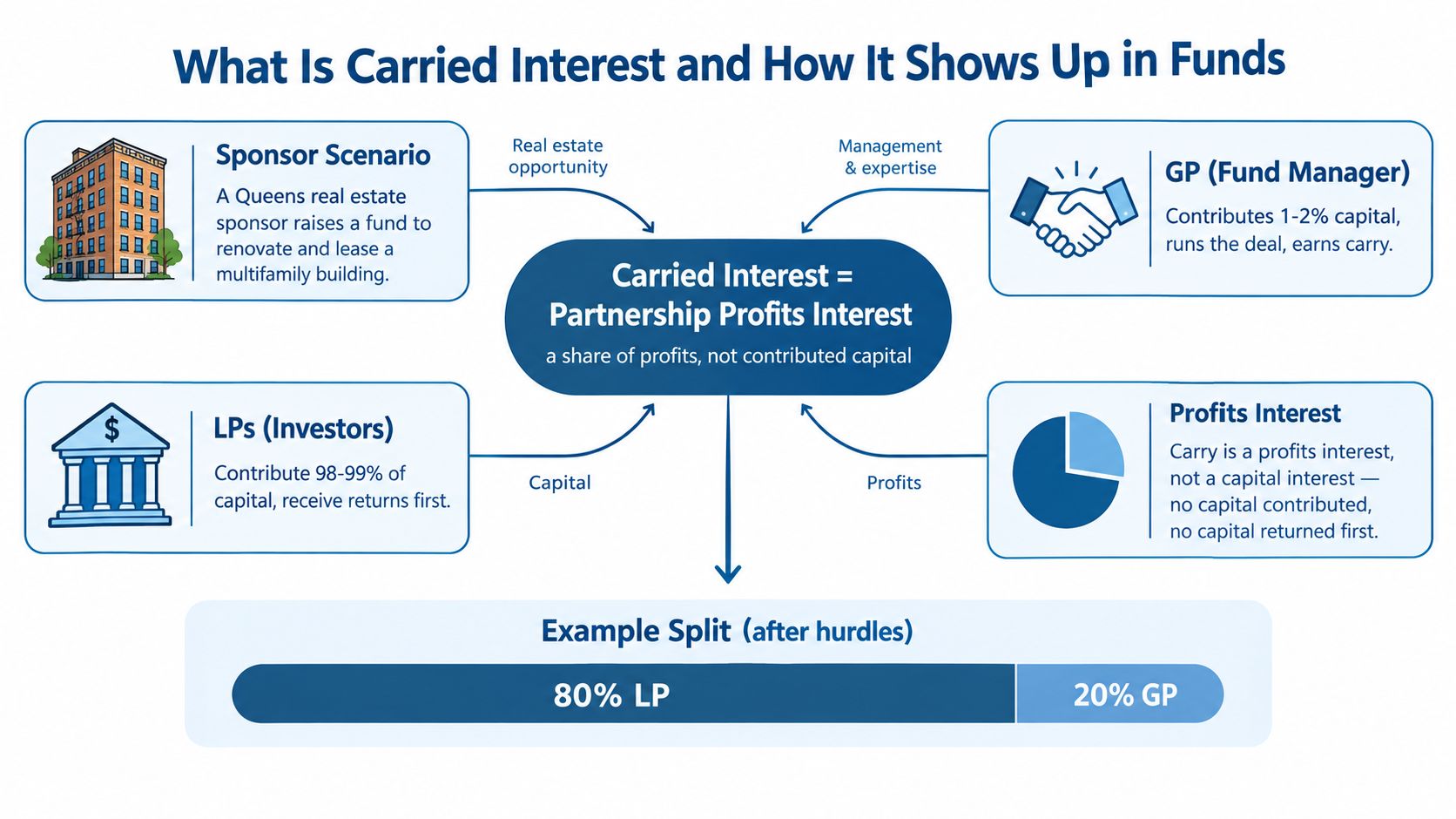
Carried interest is a service-based share of future partnership profits. A general partner or investment manager receives it for managing investments and creating gains, while limited partners generally contribute the investment capital. A profits interest usually gives the recipient rights to future income or appreciation, but not to the partnership's existing liquidation value when the interest is granted, as explained in Treasury's discussion of profits interests.
Consider a Queens sponsor who forms a partnership to acquire, renovate, and lease an apartment building. The sponsor may contribute some capital, manage the project, arrange financing, and make operating decisions. Investors contribute most of the capital. Under the agreement, investors receive the return promised by the waterfall first, and the sponsor then participates in future profits through a promote, another name for carried interest in real estate.
What should you look for in the agreement
The same economic idea appears in different structures:
- Private equity buyout fund: The GP manages acquisitions and exits, and carry depends on realized investment profits.
- Real estate syndication: The sponsor's promote may depend on property-level cash flow, refinancing, or a sale.
- Hedge fund: A performance allocation may reward investment results, but the calculation and timing can differ from private equity carry.
- Family limited partnership: A service provider may receive a future profits interest, but the agreement must establish the rights and distribution terms.
A capital interest is different. It represents a share of liquidation proceeds based on value already in the partnership, generally because the recipient contributed cash or received an interest tied to existing assets. Ordinary salary is different again. Salary is compensation paid for services under its own terms, whether or not the fund produces investment profits.
On page 30 of an LPA, recognition cues may include profits interest, promote, carried interest, incentive allocation, hurdle, catch-up, distribution waterfall, vesting, and clawback. Don't stop at the headline carry percentage. Useful real estate data for private equity firms can help with market and property research, but it won't replace reading the partnership's actual economic provisions.
The federal starting point is also specific. The IRS and Treasury adopted administrative guidance in 1993 generally treating the receipt of a qualifying profits interest for services as non-taxable when granted. That generally defers the tax question until the partnership earns income or realizes gains, subject to exceptions, including certain predictable income arrangements, a disposition within 2 years, or issuance through a publicly traded partnership. Congressional Research Service analysis describes why the agreement and the underlying transaction matter more than the label.
How the GP and LP Waterfall and Hurdle Rates Actually Work
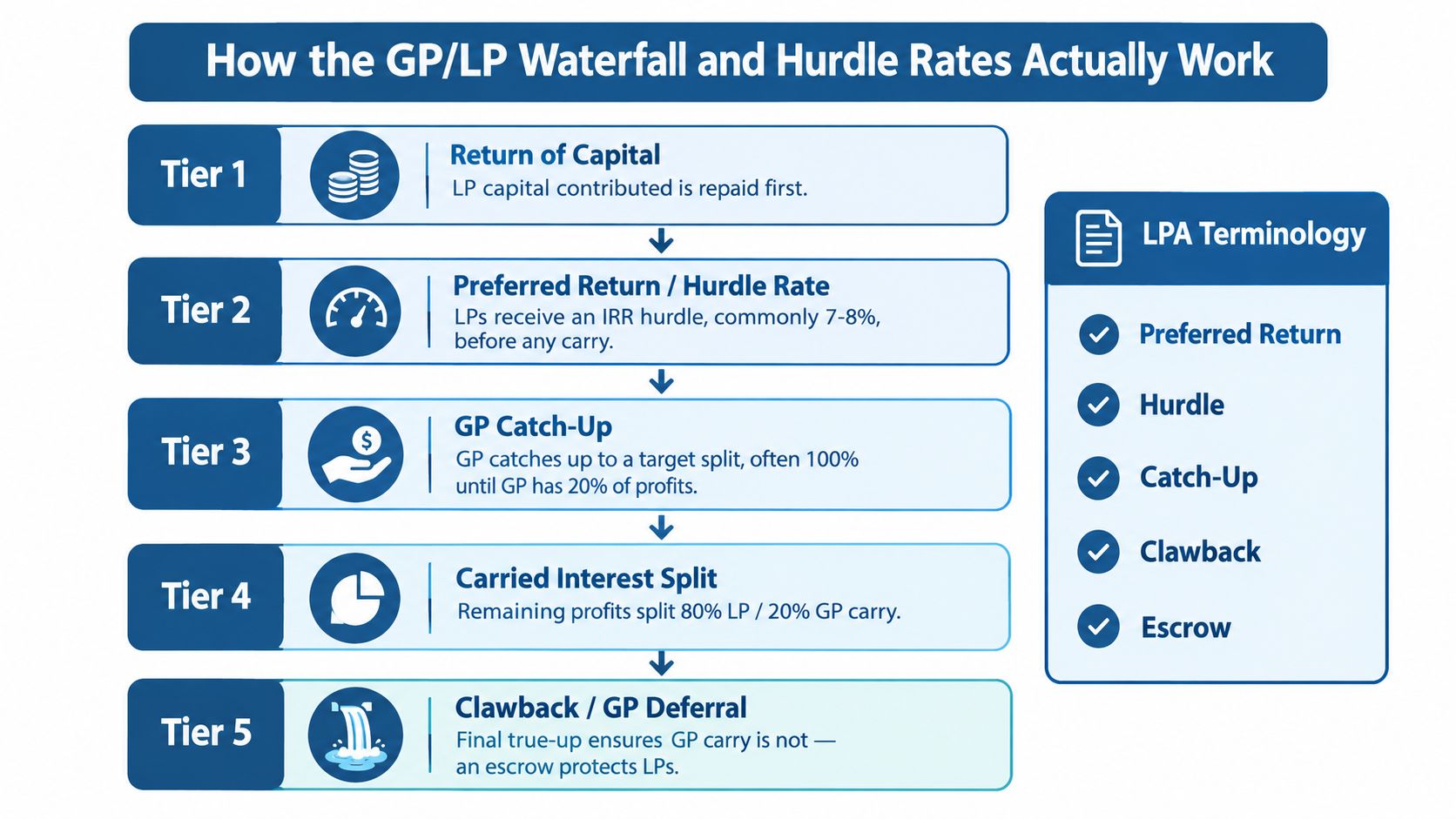
The waterfall determines who receives cash first and when the GP's promote becomes payable. A typical structure returns investor capital, satisfies a preferred return or hurdle, applies any GP catch-up, and then divides remaining profits according to the negotiated agreement.
Start with the basic terms. A preferred return is the return promised to LPs before carry is paid. A hurdle rate is the performance threshold that must be met under the agreement. A catch-up gives the GP a larger share for a period after the hurdle, allowing the GP to reach the negotiated participation level. A clawback requires the GP to return previously distributed carry if later fund results show that the GP received more than the final economics justify.
Read the waterfall as a cash-flow sequence
A simplified waterfall may operate like this:
- Return of capital: Investors receive contributed capital back.
- Preferred return: Investors receive the agreed return under the LPA.
- GP catch-up: The GP receives distributions until the stated sharing target is reached.
- Residual split: Remaining profits are divided between LPs and the GP according to the negotiated percentage.
- Final true-up: A clawback or escrow provision addresses over-distribution risk.
The requested dollar illustration using a fund size, preferred-return percentage, and exit distribution would require assumptions that aren't established by the governing agreement. The arithmetic also changes with contribution dates, interim distributions, compounding, fees, reserves, and whether the hurdle is based on internal rate of return or another test. A sponsor should run the actual LPA through a distribution model rather than apply a headline percentage to gross exit proceeds.
Practical rule: Carry is not a percentage of the fund's total assets. It's a conditional allocation of profits left after the waterfall's earlier tiers are satisfied.
The biggest economic distinction is between a whole-fund, or European, waterfall and a deal-by-deal, or American, waterfall. A whole-fund structure generally waits until the fund's results are considered together. A deal-by-deal structure may distribute carry after an individual successful exit, even though later investments could perform poorly.
That timing creates clawback exposure. If the GP receives carry from an early sale and later losses reduce the fund's final profit, the GP may need to return money. The LPA and side letter should identify the clawback obligors, any escrow, guarantees, timing of the true-up, and whether the GP or individual carry recipients fund the repayment.
For fund accounting support, review how private equity fund accounting services would track contributions, allocations, distributions, and the waterfall against the agreement. A correct tax return can't fix an allocation model that began with the wrong distribution order.
How the Three-Year Holding Period Rule Changes the Tax
For a covered U.S. service-related partnership interest, Section 1061 generally requires a holding period of more than 3 years for qualifying long-term capital-gain treatment. Before the Tax Cuts and Jobs Act of 2017, the general long-term holding-period rule was more than 1 year. If the applicable test isn't met, affected gain is generally recharacterized as short-term capital gain and taxed at ordinary-income rates, according to Congressional Research Service materials on Section 1061.
That doesn't mean every carried-interest dollar is taxed at a capital-gains rate. Partnership allocations can retain different character, including ordinary income, interest, dividends, or capital gain. The CRS identifies 20% as the top federal long-term capital-gains rate commonly relevant to carried interest and 37% as the top ordinary-income rate under the cited framework through the end of 2025. Those are federal figures for that framework, before considering other taxes and state rules, and tax rates can change.
The asset and holder questions
The holding-period analysis isn't “How long have I personally owned my carry?” The relevant rules can examine the partnership asset that generated the gain, or the sale of the partnership interest itself. IRS proposed regulations explain that the applicable period can depend on the property or partnership interest involved.
| Scenario | Holder period | Asset period | Federal tax result |
|---|---|---|---|
| Underlying asset held within the applicable period | May be longer or shorter | Three years or less | Relevant gain may be recharacterized as short-term capital gain under Section 1061 |
| Underlying asset held more than three years | Depends on the transaction | More than three years | Long-term treatment may be available if the other requirements are satisfied |
| Direct sale of the carried interest | Separate holding-period analysis | Not necessarily the same | Section 1061 can affect gain recognized on the interest sale |
A real estate flip can therefore produce a different result from a property held through a longer investment period. A mixed fund adds another complication because one asset may satisfy the relevant period while another doesn't. The manager may receive a Schedule K-1 containing allocations with different tax character rather than one uniform “carry” amount.
Capital contributed by the partner is generally treated separately from the service-based profits interest. IRS guidance summarized by Greenberg Traurig describes boundaries for capital attributable to the partner and notes entity-specific treatment, including rules relevant to interests held through an S corporation. That distinction should be documented before allocations are made, not reconstructed after an audit notice.
State, NYC, and Cross-Border Tax Considerations
Federal character doesn't answer every state or city question. New York State, New York City, New Jersey, and other jurisdictions may apply their own sourcing, conformity, residency, and entity-level rules, so a manager shouldn't assume that a federal capital-gain result produces the same state outcome.
For a GP living in Queens, the analysis can involve federal reporting, New York State income tax, New York City resident tax, and the partnership's allocation of income. A manager living in Westchester or New Jersey may face a different resident filing and allocation analysis, even if the investment vehicle is managed in New York City. The agreement, work location, residency, and source of the income all matter.
What changes across jurisdictions
| Jurisdiction | Federal character | Top rate applied | Key catch |
|---|---|---|---|
| United States federal | Depends on the underlying allocation and Section 1061 | The CRS identifies 20% for the commonly relevant top long-term capital-gain rate and 37% for the cited top ordinary-income rate | The three-year rule applies to covered service-related interests |
| New York State | State treatment requires a state-specific review | Not stated here because the applicable result depends on current state rules and facts | Federal conformity, resident status, sourcing, and pass-through elections must be reviewed |
| New York City | Separate city resident tax may apply | Not stated here because the result depends on current city rules and residency | City residence isn't the same question as working for a NYC-managed fund |
| New Jersey | Requires separate state and sourcing analysis | Not stated here because the result depends on current state rules and facts | A New Jersey resident may have filing and credit issues involving other jurisdictions |
| United Kingdom | From 6 April 2026, carried interest is generally treated as trading income subject to income tax and Class 4 National Insurance | Qualifying carry uses a 72.5% taxable multiplier, with an approximately 34.1% effective rate for additional-rate taxpayers; non-qualifying carry can face an effective rate near 47% | Qualifying treatment includes conditions such as an average holding period of at least 40 months |
The UK comparison is especially relevant for a manager relocating between financial centers. Deloitte's UK carried-interest summary describes the 6 April 2026 change, the 72.5% taxable multiplier, the 40-month average holding-period condition for qualifying carry, and the published effective-rate illustrations. Those rules don't transfer to a U.S. return.
Before a realization, map residency, services, vesting, receipt, withholding, sourcing, and reporting across every jurisdiction involved. A pass-through entity tax election may be relevant in some states, but its availability and benefit depend on the entity, owners, income, and current law.
A Worked Example for a $20M Real Estate Fund
A numeric waterfall for a $20M fund can't be presented as a factual outcome without the LPA's contribution dates, hurdle formula, expenses, reserves, distributions, and tax character. The same exit amount can produce different GP cash depending on whether the agreement uses a whole-fund or deal-by-deal waterfall, whether the preferred return compounds, and whether the GP contributed capital separately from its promote.
Take a Queens sponsor with LP capital, a separate GP co-investment, and property exits after a holding period. The sponsor should separate three ledgers: return on contributed capital, return allocated under the hurdle, and service-based carried interest. Those buckets shouldn't be combined only because they reach the GP through one distribution notice.
Build the model from the agreement
| Layer | Amount | Calculation note |
|---|---|---|
| Return of LP capital | Agreement-specific | Confirm contributed capital and any prior distributions |
| Preferred return or hurdle | Agreement-specific | Apply the stated dates, rate, compounding, and IRR test |
| GP catch-up | Agreement-specific | Determine whether the catch-up is partial, full, or absent |
| Residual carried-interest split | Agreement-specific | Apply the negotiated promote only after earlier tiers |
| Tax allocation | K-1-specific | Separate capital gain, ordinary income, interest, dividends, and other items |
The figure that matters to the GP isn't the promote percentage printed in the term sheet. It's the cash distributed after the waterfall, reduced by any reserves or clawback exposure, and then adjusted for the tax character reported by the partnership.
For example, an asset held more than three years may support long-term treatment for a covered allocation if the other Section 1061 requirements are satisfied. A faster disposition may produce short-term capital gain treatment for the affected portion. A fund can also produce mixed results when it realizes assets in different periods.
The manager should ask the fund administrator for a distribution schedule that shows:
- Capital returned: Which partner receives contributed capital and in what order?
- Hurdle satisfied: What dates and cash flows drive the test?
- Catch-up completed: What amount brings the GP to the agreed participation?
- Character preserved: Which allocations are capital gain, ordinary income, interest, or dividends?
- Clawback reserved: What amount may be repayable if later investments underperform?
For a real estate sponsor, real estate fund accounting support can help organize the books and allocation records, but the tax result still depends on the partnership agreement and applicable law. Don't promise yourself a particular after-tax amount until the complete allocation and state analysis is finished.
Planning Strategies and Risks to Discuss With Your Advisor
Carry planning starts before the fund closes. The management company, GP entity, individual recipients, partnership agreement, side letters, vesting provisions, and tax reporting should tell the same story. If those documents disagree, the tax return becomes the least convenient place to discover the problem.
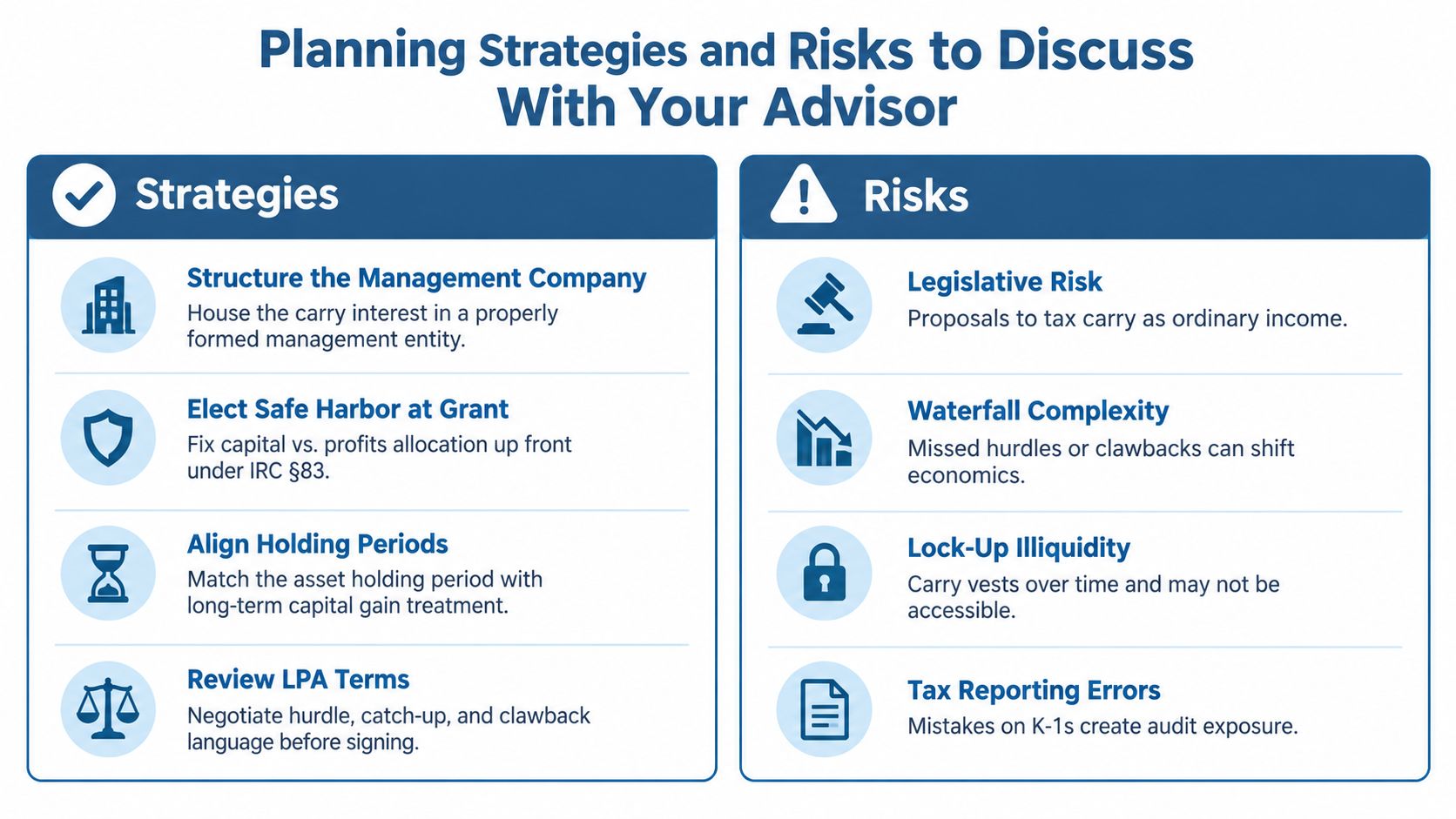
Decisions to raise before signing
- Management-company structure: Ask which entity receives the service-based interest and how allocations reach individual managers.
- Grant treatment: Review whether an available safe-harbor election should be made at grant and how capital and profits interests are documented.
- Holding periods: Track the expected holding period of each portfolio asset rather than relying only on the date the manager received carry.
- Lower-tier partnerships: Ask whether Section 1061 look-through rules affect assets held through another partnership.
- State planning: Review residency and sourcing before a realization, especially for managers moving among New York, New Jersey, and other states.
- Installment treatment: Consider whether the transaction and partnership agreement support installment reporting, while recognizing that timing and character require separate analysis.
- Pass-through elections: Examine whether a state pass-through entity tax election is available and appropriate for the entity and owners.
A manager should also review vesting, leaver provisions, transfer restrictions, and whether the carry can be pledged. An interest that looks valuable on paper may be illiquid, forfeitable, or subject to a later repayment obligation.
Document before distribution: Keep the LPA, amendments, side letters, capital-account records, grant documents, waterfall model, valuation support, and K-1 workpapers together.
Risks that deserve a written answer
A quick flip can fail the applicable three-year test. A service-based allocation can also raise questions involving self-employment tax, valuation at grant, gift and estate tax, anti-abuse rules, qualified opportunity fund allocations, and state treatment that departs from federal treatment. The consequences depend on the structure and the taxpayer, so don't treat a checklist as a conclusion.
Legislative risk also belongs in the model. The federal 20% long-term capital-gain figure cited in the CRS framework applied through the end of 2025, and future legislation can change rates or reclassify carry. A scheduled sunset or proposed change shouldn't be treated as current law without checking the tax year and enacted authority.
Before the next fund, ask an advisor to review:
- Waterfall language: Are return of capital, hurdle, catch-up, residual split, escrow, and clawback provisions internally consistent?
- Tax allocation language: Does the agreement preserve the character of partnership income where required?
- Grant records: Is the profits interest distinguished from any capital interest or co-investment?
- Holding-period records: Can the administrator identify the relevant asset and partnership-interest periods?
- State provisions: Do residency, sourcing, withholding, and pass-through elections match the expected investor base?
- Reporting controls: Can the books, waterfall, capital accounts, and K-1s be reconciled?
Blue Sage Tax & Accounting Inc. provides tax planning, partnership compliance, multi-state filings, and proactive projections for fund managers and real estate sponsors reviewing carried-interest cash flow and tax timing. Visit Blue Sage Tax & Accounting Inc. to discuss the partnership agreement, projected allocations, and state filing questions before the next distribution.
Book your free consultation call today. (https://calendly.com/bluesagetax/30min?month=2026-09)
This article is general information and not tax advice for your specific situation.