
Real estate fund accounting is the systematic tracking, reporting, and valuation of a real estate investment fund's capital, assets, and investor distributions under applicable GAAP or tax rules. The modern framework was sharpened by investment company guidance effective January 1, 2014, while some fund valuation policies make quarterly NAV available within 25 calendar days after month-end.
The practical difficulty usually appears at quarter-end. Property teams send rent rolls, debt schedules, capital expenditure details, and valuation updates. The fund administrator must turn that asset-level information into NAV, capital accounts, waterfall calculations, financial statements, and investor reports without allowing one property's late or inconsistent data to distort the fund-level picture.
That makes real estate fund accounting different from ordinary corporate bookkeeping. The work connects property operations, investor commitments, valuation policy, partnership allocations, and audit support. A fund can have accurate property books and still produce unreliable investor reporting if the data does not move consistently between the asset and fund layers.
Table of Contents
- Introduction to Real Estate Fund Accounting
- GAAP versus Tax Accounting in Real Estate Funds
- Capital Calls and Distribution Mechanics
- Valuation Methods and Reporting Standards
- Investor Reporting and Key Performance Indicators
- Audit Readiness and Compliance Best Practices
Introduction to Real Estate Fund Accounting
Real estate fund accounting records and explains how a fund receives capital, acquires or holds property, earns income, incurs expenses, changes in value, and returns money to investors. It serves sponsors, general partners, limited partners, auditors, lenders, and tax professionals, each of whom needs a different view of the same underlying activity.
At the property level, accounting follows the asset. Teams track rental income, operating expenses, debt service, repairs, capital improvements, and property-specific cash movements. At the fund level, accounting follows the investment vehicle. The records must show investor capital, allocations, fees, distributions, liabilities, valuation adjustments, and the relationship between each investor's economic position and the fund's total NAV.
Why ordinary bookkeeping falls short
A standard business ledger may answer whether the company received rent or paid an invoice. Fund accounting must answer more difficult questions:
- Ownership: Which investor funded the transaction, and under what commitment or allocation?
- Valuation: What is the current fair value of the property or investment, and which assumptions support it?
- Allocation: How should income, loss, debt, depreciation, distributions, or gains flow through each capital account?
- Reporting: Can the fund reconcile its property schedules to its financial statements and investor package?
The distinction between a qualifying investment company and an operating entity is foundational. Under IFRS, IAS 40 applies to companies holding investment property and permits a choice between the cost model and fair value model after initial recognition. Under U.S. GAAP, an investment company generally measures investments at fair value through profit or loss, while an operating entity reports property at depreciated cost and records rental income, operating expenses, and depreciation. KPMG's overview of investment property accounting explains why classification changes the balance sheet, income statement, and valuation process.
Practical rule: Decide what the fund is for accounting purposes before building recurring close procedures. A policy chosen late can force repeated restatements, new reconciliations, and difficult investor explanations.
GAAP versus Tax Accounting in Real Estate Funds
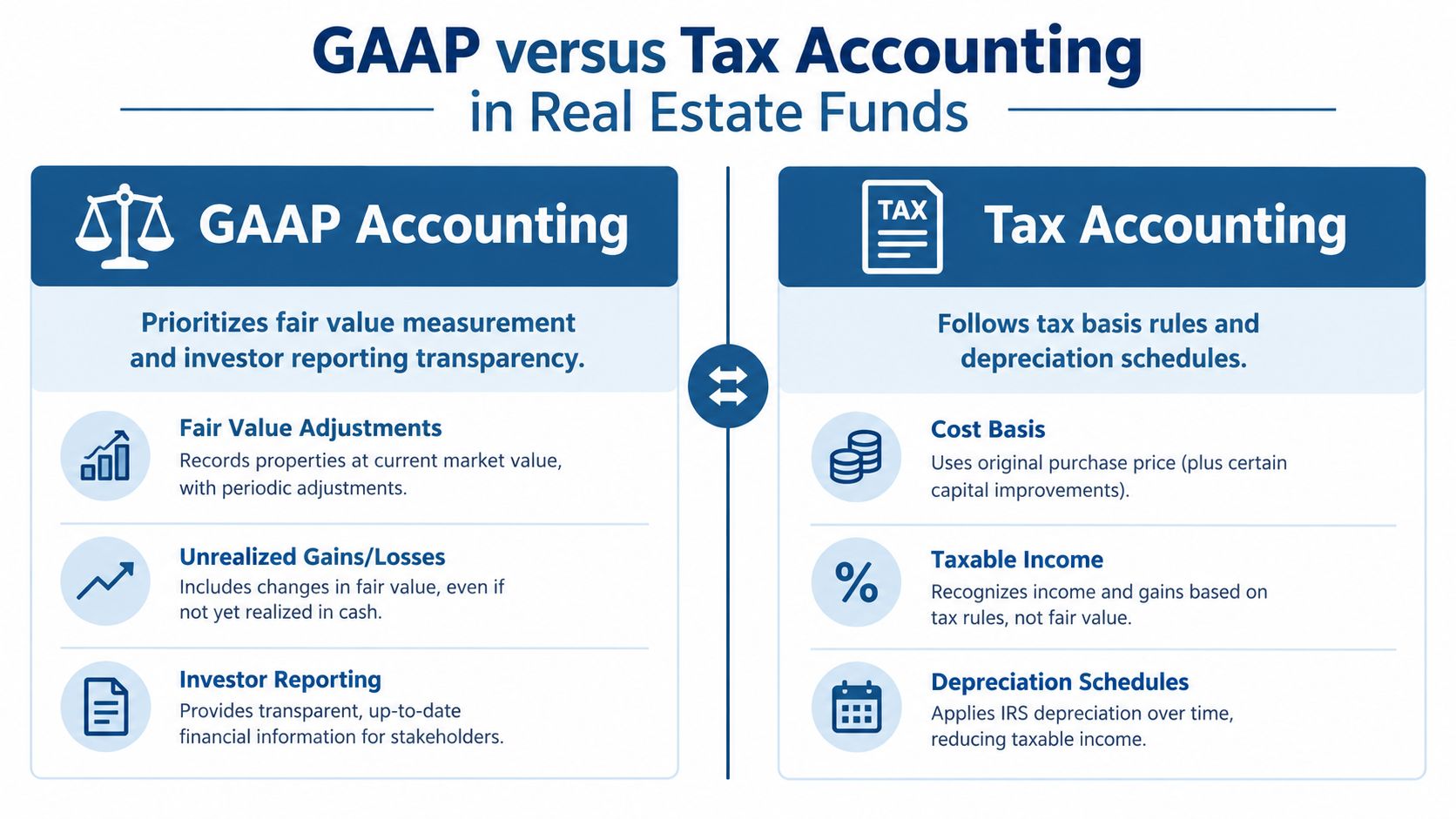
GAAP reporting and tax accounting answer different questions. GAAP reporting describes the fund's financial position and performance for investors, while tax accounting determines taxable allocations, basis, depreciation treatment, and the information needed for partnership compliance and investor tax reporting.
The two systems should remain connected, but they shouldn't be forced into one ledger without a reconciliation layer. A fair-value gain may affect book income without creating an immediate taxable event, while tax depreciation and other basis differences can change taxable allocations without appearing as the same expense in book reporting.
The classification decision comes first
Under ASC 946, a qualifying real estate investment company uses fair value accounting and provides financial highlights. A fund that doesn't qualify reports real estate assets at depreciated cost and shows rental operations in its income statement. The revised investment company literature became effective for calendar-year entities on January 1, 2014, requiring reassessment of whether entities met the investment company definition. KPMG's investment company accounting publication describes how that framework sharpened the distinction between investment funds and property-owning operating vehicles.
The choice affects more than presentation. It changes how the finance team records unrealized gains and losses, how valuation evidence is assembled, how investors interpret performance, and how the administrator prepares the close. An operating entity's statements may make rental income, depreciation, and operating costs more visible. A fair-value fund may present a more current mark of the investment, but that mark depends on valuation methods and assumptions that require support.
Tax accounting adds another layer. In a partnership-based real estate fund, each investor's capital account is updated for that partner's share of income, losses, and distributions under the partnership agreement. Distributions generally reduce basis, while income and debt allocations generally increase it. CLA's explanation of limited partner tax accounts outlines why book capital and tax capital cannot be treated as interchangeable.
Build the reconciliation before the first close
A workable process maintains separate schedules for:
- Book capital: Investor contributions, book income, book losses, allocations, and distributions.
- Tax capital: Tax-basis activity, depreciation, debt allocations, and tax-specific adjustments.
- Fair value: Valuation changes and realized or unrealized gains where the accounting policy requires them.
- Investor reporting: The figures used in capital statements, notices, and performance packages.
The weak approach is to wait until tax preparation to discover that the book records don't explain the tax allocations. The stronger approach is to document the bridge during each close, assign ownership for every adjustment, and preserve support for the accounting policy behind it.
Capital Calls and Distribution Mechanics
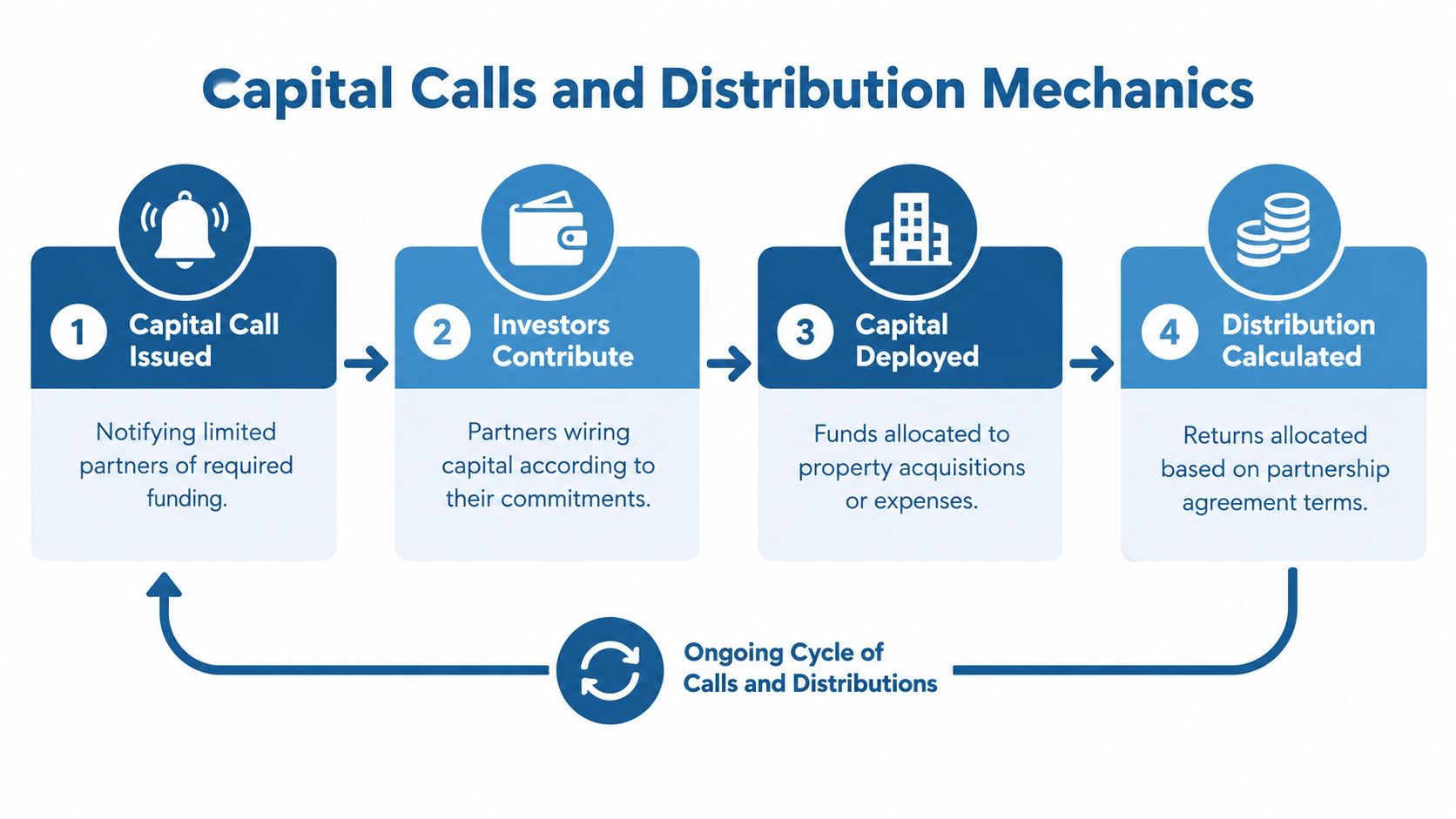
Capital calls are commitment-based, while distributions are usually waterfall-based. The administrator must track each investor's commitment percentage, funding status, preferred return, catch-up position, and carried-interest tier as transactions occur, not reconstruct them after cash has moved.
A capital call begins with the partnership agreement. The fund identifies the cash requirement, determines each investor's share, issues notices, records receivables or contributions, and matches incoming cash to the correct investor and purpose. The accounting entry is only the visible part. The underlying schedule must also show unfunded commitments and the effect of the contribution on each capital account.
How the waterfall changes the close
Suppose a fund receives sale proceeds or operating cash that the agreement allows it to distribute. The accounting team can't just divide the cash by ownership percentage. It must apply the contractual order, which may involve:
- Return of capital: Distributions first repay eligible invested capital according to the agreement.
- Preferred return: The fund satisfies accrued preferred return requirements before later tiers participate.
- Catch-up: A catch-up tier may direct distributions to the general partner until the stated economic sharing arrangement is reached.
- Carried interest: Remaining profit may be allocated between limited partners and the general partner under the agreed carry structure.
The exact result depends on the LPA. A waterfall model that uses stale contribution dates or misses a prior distribution can produce an allocation that looks mathematically clean but violates the governing agreement.
The operational standard described by real estate private equity fund accounting guidance is to keep commitments, funding status, preferred return, catch-up, and carried-interest tiers current. That discipline supports investor notices, quarterly statements, and audit evidence. For related partnership processes, fund managers can also review private equity fund accounting resources.
A distribution schedule should be reproducible from the ledger, the LPA, and the supporting capital-account roll-forward. If an administrator needs a spreadsheet with unexplained overrides, the process isn't ready for a serious close.
The hidden friction appears when property-level cash timing doesn't match fund-level reporting timing. A property may generate cash, retain reserves, refinance debt, or incur an unexpected capital need while the fund's distribution model assumes a different availability date. The administrator needs a documented cash bridge, not an informal email chain.
Valuation Methods and Reporting Standards
A real estate fund can't select a valuation method in isolation from its legal structure, accounting classification, investor expectations, and reporting documents. IFRS permits a cost-model or fair-value choice for investment property after initial recognition, while U.S. GAAP uses a different framework for investment companies and operating entities.
The decision affects both the timing and the meaning of reported performance. Cost accounting emphasizes recorded investment cost, depreciation, and operating results. Fair-value accounting emphasizes the current estimated value of the investment and recognizes realized and unrealized changes where applicable.
Comparing the principal approaches
| Approach | Description | Impact on Financials |
|---|---|---|
| Cost model | Property remains based on cost, with applicable depreciation and operating activity recorded over time. | Rental income, expenses, and depreciation remain prominent, while changes in market value may not flow through earnings in the same way. |
| Fair-value model | Property or investment is measured at an estimated current value under the applicable accounting framework. | Realized and unrealized gains or losses can materially affect reported performance and NAV. |
| Operating-entity treatment | The entity reports property as an operating asset and presents rental operations. | Debt service pressure, occupancy weakness, operating costs, and depreciation may be more visible in the income statement. |
| Investment-company treatment | The entity measures qualifying investments at fair value and provides investor-focused financial highlights. | Valuation movements become central to NAV, results, disclosures, and the close process. |
Real estate investments are often classified as Level III under ASC 820 because significant inputs are unobservable. A sample real estate fund footnote template illustrates how direct third-party acquisition costs may be capitalized into original investment cost and how realized gain or loss may be calculated using net sales proceeds and investment cost.
NAV is a controlled process, not a single formula
NAV requires more than adding property values. The administrator reconciles fair value, cash, receivables, debt, accrued expenses, capital accounts, and other liabilities before finalizing distributions or investor statements. CSC's real estate fund administration guidance describes the connection between asset-level and fund-level NAV work.
INREV's NAV guidance says NAV should reflect the fair value of underlying assets and liabilities at the balance sheet date, with adjustments for costs that benefit different investor generations. Fund documents should specify valuation rules, pricing methods, hard-to-value asset procedures, and valuation frequency. INREV's NAV framework provides useful context for documenting those decisions.
Funds with international investors also need disciplined currency treatment. The resource multi currency accounting explained is useful when a portfolio reports in one functional currency while assets, debt, or investor activity occur in others. Currency conversion policy should be documented alongside valuation policy, not added as an afterthought.
Investor Reporting and Key Performance Indicators
Investor reporting is credible only when property-level data, fund-level accounting, and allocation schedules agree. The practical sequence is to close the assets, reconcile the fund, update capital accounts, complete valuation work, run the waterfall, and then produce statements and performance measures from controlled data.
Start with a data inventory. Each property package should identify the reporting period, occupancy or rent information where relevant, operating income, expenses, debt activity, capital projects, cash balances, and valuation support. The fund administrator then maps that information into the chart of accounts and confirms that intercompany balances, management fees, reserves, and transfers are treated consistently.

What a useful investor package contains
A practical quarterly package commonly draws from several schedules:
- Fund financial statements: Balance sheet, statement of operations, and cash flow information prepared under the applicable reporting basis.
- Capital account statements: Contributions, allocations, distributions, and ending balances for each investor.
- Portfolio detail: Property-by-property operating activity, debt, capital expenditures, and valuation information.
- Waterfall support: The calculation showing how distributable proceeds were assigned across tiers.
- Narrative commentary: Explanations for material changes, valuation movements, cash retention, and significant transactions.
The reporting gap is often not a missing fund statement. It's the failure to reconcile that statement to the properties underneath it. Institutional LPs increasingly expect property-by-property reporting with the same cadence and consistency as fund-level packages, and NCREIF-PREA standards were expanded in August 2025 to formalize recommended asset- and investment-level fields. Collateral's discussion of LP reporting expectations explains why data governance and delivery cadence have become operating-model concerns.
KPIs depend on source data
IRR and MOIC are not independent accounting outputs. They depend on the timing and classification of contributions, distributions, residual value, and other cash flows. If one distribution is posted to the wrong investor or a valuation date is inconsistent, the resulting performance metric can misrepresent the investor's experience even if the formula itself is correct.
A clear package should define the period, valuation date, cash-flow treatment, and whether the metric is presented at the fund, investment, or investor level. For broader partnership processes, partnership accounting support can help connect capital-account records with the information needed for tax and investor reporting.
Audit Readiness and Compliance Best Practices
Audit readiness is built during the monthly and quarterly close, not during the week before auditors arrive. The fund should be able to trace every significant balance from the financial statements to a schedule, from the schedule to source documentation, and from the source documentation to the governing agreement or accounting policy.
The first control is a close calendar with named owners. It should show when property teams submit data, when administrators complete bank and debt reconciliations, when valuation files are approved, when capital accounts are rolled forward, and when the investor package enters review.
Keep an evidence trail for every material balance
A useful audit file usually includes:
- Cash and debt support: Bank reconciliations, loan statements, interest schedules, and confirmation of restricted cash or reserves.
- Property support: Acquisition documents, capitalized costs, rent and expense schedules, valuation reports, and sale documentation.
- Investor support: Subscription records, contribution notices, cash receipts, distribution notices, and capital-account roll-forwards.
- Allocation support: Waterfall calculations, allocation policies, carried-interest analysis, and review sign-offs.
- Financial statement support: Trial balances, consolidation entries, intercompany reconciliations, disclosure schedules, and subsequent-event records.
The guide to audit trail reporting from PropLab is a useful reference for thinking about how transactions, approvals, changes, and supporting files should remain connected. An audit trail isn't just a software feature. It's the record of who prepared a number, who reviewed it, what changed, and why the final figure is appropriate.
Choose technology around the control problem
Spreadsheets can work for limited schedules, but they become fragile when several properties, investors, currencies, valuation dates, and waterfall tiers interact. The issue isn't that spreadsheets are always wrong. The issue is that manual versions, hidden formulas, overwritten cells, and disconnected source files make review difficult.
A stronger setup usually combines:
- Property accounting software for asset-level income, expenses, payables, debt, and fixed assets.
- Fund accounting software for investor capital, allocations, NAV, and financial statements.
- A controlled investor portal or document system for notices, statements, approvals, and source records.
- A reconciliation workflow that matches property balances to fund-level entries before reporting.
- A review log documenting exceptions, judgment calls, and unresolved items.
Outsourcing can be sensible when the sponsor has strong property operations but lacks fund-level accounting capacity. It doesn't remove the sponsor's responsibility for policy decisions, approval controls, or the accuracy of information supplied to the administrator. The right model gives each party clear ownership instead of creating a vague handoff.
Use the close to improve the operating model
Recurring errors often reveal a process problem upstream. If property teams repeatedly submit inconsistent capital expenditure classifications, the chart of accounts or submission template may need revision. If valuation support arrives after the reporting cutoff, the fund may need a formal valuation calendar and escalation path. If capital accounts require recurring manual adjustments, the subscription and distribution data may not be flowing into the accounting system correctly.
The practical standard is simple. A sponsor should know which property produced each material fund-level number, which investor receives each allocation, which policy supports each valuation treatment, and which person approved the final package. That level of traceability makes audits more manageable and gives investors reporting they can actually use.
Blue Sage Tax & Accounting Inc. can support real estate investors with entity accounting, property-by-property bookkeeping, depreciation schedules, partnership compliance, and monthly or quarterly financial statement preparation. Visit Blue Sage Tax & Accounting Inc. to discuss how your fund or related real estate entities are organized, then book your free consultation call today.
This article is general information and not tax advice for your specific situation.