
A closely held corporation is, under the federal IRS test, a corporation in which five or fewer individuals own more than 50% of the stock value during the last half of the tax year, and it isn't a personal service corporation. State law may use a different threshold, so the same business can receive different answers under federal tax rules and a state statute.
If you've just incorporated a Bayside contracting business, the phrase may sound like another business entity choice. It isn't. A closely held corporation is a tax and legal classification applied to an existing corporation, and it matters because ownership concentration can activate special rules for losses, deductions, and officer compensation.
Table of Contents
- What a Closely Held Corporation Actually Is
- How the IRS Five-or-Fewer Test Really Works
- Why State Law Can Give a Different Answer
- S Corp vs C Corp Treatment for Owners
- What Tax Rules Hit Closely Held Companies Harder
- What Should Closely Held Owners Do About Estate, Gift, and Multi-State Planning
What a Closely Held Corporation Actually Is
Under the IRS test, a closely held corporation is one where five or fewer individuals together own more than 50% of the outstanding stock by value at any point during the last half of the tax year, and the company isn't a personal service corporation. The federal definition is the one owners most often encounter in tax discussions, and it connects to the closely held corporation rules described under IRC Section 542(a)(2) in IRS guidance on corporate entities and ownership attribution (IRS explanation of closely held corporations).
The practical picture is familiar. A family-owned contractor shop may have shares held by a parent and two adult children. A single-location restaurant group may be owned by two siblings. A two-partner consulting professional corporation may keep nearly all ownership with the people who operate the practice. These companies differ from public corporations, where shares are widely held and traded in securities markets.
A closely held corporation isn't a separate entity type. Your company can be a C corporation or an S corporation and still be closely held. An LLC taxed as a corporation may also meet the federal test. The classification describes who controls the stock, not the label selected on the formation documents.
Owners who are researching their company records may also need more than the articles of incorporation. A state filing search can help collect registered-agent details, entity status, and related business entity data fields, but those public records won't always show the full tax ownership picture.
Practical rule: Don't decide the classification by counting names on the visible cap table alone. Ask who owns the shares indirectly and whose ownership the IRS may attribute to someone else.
That last point causes many mistakes. A trust, holding company, partnership, or family relationship can affect the ownership analysis. A company that appears to have several unrelated shareholders may still be treated as closely held after constructive ownership rules are applied.
How the IRS Five-or-Fewer Test Really Works
The federal test has three practical steps. First, identify whether five or fewer individuals own more than half of the stock value during the last half of the tax year. Second, confirm that the corporation isn't a personal service corporation. Third, apply constructive ownership rules before reaching a final answer.
| Step | What to Check | Result if Met |
|---|---|---|
| 1 | Whether five or fewer individuals own more than 50% of stock value during the last half of the tax year | The ownership threshold is met |
| 2 | Whether the corporation is a personal service corporation | A separate PSC analysis is required |
| 3 | Whether indirect and family ownership must be attributed | The apparent shareholder count may change |
The test isn't limited to shares registered in a person's own name. IRS guidance describes direct and indirect ownership, including attribution through corporations, partnerships, estates, trusts, beneficiaries, family members, and certain option holders (current IRS entity guidance). A trust or holding company can therefore make the ownership picture more concentrated than the corporate records first suggest.
Consider this ownership example. Dad owns 30%, Mom owns 10%, Son owns 20%, Son's trust owns 15%, and an unrelated cousin owns 25%. Family attribution can treat the family block as 75%, leaving only the cousin outside that block. The company can therefore meet the closely held test even though the ownership appears spread across several entries.
The IRS treatment also distinguishes personal service corporations, such as practices where employee-owners perform services as doctors, lawyers, consultants, or similar professionals. Owners should have a tax professional review the actual entity and activities rather than assuming the ordinary ownership test answers every question.
Once the classification applies for the relevant portion of the year, special limitations may affect the corporation and its owners for that tax year. Keep the stock ledger, trust documents, shareholder agreements, and ownership changes together before filing.
Why State Law Can Give a Different Answer
Federal tax law and state corporate law don't use one universal definition of a closely held corporation. Texas, for example, uses a securities-law definition that looks for fewer than 35 shareholders and no shares listed on a national securities exchange or regularly quoted over the counter (Texas closely held corporation statute). Minnesota uses a different state threshold, summarized by the University of Minnesota Law Library, and also defines a closely held corporation as one with no more than 35 shareholders.
| Jurisdiction | Key Threshold | Attribution Rules | Typical Trigger |
|---|---|---|---|
| Federal tax | More than 50% of stock value owned by five or fewer individuals during the last half of the tax year | Direct and indirect attribution can apply | Federal tax limitations and classification |
| Texas | Fewer than 35 shareholders, with no listed or regularly quoted shares | State statutory analysis | Securities-law treatment |
| Minnesota | No more than 35 shareholders | State statutory analysis may differ from federal attribution | State corporate or securities-law treatment |
A trust arrangement shows why the distinction matters. Suppose an LLC owned by a grantor trust with three adult beneficiaries holds a C corporation subsidiary. Federal constructive ownership may push the corporation past the federal ownership bar. A state franchise-tax test that doesn't apply the same trust attribution could treat the company as broadly held.
That mismatch can affect filing thresholds, franchise-tax apportionment, exemption claims, and securities-registration exemptions. It can also matter to a restaurant owner filing in two states, or to a contractor operating from Queens while performing jobs across state lines.
The same company name, ownership chart, and tax return don't guarantee the same classification in every jurisdiction.
Owners working across state lines should run the federal test separately from each relevant state test. Document the ownership assumptions, the trust or entity relationships, and the reason each conclusion applies. A state law conclusion shouldn't be used as a substitute for federal tax analysis.
S Corp vs C Corp Treatment for Owners
Closely held status doesn't decide whether an owner should use S corporation or C corporation taxation. The S election changes how federal income generally passes through to owners, while the closely held classification can bring separate limits into the analysis.
A Bayside plumbing contractor with $400,000 in revenue might elect S corporation treatment after reviewing expected profit, payroll, benefits, ownership eligibility, and state filings. The operating shareholder generally needs a reasonable W-2 salary for services performed, and the company must follow the S corporation rules, including the single class of stock requirement. S corporation income is generally reported to owners through Form 1120-S reporting, subject to the applicable tax rules.
A sibling-owned fabrication shop might remain a C corporation instead. That structure can retain earnings in the company, but owners and advisers must consider corporate-level taxation, distributions, officer compensation, and rules that can apply when earnings accumulate or personal holding company conditions exist. An S election can also create a built-in gains tax issue within ten years of conversion, depending on the company's assets and facts.
| Issue | S Corp | C Corp |
|---|---|---|
| Income treatment | Generally passes through to shareholders | Generally taxed at the corporate level, with separate treatment for distributions |
| Owner compensation | Operating shareholder generally needs reasonable W-2 compensation | Officer compensation remains subject to corporate tax rules and scrutiny |
| Ownership structure | Must satisfy S corporation eligibility and single class of stock rules | More flexibility in classes and ownership, subject to corporate and tax law |
| Conversion concerns | Built-in gains can apply within ten years of conversion, depending on facts | No S conversion issue, but other corporate tax rules may apply |
For a practical comparison of the election itself, review S corp vs C corp taxes. Closely held status under Section 469 is separate from an S election. Still, the two issues can meet in an audit when the IRS reviews passive losses, shareholder-employee compensation, and the way owners participate in the business.
What Tax Rules Hit Closely Held Companies Harder
The IRS applies special limits to closely held corporations, including rules affecting passive activity losses, at-risk deductions, and compensation paid to corporate officers (IRS closely held corporation rules). These rules don't automatically mean a deduction disappears, but they can restrict when an owner uses it.
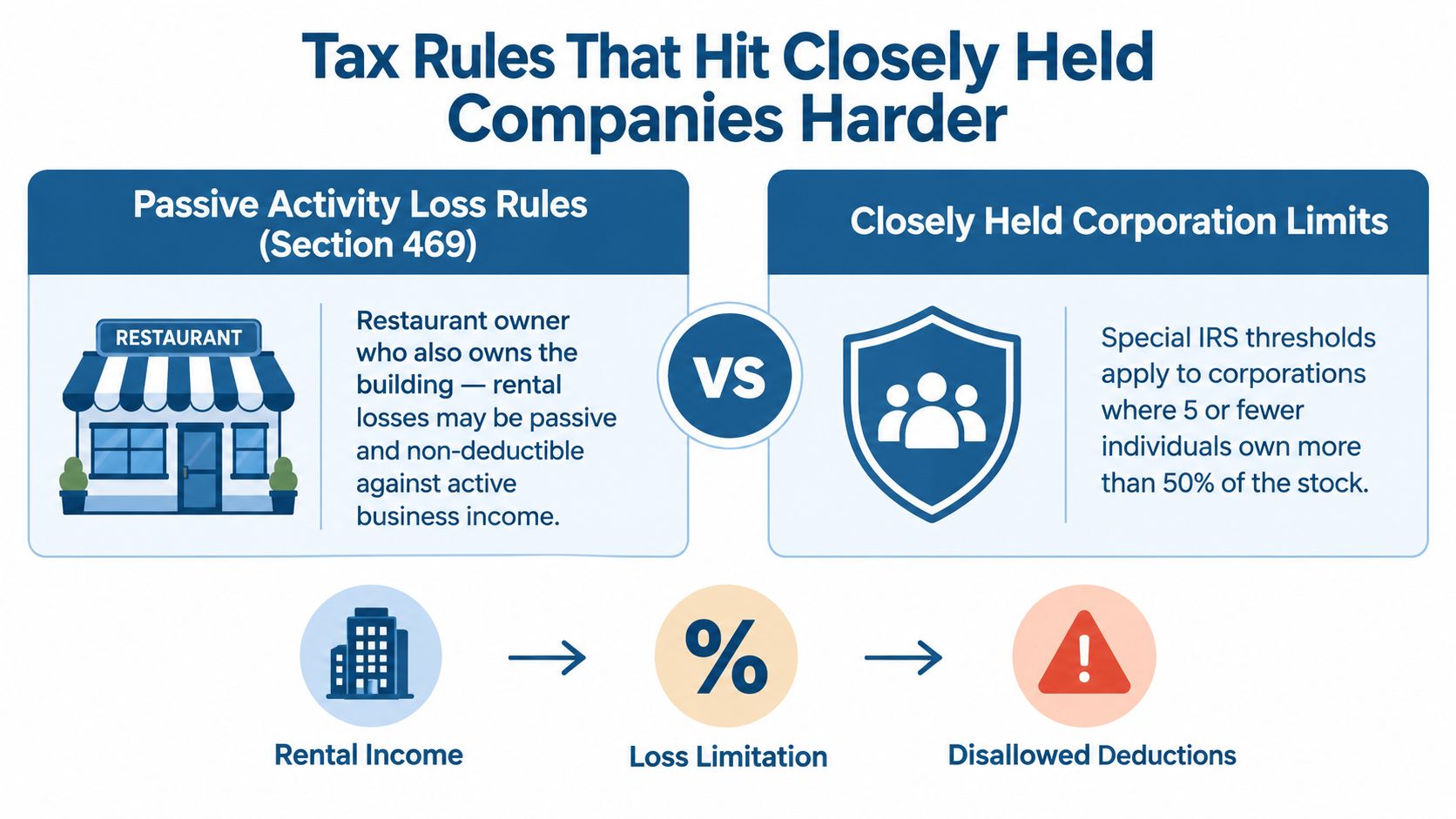
A restaurant owner who operates the business and owns the building through a separate LLC may have rental losses classified as passive. Those losses may not offset active restaurant income when the passive activity rules apply. The result depends on participation, ownership, grouping decisions, and the underlying activity.
The at-risk rules ask a different question: how much did the owner place at risk? A contractor who financed equipment with a nonrecourse loan from a related party may not receive the same treatment as an owner who personally bears the economic risk. The documents and relationship between the parties matter.
Officer compensation creates another pressure point. Closely held owners often control both payroll and distributions, so compensation should be supported by the owner's actual role, duties, and business records. Fringe-benefit coverage, accumulated earnings tax, and personal holding company tax can also require review for C corporation owners.
Estate and gift planning adds another layer. Closely held shares may qualify for valuation discounts for lack of marketability or minority interests, and gifts to children or trusts may be considered as part of a broader plan. Those are conditional planning opportunities, not automatic tax reductions. Annual exclusion gifts, estate liquidity rules involving 14-day and 65-day periods, and the company's governing documents require individualized legal and tax review.
The following video offers another general visual explanation of the topic:
What Should Closely Held Owners Do About Estate, Gift, and Multi-State Planning
Owners should treat estate, gift, and multi-state work as a coordinated review, not as separate paperwork projects. A stock transfer can affect control, tax ownership, a buy-sell agreement, and state filing responsibilities at the same time.
Valuation discounts for lack of marketability or minority interests may be relevant when transferring closely held shares. A family may also consider annual exclusion gifts of stock to children or trusts. The outcome depends on valuation support, transfer restrictions, the donor's objectives, the recipient's circumstances, and the governing documents.
For a Texas owner-focused overview of related planning issues, this resource on business owner estate planning in Texas can provide useful background. It shouldn't replace advice suited to the company's ownership structure or the owner's complete estate plan.
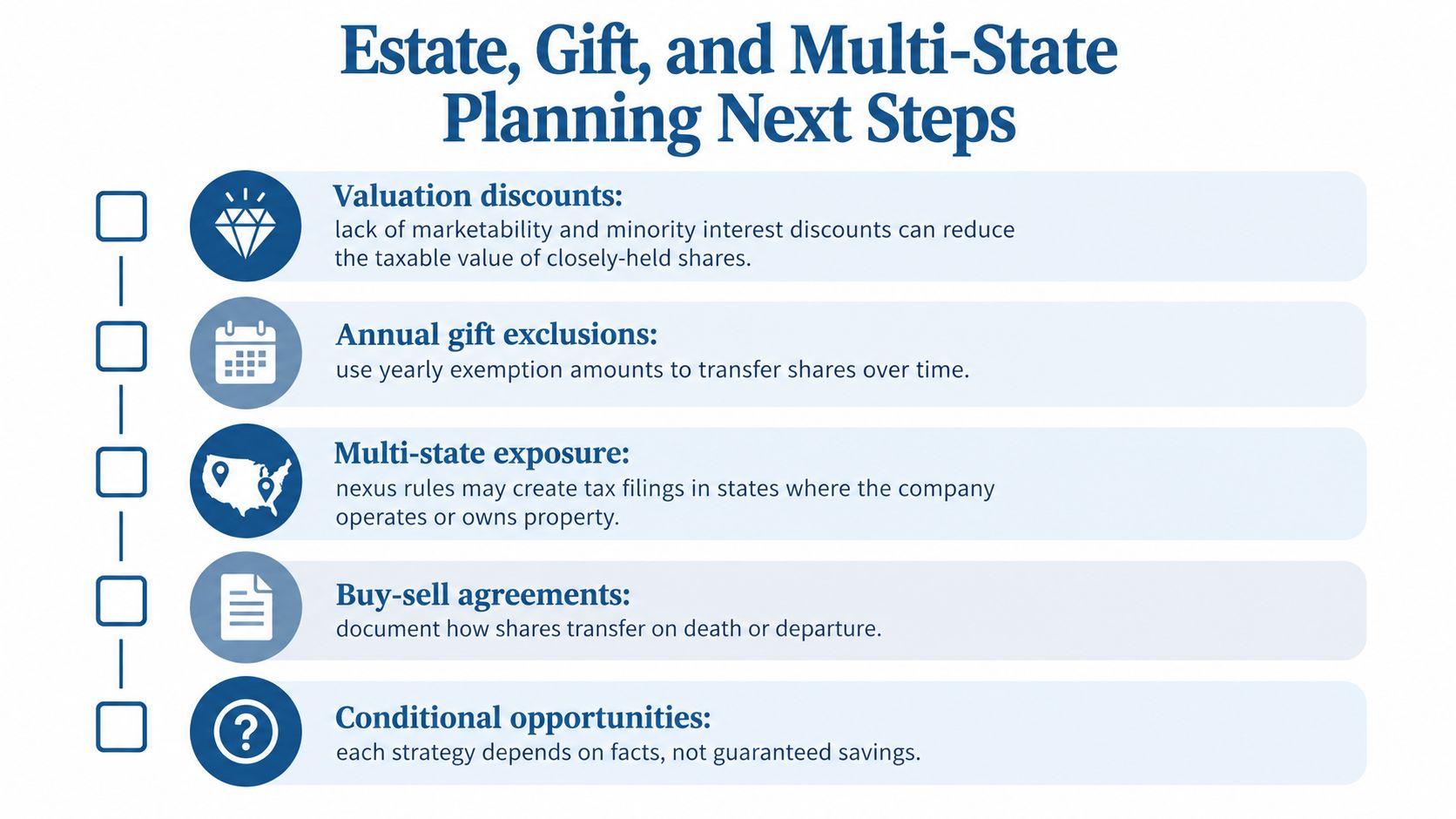
A practical review should cover the following:
- Confirm ownership: Trace stock held by individuals, trusts, partnerships, corporations, and related family members. Record the federal conclusion and each state conclusion separately.
- Review transfer documents: Check the buy-sell agreement, shareholder agreement, trust instruments, and restrictions on selling or gifting shares.
- Test multi-state exposure: A business operating in Bayside, Texas, and Minnesota may face nexus questions, franchise-tax rules, and different closely held definitions.
- Coordinate an S election: Review eligibility, reasonable compensation, stock rights, payroll, and the timing of any election before filing.
- Plan for liquidity: Consider how the company and the owner's estate would fund obligations after death or a planned departure. Insurance, redemption terms, and payment provisions should match the governing documents.
Owners shouldn't assume that a public filing tells the whole story. The federal test can look through an entity or trust, while a state rule may count shareholders differently. Keep a written ownership analysis with the tax return and update it when shares transfer, a trust changes, or the company adds another entity.
For a broader service overview focused on estate planning for business owners, owners can review the planning considerations before coordinating with their tax, legal, and estate professionals.
Blue Sage Tax & Accounting Inc. helps closely held owners with S corporation compliance, reasonable compensation analysis, tax projections, payroll coordination, and multi-state filing work. Visit Blue Sage Tax & Accounting Inc. to book a consultation about your ownership structure and filing obligations, then Book your free consultation call today.
This article is general information and not tax advice for your specific situation.