You're a Queens contractor with strong revenue, a growing payroll, and cash moving out of the business every month. The short answer to S corp vs C corp taxes is this: an S corporation usually fits an owner-operated business that distributes most of its profit, while a C corporation can fit a company that retains earnings, attracts outside investors, or is building toward a qualifying stock sale. The answer depends on federal tax, payroll, state filings, and exit treatment, not the headline rate alone.
Table of Contents
- What Are S Corp and C Corp Taxes at the Federal Level
- How Does Pass-Through Taxation Compare With Double Taxation
- How Do Payroll and Reasonable Compensation Change the Answer
- How Do QBI, Losses, Built-In Gains, and Other Federal Rules Matter
- Which Structure Fits an Owner-Operated Business or a Future Sale
- How Do New York State, NYC, and New Jersey Taxes Overlay the Federal Choice
- How Should You Choose, Convert, or Time the Election
- What Should Closely Held Businesses Do Next
What Are S Corp and C Corp Taxes at the Federal Level
An S corporation generally passes federal income, deductions, losses, and credits through to its shareholders. The corporation generally doesn't pay federal income tax at the entity level. Instead, shareholders report their allocated results on their personal returns. The IRS overview of S corporations explains this pass-through structure.
A regular C corporation is a separate federal taxpayer. It generally pays the 21% federal corporate income tax rate on taxable income, under the current federal framework described in IRS and public tax summaries for 2026. If the corporation later distributes after-tax profits as dividends, the shareholder may owe another layer of federal tax.
That difference drives most owner-level decisions. An S corporation can avoid entity-level federal income tax, but its income still reaches the owner's personal return. A C corporation can retain profit inside the company after corporate tax, but distributing that profit can create a second tax layer.
| Feature | S Corporation | C Corporation |
|---|---|---|
| Federal income tax | Generally passes through to shareholders | Paid by the corporation |
| Corporate federal income tax | Generally none | 21% federal corporate rate |
| Owner taxation | Shareholders report allocated income | Shareholders may pay tax on dividends |
| Ownership | Eligibility restrictions apply | Broader ownership flexibility |
| Stock structure | Generally one class of stock | Multiple classes may be available |
| Common fit | Owner-operated businesses distributing cash | Reinvestment, outside capital, or exit planning |
The ownership rules can decide the result
S status isn't available to every corporation. The structure generally requires no more than 100 shareholders, one class of stock, and eligible shareholders, including restrictions involving citizenship, residency, and entity ownership. A corporation that needs foreign corporate investors, complex preferred equity, or a broader ownership base may need C-corporation treatment.
Forming a corporation and choosing its federal tax classification are related but distinct decisions. A corporation generally receives C-corporation treatment unless it makes a valid S election. An LLC can also elect to be taxed as an S corporation or C corporation, so the legal entity and federal tax classification shouldn't be confused.
Advisor's view: If you own a profitable trade, professional practice, or service company and regularly take cash home, start by modeling S status. If you're retaining cash for expansion or preparing for an equity sale, start with the C-corporation exit model instead.
How Does Pass-Through Taxation Compare With Double Taxation
An S corporation generally taxes business profit once, at the shareholder level. A C corporation generally taxes profit first at the company level and again when shareholders receive dividends. That distinction matters most when the owner needs the money personally rather than leaving it in the business.
The S-corporation path
Suppose a solo contractor has $400,000 of net profit before owner salary. The contractor's S corporation must first pay reasonable compensation through payroll. The remaining profit may pass through on the shareholder's tax reporting and may be distributed without being treated as a second corporate dividend.
The tax result still depends on the owner's filing status, other income, deductions, state residence, payroll structure, and whether the income qualifies for available pass-through treatment. The IRS materials on S-corporation taxation confirm the core distinction, but they don't produce a universal owner savings formula.
Pass-through income may also interact with the Qualified Business Income deduction, subject to eligibility rules and limitations. Those limitations can depend on taxable income, W-2 wages, and the business's qualified property, so a contractor shouldn't assume that the full potential deduction applies.
The C-corporation path
A C corporation with $400,000 of taxable profit pays corporate tax before the owner receives anything. At the 21% federal corporate rate, the corporation retains the balance after federal corporate tax if it doesn't distribute the cash. If it pays a dividend, the owner may owe a second federal tax layer on that distribution.
That makes the 21% rate useful only as part of a broader plan. It can look attractive when the company is reinvesting earnings in equipment, hiring, product development, or expansion. It becomes less attractive when the owner distributes most of the earnings for personal use.
The Tax Foundation's comparison of pass-through businesses describes why double taxation has remained central to entity comparisons. Historical combined federal and average-state estimates have shown a substantial corporate-level burden before shareholder-level tax is added, while Treasury modeling has also shown materially different effective burdens for S and C treatment depending on how the comparison is weighted.
Why a universal calculation misleads
A clean side-by-side calculation requires more than multiplying profit by a tax rate. It must model:
- Owner compensation: The S corporation salary affects payroll tax and taxable pass-through income.
- Cash distributions: C-corporation dividends can create a second owner-level tax layer.
- Reinvestment: Retained C-corporation profit may avoid immediate dividend taxation, but the shareholder hasn't received that cash personally.
- QBI treatment: S-corporation pass-through income may qualify for a deduction, subject to restrictions.
- Exit value: Stock-sale benefits can outweigh years of operating-tax differences for a qualifying company.
The practical answer is direct. For a contractor who distributes operating cash, S treatment usually deserves priority. For a company that retains earnings and has a credible equity-sale strategy, C treatment deserves a serious model before anyone makes an election.
How Do Payroll and Reasonable Compensation Change the Answer
An S corporation doesn't let an owner take all business profit as a distribution. A shareholder-employee must receive reasonable W-2 compensation for services before taking non-wage distributions. The salary is subject to payroll taxes, while properly classified remaining profit generally isn't subject to payroll tax in the same way.
The IRS doesn't approve a universal salary percentage or a fixed salary-to-distribution split. Compensation should reflect the work performed, the business's facts, and what similar businesses pay people providing similar services. The IRS guidance on S-corporation compensation and medical insurance is the controlling starting point for owner compensation reporting.
The salary model matters
Consider a business with $200,000 of profit before owner compensation, using an assumption that the owner receives $120,000 as salary and $80,000 as a distribution. The salary enters payroll processing and appears on the owner's W-2. The distribution does not become a wage merely because it came from the same business, but it must be supported by valid accounting, basis, and compensation records.
The example doesn't prove that a $120,000 salary is reasonable. A contractor who performs nearly every revenue-producing function may need a different salary than an owner who manages a team and rarely performs field work. If the salary is too low, the IRS can treat distributions as wages and assess additional payroll taxes, interest, and penalties.
For a practical explanation of the facts-and-circumstances test, review reasonable compensation for S-corporation owners.
| Item | S Corporation | C Corporation |
|---|---|---|
| Owner working in the business | W-2 wages generally required | W-2 wages generally required |
| Remaining business profit | May be distributed after compensation | May remain in the corporation or be paid as dividend |
| Payroll tax treatment | Distributions generally aren't wages | Dividends generally aren't wages |
| Compensation documentation | Critical to support salary | Important for payroll and corporate deductions |
| Owner health insurance | Special reporting rules apply to greater-than-2-percent shareholders | Rules differ from S-corporation shareholder treatment |
Don't overlook shareholder benefits
For a shareholder-employee owning more than 2% of an S corporation, health and accident insurance premiums paid by the corporation generally must be reported as wages on the shareholder's Form W-2, subject to income tax withholding. The corporation may still deduct the premiums under the applicable rules, but the reporting treatment can change the owner's taxable wage picture.
The payroll advantage is real only when the owner follows the rules. Good records should connect the salary to duties, industry compensation, time spent, geographic market, business size, and the owner's role in producing revenue. A payroll service can process wages, but it can't decide whether the salary is defensible.
The right S-corporation model is salary first, distribution second, documentation throughout.
How Do QBI, Losses, Built-In Gains, and Other Federal Rules Matter
The annual tax comparison can change because of rules that sit outside the basic pass-through versus corporate-tax framework. QBI eligibility, shareholder basis, loss limitations, built-in gains, and S-corporation ownership restrictions can all change the year-end result.
QBI and loss limits
S-corporation pass-through income may qualify for the Section 199A QBI deduction, subject to the applicable federal limitations. W-2 wages and qualified property can affect the calculation, particularly as taxable income rises. C-corporation income doesn't qualify as QBI merely because the shareholder also works for the company.
S-corporation losses don't automatically become deductible on the shareholder's return. The shareholder generally needs sufficient basis and must satisfy at-risk and passive-activity rules. Basis tracking matters because distributions and losses can produce different tax consequences when the owner has limited investment basis.
A C corporation handles losses differently. The corporation generally uses its own losses under corporate tax rules, while shareholders generally can't claim corporate losses directly on their personal returns.
| Rule | S Corporation | C Corporation |
|---|---|---|
| QBI treatment | Pass-through income may qualify, subject to limits | Corporate income isn't QBI to shareholders |
| Losses | May pass through, subject to basis and other limits | Usually remain at entity level |
| Basis | Shareholder basis must be tracked | Shareholder stock and debt basis operate differently |
| Appreciated assets after conversion | Built-in gains rules may apply | No S-conversion recognition period |
| Ownership | Eligibility restrictions apply | More flexible ownership structure |
Conversion can expose old appreciation
A C corporation that elects S status may face the built-in gains tax under Section 1374 when it sells appreciated assets during the applicable recognition period. The rule exists because Congress didn't intend a corporation to avoid corporate-level tax by converting immediately before selling assets that appreciated while it was a C corporation.
This issue can matter for real estate, equipment, intellectual property, and other assets with a built-in gain. An owner should identify asset values and tax basis before an S election, not after a buyer or broker introduces a sale timetable.
S status also requires continuing compliance. A prohibited shareholder, a second class of stock, or another eligibility failure can terminate the election or create a serious tax problem. Those details deserve review before the election becomes effective.
Which Structure Fits an Owner-Operated Business or a Future Sale
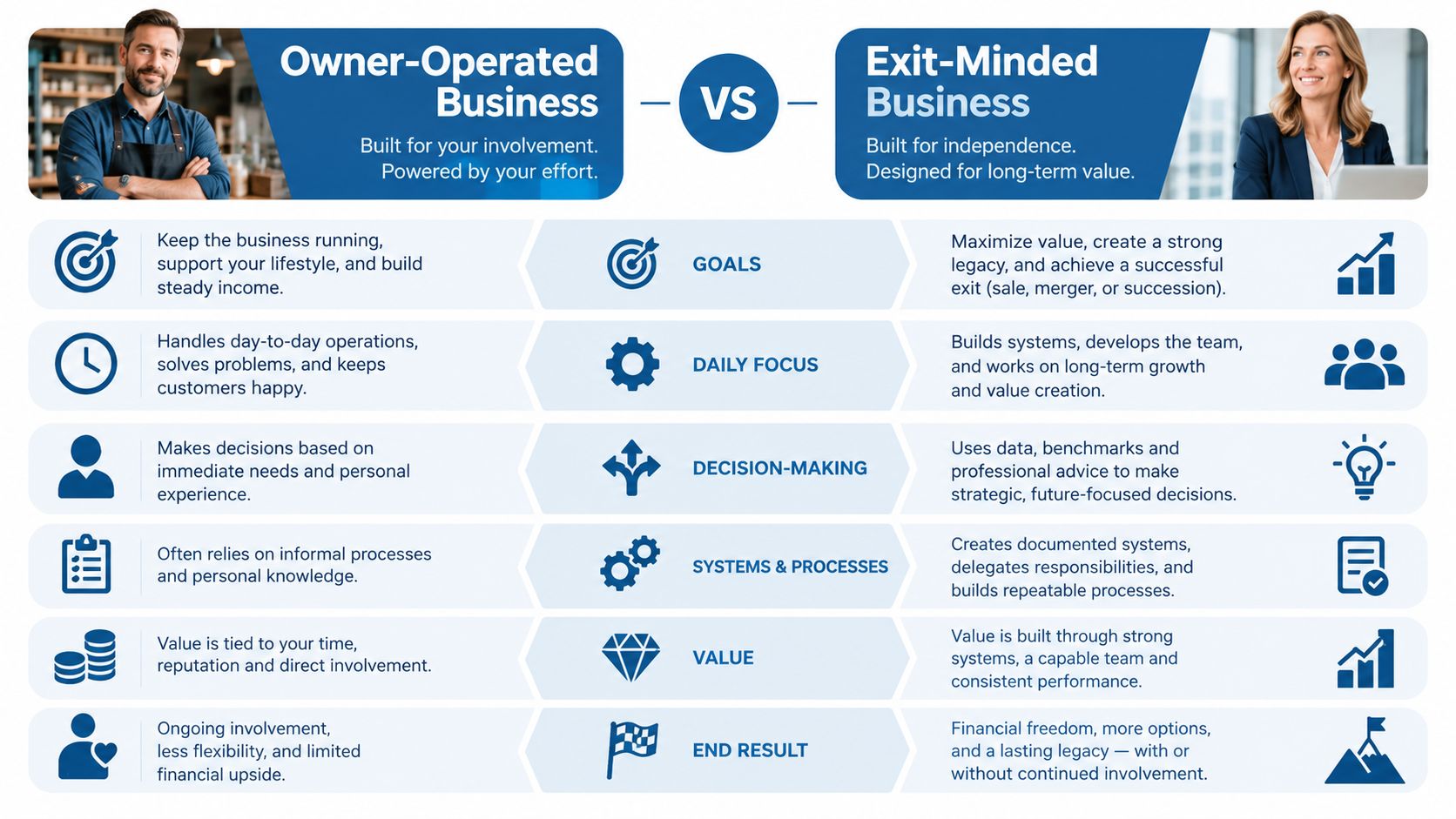
An owner-operated business usually favors S treatment when the owner performs the work, pays a defensible salary, and distributes the remaining cash. An exit-minded company may favor C treatment when it retains earnings, needs outside capital, or may qualify for expanded stock-sale benefits.
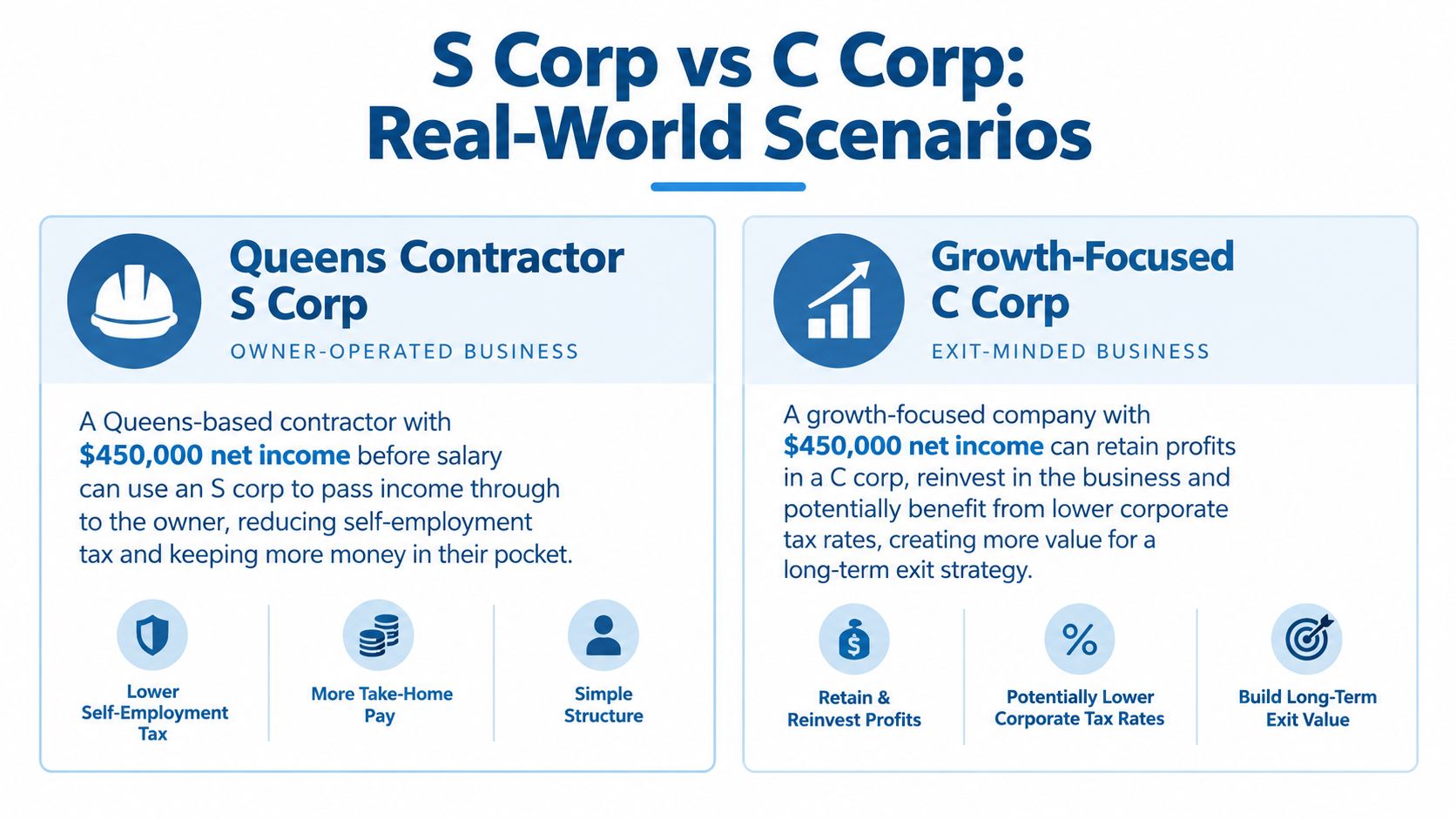
Scenario one, the Queens contractor
Assume a Queens contractor has $450,000 of net income before owner salary, as a planning assumption rather than a reported client result. The owner performs substantial field and management work, needs regular personal distributions, and isn't building a venture-backed company.
The S-corporation model would set a market-supported W-2 salary first, then distribute remaining eligible profit. The distribution may avoid payroll-tax treatment, but the owner still reports pass-through income and must account for federal, New York State, New York City, and possibly other state obligations.
A C corporation would pay federal corporate tax on taxable profit. Cash left in the company could fund trucks, staff, or equipment without an immediate dividend, but money distributed to the owner could face the second tax layer. For this fact pattern, I'd usually model S status first, then test whether the payroll administration, state taxes, and compliance costs justify the election.
Scenario two, the technology founder
Now consider a founder with appreciated intellectual property inside a Delaware C corporation. The company retains cash, issues equity to investors, and is pursuing a future stock sale. The founder may value Qualified Small Business Stock treatment more than annual pass-through taxation.
Recent policy coverage states that the QBI deduction was made permanent while QSBS was expanded, including a $15 million exclusion cap, a $75 million gross-asset ceiling, and staged exclusion benefits at three, four, and five years for qualifying stock issued after July 4, 2025. Those conditions are detailed in the financial planning coverage of the updated S-corp and C-corp trade-off. Qualification still requires careful legal and tax review.
Converting that company to S status could also bring built-in-gains concerns for appreciated IP. A C corporation may therefore be the better strategic choice even if annual operating tax looks less attractive.
Operating-year tax and sale-year tax belong in the same spreadsheet. A structure that looks cheaper every year can still produce the wrong exit result.
How Do New York State, NYC, and New Jersey Taxes Overlay the Federal Choice
Federal treatment doesn't settle a New York or New Jersey filing. New York State, New York City, and New Jersey apply their own rules, elections, minimum taxes, and pass-through limitations, so a federal S-corporation advantage can shrink after local modeling.
New York State
New York generally recognizes S-corporation treatment, but a corporation may need a separate New York S-corporation election. New York also imposes corporate franchise-tax rules, including a fixed-dollar minimum tax and a 6.5% franchise tax on the higher of business income or apportioned capital under the described framework, with a reduced rate for qualifying small businesses. Verify the applicable current-year calculation before relying on the rate.
New York's treatment can also differ from federal QBI treatment. A federal deduction doesn't automatically produce the same New York result, and the corporation's filing position can affect how owners and entities report income.
New York City
NYC can impose its own General Corporation Tax on S corporations with allocated income. A New York City resident shareholder may also face the Unincorporated Business Tax surtax on pass-through earnings above applicable thresholds. That local layer can reduce the expected benefit from shifting profit between wages and distributions.
The city analysis should include where the business operates, where the owner works, how income is allocated, and whether the corporation has city filing obligations. A business in Bayside or another Queens neighborhood may have a different result from a business with work and customers spread across several jurisdictions.
New Jersey
New Jersey generally follows federal S-corporation treatment in broad outline, but it applies its own tax and minimum-tax rules. The described framework includes a 9% rate on the larger of allocated income or a receipts-based minimum, subject to current-year rules and filing facts.
| Item | New York State | NYC | New Jersey |
|---|---|---|---|
| S-corporation conformity | Generally conforms, with state election considerations | Local corporate rules may apply | Generally follows federal treatment in broad outline |
| Local or state corporate tax | Franchise-tax and minimum-tax rules | GCT and possible UBT exposure | Corporation tax and receipts-based minimum rules |
| QBI treatment | Doesn't automatically mirror federal treatment | Local treatment requires separate review | State limitations can differ |
| Main planning issue | Allocation and state election | City allocation and owner residency | Multi-state allocation and loss limitations |
A restaurant owner filing in New York and New Jersey should model payroll, business allocation, owner residency, and pass-through losses together. Don't assume a federal election produces the same state result.
How Should You Choose, Convert, or Time the Election
Choose S status for a stable owner-operated company that distributes operating cash and can support reasonable compensation. Choose C status for a company that is reinvesting aggressively, needs flexible ownership, expects outside capital, or has a credible qualifying stock-sale strategy.
Use this decision test:
- Cash policy: If most profit leaves the business, S treatment generally deserves the first model. If profit stays inside for growth, C treatment may be more competitive during the accumulation years.
- Ownership plan: If you need foreign owners, entity investors, multiple stock classes, or a broad shareholder base, S eligibility may fail.
- Exit horizon: If a stock sale is central to the plan, test QSBS and built-in-gains consequences before changing status.
- Payroll reality: If the owner works in the business, document a defensible salary before projecting distribution benefits.
- State footprint: Include New York State, NYC, New Jersey, and every other state where the business operates or the owner has filing exposure.
A C-to-S election generally requires Form 2553, with timing rules tied to formation or the intended effective date. A late election may require relief procedures, and an inadvertent termination can create a separate compliance problem. Review the election timing with a tax professional before payroll or distributions are set up.
The conversion isn't automatically reversible. Revoking S status can trigger restrictions on making another S election, including the once-per-five-year re-election bar described in federal rules. Shareholder consents, stock terms, ownership eligibility, and the single-class-of-stock requirement should be checked before the election takes effect.
For the mechanics and risk points, see how to convert a C corporation to an S corporation.
What Should Closely Held Businesses Do Next
Pull the last three years of federal and state returns, payroll reports, shareholder basis schedules, and business financial statements. Then model salary, distributions, retained earnings, state allocation, and a possible sale under both structures. A projection is more useful than a generic claim that one entity always wins.
Before changing status, review the shareholder agreement, stock rights, owner residency, compensation support, asset appreciation, and financing plans. A restaurant with filings in two states needs a different model from a single-location contractor, and a technology company preparing for investment needs a different model from either.
Set a review cadence that matches how the business changes:
- Year-end: Revisit entity status, projected profit, retained cash, and upcoming state filings.
- Mid-year: Test whether owner compensation remains reasonable as duties and revenue change.
- Before a sale or capital raise: Review QSBS eligibility, built-in gains, stock rights, and buyer expectations.
Blue Sage Tax and Accounting Inc. provides tax preparation, projections, S-corporation compliance, payroll support, reasonable compensation analysis, and multi-state filing work for closely held businesses. The federal figures discussed here reflect 2026 rules, and tax rates, thresholds, elections, and state requirements adjust annually.
Blue Sage Tax & Accounting Inc. can model your salary, distributions, retained earnings, state filings, and potential exit treatment before you commit to an S or C election. Visit Blue Sage Tax & Accounting Inc. to review business tax planning and compliance services, then Book your free consultation call today.
This article is general information and not tax advice for your specific situation.