Stop asking which label sounds most professional. In a Sole Proprietorship vs LLC vs S Corp decision, there's no universally best structure because you're making three separate decisions at once, legal liability, federal tax classification, and state filing obligations. A sole proprietorship isn't a separate legal entity, an LLC generally creates legal separation, and S corporation treatment is a tax election that can sit on top of a qualifying corporation or eligible LLC. If you collapse those decisions into one ranking, you'll pick the wrong structure for the right sounding reason.
Table of Contents
- What Is the Best Structure for Your Business
- How Do the Three Business Structures Compare
- How Do Taxes and Owner Compensation Differ
- What Compliance Does Each Structure Require
- Which Structure Fits Your Situation
- Do I Need to File in Both States
- When Should You Convert Your Business Structure
What Is the Best Structure for Your Business
The best structure is the one that matches your liability exposure, owners, profit pattern, payroll, and state obligations, not the one a social media post says every business over a certain revenue level needs. A sole proprietorship leaves you personally exposed to business obligations. An LLC generally provides personal liability protection as a separate legal structure, while S corporation treatment lets qualifying income, deductions, and credits pass through to shareholders rather than being taxed at the corporate level, as described in the SBA guidance on choosing a business structure.
That distinction matters because legal protection and tax classification are separate decisions. You can change one without changing the other. Owners who don't separate them often form an LLC expecting a new federal tax outcome, or elect S corporation treatment expecting it alone to solve a legal risk problem.
The Three Questions to Answer First
Ask what could go wrong in the business, who owns it, and how you'll take money out. A solo consultant with no employees, no lease, and low contract risk faces a different analysis than a contractor signing subcontracts or a restaurant with payroll in two states.
- Liability exposure: Do customers, employees, vehicles, property, or borrowed money create claims that could reach you personally if there's no separate entity?
- Tax classification: Do you want default pass through treatment, or does a wage and distribution model deserve modeling for your specific profit and role?
- State obligations: Where do you operate, hire, store property, or sell, and does that state recognize your federal election the same way?
Blue Sage Tax and Accounting Inc., an accounting firm, works through those variables with owners before recommending a change. Our position is direct. Don't choose by revenue alone, don't choose by what another owner in a different state did, and don't assume Sole Proprietorship vs LLC vs S Corp are three mutually exclusive boxes. An LLC can keep default tax treatment or elect S corporation treatment if it qualifies. A sole proprietorship can't elect anything until you create an eligible entity. Start with risk and operations, then model the tax classification on real numbers.
How Do the Three Business Structures Compare
A sole proprietorship has no separate legal entity, an LLC is a state law entity that generally separates the business from its owners, and S corporation treatment is a federal tax status for a qualifying corporation or eligible LLC. A one owner LLC is generally treated by default as a disregarded entity, while a multi owner LLC is generally treated as a partnership unless it elects corporate tax treatment, according to the IRS guidance on entity classification. That's why forming an LLC may change your legal position without changing your federal income tax reporting at all.
Use the table to compare dimensions, not to declare a winner. Each row answers a different question, and a structure that wins on simplicity may lose on liability or ownership flexibility.
| Decision criterion | Sole proprietorship | LLC | S-corporation treatment |
|---|---|---|---|
| Legal liability | No separation, business obligations can generally reach personal assets | Separate legal structure, generally provides personal liability protection | Depends on underlying corporation or LLC, generally separate from shareholders |
| Default federal tax treatment | Owner reports business income personally | Single member disregarded, multi member partnership, unless it elects otherwise | Pass through to shareholders if election and eligibility requirements are met |
| Ownership limits | One owner | Flexible number and types of members under state law | 100 shareholders or fewer, with federal restrictions on who can be a shareholder |
| Owner compensation | Draws, no wage to owner | Draws or guaranteed payments depending on classification | Shareholder employee wages plus possible distributions |
| Pass through treatment | Yes, directly to owner | Yes by default | Yes, to shareholders |
| Administrative burden | Lowest entity formalities | State formation and ongoing state obligations | Election, eligibility, payroll, and corporate style records |
| Principal reason to choose it | Simplicity for a low risk, one owner operation | Legal separation with flexible tax classification | A compensation and pass through framework worth modeling |
Why the Table Doesn't Rank Them
Federal eligibility rules limit S corporations to 100 shareholders or fewer and generally exclude partnerships, corporations, and nonresident aliens as shareholders. An LLC doesn't face that same federal ownership ceiling by default, which matters if you plan to bring in an entity investor or a foreign owner. If that owner arrives after you've elected S corporation treatment, the election itself can become a problem you have to unwind.
History explains part of the confusion. S corporations were created in 1958 for closely held businesses that wanted limited liability and a single layer of federal income taxation, and by 2000 they represented more than 11% of nonfarm businesses, up from less than 4% in 1982, as documented in congressional testimony on S corporation history and use. Yet among nonfarm businesses with gross receipts below $250,000 in 2000, 79% operated as sole proprietorships and fewer than 8% used S corporation form. Smaller, simpler businesses stayed simple for a reason. Bigger operations adopted formal structures as owners, employees, and risk increased.
State law also drives formation choices in ways a federal comparison can't capture. If you're forming outside New York, resources such as Georgia entity selection for home services illustrate how state formation options frame the legal side of the decision for trades businesses. Don't copy another state's formation playbook into New York. Use it to understand the questions, then answer them under the law of the state where you form and operate.
Practical rule: Name the problem you're solving before you name the entity. Liability, tax classification, and ownership are different problems.
How Do Taxes and Owner Compensation Differ
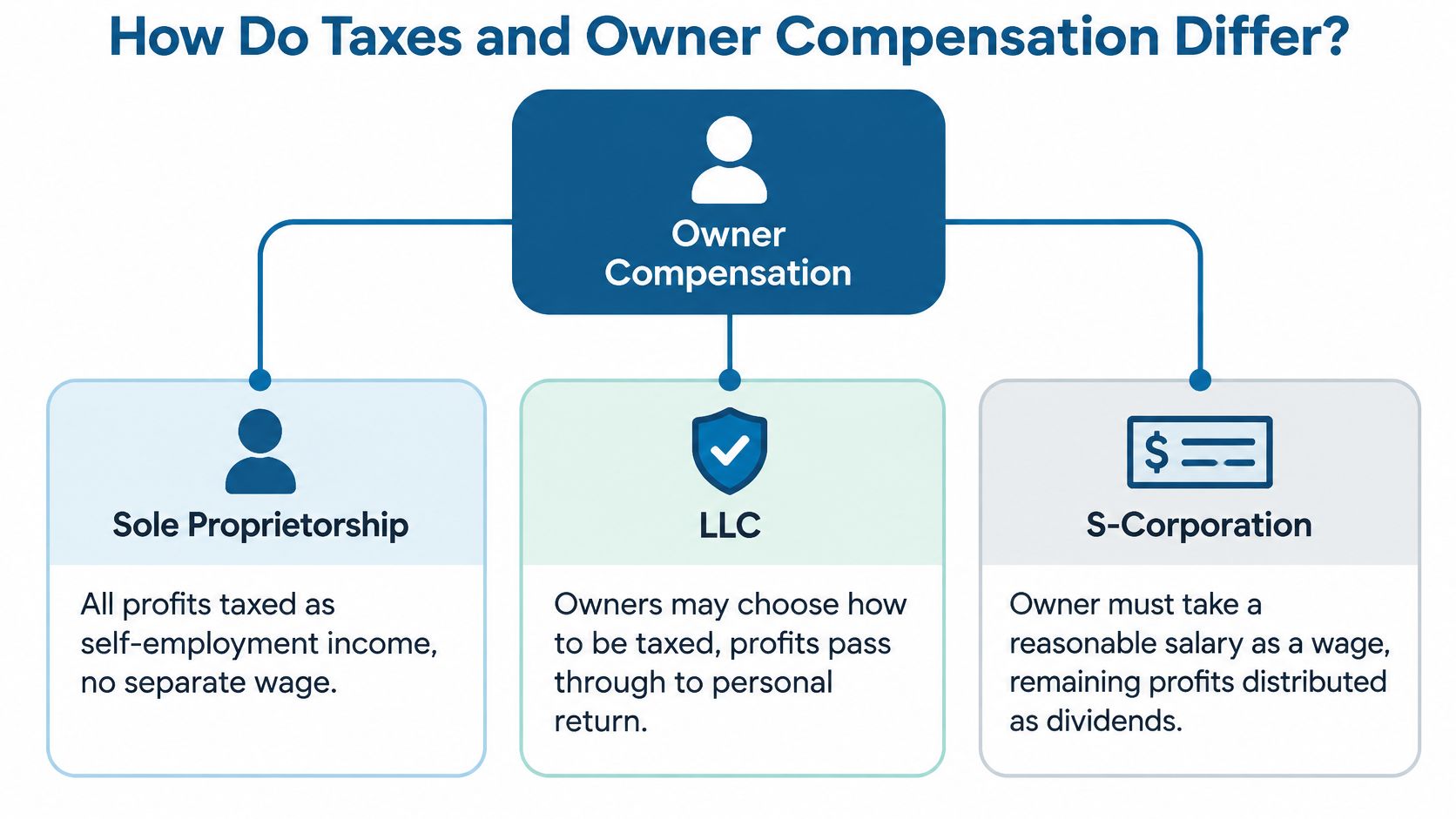
Owner compensation differs because S corporation treatment introduces a wage and distribution framework, while a sole proprietor and a disregarded LLC owner are generally treated as self employed on business profit. An S corporation doesn't pay no tax. It changes how income reaches the owner, what payroll obligations follow, and how much documentation you need to support the split.
As a sole proprietor, you don't pay yourself a wage from your own business. You take draws, and the profit is generally subject to income tax and self employment tax under the federal rules that apply to your situation. A single member LLC that hasn't elected corporate treatment works the same way for federal income tax purposes, even though the LLC exists under state law. Owners who miss that point overpay for formation expecting payroll tax savings that the LLC alone doesn't create.
What Changes Under S Corporation Treatment
A shareholder who works in the business is treated as an employee for services performed. That means payroll, wage reporting, and a defensible salary decision before distributions enter the picture. Our guidance on what counts as reasonable compensation for an S corporation owner explains why the salary can't be an arbitrary low number chosen after you see the profit.
Distributions aren't a substitute for wages when you're providing services. If you can't document duties, time, comparable pay, and business profitability, you're not ready to model S corporation treatment seriously. Depending on your circumstances, the structure may change your employment tax picture, but it also adds payroll cost, return preparation, and state tax consequences that can offset part of any federal benefit.
The best tax outcome can't be selected from revenue alone because business type, wages, owner roles, state treatment, and personal circumstances all affect the result.
Deductions Don't Depend on the Label
Owners often ask which structure gives more deductions. In most owner operated businesses, ordinary business expenses are deductible under rules that turn on the expense and documentation, not on a magic list available by forming an LLC. Keep business funds separate, substantiate expenses, and classify owner payments correctly. Mixing personal spending into the business account creates problems under every structure, and it can undermine the separation you formed an entity to create.
Model the whole picture for the relevant tax year, because amounts and thresholds adjust annually. Compare self employment treatment under your current classification with wages, payroll taxes, pass through income, retirement plan effects based on compensation, and state treatment under an S election. If the model only shows one federal line item, it's incomplete.
What Compliance Does Each Structure Require
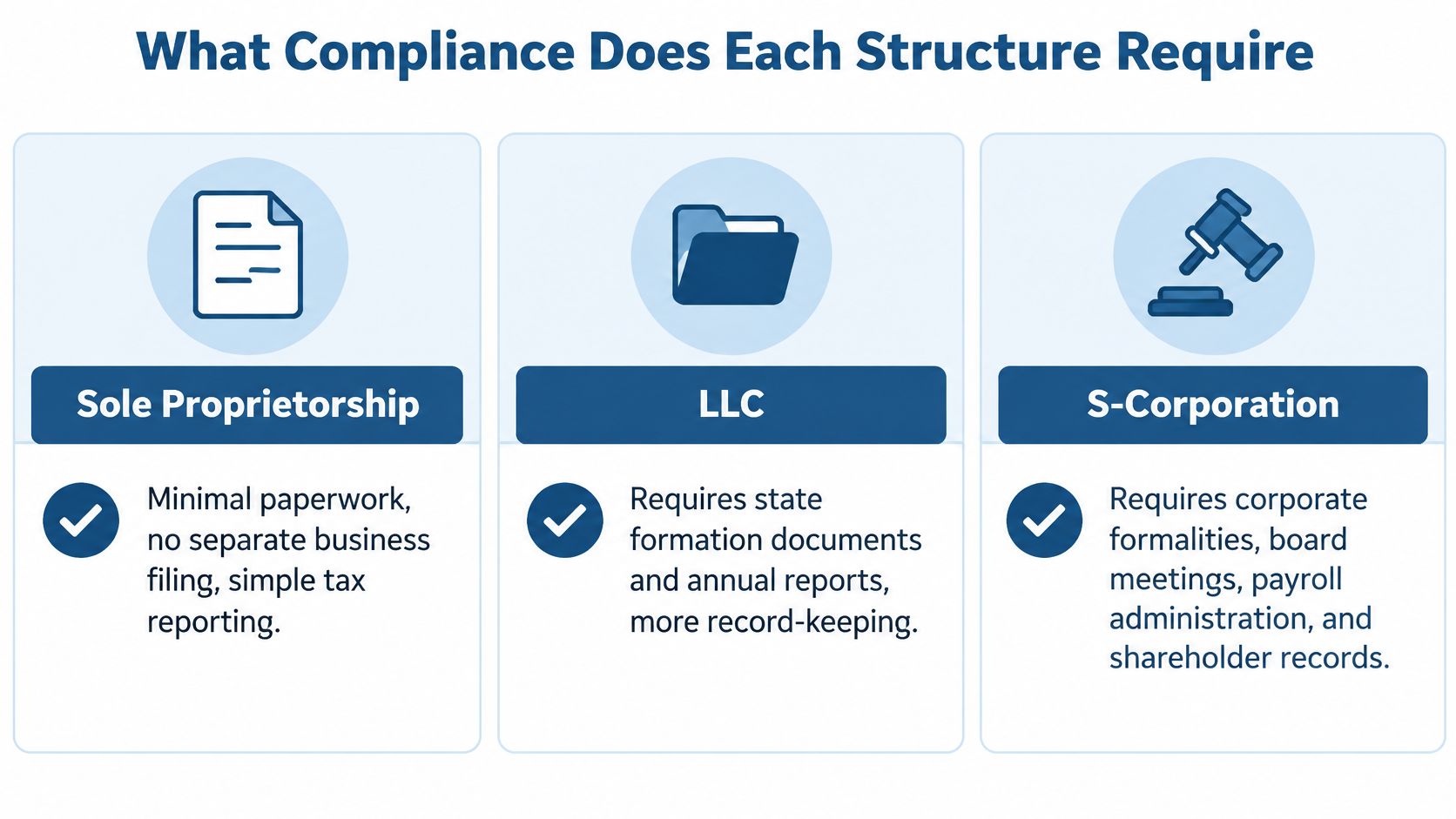
A sole proprietorship generally requires the fewest entity formalities, an LLC adds state organization and ongoing reporting, and S corporation treatment adds election, eligibility, payroll, and corporate style recordkeeping. Compliance isn't a footnote. If you won't maintain the structure, don't elect it.
A sole proprietor still needs licenses, sales tax compliance where applicable, payroll filings for employees, and clean books. The simplicity is at the entity level, not permission to run informal records. You should still use a separate business bank account, track income and expenses by category, and keep contracts and tax records you can produce later.
What the LLC and S Election Add
An LLC is formed under state law and governed by its formation documents and operating agreement. Depending on the state and tax classification, you may have annual reports, state fees or taxes, a separate entity return, and member records to maintain. A multi member LLC taxed as a partnership needs capital and allocation records that a solo owner using a personal return never had to think about.
S corporation treatment layers on more discipline. You need a timely federal election, ongoing shareholder eligibility, one class of stock compliance for a corporation, payroll for shareholder employees, and records showing compensation and distributions were handled consistently. Miss an eligibility requirement and you can create a classification problem, not just a late form.
A Verification Checklist Before You File Anything
- Current legal entity: Confirm what exists under state law today, not what you call the business informally.
- Federal tax classification: Confirm whether you're disregarded, a partnership, or under a corporate or S election.
- State reports and returns: List formation state and every operating state obligation separately.
- Payroll filings: Identify who is an employee, including a shareholder employee, and who isn't.
- Governing records: Locate formation documents, operating agreement or corporate records, and ownership ledgers.
- Compensation documentation: Write down owner duties, time, and the basis for wages before year end.
Don't rely on a generic deadline list pulled from another state or another tax year. Federal, New York State, New York City, and New Jersey obligations can differ in form, timing, and recognition of the same election. Verify the current requirement for each jurisdiction that applies to you, in writing, before you convert.
Which Structure Fits Your Situation
The right fit depends on how risk, owners, and payroll show up in your actual operations. A simple low risk business can remain a sole proprietorship without becoming overly complex. A business signing leases, hiring crews, or adding owners usually needs a harder look at legal separation and tax classification.
The scenarios below are illustrations, not recommendations for any specific taxpayer. Use them to identify which facts you'd need to model.

A Contractor With $400,000 in Revenue
A general contractor with $400,000 in revenue, subcontractors, vehicles, and job site exposure has a liability question first. Operating as a sole proprietor means business claims can generally reach personal assets, which is a difficult position when contracts and property damage risk are routine. An LLC may provide useful legal separation if it's formed and operated properly, with separate accounts, contracts in the entity name, and insurance matched to the work.
Tax classification is a second step. The LLC by itself, if disregarded, doesn't change the owner's federal self employment picture. S corporation treatment deserves analysis only if profit is consistent after a defensible wage for the owner's field and management work, and only after state obligations are priced into the comparison. Revenue of $400,000 tells you almost nothing without margin, labor mix, and how much of the profit is really the owner's personal earnings.
A Restaurant Owner Operating in Two States
A restaurant owner with locations or employees in New York and New Jersey has payroll, sales tax, property, and nexus questions that can outweigh the entity label. An LLC taxed as a partnership, an LLC with an S election, and a corporation with an S election can each produce different state filing footprints. The owner should map where employees work, where sales occur, and where equipment and inventory sit before choosing a classification to optimize.
The video below walks through entity choice considerations that apply before state specific analysis begins.
A Professional and a Growing Multi Owner Business
A consultant or professional who wants liability separation but doesn't want corporate formalities may find an LLC with default treatment fits the operating style, subject to any professional licensing rules in the relevant state. That choice can be reasonable even with solid profit if the owner values simplicity and the S corporation model doesn't produce a clear benefit after payroll and state costs. Simplicity has economic value when you're the person doing the compliance.
An owner who adds equity holders faces different pressure. You need allocation rules, transfer restrictions, buyout terms, and a compensation model for owners who work in the business versus owners who don't. S corporation treatment may warrant closer analysis if all owners are eligible shareholders and the business can support payroll discipline. If you need special allocations or entity owners that S rules don't permit, a partnership taxed LLC may fit better. Don't force ownership into a tax election. Choose the tax classification that the ownership structure can sustain.
Do I Need to File in Both States
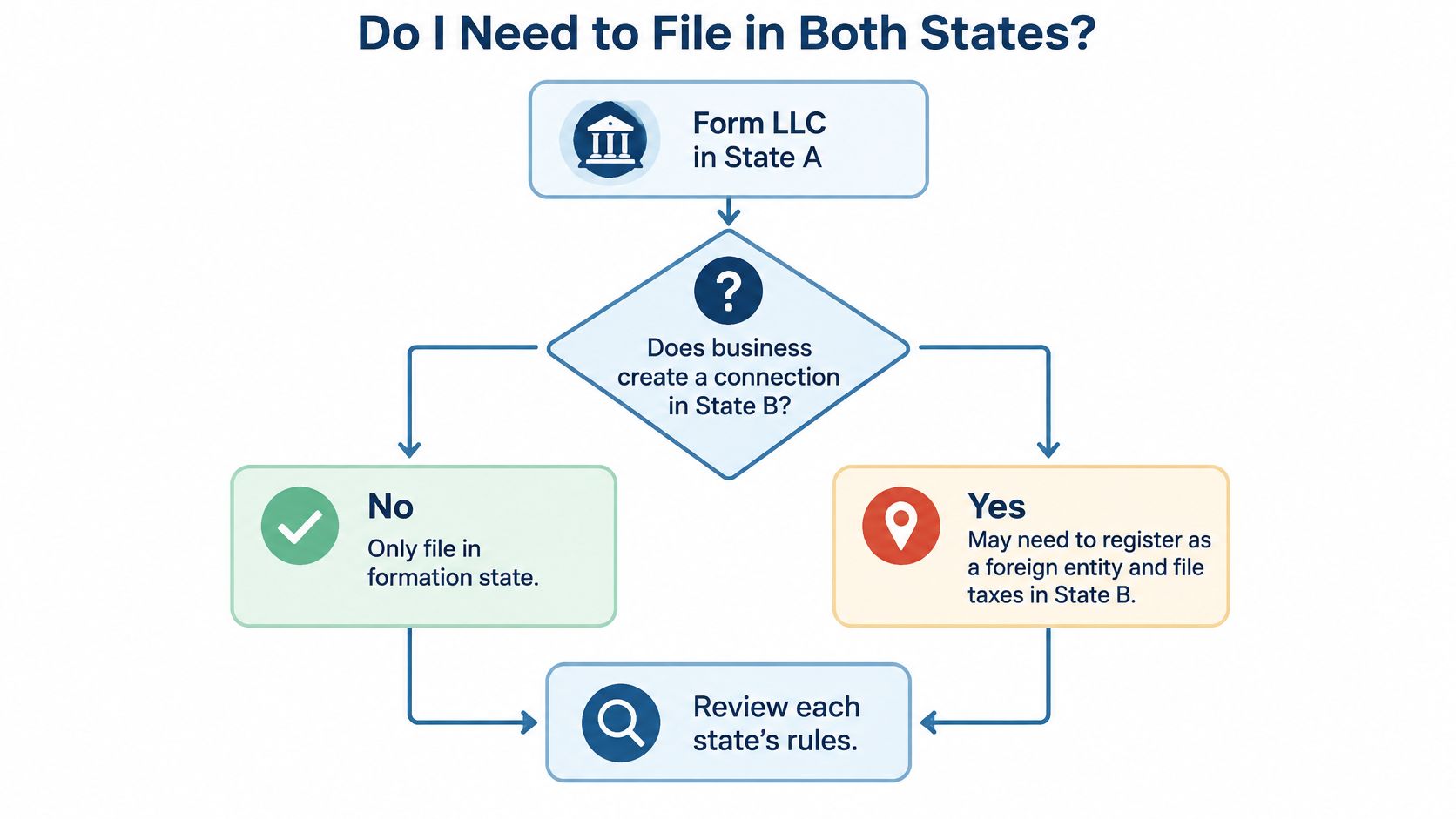
You may need to file in both states if your business creates a filing connection in a state beyond your formation state. Forming an LLC in one state doesn't confine your obligations there. Employees, property, sales, and physical operations in another state can create registration, tax return, payroll, and sales tax duties in that second state.
Federal classification doesn't answer the state question. A federal S election controls federal treatment if it's valid. Each state then decides whether and how it recognizes that election, what return it requires, and whether a separate state election is needed.
The New York S Corporation Trap
New York State doesn't always automatically treat a federally elected S corporation as a New York S corporation. The corporation must first be a federal S corporation, meet applicable New York requirements, and obtain shareholder consent, and the election is made by filing Form CT-6, as explained by the New York Tax Department guidance on S corporations. After approval, a qualifying general business corporation files Form CT-3-S rather than the regular general business corporation return.
Timing is specific under New York State rules. To apply for a tax year, Form CT-6 must generally be filed during the preceding tax year or by the 15th day of the third month of the tax year to which the election applies. That's a New York rule, not a nationwide federal deadline, and you should check the applicable deadline for the relevant tax year because amounts and procedural details can adjust annually. Owners who file only the federal election and assume New York follows can end up with the wrong New York return and a mismatch between federal and state treatment.
Pass Through Entity Tax Adds Another Layer
New York's pass through entity tax, or PTET, isn't available to every pass through business. Sole proprietorships are ineligible to opt into PTET, and single member LLCs are also ineligible unless they elect to be treated as an S corporation for New York purposes, according to the New York Tax Department page on pass through entity tax. Eligible categories can include partnerships, including an LLC taxed as a partnership for federal purposes, and eligible New York S corporations subject to the applicable requirements.
That eligibility gap changes the Sole Proprietorship vs LLC vs S Corp analysis for New York owners. A single member LLC treated federally as disregarded is generally treated as a sole proprietorship for New York purposes when its owner is an individual, while an LLC treated federally as an S corporation is treated as a New York S corporation if the New York S election is made or otherwise mandated. Whether PTET helps depends on your resident status, credits, income sources, and other state filings. Don't elect a structure solely to chase PTET eligibility without modeling the owner level result.
If you operate in New Jersey or another state as well, run the same recognition analysis there. Never present a New York rule as national, and never assume New York City follows New York State treatment for every tax. Jurisdiction by jurisdiction review is the work.
When Should You Convert Your Business Structure
Convert when the facts that justified your current structure have changed, not when revenue crosses a number you heard online. New liability exposure, a lease, employees, borrowed money, valuable property, or a new owner can each justify reconsidering a sole proprietorship. Consistent profit after a defensible owner wage, eligible owners, and willingness to run payroll can justify evaluating S corporation treatment for an LLC or corporation.
Conversion timing matters because elections have effective dates and state recognition may follow a different clock. For a New York business, a federal S election alone may leave a separate New York election to investigate, with its own consent and filing window for the tax year at issue. Start before the year you want the election to cover whenever possible. Retroactive fixes exist in some situations, but you shouldn't build a plan that depends on relief.
A Conditional Conversion Framework
- Verify current status: Confirm your legal entity, federal classification, and state classification in each jurisdiction where you file.
- Assemble records: Gather formation documents, ownership records, prior elections, payroll history, and owner compensation support.
- Model both years: Compare current year and a future year, because a structure that helps in a high profit year can cost you in a lean year when payroll and compliance continue.
- Confirm sequencing: Determine formation, federal election, state election, payroll registration, and bank and contract changes in order.
- Price the compliance: Include payroll processing, additional returns, state taxes or fees, and bookkeeping cleanup in the comparison.
Our detailed walkthrough on converting an LLC to S corporation tax treatment covers the election mechanics when you've already decided an LLC is the right legal entity. Read it as a sequencing guide, not as proof that conversion fits your business. The modeling still has to come first.
Decision standard: A conversion should survive a bad year, a state notice, and a request to document owner pay. If it only works on a best case projection, wait.
Don't convert midstream without checking contracts, licenses, insurance, loans, and sales tax accounts that reference the old structure. A new entity or new classification can require updated registrations and counterparty notices, and sloppy transitions create gaps in liability separation. Depending on your circumstances, staying put for one more tax year while you clean up books and document compensation may produce a better result than rushing an election you can't support.
If you're weighing a change for the coming tax year, bring your current return, year to date profit, owner pay history, and a list of states where you operate. Book your free consultation call today.
This article is general information and not tax advice for your specific situation.
Blue Sage Tax & Accounting Inc. helps owner operated businesses compare sole proprietorship, LLC, and S corporation treatment across federal, New York, and multi state filings, including reasonable compensation and conversion timing. If you want that analysis run on your actual profit, payroll, and state footprint before you elect anything, visit Blue Sage Tax & Accounting Inc. to start the conversation.