A contractor reviewing $400,000 in revenue may wonder whether converting from an LLC to an S corp is worth the payroll and filing burden. For many eligible LLCs, the change is primarily a federal tax election, not an automatic replacement of the LLC's legal structure. The practical transition is still substantial: you must satisfy S-corporation eligibility rules, obtain every shareholder's consent, file Form 2553 on time, establish payroll, document reasonable compensation, and check state requirements. The right decision depends on your profit pattern, ownership, payroll readiness, and federal, New York, New Jersey, or multi-state obligations.
Table of Contents
- Is Converting from LLC to S Corp Worth the Complexity
- Does Your LLC Qualify for S Corporation Status
- How to File the IRS Election for S Corp Taxation
- Navigating New York and Multi-State Filing Requirements
- What Payroll and Reasonable Compensation Changes After the Election
- What Should Owners Do After the IRS Acknowledges the Election
Is Converting from LLC to S Corp Worth the Complexity
An LLC can show strong sales while producing limited profit after materials, subcontractors, vehicles, insurance, and other operating costs. That distinction often determines whether an S corporation election deserves consideration. The administrative work can make sense when operating profit is consistent and the owner can support compliant payroll, but the election adds responsibilities that default LLC taxation does not.
Start with net business profit, owner involvement, payroll feasibility, and state treatment, rather than sales alone. A service business whose owner performs most of the revenue-producing work faces a different compensation and payroll analysis from an LLC with substantial outside labor.

What changes after the election
An LLC can remain an LLC under state law while receiving S corporation tax treatment federally. The IRS separates legal entity classification from tax treatment, so an eligible LLC may file Form 2553 without first forming a new corporation. The election changes the tax reporting and operating requirements, not necessarily the entity created under state law.
Payroll is often the first source of friction. An owner who previously took draws and reported pass-through income under the LLC's default classification must establish shareholder-employee payroll, withhold and remit employment taxes, issue required wage reporting, and keep wages separate from distributions. Payroll timing matters because wages need to be processed consistently, not reconstructed at year-end after distributions have already been taken.
The business also shifts toward Form 1120-S reporting instead of the partnership-style filings or individual schedules associated with its prior classification. A useful comparison of legal structure and tax status appears in this LLC vs S Corp 2026 guide from Coto & Waddington, Attorneys at Law. The more accurate comparison is usually an LLC with default tax treatment versus an LLC that elects S corporation taxation.
Where owners misjudge the workload
The federal filing may be orderly, while payroll setup and state compliance create ongoing work. New York and New Jersey may require separate analysis after the federal election. A business operating across state lines may also need distinct reviews for income tax, payroll, registrations, and annual filings.
Before deciding, review these points:
- Profit pattern: Does the business produce recurring operating profit after expenses?
- Owner role: Does the owner perform services that must be reflected in reasonable compensation?
- Payroll capacity: Can the business run payroll consistently and retain supporting records?
- State exposure: Does it operate, employ people, or allocate income in New York, New Jersey, or another state?
- Ownership structure: Do all owners satisfy federal eligibility rules and agree to the election?
The strongest case for proceeding is a documented fit between the tax classification and the way the business operates. That fit must account for payroll timing, reasonable compensation, and state obligations, not only a projected federal tax difference.
Does Your LLC Qualify for S Corporation Status
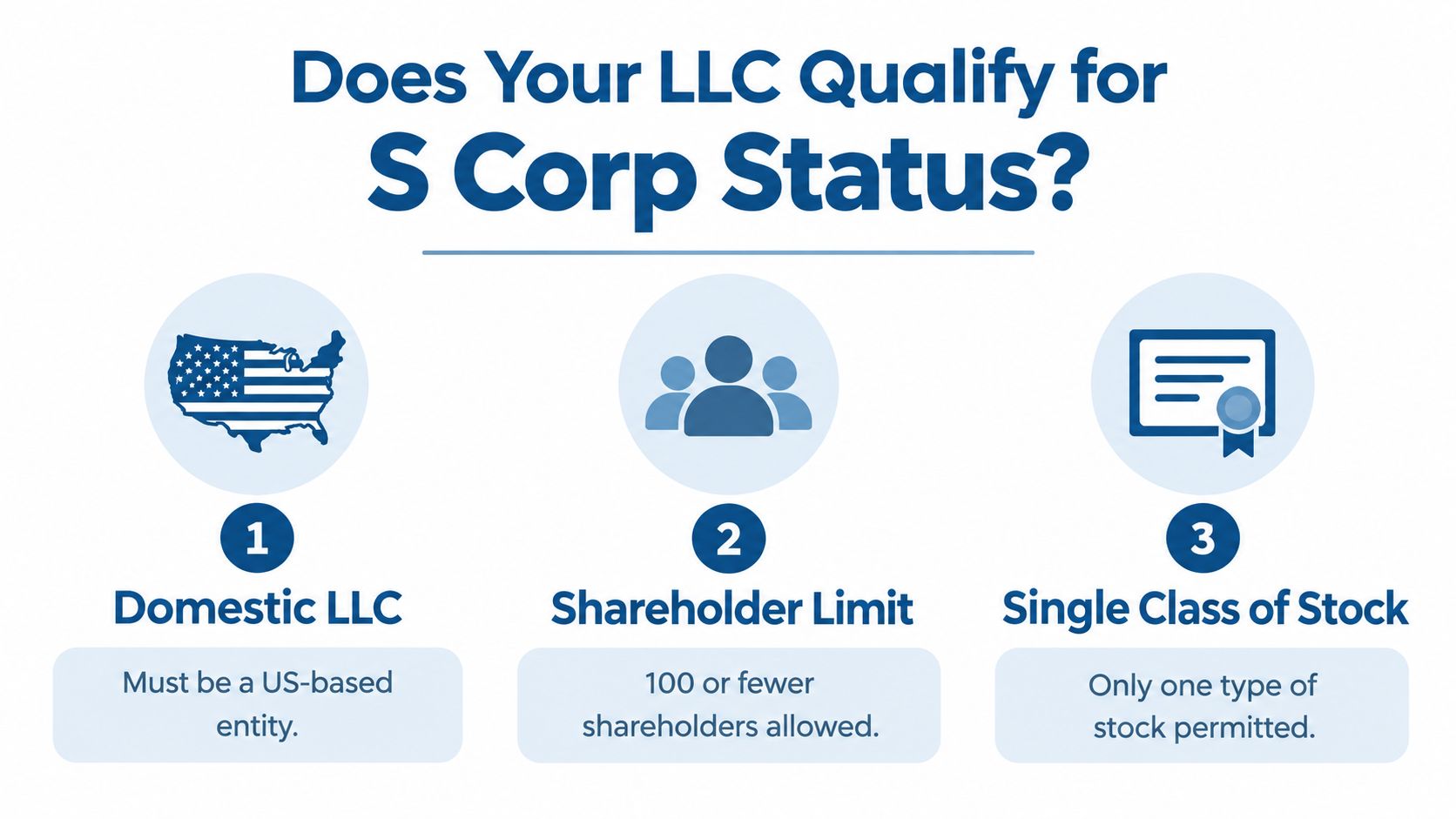
Your LLC must satisfy strict federal requirements before you file. The entity must be domestic, have no more than 100 shareholders, have one class of stock, and have only eligible shareholders. Every shareholder must sign Form 2553, and a failure to obtain unanimous consent can undermine the election.
The eligibility review should happen before payroll changes, bookkeeping conversions, or state filings. An LLC that doesn't qualify cannot fix the problem by submitting a complete form.
The federal gatekeepers
The IRS describes the core restrictions for S corporations in its guidance on S-corporation eligibility requirements. The company must be a domestic entity, and the shareholder count can't exceed the federal limit. Shareholders must also fall within permitted categories. Certain entities and foreign ownership arrangements can prevent qualification.
The one-class-of-stock rule deserves special attention for multi-member LLCs. LLC agreements often allow flexible allocations, special distributions, or economic rights that don't line up neatly with S-corporation requirements. An arrangement can look commercially reasonable among owners while creating a tax-classification problem if it gives one owner different economic rights.
Review the operating agreement, capital accounts, distribution provisions, and ownership records together. Don't rely on the fact that the business has always been treated as an LLC. The S election imposes a different set of tax constraints.
Why consent causes so many problems
All shareholders must consent to the election, and Form 2553 must contain the required signatures. This is a practical control point, not a minor formality. One owner who doesn't sign, signs for the wrong period, or has an ineligible ownership status can create a filing defect.
The IRS also expects the entity to receive acknowledgment of whether the election was accepted and when it takes effect. Keep the submitted form, signature evidence, ownership records, and IRS response with the permanent tax file.
Owners comparing filing obligations can also review this overview of forms for LLC tax elections from HireAccountants. The key point is to identify the LLC's current classification before deciding whether Form 8832 is needed or whether Form 2553 can address the intended federal treatment.
How to File the IRS Election for S Corp Taxation
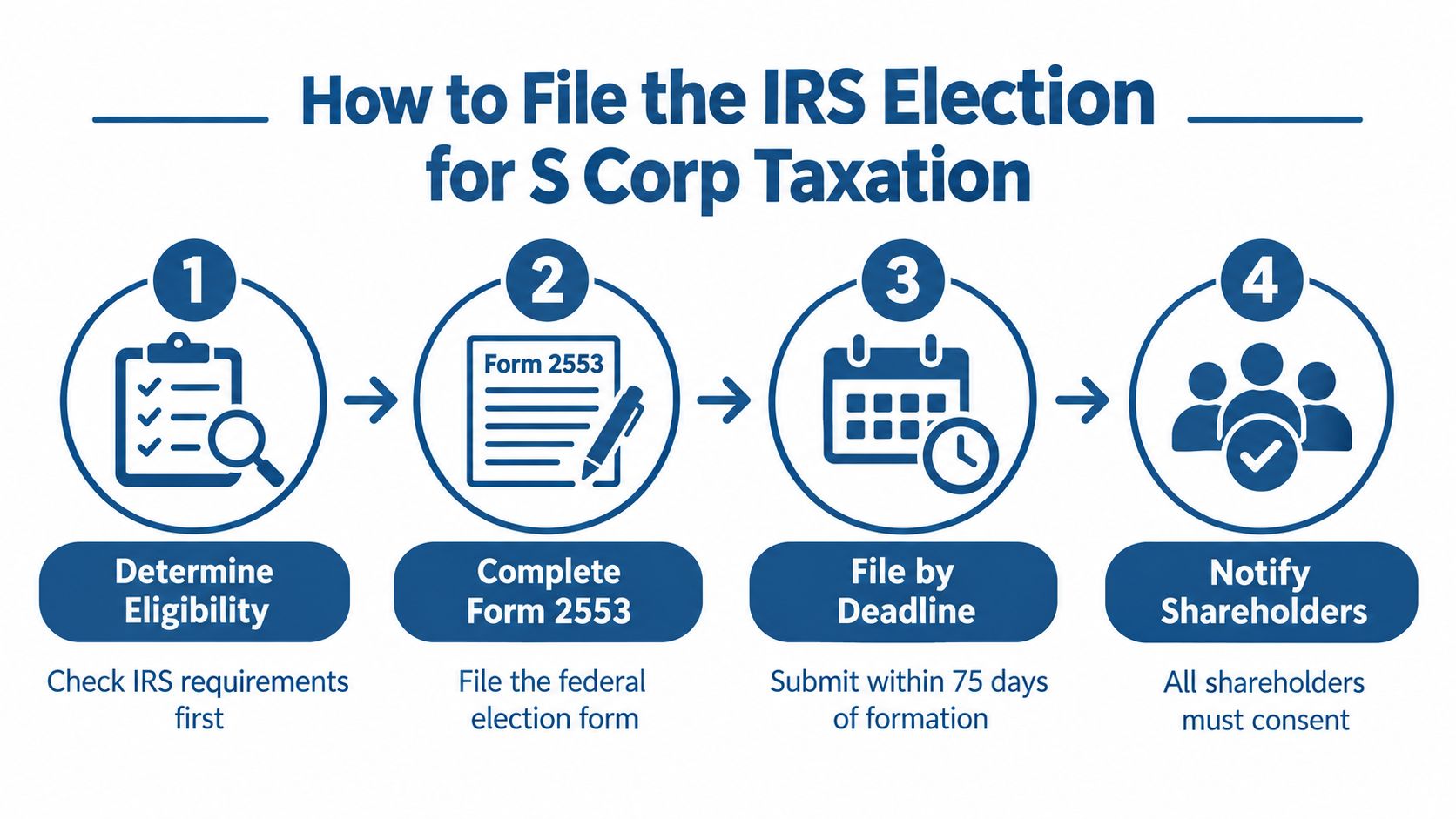
An eligible LLC generally files Form 2553 to elect S-corporation tax treatment. The election must generally be filed within 2 months and 15 days after the start of the tax year for which it will apply, or during the preceding tax year if the owner wants the election to begin with the following year, as explained in the IRS Form 2553 instructions.
Form 8832 serves a different purpose. The IRS says an LLC needs Form 8832 when it first needs to elect corporate classification. A qualifying LLC that timely files Form 2553 can generally have the corporate classification and S election handled through that filing.
A workable federal filing sequence
Use a controlled process rather than completing the form in isolation:
- Confirm eligibility. Review domestic status, shareholder eligibility, the shareholder count, stock rights, and the intended effective date.
- Collect unanimous consent. Make sure every shareholder signs and that the ownership information matches the entity's records.
- Complete Form 2553. State the requested effective date accurately and provide the entity and shareholder information the IRS requires.
- File within the applicable window. Retain proof of submission and the complete signed copy.
- Track IRS acknowledgment. The IRS should communicate whether the election was accepted and when it takes effect.
- Change the reporting rhythm. Prepare for Form 1120-S reporting and the payroll, bookkeeping, basis, and state work that follows.
The IRS explains the relationship between Form 2553, Form 8832, default classification, and the move to Form 1120-S in its entity election FAQ. Your filing should match the actual classification and the tax year you intend to change.
What happens when timing is missed
Consider an owner of a calendar-year business who realizes after the March 15 filing date that the election wasn't submitted. The owner can't just backdate payroll records and assume the election will be accepted. Late-election relief may require additional statements explaining the failure and demonstrating consistent treatment for the affected period.
That creates avoidable risk. If the business has already taken distributions, paid no shareholder wages, or reported income under its prior classification, correcting the record becomes more complicated. A tax professional should review the facts before the owner submits a late election or changes previously filed reporting.
For help with the federal filing process, review Blue Sage's S-corporation election service before choosing an effective date. The filing date, payroll launch, bookkeeping transition, and state review should be planned as one timeline.
Navigating New York and Multi-State Filing Requirements
A federal Form 2553 filing doesn't automatically resolve every state question. New York, New Jersey, and other jurisdictions may apply their own recognition rules, elections, filings, or entity-conversion procedures, so a business operating in more than one state needs a state-by-state review.
The central distinction is between changing the legal entity and changing federal tax treatment. Some LLCs retain their legal identity and make only the federal tax election. Other businesses may need state conversion filings or additional corporate documentation before a state recognizes the intended treatment.
Federal simplicity versus state procedure
The IRS allows a qualifying LLC to use Form 2553 for S-corporation tax status, with Form 8832 used only when a separate corporate-classification election is needed. That federal rule doesn't tell you how New York or New Jersey will process the entity for state purposes.
Wolters Kluwer's discussion of converting an LLC to an S corporation highlights the confusion created when legal conversion and tax election are treated as identical. They aren't identical. A business may need to preserve its LLC registration while separately addressing state tax recognition, or it may need a formal state filing depending on its facts.
A multi-state example
A restaurant owner with locations or taxable activity in both New York and New Jersey shouldn't assume that one federal acceptance notice closes the file. The owner may need to verify how each state treats the S election, how income is apportioned, where payroll registrations apply, and whether the business must file separate state returns or elections.
New York City can add another layer because local tax obligations may not follow the same treatment as federal or New York State reporting. The answer depends on the entity, activity, employees, and filing profile. Don't use a generic national checklist for a Queens business that operates across the Hudson River.
Practical rule: Treat federal acceptance as the starting point for the state review, not the finish line.
What Payroll and Reasonable Compensation Changes After the Election
The largest operational change is usually payroll. An owner who previously transferred cash from the LLC account as draws must generally separate compensation for services from shareholder distributions after S-corporation treatment begins, and the compensation must be reasonable for the work performed.
A construction contractor may spend the year estimating jobs, supervising crews, purchasing materials, and managing customers. Once the election takes effect, the business should establish a payroll process that reflects those services instead of waiting until tax-return preparation to decide how much the owner was paid.

Why timing matters
Payroll should line up with the effective date of the election. Switching systems halfway through a tax year can leave gaps in wage records, employment-tax deposits, payroll returns, and owner compensation documentation. Waiting until Form 1120-S preparation may force the accountant to reconstruct events that should have been recorded as they occurred.
Reasonable compensation isn't a universal preset. The analysis should consider the owner's duties, time, experience, industry role, business performance, and the work performed by other employees or contractors. The result should be documented, reviewed, and updated when the owner's role changes.
Read Blue Sage's explanation of what reasonable compensation means before setting the payroll amount. The goal is not to choose an arbitrary wage. It's to create a supportable relationship between services, wages, and distributions.
Two common transition problems
A restaurant owner may continue taking weekly withdrawals while postponing payroll setup. A contractor may run payroll but pay a token wage that doesn't reflect the substantial services performed. Both approaches create documentation and classification risk.
The owner should establish:
- Payroll registration: Confirm federal and applicable state employer accounts before the first payroll.
- Payroll calendar: Set regular pay dates, withholding procedures, and deposit controls.
- Wage support: Keep records supporting the compensation decision and the owner's duties.
- Distribution records: Track distributions separately from payroll and shareholder basis records.
- Year-end reporting: Prepare for wage forms, shareholder reporting, and Form 1120-S filing.
The IRS has identified payroll and compensation timing as a recurring risk area for owners changing status during a tax year. An invalid election, or compensation practices that don't match the effective date, can leave the business taxed under a different classification than the owner expected. That can undo the intended planning and create corrective work.
The operational difference is easier to see in a short video before changing your payroll workflow:
What Should Owners Do After the IRS Acknowledges the Election
After acceptance, the business should move into a recurring compliance rhythm. That means maintaining separate wage and distribution records, preparing for Form 1120-S reporting, monitoring shareholder basis, and reviewing federal and state filing obligations throughout the year.
The election isn't set-and-forget. The first post-election period is when bookkeeping, payroll, estimated taxes, and state registrations must all begin reflecting the new treatment.
The first operating checklist
- Confirm the effective date: Match the IRS acknowledgment to the tax year and the books.
- Complete payroll setup: Verify employer registrations, withholding, deposits, payroll returns, and wage reporting.
- Change bookkeeping: Separate wages, distributions, shareholder loans, reimbursements, and business expenses.
- Plan estimated taxes: Recalculate owner payment needs using current business results and other personal income.
- Prepare for Form 1120-S: Maintain records needed for the S-corporation return and shareholder reporting.
- Review state filings: Confirm New York, New Jersey, New York City, and other applicable requirements.
- Document basis: Track contributions, income, distributions, and other items affecting shareholder basis.
A contractor with expanding operations may also need monthly bookkeeping and periodic projections to prevent payroll and distributions from drifting apart. A restaurant filing in multiple states may need coordinated state income, payroll, sales tax, and apportionment reviews. Those are ongoing accounting tasks, not one-time election paperwork.
Blue Sage Tax & Accounting Inc. handles S-corporation compliance, payroll coordination, bookkeeping, reasonable compensation analysis, and multi-state filing reviews for owners who need the federal election connected to day-to-day records.
Book your free consultation call today with Blue Sage Tax & Accounting Inc. to review your LLC's eligibility, election timing, payroll setup, and New York or New Jersey filing exposure. Schedule the conversation through the consultation calendar before changing your tax treatment or owner compensation.
This article is general information and not tax advice for your specific situation.