You're staring at a stack of receipts, a bank feed that doesn't quite make sense, and payroll that has to clear on time. Monthly bookkeeping services turn that mess into organized records every month, by categorizing transactions, reconciling accounts, tracking payroll and supporting documents, and producing reports you can use for tax filings and day-to-day decisions. For a contractor, restaurant owner, or S-corporation owner, the value isn't just "keeping the books," it's getting a recurring close that shows what happened, what's missing, and what needs attention now.
Table of Contents
- What Monthly Bookkeeping Services Actually Include
- The Core Steps in a Monthly Bookkeeping Workflow
- How Monthly Books Turn Into Cash-Flow Control
- When Monthly Is Not Enough or Is Too Much
- How Monthly Bookkeeping Services Are Priced
- How to Choose the Right Monthly Bookkeeping Provider
What Monthly Bookkeeping Services Actually Include
A contractor who's in the field all day or a restaurant owner juggling deposits, tips, and vendors usually doesn't need more paperwork, they need a system. Monthly bookkeeping services are that system, a recurring process that organizes transactions, reconciles accounts, and prepares records that support tax returns and management decisions.
What you're actually buying
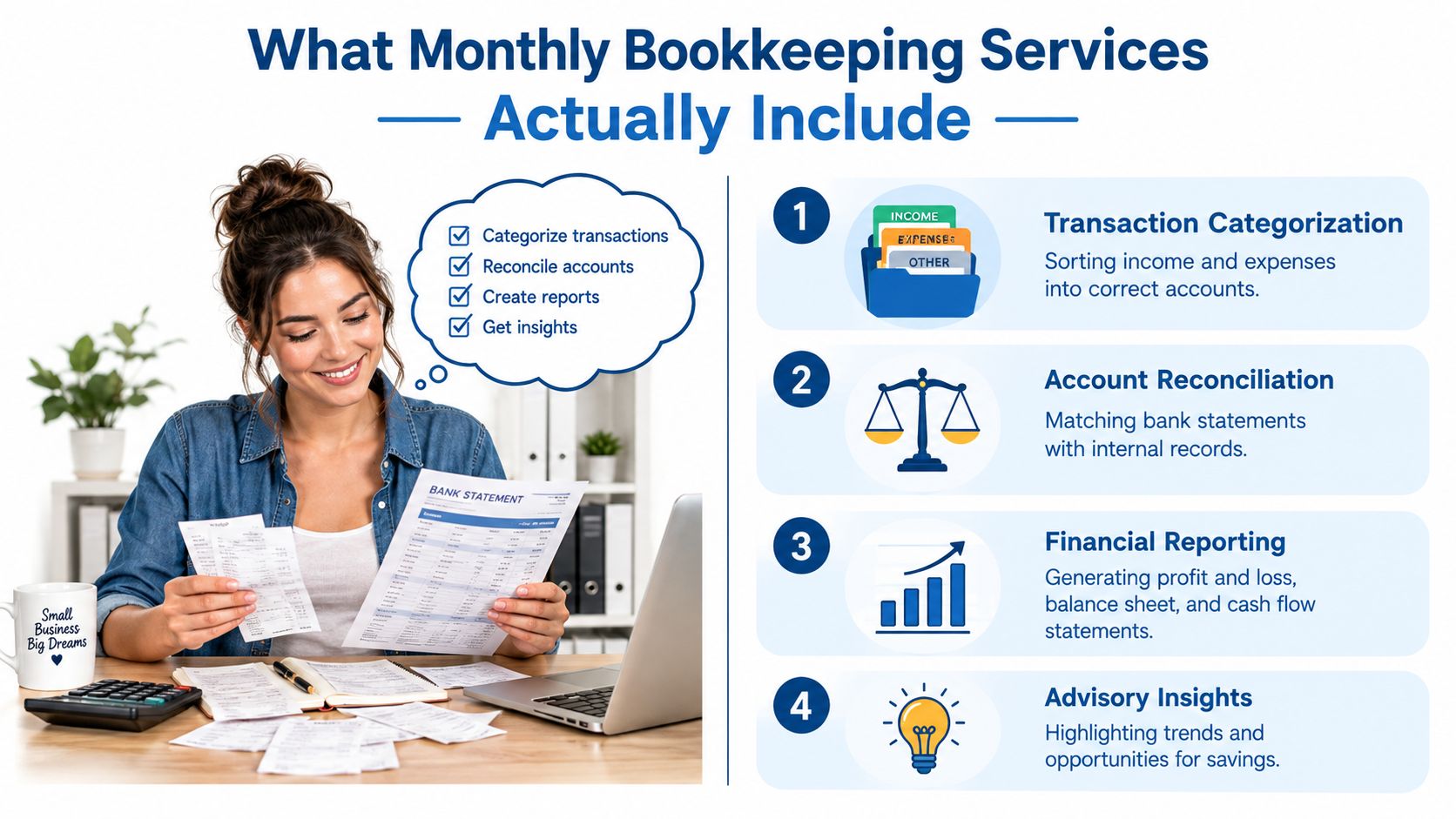
At a practical level, monthly bookkeeping generally covers several ongoing needs at once, including recording sales and expenses, organizing payroll and supporting documents, monitoring cash flow, and producing records that can later support tax filings (ledgerism.net). That's a different job from annual tax preparation, which looks backward once a year, and it's also different from a one-time cleanup, which only fixes the past.
A monthly close creates a rhythm. It takes the pile of receipts, deposits, payroll reports, bills, and card charges that build up during the month and turns them into a readable financial picture before the next cycle starts. The IRS expects business records to show gross income, deductions, and credits, so monthly bookkeeping is really about building that record step by step, not hoping you can reconstruct it later (IRS recordkeeping).
Practical rule: if a bookkeeper can't tell you what's included in the monthly close, they're probably selling data entry, not bookkeeping.
Monthly vs annual bookkeeping scope
| Scope | Monthly Service | Annual Only |
|---|---|---|
| Transaction entry | Ongoing categorization during the month | Recreated later from old records |
| Reconciliations | Bank, credit-card, and other key accounts each month | Often delayed until tax time |
| Payroll support | Payroll entries and supporting records tracked as they happen | Gathered after the year ends |
| Cash visibility | Regular review of inflows, outflows, and exceptions | Limited to a year-end snapshot |
| Tax support | Organized records ready for filings | Cleanup needed before filing |
If you want a deeper look at why month-end discipline matters, deterministic close workflows with audit trails is a useful reference for the mechanics of a clean close.
The Core Steps in a Monthly Bookkeeping Workflow
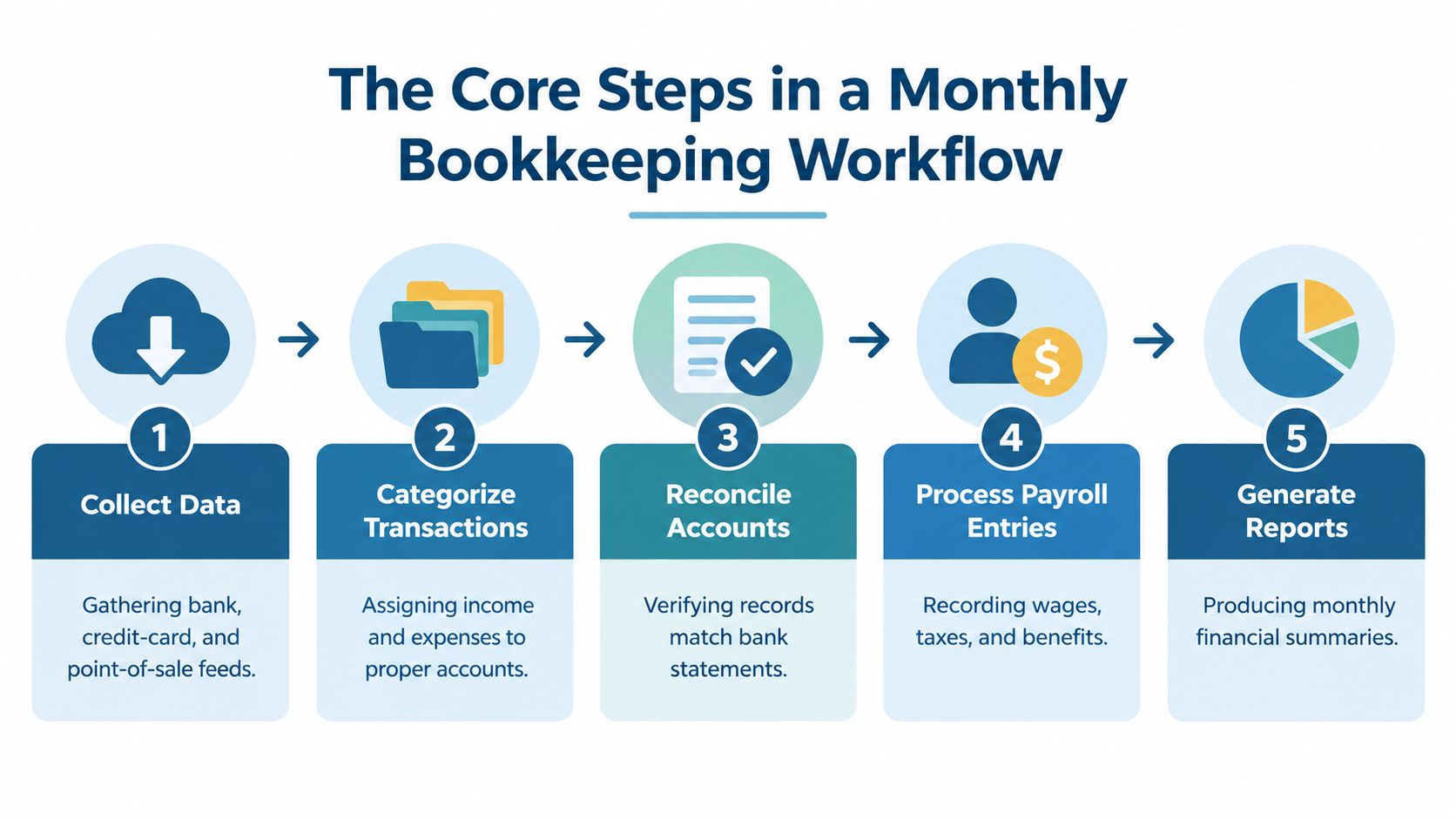
A construction company may finish a job, a restaurant may close a busy service, or an S-corporation owner may transfer money from the business account. Monthly bookkeeping turns those separate events into a controlled record. Each close follows a repeatable sequence: gather evidence, classify activity, reconcile balances, review payroll and owner transactions, then issue reports.
Source documents come first
The bookkeeper collects bank feeds, credit-card activity, point-of-sale reports, invoices, bills, payroll records, and receipts. IRS guidance says business records should clearly show gross income, deductions, and credits. Expense support should identify the payee, amount, payment evidence, date incurred, and business purpose (IRS records to keep).
Classification follows. A payroll payment is different from an owner draw, and an equipment purchase is different from an ordinary vendor bill, even when each leaves the same checking account. Electronic bookkeeping is allowed, provided records remain complete, accurate, and accessible. Cloud software works only when its audit trail preserves the underlying support.
A clean ledger without receipts is still a weak ledger.
Reconciliation tests the record
After transactions are categorized, the bookkeeper compares the ledger with bank and credit-card statements. This process identifies missing entries, duplicates, timing differences, and unexplained gaps. A contractor may match deposits to invoices and job payments. A landlord may match rent receipts and deposits. The goal is to confirm that recorded activity agrees with actual money movement.
For businesses operating in New York and New Jersey, the review can also separate sales by location and help identify which state rules apply. New Jersey sales-tax treatment may depend on where delivery occurs or where a service is performed. New York requires detailed records supporting taxable and total sales at the transaction level (New Jersey recordkeeping guide, New York sales-tax recordkeeping). A monthly package should include bank account reconciliation rather than treating it as an optional add-on.
Property owners also need records that connect rent, repairs, deposits, and property activity. Practical landlord tax guidance can provide related context when rental transactions form part of the books.
Payroll and owner activity require separate treatment
Payroll is more than one expense line on a profit-and-loss report. IRS employment-tax guidance covers employee information, withholding forms, tax-deposit dates, filed returns, confirmation numbers, and supporting schedules (IRS employment-tax recordkeeping).
A monthly bookkeeper therefore compares payroll reports with the general ledger and keeps owner distributions separate from wages and business expenses. For an S-corporation, that separation helps the records reflect different types of owner activity before tax preparation begins.
The close should produce current financial reports, an exceptions list, and an organized document archive. Those outputs give the owner something specific to review, question, and act on each month.
How Monthly Books Turn Into Cash-Flow Control
A construction company can show a profit on its income statement and still struggle to cover Friday's payroll. Cash flow measures both the amount and timing of money entering and leaving the business, while profit records revenue and expenses for the accounting period (SBA cash-flow guidance).
Why the monthly close changes decisions
Monthly bookkeeping turns individual transactions into a usable control process. The close shows what the business earned, what customers paid, which invoices remain outstanding, and which commitments are approaching. Those commitments can include supplier bills, payroll, loan payments, and tax deposits.
A contractor might record $400,000 in revenue while waiting weeks for customers to pay. The company may look profitable, yet its bank account can be too low for the next payroll. Restaurants face a related timing problem when food purchases and wages must be paid before all daily sales reach the bank. Employer firms commonly identify costs of goods, services, wages, operating expenses, and uneven cash flow as financial challenges. A monthly review brings those pressures into view before the owner makes another spending or hiring decision.
The process also supports recordkeeping. Clear monthly reports create an organized trail for tax work and help an owner explain how business activity led to the reported results.
What owners should look at each month
The owner should receive more than a finished profit-and-loss statement. A useful close answers four practical questions:
- Who owes the business money? Review aging receivables and identify invoices that need follow-up.
- Why does profit differ from cash? Compare bank balances with unpaid customer invoices and upcoming payments.
- What must be paid soon? List payroll, supplier bills, loan payments, and tax deposits.
- What changed? Review variances from the prior month or budget and investigate unusual costs.
For an S-corporation owner, the review can also confirm that wages, distributions, and business expenses remain separated in the records.
Blue Sage Tax & Accounting Inc. describes this decision layer in its guide to cash flow management for small business.
Decision rule: a monthly close should help you bill, spend, or plan with better information.
When Monthly Is Not Enough or Is Too Much
Monthly is a useful cadence for many owner-operated businesses, but it isn't the right pace for every situation. The right rhythm depends on transaction volume, payroll timing, seasonality, customer payment terms, and whether you operate in one state or several.
When you need faster review
A seasonal restaurant, a construction firm with tight payroll timing, or a transportation business with fuel-heavy expenses may need weekly cash reviews or mid-month reconciliations. A monthly close can tell you what happened, but it may not warn you early enough if cash is about to tighten before the next payroll or sales-tax deadline.
That's also where rolling 30/60/90-day cash forecasts become more useful than a simple month-end package. If your receivables are uneven, your vendor terms are short, or your state filing obligations differ by location, a faster review cycle can surface the problem while there's still time to act. The Yahoo Finance coverage of a recent small-business survey noted that 78% of 1,031 U.S. small and medium-sized businesses experienced at least one unexpected cash-flow issue in the prior year, while only half regularly reviewed financial statements (Yahoo Finance survey coverage).

When a lighter cadence may be enough
A solo consultant with few transactions, stable customers, and no payroll may be fine with a clean monthly close and periodic tax planning. In that kind of business, quarterly review can be enough for some tasks, as long as records are still kept continuously and source documents are preserved.
The difference is usefulness. A monthly close can be accurate and still be too slow for a business with inventory, employees, or multiple tax jurisdictions. That's why the right cadence is a function of business activity, not a generic package name.
If you're trying to decide whether you need monthly or something more frequent, the practical question is simple. Will the report arrive soon enough to change what you do next month?
How Monthly Bookkeeping Services Are Priced
Pricing usually follows scope, not just the word “bookkeeping.” Two quotes can both say monthly bookkeeping and still cover very different work, so the comparison has to start with what's included.
The common pricing models
The most common arrangement is a monthly fixed fee, where the provider agrees to a defined scope of reconciliations, categorization, and reporting. That model works well when the business has stable volume and the owner wants predictable billing.
Other providers price by transaction volume, hourly catch-up work, or a broader accounting-plus-tax bundle. A bundled package might include payroll support, sales-tax filings, or year-end tax preparation, while a narrower bookkeeping package might stop at reconciliations and monthly reports. Because scope differs so much, the right comparison is usually not “cheapest,” it's “what did I buy?”
What changes the quote
A provider will usually look at:
- How many accounts need reconciliation.
- How many transactions hit those accounts each month.
- Whether payroll, sales tax, or multi-state filings are part of the job.
- Whether the books are current or need cleanup.
For a restaurant with payroll, tips, and multiple payment sources, the work is naturally different from a consultant with one checking account and a few monthly invoices. For an S-corporation with owner distributions, payroll entries, and multiple vendors, the monthly close also needs more judgment around classification and support. Blue Sage Tax & Accounting Inc. offers monthly bookkeeping and accounting, along with payroll, sales tax, and multi-state filing support, so it's one option if you want bookkeeping tied to tax review instead of a disconnected data entry service.
How to Choose the Right Monthly Bookkeeping Provider
A construction owner may need job-cost details, while a restaurant must track payroll, tips, and several payment systems. An S-corporation owner needs clean records for payroll, distributions, and vendor payments. Choose a provider who understands the decisions behind those entries, not only the software used to record them.
Start by asking who reviews the work, how exceptions are handled, and what you receive each month. Ask how the team catches duplicate entries, failed bank connections, and misclassified transactions. Cloud software helps collect information, but it does not replace review. The IRS still expects complete, accurate records and an audit trail that can be retrieved when needed (IRS publication on recordkeeping).
Request a sample monthly close package. It should identify reconciliations completed, financial statements delivered, and unresolved items requiring your attention. If the provider cannot explain what you will review or who answers questions, keep looking. Businesses operating in New York or New Jersey should also ask about local sales-tax and recordkeeping requirements.
Broader payroll support is a separate decision. PEO options from Benely can help you compare payroll-adjacent services, but the bookkeeping still needs independent review. Blue Sage Tax & Accounting Inc. offers monthly bookkeeping, accounting, payroll, sales-tax, and tax support.
This article provides general information, not tax advice for your situation.