Your bank balance may look right while your books are wrong. Bank account reconciliation compares the bank statement with your accounting records, then investigates whether each transaction is complete, recorded in the correct period, and classified to the right account. A proper reconciliation confirms the cash available for payroll, vendors, taxes, and owner decisions, but it also exposes owner draws coded as expenses, missing deposits, duplicate payments, and payroll or sales-tax items that can distort year-end reporting.
Table of Contents
- What Bank Account Reconciliation Really Does
- How to Prepare for a Clean Reconciliation
- Step-by-Step Reconciliation Procedure
- Common Discrepancies and How to Resolve Them
- Internal Controls That Make Reconciliation a Real Safeguard
- Checklist, Retention, and When to Bring in Your Accountant
What Bank Account Reconciliation Really Does
Bank account reconciliation is the recurring process of comparing recorded checking-account transactions and balances with the bank statement. The U.S. Government Accountability Office describes it as an internal control intended to maintain record accuracy and avoid costly mistakes (GAO guidance).
The first job is straightforward: establish the cash balance you can rely on. The second job is more consequential for an owner-operated business: confirm that transactions belong to the right account, period, entity, and category. A bank feed may match a withdrawal perfectly while the bookkeeping still records a personal purchase as a business expense, an owner draw as repairs, or loan principal as interest.
Practical rule: A zero unreconciled difference proves that cash activity agrees. It doesn't prove that taxable income, payroll liabilities, or expense classifications are correct.
That distinction matters for an S-corporation owner reviewing reasonable compensation, a contractor projecting quarterly taxes, or a landlord separating repairs from debt payments. A reconciled bank account with misclassified transactions can still produce unreliable profit and tax projections. Owners using Shopify or another payment platform may also benefit from a focused resource on financial reconciliation for Shopify owners, particularly where processor settlements and bank deposits occur on different dates.
Who should prepare and review it
The person preparing the reconciliation should have access to the statement and ledger, but shouldn't be the only person who initiates payments, handles deposits, or posts every cash entry. In a small business, one person may need to perform the preparation, but an owner, controller, or outside accountant should review unusual items and sign off.
Reconciliation should be a recurring control, not an annual cleanup. Monthly work is the minimum practical rhythm for most operating accounts. High-volume accounts need more frequent exception review because waiting until month-end makes it harder to identify an unfamiliar payee, missing processor settlement, or altered check.
How to Prepare for a Clean Reconciliation
Pull the complete bank statement first, then assemble the accounting ledger and supporting transaction detail for the same dates. The Washington State Auditor requires monthly documentation and directs organizations to compare bank receipts, deposits, and ending balances with accounting-record revenues, expenditures, and balances (Washington State Auditor guidance).
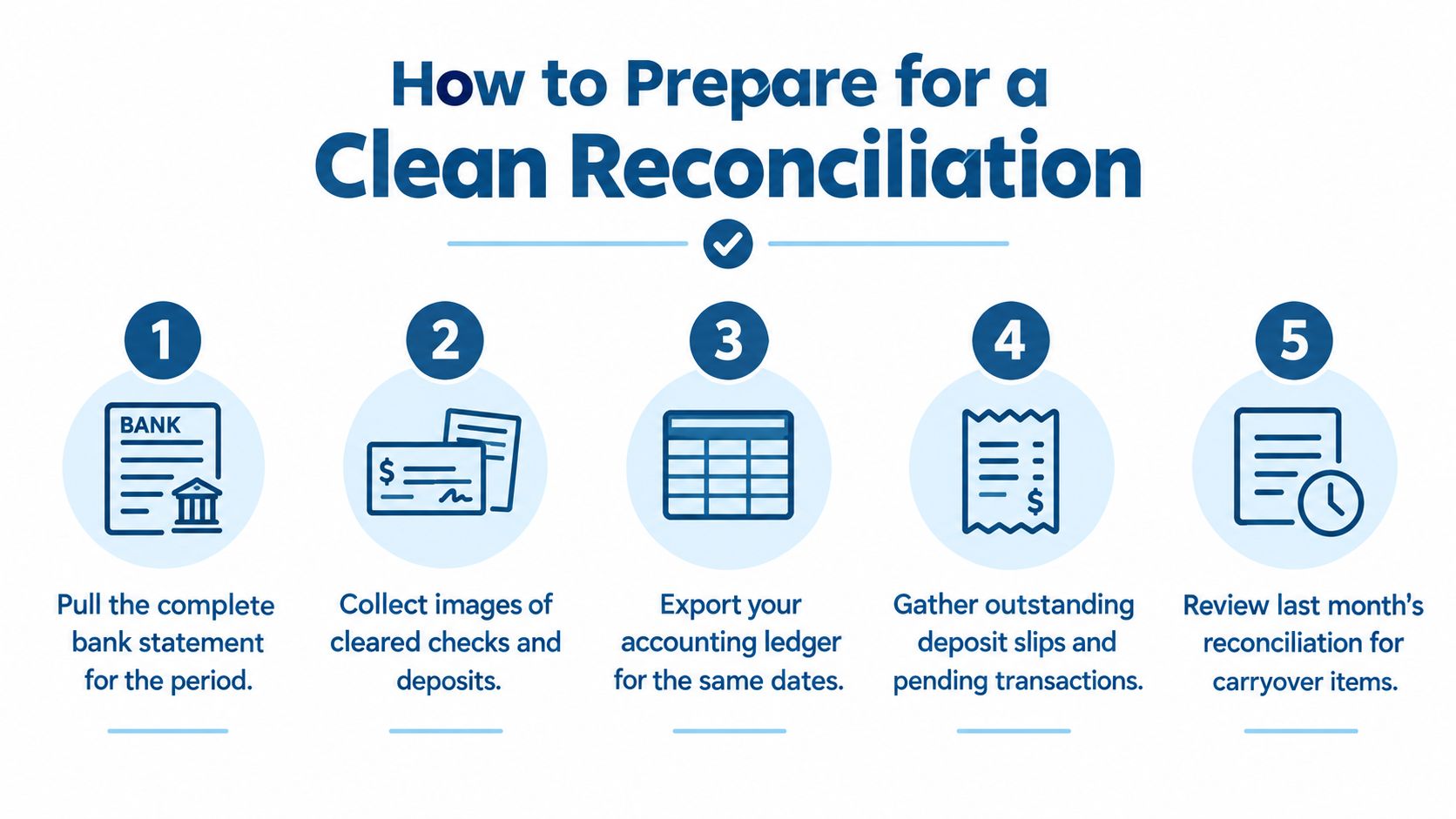
Before matching transactions, collect:
- Complete statement: Include the beginning and ending balances, cleared checks, deposits, electronic withdrawals, transfers, fees, and interest.
- Check and deposit images: A check image can reveal a changed payee or amount. Deposit detail helps distinguish a missing receipt from a bank processing delay.
- General ledger export: Use the cash account for the exact statement period, not a broader date range that obscures cutoff.
- Processor reports: Pull Stripe, Square, Toast, ACH, payroll, and other settlement detail when deposits reach the bank later than the underlying customer transaction.
- Prior reconciliation: Carry forward unresolved checks, deposits, and adjustments. An old item shouldn't disappear because a new month opened.
Set a documented close deadline and keep the statement period consistent. A restaurant may record Toast sales daily while the settlement reaches the bank later. A contractor may record a customer check when deposited, while the bank processes it after the statement closes. Those differences need documentation, not forced journal entries.
If you're still cleaning up receipts and vendor charges, use a separate process for tracking business expenses so the reconciliation isn't overloaded with missing documentation.
For a single-employee shop, separation of duties may be difficult. The workable alternative is an independent reviewer who examines the completed reconciliation, unusual transfers, old outstanding checks, and unsupported adjustments without handling cash or preparing the ledger.
Step-by-Step Reconciliation Procedure
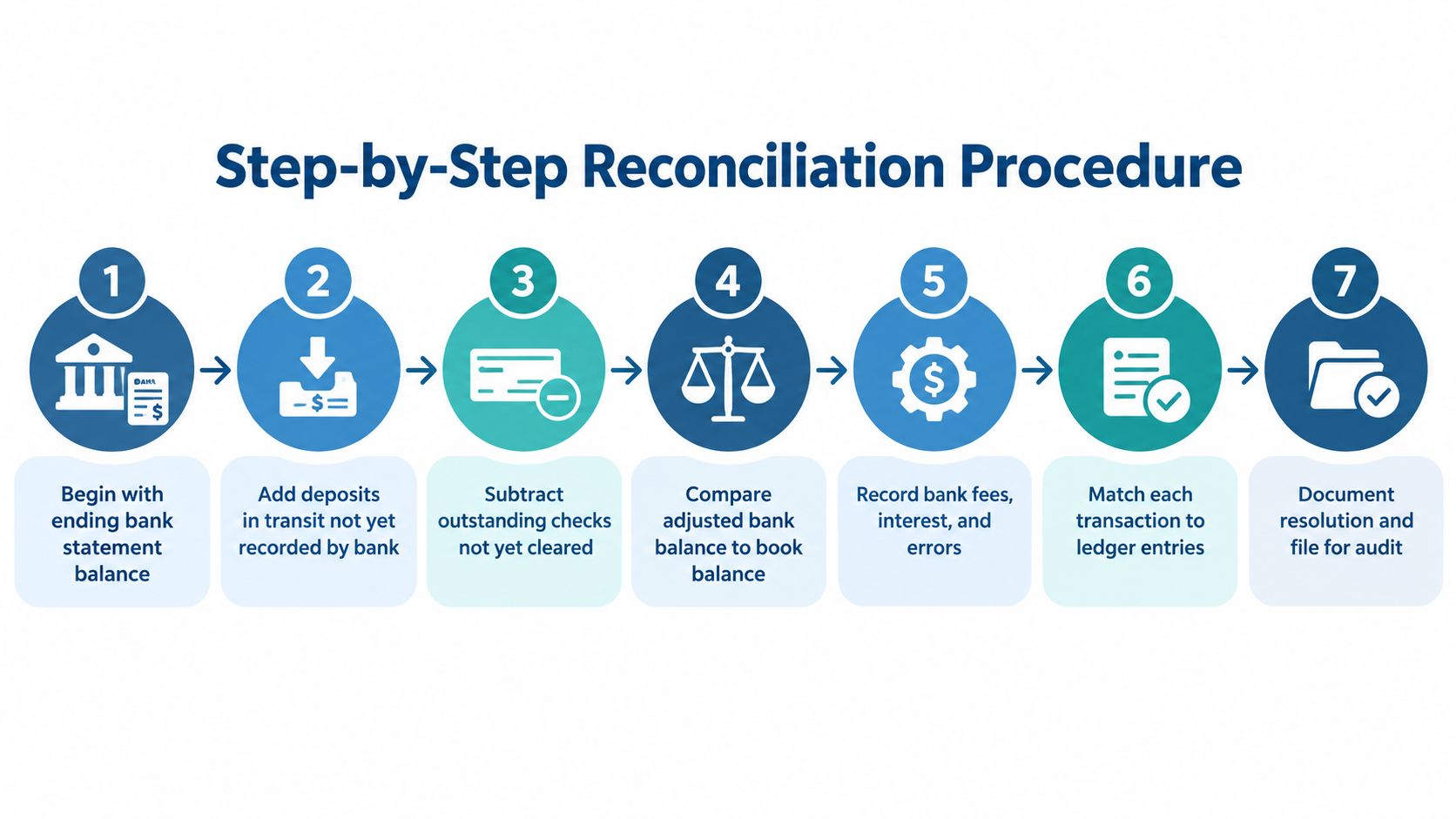
Start with the complete statement and the cash ledger for identical dates. The IRS describes the procedure as comparing deposits, checking every canceled check by number and amount, treating recorded checks that haven't cleared as outstanding, and updating the checkbook or journals for items such as bank charges and recording errors (IRS Publication 583).
Follow the cash from statement to ledger
-
Obtain the full statement. Download cleared check images, deposit detail, and electronic transaction descriptions. A construction company shouldn't reconcile only the visible bank-feed summary when the underlying check image is available.
-
Export the ledger activity. Pull every receipt, payment, transfer, and adjustment posted to the cash account for the statement period. Preserve the export used, rather than replacing it after edits.
-
Compare the major balances and flows. Match the ending balance, deposits, withdrawals, transfers, fees, and interest. For an e-commerce operator, compare gross processor activity with net settlement deposits and separately identify reserves, refunds, and fees.
-
Classify each difference. A check written in March that clears in April is a timing item. A payment recorded twice, omitted from the ledger, or posted to the wrong amount is an accounting issue. Don't treat both as the same type of exception.
-
Post supported adjustments. Record bank fees, interest, returned payments, and unrecorded electronic withdrawals in the books when the statement supports them. A monthly service fee of $35 is a bookkeeping adjustment only when the statement confirms that amount. It isn't a reason to plug the reconciliation.
-
Investigate every unexplained variance. Trace the item to the source document, bank detail, processor report, payroll register, or vendor record. If the bank posted a transaction incorrectly, contact the bank and retain the correspondence instead of changing the ledger to conceal the bank error.
-
Retain the completed file. Save the reconciliation, statement, transaction detail, adjustment support, exception explanations, and reviewer sign-off. A clear file should let another person reproduce the ending balance without relying on the preparer's memory.
The adjusted bank balance should equal the adjusted book balance. For additional workflow ideas, bank reconciliation tips for Jacksonville businesses can help owners compare their process with another practical bookkeeping framework.
Common Discrepancies and How to Resolve Them
An automated match isn't the same as a clean reconciliation. Matching proves that the amount and transaction may correspond, but the second review must ask whether the item was posted to the correct account, entity, tax year, and owner or business category.
Timing items are explanations, not corrections
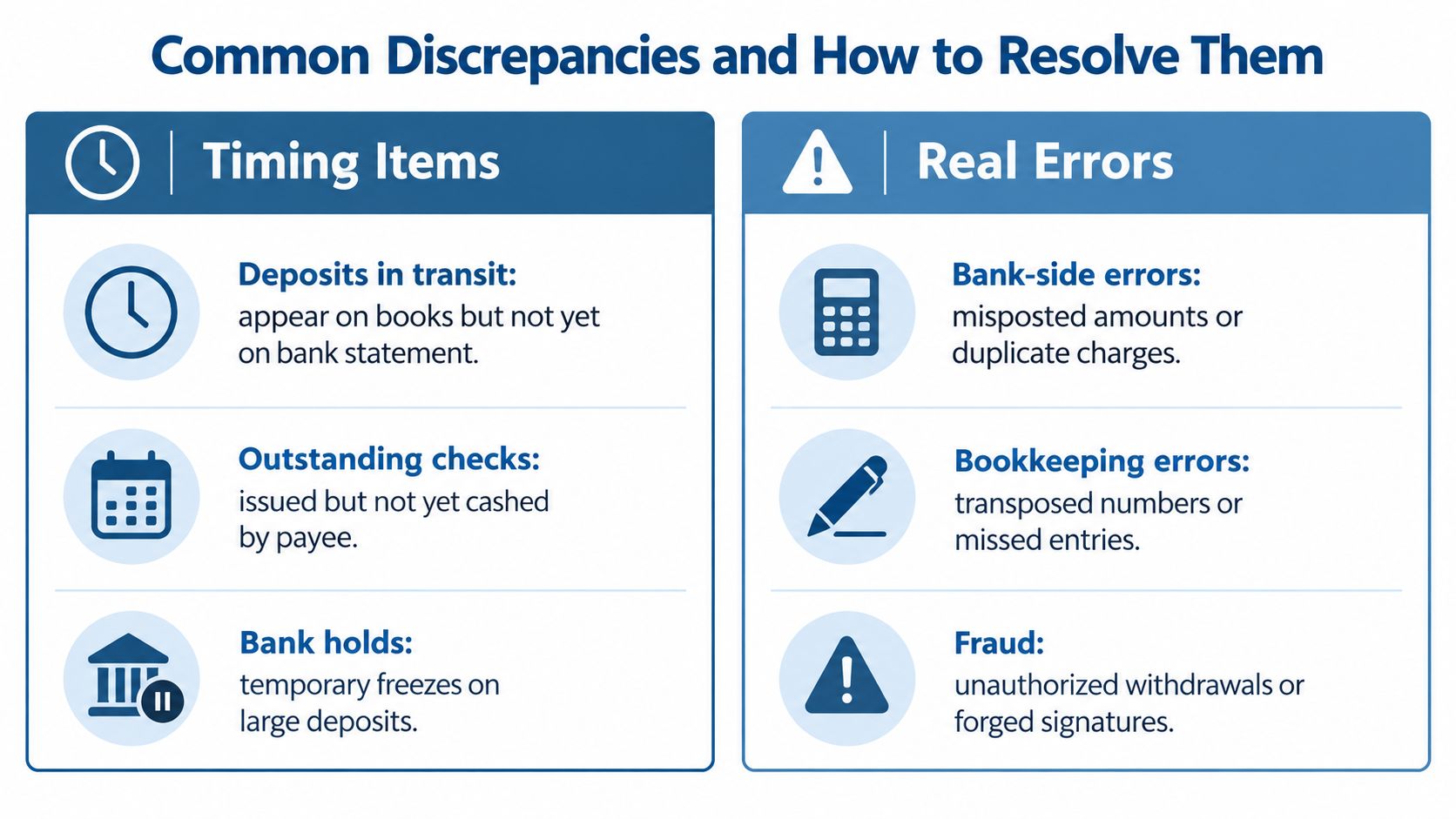
A deposit in transit is cash recorded in the general ledger that the bank hasn't processed by the reconciliation date. An outstanding check has been written and recorded but hasn't been paid or cleared by the bank (AccountingCoach explanation).
Add deposits in transit to the bank balance and deduct outstanding checks when preparing the reconciliation. Usually, no new ledger entry is needed because the business already recorded those transactions. If a check remains outstanding through later periods, contact the payee, review whether it was lost or stale, and consider the appropriate bank and bookkeeping response.
Real errors require investigation
Bank fees, interest, returned payments, and electronic withdrawals often appear on the statement before the bookkeeper records them. Post the supported entry to the appropriate account. A returned customer payment shouldn't remain as revenue and cash just because the original deposit matched the sales record.
Transfers require special care. A transfer between operating and payroll accounts may appear as a withdrawal in one account and a deposit in the other. If only one side is recorded, both reconciliations can look wrong. If both sides are recorded to expense accounts, the balances may reconcile while profit is understated.
Owner activity creates a different risk. A personal purchase from a business account may match the bank feed but belongs in an owner draw or distribution, not a business expense. Loan principal, payroll-tax withdrawals, credit-card payments, and sales-tax remittances can also reconcile while distorting liabilities and profit.
Escalate unfamiliar payees, duplicate withdrawals, altered check images, unexpected ACH debits, missing deposits, and amounts that cannot be reproduced from source documents. Check fraud remains a major vulnerability, cited by 63% of survey respondents in recent fraud-control reporting (payments fraud-control survey highlights). If customer disputes or card-payment reversals are affecting deposits, a separate process to fight chargebacks may belong alongside the accounting investigation.
Internal Controls That Make Reconciliation a Real Safeguard
A prepared reconciliation only becomes a safeguard when someone independent reviews it and unresolved items receive follow-up. The preparer shouldn't approve their own work, control cash receipts, initiate vendor payments, and post every adjustment without oversight.

Match the cadence to account risk
A low-volume, stable account may need a formal monthly reconciliation. An operating account with daily card settlements, payroll, cash deposits, multiple processors, or high-value vendor payments needs daily or weekly exception review in addition to the formal month-end close.
A practical cadence looks like this:
- Daily: Review bank-feed alerts, unfamiliar payees, duplicate withdrawals, unexpected ACH activity, payroll debits, and negative balances on active accounts.
- Weekly: Review processor deposits, outstanding checks, missing receipts, and transfers between accounts.
- Month-end: Reconcile each bank account to the complete statement, then tie related credit cards, loan balances, payroll liabilities, and inter-account transfers to the ledger.
The formal reconciliation should be completed at least monthly. The frequency of monitoring should increase when transaction volume, fraud exposure, or cash-flow pressure increases.
Build a review trail
Require evidence for every adjustment, approval for unusual transfers and vendor-bank changes, and reviewer sign-off showing what was examined. Age outstanding items and investigate those that remain unresolved instead of carrying them forward without explanation.
The ACFE 2026 study summary covered 2,402 occupational-fraud cases across 143 countries, reported estimated organizational losses of 5% of annual revenue, and identified account reconciliation as the detection method in 77 cases with a median loss of $163,000 (fraud-control summary). Those figures concern occupational fraud broadly, not every bank reconciliation, but they illustrate why review quality matters.
For broader process guidance, best accounting practices for small businesses should include documented reconciliations, clear ownership, and timely exception resolution. Clean monthly cash records also give tax projections a dependable base. Unclassified bank activity found in the first month is easier to resolve than the same activity discovered during year-end preparation.
Checklist, Retention, and When to Bring in Your Accountant
Retain the statement, ledger export, check and deposit detail, reconciliation, adjustment support, exception explanations, and reviewer sign-off in an organized file. Keep records according to the applicable federal, state, lender, and dispute requirements, and retain longer where a state audit, loan covenant, or forensic issue could require older support.
Bring in an accounting professional for suspected fraud, payroll-tax mismatches, multi-entity allocations, unexplained variances, or reconciliations that cannot be reproduced from source documents. Blue Sage Tax & Accounting Inc. provides monthly bookkeeping that includes bank-account reconciliations and can rebuild prior periods from bank statements when catch-up work is needed.
This article is general information and not tax advice for your specific situation.
Blue Sage Tax & Accounting Inc. can help reconcile your bank accounts, investigate misclassified transactions, and connect clean monthly books to proactive tax projections. Visit Blue Sage Tax & Accounting Inc. and Book your free consultation call today.