IRS audit representation cost isn't a fixed government fee. As practical planning benchmarks, a correspondence audit response may cost $1,500 to $3,500, while a business or multi-year field audit may cost roughly $7,500 to $15,000 or more, depending on the work involved.
You're probably asking because an IRS notice has landed on your desk, and the notice itself doesn't tell you what professional help will cost. A single request for receipts is a different project from an examination of an S-corporation, its owner's return, payroll records, and several tax years. The invoice follows the work, not merely the label on the notice.
The useful questions are straightforward. Is the representative charging hourly, using a fixed fee, or combining both? Does the quote cover only the first IRS response, or also meetings, follow-up requests, Appeals, and collection work? How complete are your books, and how many entities, tax years, states, and disputed issues are involved?
Table of Contents
- What IRS Audit Representation Actually Costs
- How Professionals Bill for Audit Representation
- What Drives an Audit Representation Bill Up or Down
- Sample Price Ranges by Audit Type
- When Representation Pays for Itself and When It Does Not
- A Practical Checklist for Choosing and Working With a Representative
What IRS Audit Representation Actually Costs
IRS audit representation usually costs less for a focused correspondence examination and more for an office or field examination involving business records, multiple years, or disputed technical issues. The IRS doesn't set a standard representation fee, so your price depends on the audit type, scope, records, fee model, and whether the matter reaches Appeals.
The $1,500 to $3,500 correspondence benchmark and roughly $7,500 to $15,000 or more field-audit benchmark are planning figures, not promises. A simple individual document request may fit near the lower end, while a business examination can rise when the representative must reconcile accounting records, payroll, distributions, or state filings.
A historical government comparison helps explain the difference in work intensity. A U.S. Government Accountability Office analysis of IRS examinations opened in 2007 and 2008 estimated the IRS's average administrative cost at $274 for a correspondence examination and $2,278 for a field examination, a difference of approximately 731%. Those figures measure the IRS's internal enforcement cost, not taxpayer invoices, but they show why examination format matters.
Before accepting a quote, ask for these items in writing:
- Initial scope: Which tax years, forms, entities, and issues are included?
- Deliverables: Will the representative prepare documents, communicate with the IRS, attend conferences, or all three?
- Expansion terms: What happens if the examiner raises a new issue?
- Appeals treatment: Is an appeal included, or priced as a separate phase?
- Billing details: What rate, retainer rules, billing increments, and communication limits apply?
Practical rule: Compare engagement scopes, not just totals. A lower quote can be more expensive if it covers only one letter and excludes the work that follows.
How Professionals Bill for Audit Representation
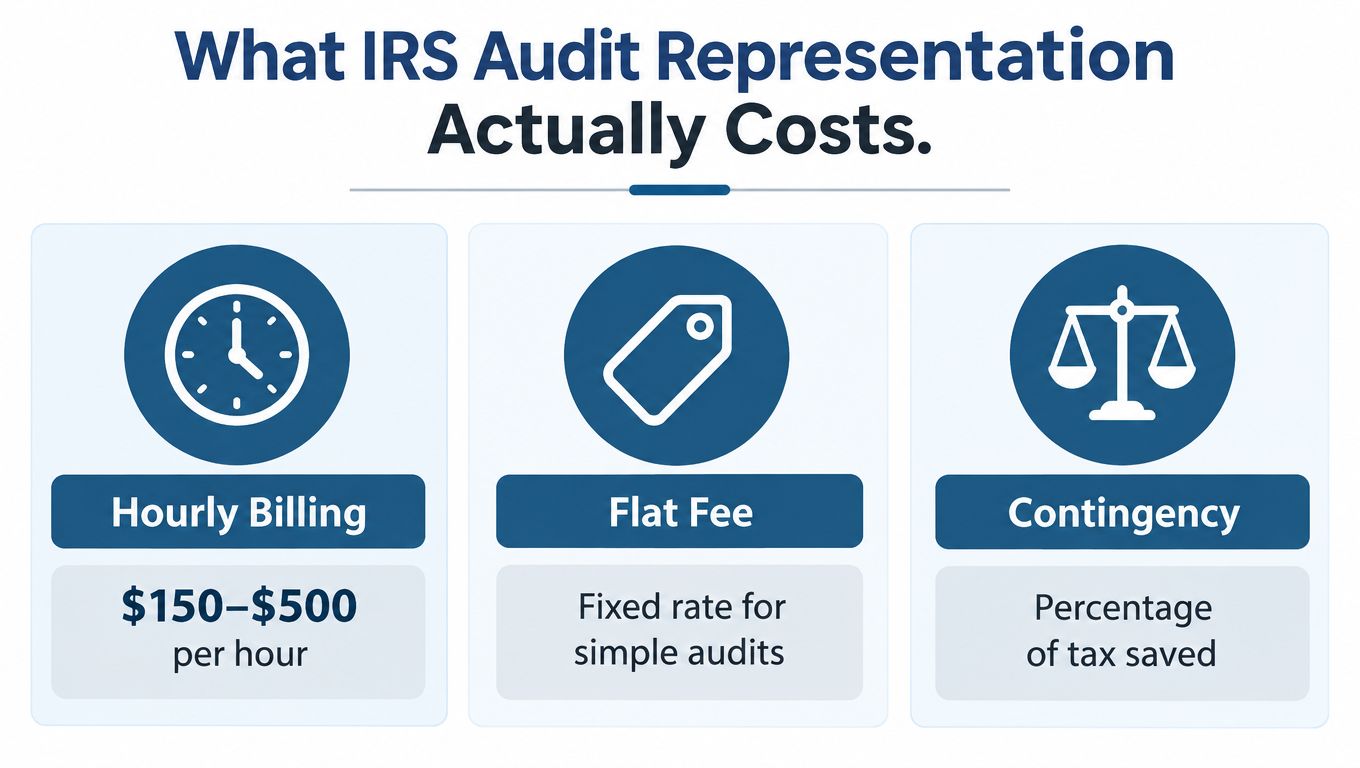
Most representatives use hourly billing, a fixed fee for a defined phase, or a hybrid. The right structure depends on whether the work is predictable, how complete your records are, and how likely the IRS is to expand the examination.
Hourly billing works well when the scope is uncertain. A sole proprietor with one correspondence notice may pay for document review, response preparation, and limited communication as the work occurs. An hourly engagement can be fair when nobody yet knows whether the IRS will ask for more records, but you should receive a written estimate and regular updates on remaining time.
A flat fee fits a clearly defined assignment. For example, the representative might agree to review a specific notice, analyze a stated issue, prepare one response, and communicate with the IRS through a defined stage. The advantage is predictability. The limitation is that additional years, new issues, meetings, or Appeals may fall outside the quoted work.
A hybrid arrangement combines a fixed initial phase with hourly billing for expansion. This is often sensible for an S-corporation examination. The first phase may cover intake, authorization, and the initial response. If the IRS requests payroll reconciliations, basis schedules, or another tax year, the engagement moves to separately billed work.
Form 2848 matters because it defines the authority being granted. According to IRS guidance on Form 2848, taxpayers may authorize representation through the Power of Attorney and Declaration of Representative, which identifies the specific tax matters, forms, and periods covered by the engagement.
Ask one direct question before signing: “What exact event causes the fee to change?”
Your engagement letter should address retainers, replenishment rules, billing increments, document handling, response times, examiner conferences, Appeals, penalty-abatement requests, and collection matters. Don't assume that “audit representation” includes every stage after the initial examination.
What Drives an Audit Representation Bill Up or Down
The dominant cost driver is the amount of work required. A notice can look narrow while the underlying records connect several returns, entities, payroll filings, or jurisdictions.
The records determine the workload
Consider a Brooklyn contractor reporting $400,000 in revenue who receives an IRS notice covering two years of payroll and shareholder distributions. That isn't just a letter-response project. The representative may need to compare the business books with payroll filings, trace distributions, review the owner's return, examine basis information, and explain whether compensation and expenses were reported consistently.
The number of tax years matters because each year creates another set of returns, schedules, supporting documents, and possible adjustments. An S-corporation review may also involve the shareholder's individual return. An LLC or partnership examination can require analysis of member allocations, Forms K-1, basis, distributions, and related transactions.
Incomplete records push fees higher because the professional must reconstruct information before responding. Missing bank statements, disorganized invoices, unreconciled accounts, amended returns, and high transaction volume all add review time. The same applies when the IRS asks about cash receipts, subcontractors, vehicle expenses, depreciation, or payroll.

Business and multi-state issues expand the file
A restaurant owner filing in New York and New Jersey may face overlapping federal and state records, sales tax questions, payroll filings, and income allocation issues. Those state matters aren't automatically included in a federal IRS engagement. Get confirmation about whether the quote covers federal work only, New York State, New York City, New Jersey, or the full multi-state file.
Foreign reporting, related-party transactions, large asset purchases, and several operating entities can create similar expansion. So can an IRS request that begins with one deduction and develops into questions about income classification or substantiation.
The IRS reports that its most complex individual, corporate, and partnership examinations are handled by revenue agents and average approximately 61 to 251 IRS hours per return, according to its audit update. That is the IRS's workload benchmark, not a prediction of your representative's bill, but it makes the central point clearly. Complexity can dominate cost.
Sample Price Ranges by Audit Type
Use $1,500 to $3,500 as a planning range for a focused correspondence response and roughly $7,500 to $15,000 or more for a business or multi-year field examination. Office audits sit between those descriptions, but the actual quote depends on records, entities, years, and disputed issues.
| Audit Type | Typical Scope | Indicative Fee Range |
|---|---|---|
| Correspondence | Narrow issue, organized records, response by mail | $1,500 to $3,500 |
| Office | In-person or scheduled examination with broader document review | Varies with scope, often above a simple correspondence response |
| Field | Business, multi-year, or extensive examination at a business or representative's office | Roughly $7,500 to $15,000 or more |
These ranges describe professional representation planning, not IRS charges, tax liabilities, penalties, or interest. A pass-through business return can exceed a correspondence benchmark when the representative must review both entity and owner records.
Appeals should be treated as a separate budget question. If you disagree with proposed adjustments, the representative may need to prepare a written protest, organize disputed items, develop legal and factual arguments, and attend an Appeals conference. Some engagement letters include that work. Many don't.
The IRS reported that it closed 497,621 audits in FY 2025 and recommended $26.8 billion in additional tax, an average of roughly $53,800 per closed audit when calculated across all examinations, according to IRS compliance-presence data. That average is an aggregate benchmark, not a forecast for your return. Audit outcomes vary widely by return type, income, documentation, and issue complexity.
When Representation Pays for Itself and When It Does Not
Hiring a representative isn't automatically worthwhile. A single-issue correspondence notice with organized records may be manageable on your own, while a multi-year S-corporation examination involving payroll, distributions, and related returns usually justifies professional help.
The right comparison isn't just the proposed tax. Consider the exposure, your records, the response deadline, the number of years and jurisdictions involved, and whether you can communicate clearly with the IRS without making the problem broader.
| Situation | Practical starting point |
|---|---|
| One issue, one return, complete records | Self-representation may be reasonable |
| Several deductions or missing support | Get a professional review before responding |
| S-corporation, partnership, or LLC records | Representation is usually worth serious consideration |
| Multiple years, states, payroll, or foreign reporting | Obtain a defined representation proposal |
| Proposed adjustments and appeal rights | Confirm whether Appeals work is included |
A self-represented taxpayer must still meet IRS deadlines, provide relevant records, and understand what the notice requests. Sending unorganized records or volunteering unrelated information can create avoidable work. If you hire help, ask the representative to limit the initial engagement to clearly defined years, issues, and deliverables.
For a broader way to think about professional fees, expected effort, and measurable value, Fluidwave's guide to automation ROI offers a useful framework for comparing an investment with the work it replaces. The same discipline applies here, but don't turn it into a guaranteed savings calculation.
If you want an accounting firm to assess the scope of an IRS notice and explain what representation may involve, review Blue Sage Tax & Accounting Inc.’s tax audit defense service. The firm can distinguish a limited notice response from a broader business examination and identify which items need separate pricing.
A Practical Checklist for Choosing and Working With a Representative
Choose a representative who gives you a written scope, identifies exclusions, and explains what happens when the IRS adds an issue. Don't accept a vague promise to “handle the audit” without knowing whether that includes records analysis, IRS communication, conferences, Appeals, or collection work.
Bring the notice, the relevant returns, prior IRS correspondence, bookkeeping records, payroll filings, and a list of entities and tax years to the first call. Then ask:
- Who will communicate with the IRS? Confirm whether the engagement includes direct communication and who has authority.
- What is included initially? Separate intake, authorization, records analysis, response drafting, meetings, and follow-up.
- What triggers extra billing? Require a written change-order process for new years, issues, entities, or jurisdictions.
- What happens at Appeals? Confirm whether Appeals preparation and conferences are included or separately authorized.
- Who should represent me? Use this guide comparing an accounting professional and a tax attorney when the matter raises legal or procedural concerns.
Form 2848 should match the actual federal tax matters, forms, and periods you want represented. If the IRS offers appeal rights, follow the deadline and instructions in that specific letter. A Small Case Request may be available when the additional tax and penalty proposed for each tax period is $25,000 or less, according to IRS taxpayer-rights guidance. That threshold is procedural, not a representation-fee limit.
Blue Sage Tax & Accounting Inc. can review the notice, map the records and tax years involved, and provide a written scope for IRS representation where appropriate. Book your free consultation call today.
This article is general information and not tax advice for your specific situation.