Inside basis is the partnership's tax basis in its assets, while outside basis is the individual partner's tax basis in their partnership interest. These numbers are tracked separately and frequently diverge.
That distinction matters when a contractor contributes equipment, a restaurant owner takes a distribution, or a partner claims losses on an individual return. A business can have substantial cash and valuable property while an owner lacks enough outside basis to support a tax-free distribution or deductible loss. The IRS describes inside and outside basis as separate measures that can diverge because of liabilities, contributions, distributions, and asset appreciation. IRS guidance on partner outside basis provides the federal framework.
Table of Contents
- What Is the Difference Between Inside and Outside Basis
- How to Calculate Initial Inside and Outside Basis
- When Do Inside and Outside Basis Diverge
- What Tax Consequences Follow When Basis Diverges for Partners
- How Do S Corporation Basis Rules Differ From Partnerships
- What Tax Planning Strategies Prevent Basis Mistakes
What Is the Difference Between Inside and Outside Basis
Inside basis is the partnership's tax basis in the assets it owns. Outside basis is a partner's tax basis in their ownership interest. Inside basis belongs to the entity. Outside basis belongs to the individual partner.
The two figures may begin with a relationship to the same contribution, but they're maintained at different levels. Inside basis answers, “What is the partnership's tax basis in its building, equipment, cash, or other property?” Outside basis answers, “What is this particular partner's tax basis in the partnership interest?”
| Basis type | Whose basis is it? | What does it measure? | Why it matters |
|---|---|---|---|
| Inside basis | The partnership | Tax basis in partnership assets | Affects gain or loss when the partnership disposes of property |
| Outside basis | The individual partner | Tax basis in the partnership interest | Affects distributions, loss deductions, and gain or loss when the interest changes hands |
Why separate tracking matters
A partnership tax return generally reports the entity's income, deductions, assets, and liabilities. A partner's individual return requires a separate analysis of the partner's outside basis. The Schedule K-1 alone doesn't always provide every adjustment needed to establish the partner's complete outside-basis history.
Confusing the two can produce a return that looks internally consistent but still reports the wrong taxable result. For example, the partnership may have an asset with a substantial inside basis, while the partner's outside basis has been reduced by prior distributions. Using the asset's basis as though it were the partner's basis can distort the tax treatment of a later distribution.
Practical rule: Keep one schedule for the partnership's assets and a separate schedule for each partner's outside basis.
Partnership liabilities, property contributions, distributions, and appreciation can all create differences between the figures, according to the IRS explanation of outside basis. That's why basis isn't a one-time entry made when the LLC opens. It's a running tax account that must be updated as the business and ownership change.
How to Calculate Initial Inside and Outside Basis
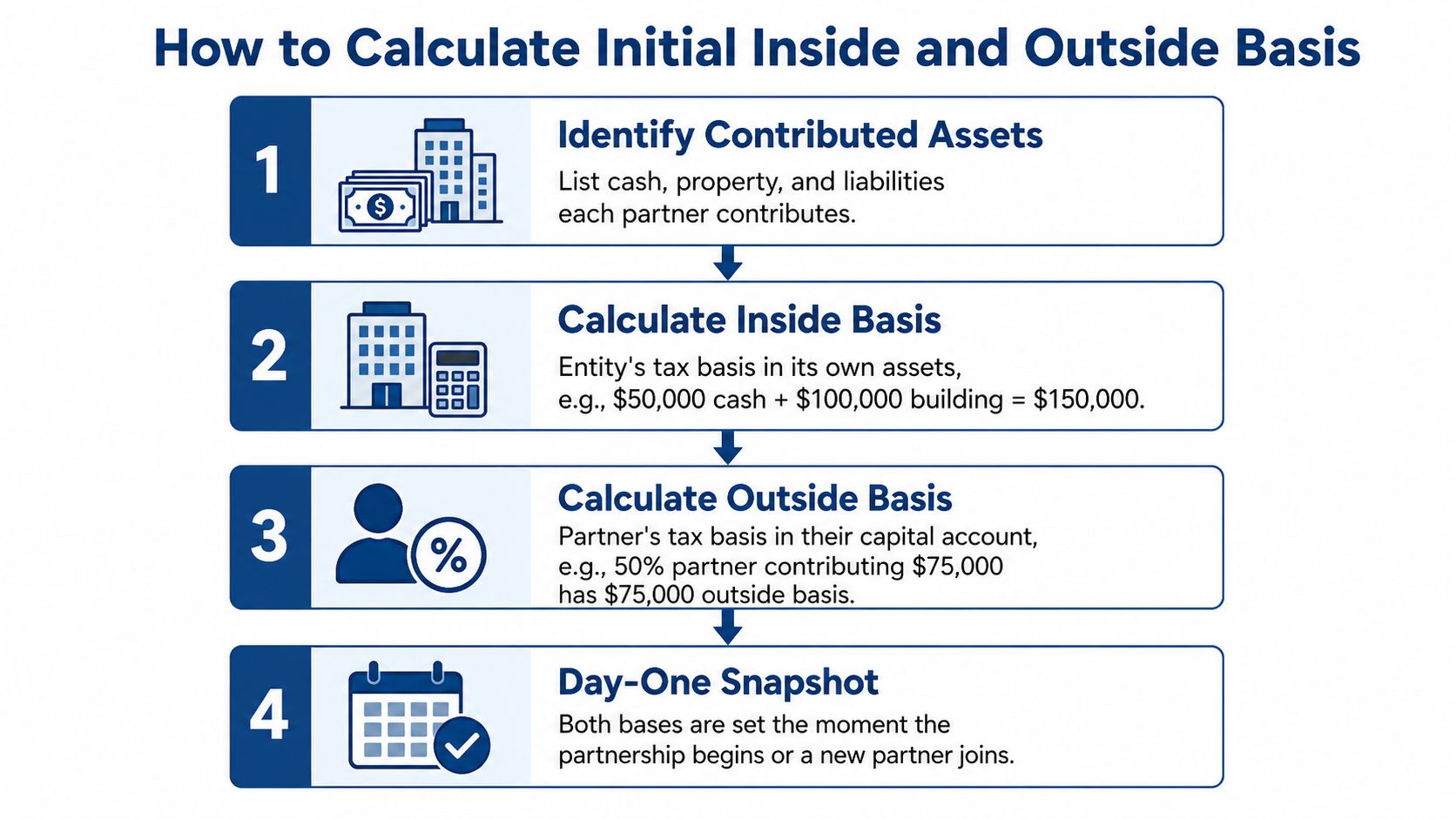
The starting point is to identify what each partner contributes and determine the tax basis of the contributed property. For a simple partnership, the partnership generally takes a carryover basis in contributed property, while the contributing partner's outside basis generally reflects the cash and adjusted tax basis of property contributed, subject to liability and other partnership rules.
Consider a contractor forming an LLC with one other owner. The contractor contributes $50,000 of cash and equipment with an adjusted tax basis of $100,000. The equipment's current market value may differ, but the tax calculation starts with its adjusted basis, not an informal estimate of what the equipment could sell for.
Step one, calculate the partnership's inside basis
The partnership records tax basis in the assets it receives:
- Cash: $50,000
- Contributed equipment: $100,000 adjusted tax basis
- Total initial inside basis: $150,000
That $150,000 is the partnership's combined tax basis in those contributed assets for this simplified example. The partnership doesn't automatically receive a fresh tax basis equal to the equipment's current market value merely because ownership changed.
Step two, calculate the contributing partner's outside basis
The contractor's initial outside basis starts with the same contributed amounts in this simplified fact pattern:
- Cash contributed: $50,000
- Adjusted basis of equipment: $100,000
- Initial outside basis: $150,000
The other partner's outside basis would depend on that partner's own contribution and the partnership agreement. Ownership percentages and capital accounts can help explain the economics, but they don't replace a partner-by-partner outside-basis schedule.
Step three, record liabilities separately
If the contributed equipment is subject to a liability, or if the partnership assumes a liability connected with contributed property, the outside-basis calculation needs a separate liability analysis. A liability can affect the partner's outside basis even though it doesn't change the partnership's tax basis in the underlying asset in the same way.
That's where business owners often make their first serious mistake. They enter the cash and property contribution correctly, then fail to record the liability movement that changes the partner's personal basis.
Step four, preserve the day-one records
Keep the contribution agreement, asset purchase records, depreciation history, loan documents, and ownership records together. The opening schedule should show each asset, its adjusted tax basis, any relevant liability, the partner's contribution, and the resulting outside basis.
This documentation becomes essential when the partnership sells property, distributes cash, admits a new partner, or liquidates an owner's interest. Without it, the preparer may have to reconstruct years of basis adjustments from incomplete books and old tax returns.
When Do Inside and Outside Basis Diverge
A partnership can borrow cash, distribute property, or admit a new owner while the partnership's tax basis and a partner's basis move in different directions. That divergence creates problems when owners rely on a capital account, market value, or the partnership's asset schedule instead of maintaining a separate outside-basis schedule for each partner.
A bank loan shows why the distinction matters. Borrowing increases the partnership's cash and liabilities, but the loan does not, by itself, create tax basis in a particular asset. A partner's share of partnership liabilities can increase or otherwise affect outside basis, while inside basis depends on how the partnership uses the borrowed funds and the tax basis of what it acquires.
The table below shows the direction of each effect. A single transaction can move inside basis and outside basis in opposite directions, so reconcile both schedules after every material event rather than waiting until year-end.
| Business event | Impact on inside basis | Impact on outside basis |
|---|---|---|
| Cash contribution | Increases the partnership's basis in cash | Increases the contributing partner's basis in the partnership interest |
| Property contribution | Usually carries the contributing partner's adjusted basis into the partnership's assets | Generally reflects the partner's adjusted basis in the contributed property, subject to applicable liability rules |
| Partnership borrowing | Does not, by itself, establish tax basis in a particular asset | A partner's share of partnership liabilities can affect outside basis |
| Asset appreciation | The partnership's tax basis generally doesn't rise merely because market value increases | The partner's outside basis generally doesn't rise merely because the asset appreciates |
| Cash distribution | Reduces partnership cash and can affect the partnership's asset position | Reduces the recipient partner's outside basis and may create taxable gain |
| Property distribution | Removes the distributed property from the partnership's asset base | Changes the recipient partner's basis according to the distribution rules |
| Ownership transfer | May lead to a special inside-basis adjustment | The buyer's outside basis is based on the acquired partnership interest |
Why appreciated assets create confusion
Suppose a partnership owns real estate that has increased in value. Inside basis remains tied to the property's tax basis, not its current market value. Partners may discuss the real estate at its economic value, but tax reporting continues to use historical basis and any applicable adjustments.
The mismatch becomes important when a partner sells or transfers an interest. A buyer may pay an amount that differs from the buyer's share of the partnership's existing inside basis. A properly considered Section 754 election may support a special basis adjustment in that situation, depending on the facts and the partnership's filing position.
Why distributions accelerate errors
An owner may view a cash withdrawal as a simple reduction of the capital account. The tax analysis turns on outside basis. That amount, rather than the bank balance or book capital account alone, helps determine whether the distribution remains tax-free or produces gain.
Property distributions require the same discipline. Before approving a distribution, calculate the recipient's outside basis and review the partnership's basis in the property. Record liability changes, distributions, transfers, and asset adjustments promptly. A year-end reconstruction can leave the partnership unable to explain the tax result when an owner exits or property is sold.
What Tax Consequences Follow When Basis Diverges for Partners
Basis divergence matters most when a partner receives property or cash, claims pass-through losses, or exits the partnership. The tax result depends on the partner's outside basis and the partnership's inside basis, not on the business owner's intuition about how much money or value the business contains.
Consider a partner receiving property in a distribution. The property's tax basis generally starts with the partnership's inside basis immediately before distribution. If the partner's outside basis is lower than that inside basis, the basis of the distributed property is capped at the partner's outside basis. That rule is discussed in this technical analysis of partnership basis adjustments.
Distribution example
A partnership may own equipment with a tax basis that exceeds the recipient partner's outside basis. The partner receives the equipment in a liquidation or other distribution and assumes the equipment's full partnership basis carries over automatically.
That assumption can be wrong. If the partner's outside basis is lower, the distributed property's basis is limited to the partner's outside basis. The difference isn't merely an accounting mismatch. It can affect the partner's future gain when the property is sold and can create an unexpected result during liquidation planning.
A distribution analysis should begin with the recipient partner's outside-basis schedule, not with the partnership's balance sheet.
Cash distributions create a separate problem. A partner may withdraw cash because the business has sufficient funds in its bank account, but available cash doesn't prove the partner has enough outside basis for the distribution to remain tax-free. Prior distributions, allocated liabilities, losses, and income adjustments can leave the personal basis lower or higher than the owner expects.
Loss deduction example
Partnership losses pass through to partners, but a partner can't automatically deduct every loss shown on a Schedule K-1. Outside basis is one of the central limitations. If the partner lacks sufficient basis, the loss may not be currently deductible and may require tracking until the relevant limitation is satisfied.
A contractor with strong revenue can still face this issue if the business has distributed cash, allocated liabilities differently over time, or generated deductions that reduced outside basis. The contractor's gross receipts don't answer the basis question. The partner needs a current tax-basis schedule that reconciles contributions, income, losses, distributions, and liability changes.
The correct workflow is straightforward:
- Update outside basis: Record the partner's contributions, allocated income, losses, distributions, and liability changes.
- Review the transaction: Determine whether the event involves cash, property, a sale, redemption, or liquidation.
- Compare both levels: Reconcile the partner's outside basis with the partnership's inside basis in the relevant assets.
- Document the result: Preserve the calculations with the partnership records and individual tax workpapers.
For a partnership distribution, guessing is expensive. A preparer should calculate the result before funds or property move, especially when the transaction involves appreciated assets, debt, or a complete exit.
How Do S Corporation Basis Rules Differ From Partnerships
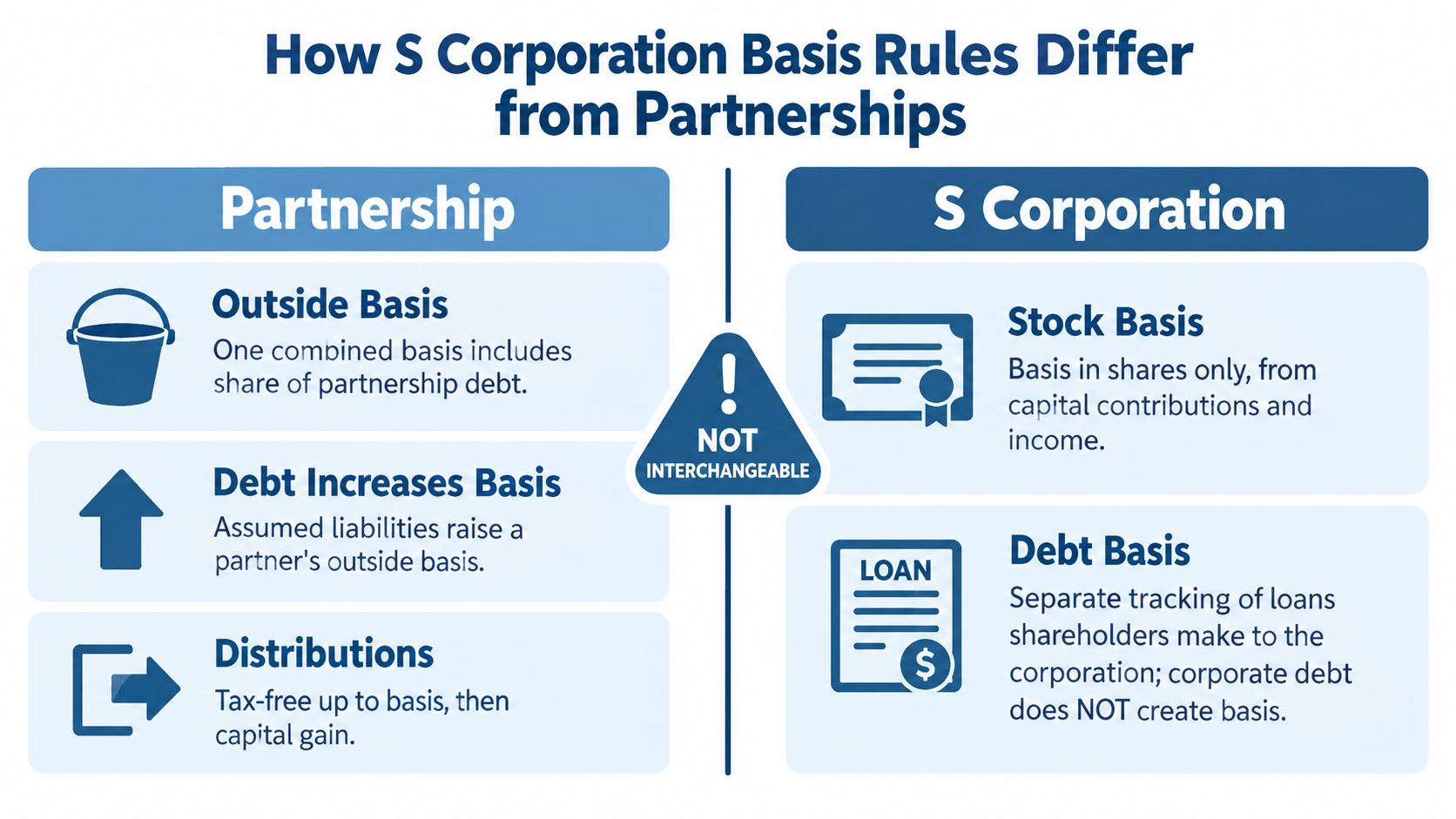
S corporation basis isn't a partnership-style outside-basis account. An S corporation shareholder tracks stock basis and debt basis separately, and the two amounts can't be freely combined. The IRS states, “Stock basis and debt basis must be figured separately,” with debt basis addressed in Part II of Form 7203. The IRS explanation of S corporation stock and debt basis should control the analysis.
An owner may personally guarantee an S corporation loan or watch the corporation borrow substantial funds, but corporate debt doesn't automatically create shareholder debt basis. Debt basis generally relates to bona fide loans the shareholder makes directly to the corporation, and those loans are tracked apart from stock basis.
The common mistake
An S corporation owner sees business borrowing on the corporate books and assumes the debt increases the owner's basis. That's a partnership assumption applied to the wrong entity type. The corporation's loan remains corporate debt unless the shareholder separately lends money to the corporation in a manner that creates shareholder debt basis under the applicable rules.
The reverse mistake also occurs. An owner may have stock basis and shareholder debt basis, then use one bucket to support a deduction that belongs in the other. The separation prevents that shortcut.
The practical comparison is:
- Partnerships: A partner's outside basis can reflect the partner's share of partnership liabilities, subject to the partnership liability rules.
- S corporations: Stock basis and debt basis remain separate, and corporate borrowing doesn't automatically create basis for the shareholder.
- Both entity types: Basis must be updated as income, losses, contributions, distributions, and loans change.
The distinction matters for an owner who operates multiple entities. A construction company taxed as a partnership may produce one basis analysis, while an S corporation used for another business requires a stock-and-debt review. The accounting records may sit in the same bookkeeping system, but the tax rules aren't interchangeable.
Watch the explanation in this video before treating an S corporation loan as shareholder basis:
What Tax Planning Strategies Prevent Basis Mistakes
The best basis strategy is routine reconciliation before a transaction, not a last-minute repair during tax preparation. Owners should treat basis as a living tax schedule and update it whenever the business contributes property, borrows money, distributes cash, allocates income or losses, or changes ownership.
Start with the records that support the calculation. The bookkeeping file may show cash and debt, but it may not show each partner's adjusted tax basis or the tax history of contributed property.
Year-end basis checklist
- Reconcile contributions: Confirm cash, property, and any liabilities connected with contributions.
- Review allocations: Check that income and losses were assigned to the correct partner under the operating agreement and tax reporting.
- Update distributions: Record every cash and property distribution, including transactions owners may have treated as draws.
- Analyze debt changes: Reconcile partnership liability allocations, and keep shareholder loans to an S corporation separate from corporate borrowing.
- Test planned transactions: Review proposed distributions, redemptions, transfers, and liquidations before they occur.
Cash in the bank isn't the same as available tax basis. A restaurant owner filing in two states may have sufficient operating cash to make an owner distribution, yet still need a federal and multi-state basis review before taking the money. State filing obligations can add another layer, but the federal basis calculation remains the starting point.
Advisor's recommendation: Don't approve a large distribution or ownership transfer until the current outside-basis schedule has been reconciled to the partnership's asset and liability records.
Business owners should also separate book capital from tax basis. Bookkeeping software can track contributions and withdrawals, but it may not automatically handle tax-basis adjustments, contributed property, liability allocations, or suspended losses. The tax preparer needs source records and a clear transaction history.
Blue Sage Tax and Accounting Inc. provides partnership and S corporation compliance, year-round tax planning, bookkeeping, and proactive projections for business owners who need basis reviewed before filing or before a major distribution. Visit Blue Sage Tax & Accounting Inc. to discuss your entity's basis records and upcoming tax transactions.
Blue Sage Tax & Accounting Inc. can review your partnership or S corporation basis schedules, reconcile contributions and distributions, and coordinate tax planning before year-end transactions. Book your free consultation call today.
This article is general information and not tax advice for your specific situation.