Construction accounted for 9.6% of all U.S. nonemployer establishments in 2022, according to the U.S. Census Bureau, so contractor accounting isn't just a large-company concern. Contracting company accounting means tracking revenue, costs, billing, retainage, and cash by project, then applying the appropriate financial-reporting and tax methods. For an owner-operated business, the practical goal is to know which jobs are profitable, which are consuming cash, and what those results mean for estimated taxes before year-end.
Table of Contents
- What Accounts Does a Contracting Company Need?
- How Do Contractors Recognize Revenue on Long Jobs?
- How Should Retainage Show Up in Your Cash Plan?
- How Do Payroll and Subcontractor Rules Change Your Books?
- Which Sales Tax Rules Apply in New York and New Jersey?
- What Should Contractors Review Before Year-End?
- How Should You Set Up Your Month-End Close This Quarter?
What Accounts Does a Contracting Company Need?
A contracting company needs separate accounts for contract revenue, retainage, direct job costs, overhead, and overbilling or underbilling balances, supported by project codes. Customer deposits also need their own liability account until the applicable accounting treatment permits recognition as revenue.
The chart of accounts identifies what happened. The job code identifies where it happened. Don't create a separate general-ledger account for every project, because that makes the ledger difficult to maintain and compare.
Core contractor accounts and what each one tracks
| Account | What It Tracks | Contractor Example |
|---|---|---|
| Contract revenue | Progress billings and approved change orders, reconciled to earned revenue | Framing-phase billing on a hypothetical $400,000 remodel |
| Retainage receivable | Amounts the owner withholds until final acceptance | Hypothetical 10% hold on a $100,000 billing |
| Retainage payable | Amounts withheld from subcontractors | Hypothetical 10% hold on a drywall subcontractor's invoice |
| Direct labor job cost | Crew wages and burden assigned to a job | Crew hours coded to a kitchen renovation |
| Materials job cost | Materials purchased for a specific project | Lumber and fixtures delivered to one site |
| Subcontractor job cost | Subcontractor charges by job | Electrical invoice assigned to the renovation |
| Equipment and vehicle cost | Machine and truck use attributable to projects | Mini-excavator rental charged to one project |
| Overhead | Costs not directly attributable to a job | Office rent, general insurance, and software |
| Costs in excess of billings | Costs and estimated earnings exceeding amounts billed | Earned work not yet invoiced at month-end |
| Billings in excess of costs | Billings exceeding recognized costs and estimated earnings | Progress billing ahead of earned work |
| Customer deposits | Advance receipts awaiting the appropriate revenue treatment | Mobilization money received before work starts |
Keep the ledger usable
Say a remodeling contractor has $400,000 in annual revenue and runs three jobs simultaneously. On a hypothetical $100,000 billing with 10% retainage, the records separate $90,000 of ordinary receivables from $10,000 of retainage, rather than treating the entire invoice as currently collectible.
We include an industry-specific chart of accounts with consistent transaction categorization. Every transaction should carry either a job code or an explicit overhead designation, including supplier credits, refunds, and shared-cost allocations.
Practical rule: If you can't tell which project incurred a cost, resolve the coding before closing the month.
How Do Contractors Recognize Revenue on Long Jobs?
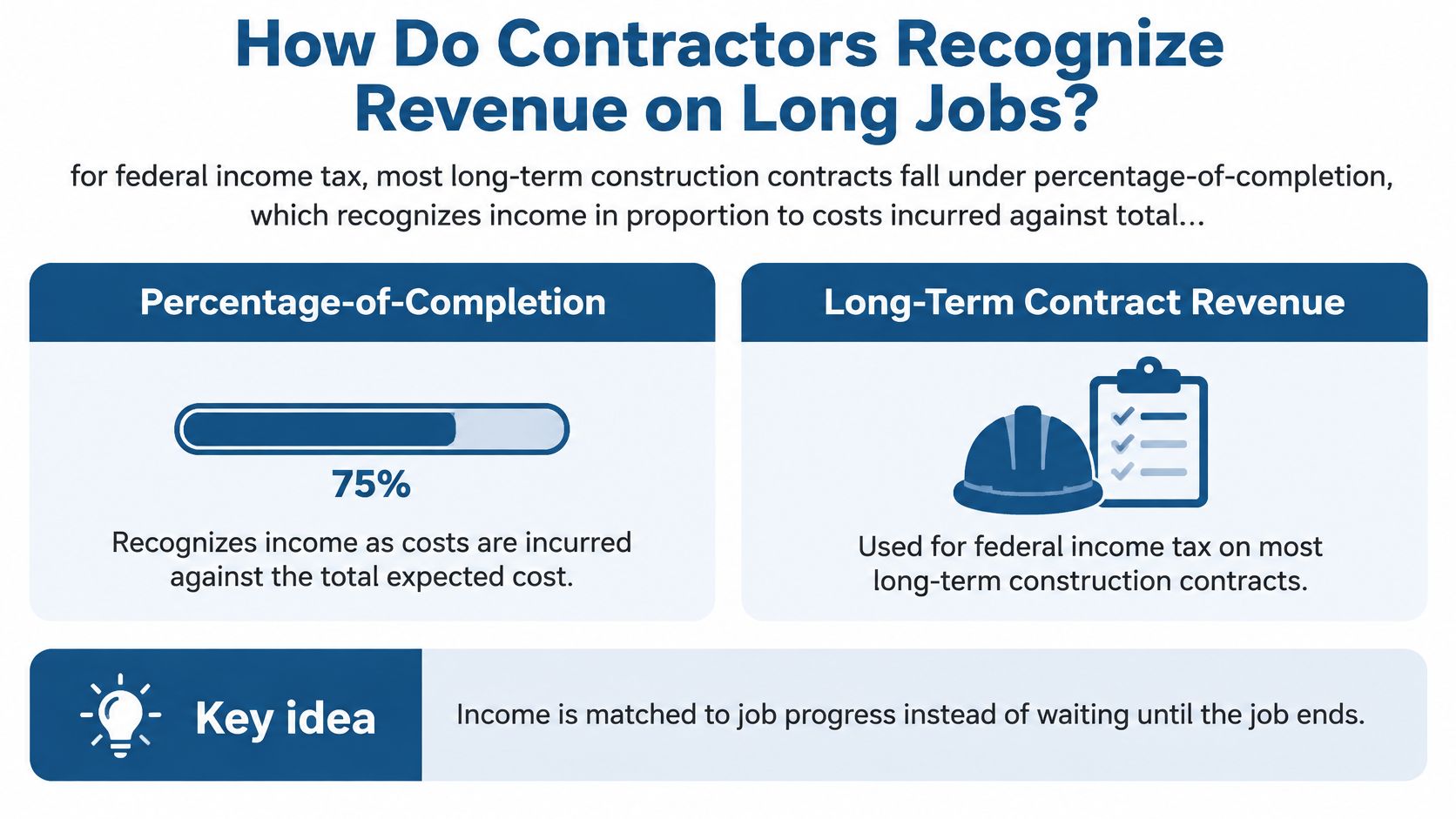
For U.S. federal income tax, long-term construction contracts generally use percentage-of-completion unless a statutory exception applies. Under the cost-to-cost approach described in the IRS construction tax guide, completion equals cumulative allocable costs incurred divided by total estimated allocable costs.
A hypothetical contract shows the arithmetic:
- Contract price: $500,000.
- Estimated total allocable cost: $400,000.
- Allocable costs incurred: $200,000.
- Completion: $200,000 divided by $400,000 equals 50%.
- Cumulative recognized revenue: 50% of $500,000 equals $250,000, less revenue already recognized in prior periods to determine the current-period amount.
The visual below summarizes the relationship between cost progress and revenue.
Choose the method by contract eligibility
The federal long-term-contract regulations distinguish percentage-of-completion, completed-contract treatment for exempt construction contracts, and special treatment for qualified residential construction and certain ship contracts.
Long-term contract methods for federal income tax
| Method | When Income Is Reported | When It Applies |
|---|---|---|
| Percentage-of-completion, cost-to-cost | Contract price recognized according to allocable costs incurred versus estimated total costs each tax year | Generally the default for long-term construction contracts unless an exception applies |
| Completed-contract | Gross contract price and allocable costs reported in the completion year | Eligible exempt construction contracts |
| Residential or other special-rule contracts | Under the applicable percentage-of-completion/capitalized-cost rules | Qualified residential construction contracts and certain ship contracts |
An optimistic estimate overstates expected margin. If remaining labor or subcontractor costs increase on a fixed-price job, revise the forecast promptly. Escalate projected losses immediately, and determine the required book and tax adjustments separately.
Your overall bookkeeping method doesn't automatically determine your long-term-contract method. Certain corporations and partnerships with corporate partners also face federal cash-method restrictions, as discussed in the IRS Construction Industry Audit Technique Guide; confirm the applicable gross-receipts threshold for the tax year because indexed amounts adjust annually.
Update cost-to-complete monthly. Keep approved changes, unapproved claims, stored materials, and subcontractor commitments distinguishable rather than assuming every requested extra increases the recognized contract price.
For the billing workflow that supports those records, JobsiteStack's contractor invoicing guide provides a useful operational companion. Accurate invoicing supports collection, but it doesn't replace revenue-recognition calculations.
This video offers an additional explanation of construction revenue recognition.
How Should Retainage Show Up in Your Cash Plan?
Retainage is money withheld from progress billings pending satisfactory completion and acceptance, so track it separately from ordinary receivables. Don't include it in near-term available cash unless the release conditions and expected payment date support that assumption.
The Construction Business Owner discussion of income-tax accounting methods explains why retainage can create differences between project progress, reported income, and available cash. Its tax treatment depends on the permitted accounting method, not on whether the customer has paid.
For a hypothetical $100,000 progress billing with 10% withheld, $90,000 is available for ordinary collection and $10,000 remains subject to release. Even the ordinary receivable isn't cash until the customer pays. A billing approval isn't a bank deposit.
Build an actionable retainage register
A useful register should contain:
- Project and counterparty: Identify who owes the money and who authorizes release.
- Amounts withheld and released: Show the remaining balance and any disputed portion.
- Release conditions: Record acceptance requirements, outstanding closeout documents, and contractual milestones.
- Expected collection date: Use a supported date, with a named person responsible for follow-up.
Monthly reporting should distinguish billed receivables, retainage receivable, retainage payable, unbilled revenue, and contract assets and liabilities by project. Reconcile those balances to signed contracts, payment applications, approved changes, completion milestones, lien waivers, closeout documents, and the general ledger.
A profitable job can still leave you unable to fund payroll if the customer controls when earned money becomes collectible.
Investigate aged retainage separately from overdue invoices. An unpaid invoice might need collection follow-up; withheld retainage might need a missing closeout package resolved. Review retainage payable to subcontractors separately as well, including release conditions and amounts eligible for payment.
We include accounts receivable and payable tracking. For cash planning, assign expected receipts to the period when collection is reasonably supported, then compare them with payroll, supplier commitments, debt payments, and tax payments. Run a delayed-collection version before committing to another cash-intensive job.
How Do Payroll and Subcontractor Rules Change Your Books?
Payroll and subcontractor payments need separate records because worker classification, withholding, and information reporting aren't determined by job-cost coding. Calling someone a subcontractor or receiving an invoice doesn't establish independent-contractor status.
For federal classification purposes, examine the actual relationship, including control over how work is performed, financial independence, and the parties' arrangement. New York State and New Jersey apply their own employment and withholding requirements, so a federal conclusion shouldn't be treated as automatic clearance under state rules.
Consider an electrician who pays the same helper as a subcontractor throughout the year. If the electrician directs the helper's daily work, supplies the tools, and treats the helper like regular crew, the arrangement warrants classification review. A signed subcontract doesn't override the underlying facts.
Separate compliance balances from job labor
Record gross wages, employee withholding, employer payroll taxes, and payroll deposits in the appropriate accounts. Don't post the entire payroll withdrawal as labor expense, because that can mix expenses with payments of existing liabilities.
Allocate payroll burden, such as employer taxes and applicable insurance, consistently between jobs and overhead. Direct labor without its related burden can make a labor-heavy project appear more profitable than it is.
Our payroll tax compliance services support the payroll side of those records. We track 1099 contractor payments throughout the year, with W-9s collected before January; operationally, obtaining the W-9 before the first payment avoids a year-end chase.
Before replacing your system, use Snyp to compare accounting software for contractors, focusing on payee records, job-coded payments, payroll integration, and exportable reporting rather than dashboard appearance.
Use this monthly check:
- Collect W-9s for subcontractors before payment whenever possible.
- Code payments to both the payee and the correct job, including credits and reimbursements.
- Review direction and control. Flag workers whose actual arrangements resemble employment.
- Reconcile totals between payroll reports, subcontractor records, payment accounts, and the general ledger.
Confirm federal and state reporting requirements for the filing year. Don't assume every threshold changes annually or that every subcontractor payment receives identical information-return treatment.
Which Sales Tax Rules Apply in New York and New Jersey?
In New York State and New Jersey, first determine whether the work is a capital improvement or a repair, maintenance, or installation service. Then apply that state's customer-billing and materials-purchasing rules, including New Jersey's separate presentation of labor and materials.
Under New York State contractor guidance, qualifying capital improvements are generally billed without sales tax, while contractors normally pay sales or use tax on materials. New Jersey's contractor guidance distinguishes exempt improvement labor from taxable services and generally treats contractors as consumers of incorporated materials.
Sales tax treatment of contract work in New York State and New Jersey
| Work Type | New York State | New Jersey |
|---|---|---|
| Capital improvement, permanent addition | Generally billed without sales tax, supported by a properly completed Form ST-124; contractor normally pays tax on materials | No sales tax on labor for an exempt capital improvement; contractor generally doesn't charge customer sales tax on incorporated materials |
| Repair, maintenance, or installation | Generally taxable; collect sales tax from the customer | Tax applies to labor for taxable services |
| Materials for exempt work | Ordinary capital-improvement status doesn't itself exempt the contractor's materials purchases | Purchases exclusively for qualifying exempt-entity work may qualify for exemption when state requirements are met |
Document the work before billing
A New York State capital improvement must satisfy all three conditions: substantially add value or appreciably prolong useful life; become part of the property or be permanently affixed so removal would cause material damage; and be intended as permanent. Keep the customer's properly completed Form ST-124, Certificate of Capital Improvement, with the job file.
For supporting documentation and related distinctions, consult our New York sales tax exemptions guide. A customer describing work as an improvement isn't sufficient documentation.
New Jersey invoices should separately state materials and labor. Form ST-13, Contractor's Exempt Purchase Certificate, may support qualifying purchases for exempt-entity work when the state's conditions are met; it isn't a blanket exemption for construction materials.
Say a New York electrician installs permanent building wiring while a New Jersey plumber replaces a faucet. The wiring project needs evaluation against New York's capital-improvement conditions. The faucet replacement should be reviewed as repair or maintenance rather than assumed exempt because a fixture is attached to the building.
These are state-level rules, not national rules. For work in both states, retain the job location, scope, customer documentation, and invoice treatment separately, and confirm current requirements before billing.
What Should Contractors Review Before Year-End?
Before year-end, confirm that every open job has a current completion estimate, work in progress follows the applicable method, and incurred costs haven't disappeared because invoices arrived late. Book adjustments and tax deductions aren't interchangeable, so evaluate each item under the business's reporting and tax methods.
Turn the job records into a tax projection
Use a focused closing checklist:
- Confirm estimated costs at completion. Review remaining labor, purchase commitments, and subcontractor exposure. Document projected losses and determine the required accounting treatment.
- Identify uninvoiced costs. Obtain subcontractor statements and receiving records. Record accruals where appropriate for the books, then determine their tax treatment separately.
- Reconcile retainage balances. Verify release status and expected dates for receivables and payables rather than assuming completion means immediate payment.
- Review equipment and vehicles. Confirm ownership, business use, placed-in-service dates, financing, and disposals before evaluating federal deductions.
- Compare the projection with payments. Review year-to-date taxable income, estimated payments, and prior-year liability to determine whether a payment adjustment may be appropriate.
- Complete payroll and subcontractor records. Resolve missing payee information and reconcile annual totals before information returns are prepared.
Federal equipment deductions and other indexed limits can change by tax year. Confirm the rules for the year being closed rather than reusing a prior-year depreciation worksheet.
Year-end discipline: Don't buy equipment solely to create a deduction while leaving payroll, supplier bills, or taxes unfunded.
A projection should explain the difference between accounting profit, estimated taxable income, and available cash. No purchase or timing choice guarantees a tax reduction, and a potential deduction doesn't make an unaffordable purchase sensible.
How Should You Set Up Your Month-End Close This Quarter?
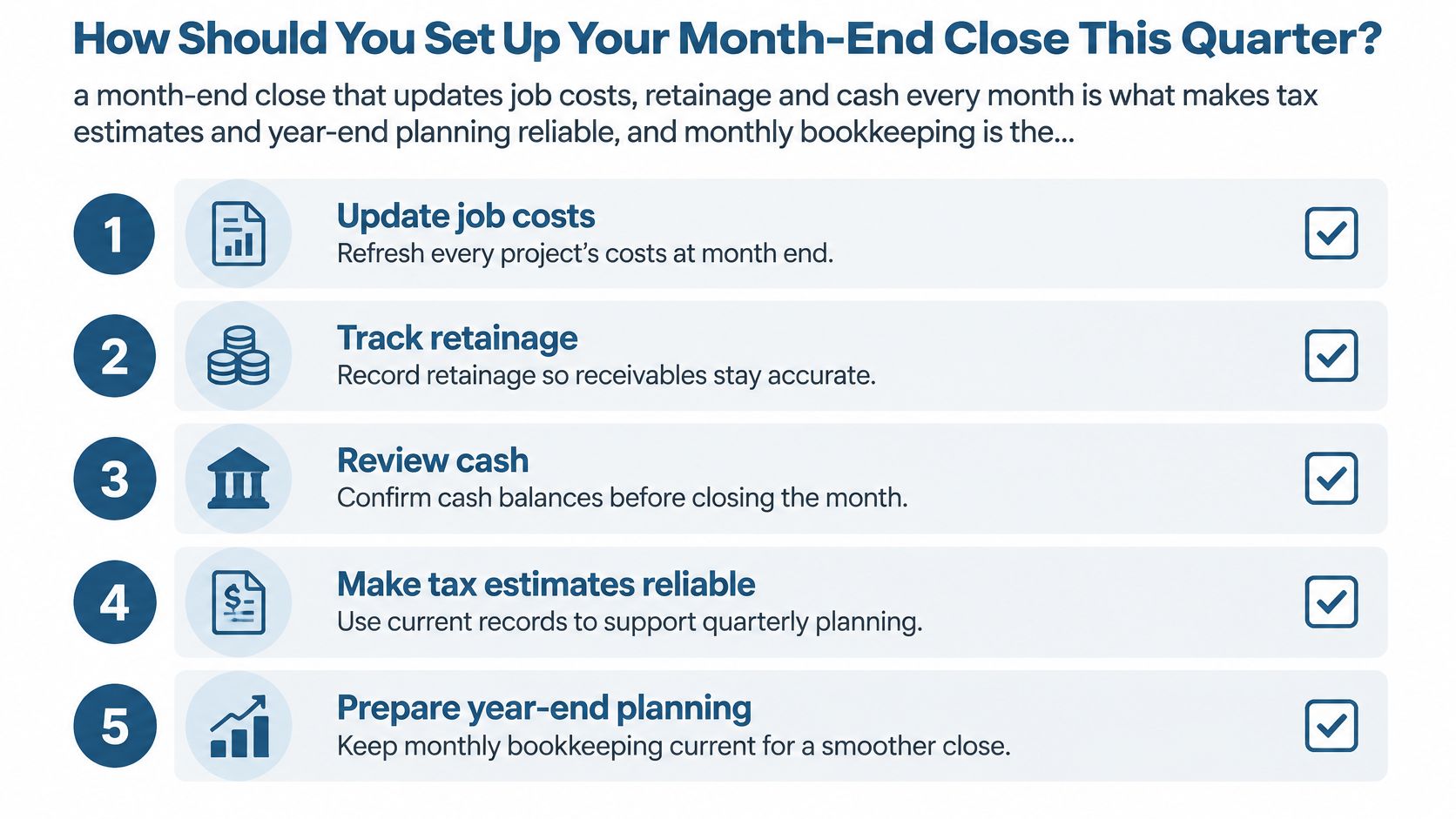
A useful month-end close updates job costs, retainage, financial statements, and cash expectations together. Monthly bookkeeping is the practical minimum for contractors who make estimated tax payments, borrow, or plan around profit.
Use a repeatable close rather than waiting for the bank balance to look wrong:
- Reconcile bank and card accounts, including transfers, outstanding checks, and loan activity.
- Update cost-to-complete for each open job with the person responsible for delivery.
- Confirm change orders, retainage, and unbilled work against supporting documents.
- Review receivable and payable aging, including approval status and payment commitments.
- Read the profit and loss, balance sheet, and cash flow statements together.
- Compare year-to-date results with estimated tax payments and refresh the projection when circumstances change.
The checklist below provides a visual reminder of the close's core functions.
Choose controls before buying software
In the 2024 AGC and Sage survey, 38% of contractors surveyed planned to increase accounting-software spending, making it one of the two leading technology investment areas, according to Sage's construction outlook. Choose tools that preserve job codes, retainage fields, supporting documents, and an audit trail.
Record transactions promptly, separate bill and payroll approval from entry where staffing allows, lock closed periods, and document estimate revisions. File signed contracts and change orders by job rather than leaving them in individual inboxes.
We deliver profit and loss, balance sheet, and cash flow reports after each monthly close. Those reports should support a decision: collect, bill, revise an estimate, defer a commitment, or update the tax projection.
Blue Sage Tax and Accounting Inc., an accounting firm, offers monthly bookkeeping and proactive tax projections that connect contractor records with year-end planning; visit Blue Sage Tax & Accounting Inc. to review the services. Our process starts with a free consultation, followed by a fixed written quote before work begins, then filing and a projection before year-end. Book your free consultation call today.
This article is general information and not tax advice for your specific situation.