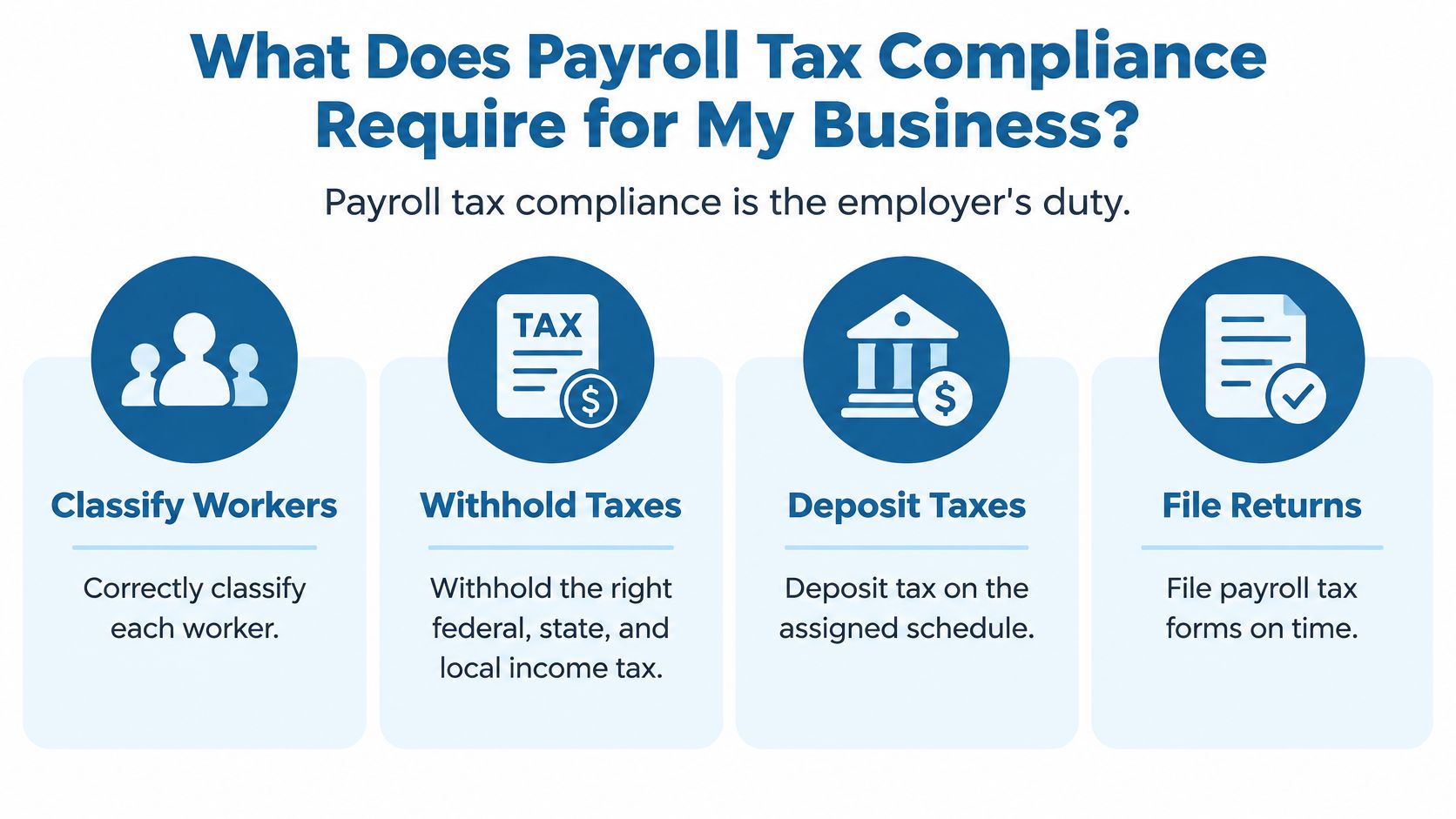
Payroll tax compliance means you classify each worker, withhold the right federal, state, and local tax, deposit it on schedule, and keep the register, liability ledger, return, and bank confirmation in agreement. For tax year 2022, IRS tax gap statistics put the gross federal tax gap at $696 billion, with employment taxes at $127 billion, about 18.2%. That share includes failures to file, to report the right amount, and to remit tax after reporting it.
Table of Contents
- What Does Payroll Tax Compliance Require for My Business?
- Do I Need to Register Before My First Payroll?
- When Are Federal, New York, and New Jersey Payroll Taxes Due?
- Do You Withhold Where the Employee Lives or Works
- What Payroll Mistakes Lead to Federal Penalties?
- Which Records Should You Keep for a Payroll Notice
- Should I Keep Payroll In House or Hand It Off?
What Does Payroll Tax Compliance Require for My Business?
You owe four duties, and they have to match. Classify each worker correctly, withhold the federal, state, and local income tax that applies where the work is performed, deposit on the assigned schedule, and file the wage reports. The payroll register, the liability ledger, the filed return, and the bank confirmation then need to agree. A paycheck, or a Form W-2, doesn't close the file.
Two pockets of money sit in every run. One is tax taken from the employee's pay. The other is the employer's own share, including the employer half of Social Security and Medicare plus unemployment taxes. Spending withheld tax as operating cash is how a routine payroll becomes a balance due.
This is the file for a contractor with about $400,000 in revenue and several crews, a restaurant with tipped staff, a real estate entity paying a shareholder-employee, a family office with household or entity payroll, or a nonprofit with employees. Rates, deposit schedules, and dollar thresholds change each year. What you owe also depends on the jurisdiction where the services are performed.
Practical rule: Treat withheld tax as money that already belongs to the government, not as cash you can use until the return is due.
Do I Need to Register Before My First Payroll?
Yes, and the reason is mechanical. Every deposit, return, and wage report carries an account number, and that number has to exist before the first taxable payroll in each state where employees work. Registration works like opening a bank account: money can move through it only after the account is open. You register where the services are performed, so an owner working from Connecticut with an employee on a Brooklyn job site registers in New York.
Federal. The EIN is the identifier on Form 941 and every wage report that follows it.
New York State. Register for withholding before the first payroll for New York employees, and open unemployment insurance as its own account. The employer state ID number is the piece payroll software can't invent for you.
New Jersey. Register as an employer before you pay New Jersey wages. The account needs to be active before the first check, because everything filed after it pulls its identity from that registration.
New York City. Confirm the current-year local duties before you build the payroll. They're administered alongside New York State, and a local rate shouldn't be typed in until you've confirmed it.
Sequence matters here. A withheld dollar with no open account behind it has nowhere to post.
Work through the registration in this order:
- Gather the legal name, EIN, and ownership details.
- List every state where employees perform services, including job sites and home-office days.
- Register for withholding and unemployment in each of those states before the first taxable payroll.
- Load each jurisdiction into the payroll software.
- Store every registration number with the payroll records.
Founders doing this for the first time can cross-check the sequence against payroll guidance for startup founders, then confirm each state account is open before running the first payroll. Nonprofits and family offices follow the same steps. Any exemption should be confirmed in writing, not assumed.
When Are Federal, New York, and New Jersey Payroll Taxes Due?
Federal employment taxes follow a monthly or semiweekly deposit schedule tied to your liability. New York State wants a remittance after the payroll that pushes accumulated withholding to $700 or more. New Jersey has its own quarterly return and, for some employers, a faster payment rule. None of these is one national due date.
Three calendars, not one reminder
Per the IRS overview of employment tax deposits, employers exceeding $50,000 of combined relevant liability during the applicable lookback period are generally semiweekly depositors. Confirm that lookback for the current year before you assume a monthly date still fits.
On New York withholding filing requirements, you file Form NYS-1 and remit after accumulated withholding reaches or exceeds $700. A five-day filer has five business days. A three-day filer, an employer that withheld $15,000 or more during the calendar year preceding the previous calendar year, has three business days. Those deadlines are New York State withholding only.
New York's due-date page sets Form NYS-45 for April 30, July 31, October 31, and January 31. A Saturday, Sunday, or legal holiday moves filing to the next business day. New York doesn't allow extensions of time to file or pay.
New Jersey's employer withholding instructions require Form NJ-927 every quarter, even when no New Jersey income tax was withheld, electronically by 11:59 p.m. on the 30th day of the month after the quarter. A weekend or holiday moves that date to the next business day, and Form NJ-W-3 is due by February 15, or the next business day. Where the faster schedule applies, New Jersey's withholding payment rule says payment is due by the Wednesday of the week following the week that contains the payday.
| Duty | Jurisdiction | Form or trigger | Timing |
|---|---|---|---|
| Wage and employment-tax return | Federal | Form 941 for withheld income tax, Social Security, and Medicare | Quarterly reporting; deposit monthly or semiweekly |
| Semiweekly deposit status | Federal | Combined relevant liability above $50,000 in the lookback period | Generally semiweekly rather than monthly |
| Withholding remittance | New York State | Form NYS-1 after accumulated withholding reaches $700 | Five business days, or three business days for a three-day filer |
| Three-day filer status | New York State | Withheld $15,000 or more in the calendar year preceding the previous calendar year | Three business days after the triggering payroll |
| Quarterly combined return | New York State | Form NYS-45 | April 30, July 31, October 31, and January 31; no extensions |
| Quarterly withholding return | New Jersey | Form NJ-927, even if no tax was withheld | 11:59 p.m. on the 30th day of the month after the quarter |
| More frequent withholding payment | New Jersey | Tax withheld on a payday | Wednesday of the week following the week of that payday |
| Annual reconciliation | New Jersey | Form NJ-W-3 | February 15, or the next business day |
Say you own a restaurant that files in both states. You keep separate calendars for federal deposits, NYS-1, NYS-45, and NJ-927. One sticky note labeled "payroll taxes" will miss at least one of them.
Do You Withhold Where the Employee Lives or Works
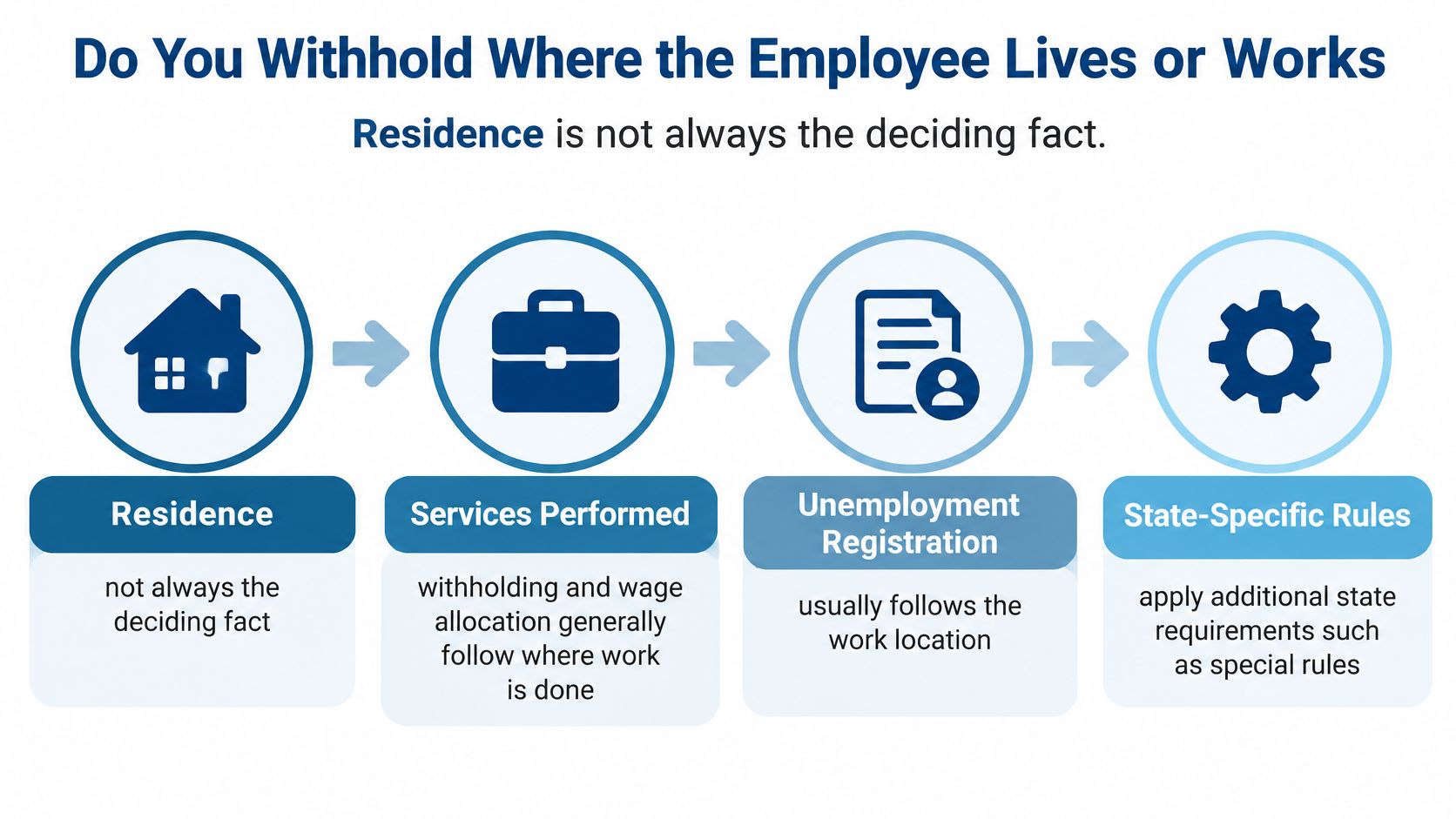
Residence isn't always the deciding fact. Withholding, wage allocation, and unemployment registration generally follow where services are performed, plus state-specific rules such as convenience of the employer. A remote or traveling employee can force a new withholding account, an unemployment account, allocated wages, and more than one W-2.
The 2025 Wipfli HCM payroll update identifies Connecticut, Delaware, Nebraska, New Jersey, New York, and Pennsylvania as states using convenience-of-the-employer rules, and notes that employers generally must allocate wages and taxes among every state where services were performed. That list and those tests can change, so don't lock a setup to a home address from an old hire form.
A foreman who works both sides of the river
Say a Bayside contractor with about $400,000 in revenue has a foreman who lives in New Jersey, works job sites in New York, and sometimes works from home. The address on the application doesn't tell you which state earned the wages that week.
Walk it in order. Confirm the work locations from a day-by-day log. Register for withholding and for unemployment where required before the first taxable payroll in that state. Unemployment registration is separate from income-tax withholding. Allocate the wages, then add the extra state in the payroll system. If the employee moves midyear and a return already went out wrong, correct it through that jurisdiction's correction process. Changing only the next payroll leaves the filed return standing.
A family office or a real estate entity hits the same question when an employee crosses into New Jersey or Pennsylvania.
Multi-state filing support is built around that work-location chain, not around the address on a driver's license. A short walkthrough of how residence and work location pull in different directions is below.
What Payroll Mistakes Lead to Federal Penalties?
A federal deposit misses first, and the penalty can start before the quarterly return is filed. The IRS failure-to-deposit penalty is tiered by lateness: 2% for deposits 1 to 5 calendar days late, 5% for 6 to 15 days late, and 10% when more than 15 days late. These rates are federal only. New York and New Jersey set their own penalty and interest rules, so a clean federal answer does not settle the state side.
| Deposit timing | Federal penalty rate |
|---|---|
| 1 to 5 calendar days late | 2% of the unpaid deposit |
| 6 to 15 calendar days late | 5% of the unpaid deposit |
| More than 15 calendar days late | 10% of the unpaid deposit |
Say a restaurant misses a Friday bank authorization after a heavy tipped weekend, or a trucking company's bonus run changes the liability and the cash leaves late. The penalty can attach before anyone files the quarter. The quarterly form doesn't erase it.
You stay liable for the federal tax, penalties, and interest if a payroll provider fails to deposit. Handing over the login isn't a transfer of the debt.
A Form 1099-NEC doesn't settle worker status either. The W-2 contractor versus 1099 contractor comparison is the right place to test a borderline role. A worker who uses the company vehicle, follows the company schedule, works only for that company, and does the same tasks as employees belongs in the memo before the first payroll or the first 1099. If the conclusion later changes, correct wage reporting, unemployment, and payroll tax, not only the checks going forward. Shareholder-employees of S corporations need pay you can defend as reasonable.
The misses that show up again and again:
- Missed deposit: The bank file fails and nobody checks the confirmation that day.
- Wrong worker status: A 1099 goes out for someone who works like an employee.
- Tips or bonuses left out: The liability is calculated on base pay only after a tipped weekend or bonus run.
- A second state never registered: Work crossed a border and the account was never opened, even though state registrations and withholding setup are required where the work was performed.
Which Records Should You Keep for a Payroll Notice
A payroll notice is a timing problem before it is a legal argument. The file has to show that the wages on a run became a liability, the liability left the bank electronically, and the same amounts reached the federal, New York, or New Jersey return for that quarter. When one leg is missing, the gap usually sits in timing or jurisdiction.
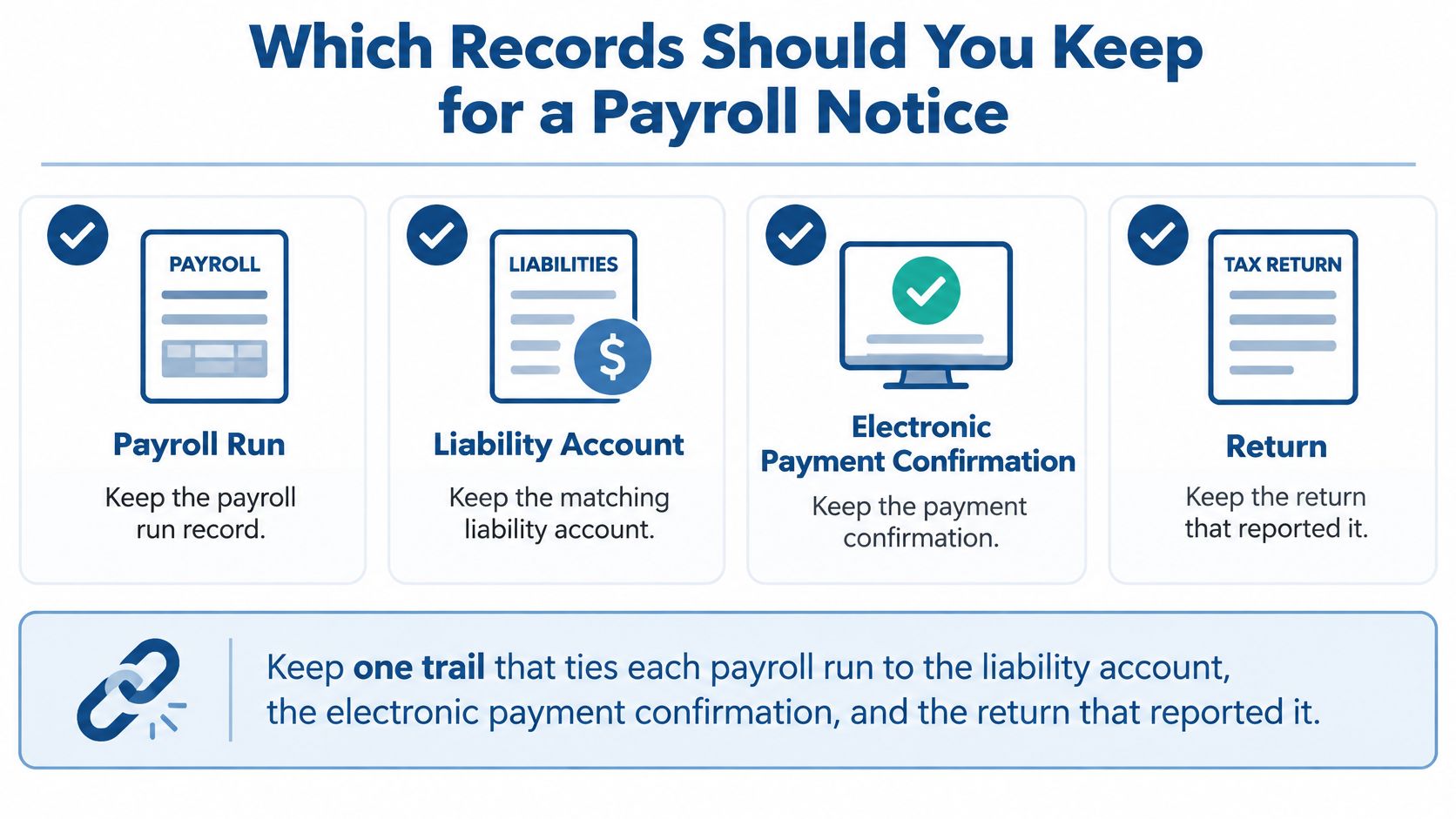
Keep the file sorted by quarter and by jurisdiction, then test four points against each other until nothing is unexplained:
- Payroll register: The run that created the wages.
- General-ledger liability accounts: The amounts you say you still owe.
- Deposit confirmations: Proof the electronic payment cleared.
- Filed federal returns: What you told the IRS.
- New York NYS-45 and NYS-1 records: State withholding and the quarterly combined return.
- New Jersey NJ-927 and NJ-W-3 records: The quarter and the annual reconciliation.
- Work-location logs and classification memos: Where the person worked, and why you treated them as you did.
- W-2 or 1099 copies: What the worker received.
The state trail matters because withholding can follow where services were performed, which is not always where the employee lives. A New York home-office day and a New Jersey job-site day belong in different buckets before the quarter closes. Software can carry jurisdiction-aware tables, year-to-date totals, and an export that links each filed return to the payroll runs behind it, but it cannot infer a work location nobody entered.
When a previously filed Form 941, 943, or 944 is wrong, correct it on the applicable X-series form rather than hiding the change inside the next quarter. Keep the correction with the original quarter's register and deposit proof so the amendment explains the break instead of creating a second one.
For a balance-due letter or a mismatch notice, check the proposed tax against the register before anyone agrees to it. Decide in writing who may speak for the business to the IRS or a state agency, authorize that person with the federal power of attorney form, and calendar the response date printed on the notice before anyone signs an agreement. That person should review the four-way tie-out first.
Should I Keep Payroll In House or Hand It Off?
You can hand off the processing. The legal duty stays with you. Software or a payroll company can calculate, deposit, and file, yet the employer still owes the tax when a deposit fails. So the choice comes down to who owns the calendar and who reconciles after every run.
In-house payroll works when one named person does that reconciliation and tracks the New York and New Jersey schedules separately from the federal one. A single-state business with stable wages can often keep its software, provided the tie-out happens. A contractor or restaurant running payroll in both states, or an S-corporation with a shareholder-employee whose salary has to stay defensible, usually does better with a setup review and a quarterly tie-out. Which route fits depends on your facts.
Before you decide, run through this checklist:
- List every state where employees perform work, because where the work happens can matter more than where the employee lives.
- Confirm each registration is active.
- Name the person who owns the deposit calendar and the reconciliation.
- Ask any software or provider who catches a missed deposit and how a correction gets filed.
- Review the file after the first full quarter.
Blue Sage Tax and Accounting Inc. reconciles payroll journal entries to the quarterly filings, so the wages on the return match the wages reported. The S-corporation service includes payroll setup and quarterly filings, or a review of the payroll provider you already use, and multi-state work covers state registrations and withholding setup where required. When an IRS or state notice arrives, the firm reads it, checks it against your records, and files the response, correction, or penalty abatement request. Service details are on our payroll and multi-state pages.
Book a consultation call today.
Blue Sage Tax & Accounting Inc. reconciles payroll to the quarterly filings, sets up state withholding where your people work, and answers an IRS or state notice from your records rather than from a guess. If New York and New Jersey dates, deposits, or worker status are already tangled, a short call can sort out which account needs attention first. Visit Blue Sage Tax & Accounting Inc. and book a consultation call today.
This article is general information and not tax advice for your specific situation.