
76% of customers had experienced payment-technology problems, according to a 2025 restaurant technology survey. Bookkeeping services for restaurants must therefore do more than import sales: they record sales, tips, supplier bills and payroll, reconcile those records against financial accounts, and produce monthly statements owners can use. The practical value is knowing whether revenue is complete, labor is correctly recorded and operating costs leave enough profit, before year-end.
Table of Contents
- What Do Bookkeeping Services for Restaurants Include?
- Which Records Must Be Reconciled Every Month?
- Which Restaurant Benchmarks Should Your Books Track?
- Should You Hire In-House or Outsource Bookkeeping?
- What Drives the Cost of Restaurant Bookkeeping?
- What Should I Confirm Before My Next Month Closes?
What Do Bookkeeping Services for Restaurants Include?
Bookkeeping services for restaurants include transaction recording, account reconciliation, payroll and tip accounting, supplier and customer balances, and monthly financial statements. The work should produce reconciled books, consistent categories and records a tax return can be prepared from directly.
Core bookkeeping services for a restaurant
| Service | What It Covers | Why It Matters for a Restaurant |
|---|---|---|
| Bank, card and loan reconciliation | Every account matched to the ledger each month | Catches gaps between card settlements and deposits |
| POS sales mapping | Food, beverage, delivery, catering, sales tax, tips and service charges | Separates revenue from taxes and employee amounts |
| Industry chart of accounts | Consistent categories for food cost, labor, occupancy and overhead | Makes month-to-month comparisons reliable |
| Payroll and tip records | Wages, reported tips and payroll tax liabilities | Supports payroll filings and tip compliance |
| Accounts payable and receivable | Supplier invoices, catering and event billing | Shows what's owed in and out at month-end |
| Monthly financial statements | Profit and loss, balance sheet and cash flow | Gives owners figures to act on after closing |
| Tax-ready books | Records a return can be prepared from directly | Reduces rework at filing time |
At Blue Sage Tax and Accounting Inc., monthly bookkeeping includes reconciliation of every bank, card and loan account, an industry-specific chart of accounts, and consistent transaction categorization. Accounts payable and receivable tracking keeps unpaid supplier bills and outstanding catering invoices visible instead of treating the bank balance as the complete picture.
Payroll processing and payroll reconciliation aren't interchangeable. A payroll provider may calculate checks correctly while the ledger still contains duplicated wages or missing liabilities. Our payroll processing services address the payroll side; the monthly close must also tie those records to the accounts.
A connected bank feed imports transactions. It doesn't establish that restaurant revenue, tips and liabilities are complete.
For quote-comparison checks, use the cost questions below rather than judging scope by the word “bookkeeping” alone.
Which Records Must Be Reconciled Every Month?
A monthly bookkeeper matches every restaurant revenue source to bank deposits and payroll records in a fixed order. Every difference needs an explanation supported by a source report, not an adjustment entered just to make the accounts balance.
This visual summarizes the main reconciliation checkpoints.
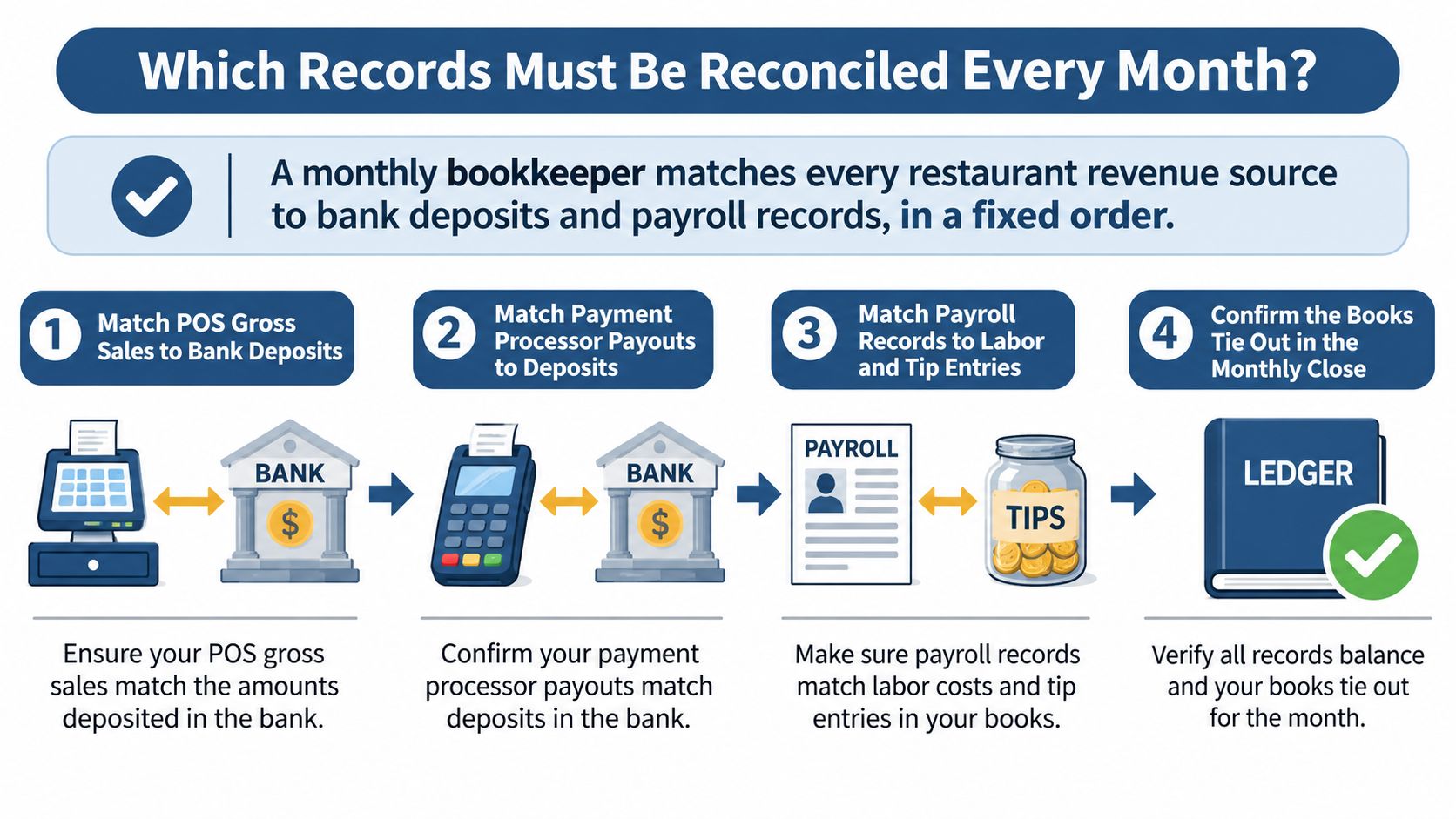
- Match gross sales to processor settlements. Reconcile POS totals to processor reports, identifying fees, refunds and chargebacks. A net payout isn't gross revenue.
- Match cash deposits to POS cash totals. Document cash retained for change, approved payouts and deposit timing. Don't assume an unexplained shortage is a timing difference.
- Reconcile tips to payroll. For federal compliance as of 2026, the IRS tip-reporting guidance requires employees receiving at least $20 in cash tips in a calendar month from one employer to report all those tips in writing. Cash tips include check and card tips; the threshold isn't a general tax exemption for smaller amounts, and current thresholds should be checked because rules can change.
- Separate service charges. Under the IRS instructions for Form 8027, service charges distributed to employees are wages reported on Form W-2, not tips. Keep them separate in both POS mapping and payroll.
- Check New York State sales tax. The New York State restaurant sales bulletin makes on-premises food and drink taxable and voluntary gratuities nontaxable. Mandatory gratuities are generally taxable unless separately shown, identified as tips or gratuities, and entirely distributed to employees.
- Tie payroll to timekeeping and tax deposits. Check wages, reported tips, employer taxes and outstanding payroll liabilities. Allocate shared staff consistently across locations.
- Record marketplace fees separately. OrderOut's guide to match delivery app earnings to sales is useful when settlement deductions obscure gross orders. Record delivery fees as expenses rather than reducing sales without clear documentation.
- Resolve variances before issuing statements. Our bank account reconciliation work supports the monthly close. Each adjustment should trace to a report the owner can produce on request.
Use the video alongside the source reports, not instead of them.
Which Restaurant Benchmarks Should Your Books Track?
Restaurant benchmarks are useful only when the underlying numbers are classified consistently. Track prime cost, labor, occupancy and income before taxes to see whether a change comes from purchasing, scheduling, rent or sales.
Restaurant benchmarks from National Restaurant Association data
The National Restaurant Association's operational release reports prime-cost and pretax-income medians from its 2025 dataset covering more than 900 U.S. restaurants, and wage medians from 2024. Its occupancy analysis reports 2024 occupancy medians.
| Metric | Limited-Service | Full-Service |
|---|---|---|
| Prime cost, food, beverage and labor (2025 dataset) | 65% | Not reported in the cited release |
| Salaries and wages including benefits (2024) | 31.7% | 36.5% |
| Income before taxes (2025 dataset) | 4.0% | 2.8% |
| Occupancy costs (2024) | 5.2% | 5.7% |
Prime cost combines food, beverage and labor. Keep purchases, inventory adjustments, hourly wages, management payroll, payroll taxes and benefits distinct in the books. Otherwise, a rising prime-cost percentage won't show whether purchasing or staffing drove the change.
Labor percentage needs context. If sales fall while scheduled hours hold steady, labor as a share of sales rises even if no one receives a pay increase. Compare timekeeping with sales by location, role and daypart before adjusting shifts.
Pretax income and occupancy measure different pressures. Income before taxes shows what remains after expenses; occupancy measures costs that staffing changes alone cannot address.
Treat the Association's figures as management benchmarks, not universal targets. They reflect the stated reporting periods, not tax-year allowances. Compare your own monthly trend with the relevant category, then investigate waste, purchase-price changes, overtime, scheduling, discounts and unrecorded sales before changing menu prices.
Only 15% of surveyed U.S. restaurants could easily access key cost inputs such as food and labor as a percentage of sales in 2025, according to Digital Transactions' report on SpotOn's Penta survey. Building these measures into regular financial reporting gives owners a clearer basis for decisions before year-end.
Should You Hire In-House or Outsource Bookkeeping?
Choose in-house bookkeeping when daily on-site access justifies employment costs, and outsourcing when you need a dependable monthly reporting process without hiring. If records are behind, catch-up work usually comes first, regardless of the long-term model.
Bookkeeping models for restaurants
| Model | Best For | Trade-Offs |
|---|---|---|
| In-house bookkeeper | Owners who want daily on-site control | Salary, benefits, payroll taxes and leave coverage |
| Outsourced monthly bookkeeping | Owners still categorizing transactions or running only a bank feed | Requires timely POS, payroll and processor reports |
| Catch-up plus monthly service | Books behind or needing cleanup before filing | Catch-up is quoted separately |
| Hybrid manager and outside bookkeeper | Multi-location groups with daily sales activity | Needs shared reports and a clear monthly handoff |
An in-house bookkeeper can resolve questions with managers during service preparation and follow up on missing receipts immediately. The owner still needs documented procedures and backup access so leave or turnover doesn't interrupt reporting.
An outsourced service provides outside review and a reporting rhythm, but it can't reconcile reports nobody supplies. Monthly bookkeeping is the practical minimum for owners making estimated tax payments, borrowing or planning around profit; staffing decisions may require more frequent operational reporting.
Outsourcing the accounting doesn't outsource responsibility for producing complete source records.
Say a single-location bar has a shoebox of receipts and a bank feed. Catch-up bookkeeping rebuilds prior periods from bank statements, card statements and available records before monthly service begins, and is usually needed before back returns can be filed accurately.
A multi-location group may use managers to record daily activity while an outside bookkeeper reconciles and reports. The right arrangement follows the owner's records, staffing and tax obligations, not restaurant size alone.
What Drives the Cost of Restaurant Bookkeeping?
The monthly fee reflects the accounts, locations and systems that need reconciliation, plus the condition of the existing records. There isn't a single useful price for every restaurant, so compare defined scope, not an unsupported package estimate.
The main cost drivers are:
- Financial accounts: Bank, card and loan accounts requiring reconciliation.
- Locations and POS systems: Separate terminals, entities and location reporting.
- Sales channels: Delivery marketplaces, online ordering, gift cards and loyalty activity.
- Payroll support: Setup, provider review, tip reconciliation and liability tracking.
- Tax workload: Sales tax and tip reporting, including New York State rules where applicable.
- Planning support: Quarterly estimated tax calculations and customized reporting.
- Historical cleanup: Missing periods and corrections before recurring work starts.
Our prior-period cleanup and catch-up bookkeeping are quoted separately from the monthly fee. The Gold plan includes everything in Essential, plus monthly bookkeeping, customized financial reporting, payroll service setup and quarterly estimated tax payments.
How Should You Compare Quotes?
Compare an itemized proposal against the accounts and reports your restaurant uses. Confirm whether payroll and tip reconciliation, marketplace settlements, financial statements and tax preparation are included, and identify exclusions before signing.
A lower quote that omits tip reconciliation or historical cleanup may leave additional work to purchase later. Also agree on who supplies missing reports and how unresolved questions affect the close date.
Cost and value depend on your restaurant's circumstances and records. No bookkeeping package promises a savings outcome.
What Should I Confirm Before My Next Month Closes?
Before the month closes, confirm who will supply each report and resolve any missing records. Accurate restaurant books depend on the detail behind POS sales, processor deposits, payroll and tips.
Use this checklist to organize the handoff.
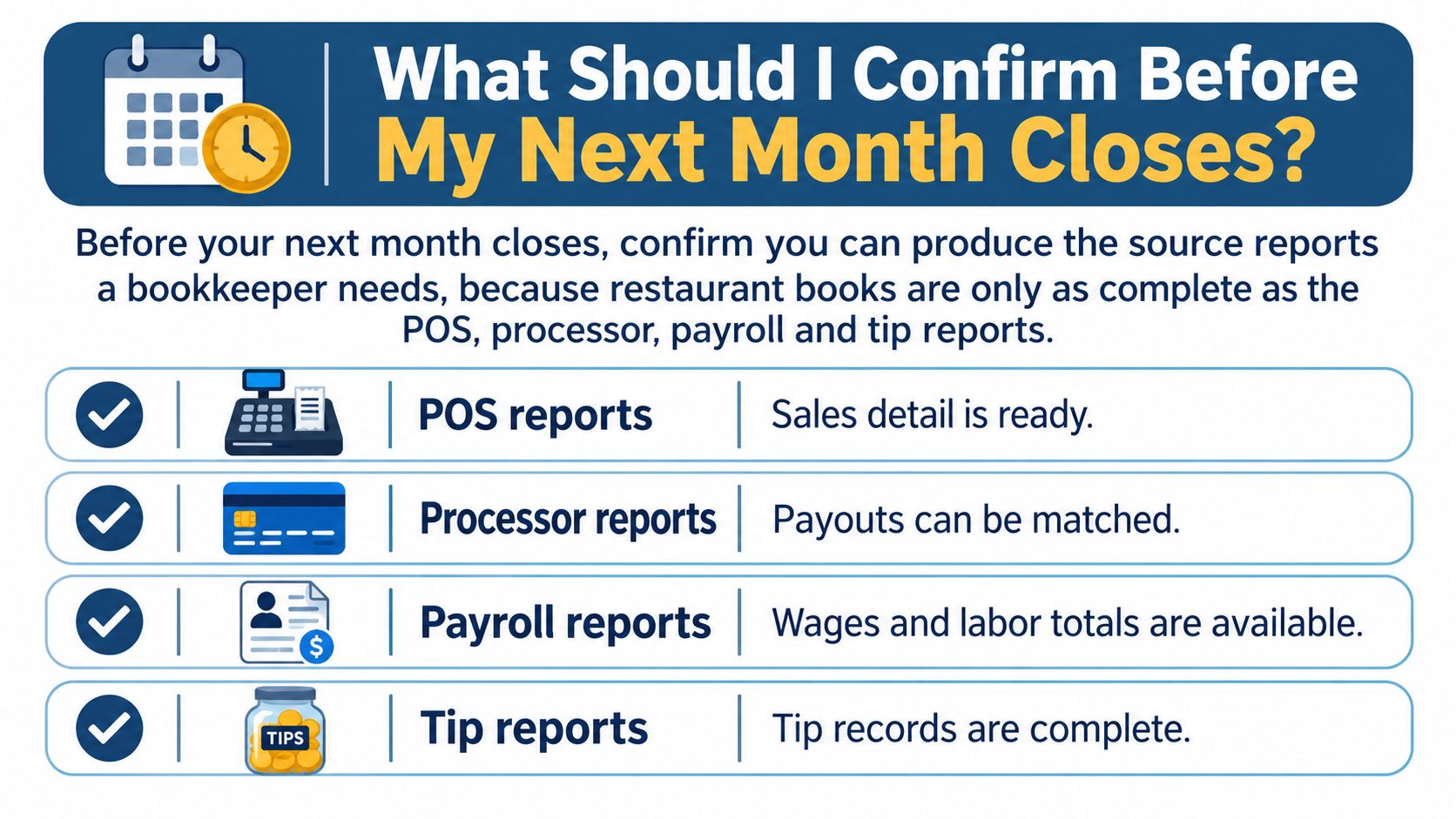
- POS summaries: Daily totals by payment type, including discounts, voids and service charges.
- Settlement reports: Merchant processor and delivery-platform detail, not just payout notifications.
- Payroll and tip records: Payroll registers, timekeeping, employee tip reports and distribution records.
- Account statements: Bank and card statements, with feeds connected and account access current.
- Restaurant categories: A chart of accounts that separates operating costs consistently.
- Variance documentation: An explanation and supporting report for each unresolved difference.
- Reporting date: An agreed date for monthly statements and responsibility for outstanding questions.
Downloadable reports preserve the detail needed to investigate refunds, deposits and payroll adjustments. Screenshots of dashboard totals can leave a manager without enough information to trace a difference.
Blue Sage Tax and Accounting Inc. provides monthly bookkeeping and accounting for restaurant and hospitality businesses. Monthly bookkeeping includes reconciling every bank and card account, consistent transaction categorization and financial statements shortly after each month closes.
For restaurant bookkeeping that connects reconciled accounts with monthly reporting, visit Blue Sage Tax & Accounting Inc. to learn about the firm's services. Bring your POS, payroll and settlement reports to discuss your restaurant's bookkeeping needs. Book a consultation call to discuss your restaurant's bookkeeping needs.
This article is general information, not tax advice for your specific situation.