A usable accountable plan sample requires three things for every payment: a business connection, timely substantiation, and return of any excess. Labeling a document an accountable plan isn't enough on its own.
That's the point most popular advice gets backwards. Owners search for a template, sign it, file it away, and keep paying themselves the same way they did before. The signed PDF doesn't do the work. The expense reports, receipts, approvals, bookkeeping entries, and repayments do. If those records don't exist month after month, there's no operating plan to rely on, only a title page.
For an S corporation owner, that distinction matters because you aren't a sole proprietor picking up costs on Schedule C. You're an employee of your own corporation for this purpose, and the corporation needs a clean path to reimburse costs you paid personally. The sample below is built as that path, not as a standalone form.
Table of Contents
- What Must an Accountable Plan Sample Include?
- Which Expenses Can an Accountable Plan Sample Reimburse?
- How Do I Write the Sample Policy?
- When Are Records and Excess Advances Due?
- How Does an Owner Submit Expenses and Get Reimbursed?
- Do Mileage Rates and Multi-State Costs Change the Sample?
- What Mistakes Make Reimbursements Taxable Wages?
- Is My Accountable Plan Sample Ready to Adopt?
What Must an Accountable Plan Sample Include?
An accountable plan sample is a written employer reimbursement arrangement under which amounts stay out of wages only when each expense has a business connection, the employee substantiates it within a reasonable period, and any excess advance or reimbursement is returned. Those three tests are the whole structure. Miss one for a payment and that payment doesn't get accountable plan treatment.
These are federal rules, stated in Treasury Regulation section 1.62-2 and explained for employers and employees in IRS Publication 463. They are not a New York State, New York City, or New Jersey statute, and the sample shouldn't present them as one.
Why an S Corporation Owner Can't Skip the Plan
As an S corporation owner, you can't run the company like a Schedule C sole proprietorship. A sole proprietor deducts business costs directly on a personal return. A shareholder-employee doesn't. Costs you pay personally for the corporation become the corporation's costs only when the corporation reimburses you under a plan that meets the federal tests. Without that step, the expense sits in the wrong place, on your personal card, outside the corporate books.
That's why the sample has to do more than recite the three tests. IRS Publication 463 describes an accountable plan sample for an S corporation or LLC taxed as a corporation as requiring a deductible expense incurred while performing services for the business, substantiation capturing the amount, date, place, and business purpose, and repayment of excess amounts. Publication 463 also states that records provided to the business should be equivalent to the information that would be required if the deduction were examined.
A Label Compared With an Operating Policy
A PDF titled "accountable plan" that nobody follows fails that standard. A working sample names the form fields, says who approves an owner-employee's own report, explains how the payment is posted in the books, and sets out what happens to an unreturned advance. Those four operating details are what separate a policy from a label.
Practical rule: If your sample doesn't tell a bookkeeper what to post and what to file, it isn't finished yet.
Say an electrical contractor in New York with about $400,000 in revenue buys fuel and small tools on a personal card between job draws. Before the corporation reimburses those charges, the sample must capture the vendor, amount, date, job or business use, and the receipt for each purchase. It must also say who checks the report when the buyer and the owner are the same person. The expense table in the next section is the working sample for exactly that decision.
Which Expenses Can an Accountable Plan Sample Reimburse?
The sample can reimburse only costs that are deductible to the business and were paid while the owner or employee performed services for it, and each reimbursement needs a matching record. Copy a row into your policy only when both conditions are met for that expense. If either one fails, the payment doesn't belong in the plan.
| Expense | Sample must capture | If substantiated | Fails the plan |
|---|---|---|---|
| Business mileage | Date, origin, destination, purpose, miles, vehicle, rate used | Company vehicle expense, not wages | Flat car allowance with no log |
| Travel and lodging | Amount, date, place, business purpose, receipt | Travel expense | Personal days not split out of the trip |
| Business meals | Amount, date, place, who attended, business purpose, receipt | Meal expense, subject to the business deductibility limit | Meal or entertainment with no business purpose |
| Supplies and tools | Date, vendor, amount, business use, receipt | Supplies or tools | Household or personal items |
| Mixed-use cell phone | Business-use support and only that portion | Business portion only | Reimbursing the entire personal bill |
| Home office paid personally | Regular and exclusive business use and the calculation | Home-office reimbursement | Unallocated rent or mortgage |
| Dues and job education | Invoice and connection to services for the company | Dues or education | Credentials unrelated to the business |
| Cash advance | Amount, date, later substantiation or repayment | Expense up to the amount substantiated; remainder returned | Excess never returned |
Mileage, Travel, and Meals
Business mileage needs a log, not an estimate at year end. Each line should show the date, where the trip started and ended, why it was a business trip, the miles, the vehicle, and the rate used. A flat car allowance paid with no log doesn't meet that record requirement, because there's nothing tying the payment to actual business driving.
Travel and lodging need the amount, date, place, business purpose, and receipt for each cost. The common failure is a mixed trip. If an owner adds vacation days to a job trip, the personal days have to be split out before reimbursement. Reimbursing the whole hotel bill without that split supports personal costs with company money.
Business meals need who attended and why, on top of the amount, date, place, and receipt. Say a New York restaurant owner meets a vendor for a meal in New Jersey. The location doesn't change the record. The form still needs the attendees, the business reason, the amount, and the date. A meal can be excludable to the employee under an accountable plan and still only partly allowable to the business as a deduction, and entertainment is generally not a reimbursable business expense.
Supplies, Phones, and Home Office
Supplies and tools are the simplest row. Date, vendor, amount, business use, and receipt are enough. The failure mode is household or personal items mixed into the same purchase, so split those out before you submit.
A mixed-use cell phone requires support for the business-use portion, and the plan reimburses only that portion. Paying the entire personal bill through the company overstates the business cost and leaves nothing showing how much of the bill was personal.
Home office costs an owner paid personally need two things the other rows don't. The space must be regularly and exclusively used for business, and the reimbursement must rest on a calculation, not on an unallocated share of rent or mortgage. A spare bedroom that doubles as a guest room doesn't meet the exclusive use test, however the form is filled out.
Dues, Education, and Advances
Professional dues and job-related education need an invoice plus a stated connection to the services performed for the company. A credential or course with no tie to the company's work doesn't have a business connection, even if it's useful to the owner personally.
Cash advances are tracked differently because the money moves before the expense happens. The sample must record the amount and date, then require either later substantiation or repayment. An advance that's never accounted for isn't a reimbursement. It's an open amount the owner owes back.
The next section turns these rows into policy language you can adopt.
How Do I Write the Sample Policy?
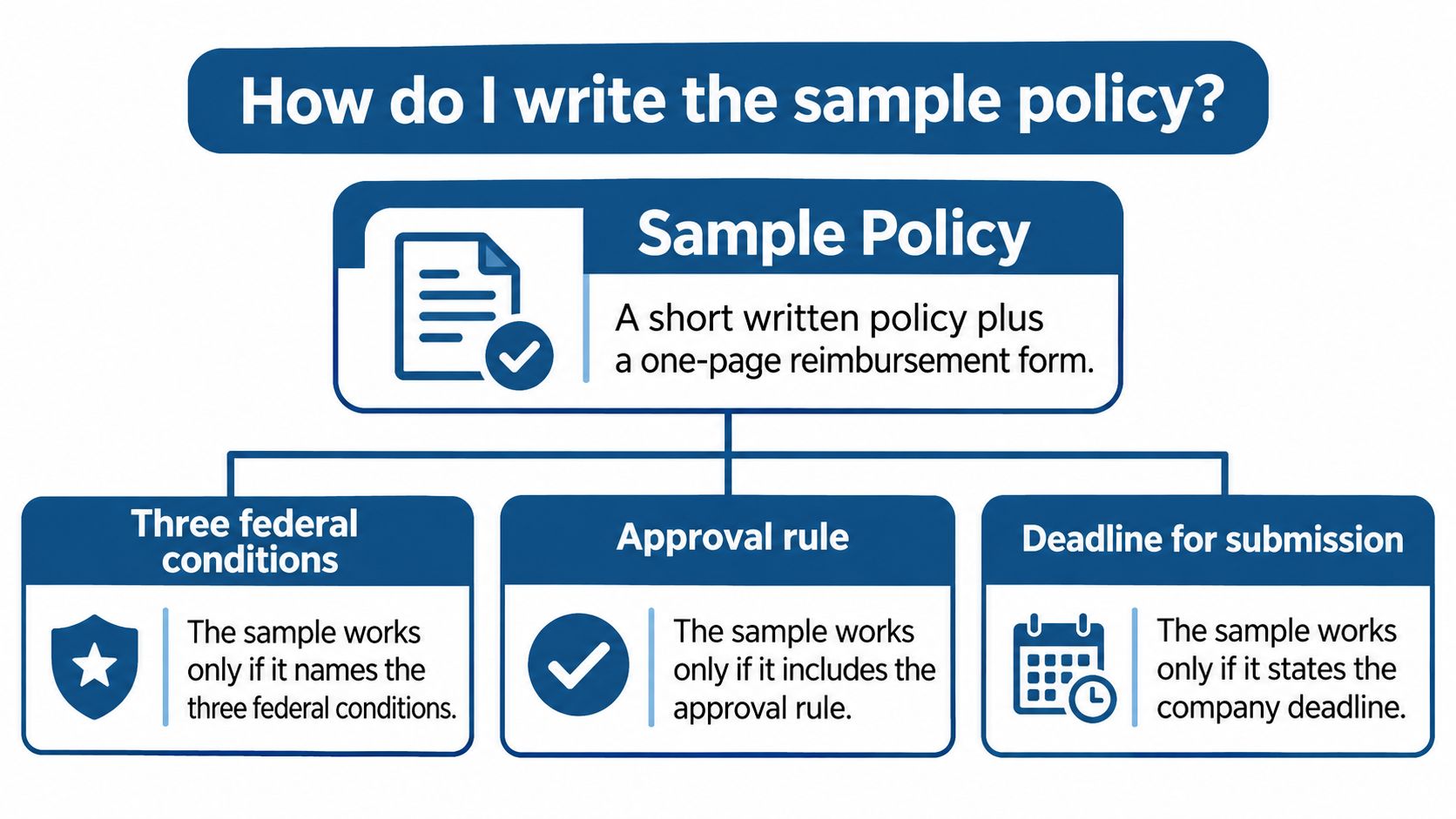
The sample is a short written policy plus a one-page reimbursement form, and it works only if it names the three federal conditions, the approval rule, the deadline the company chooses, and the payroll path for unsupported amounts. Leave out any one of those four and the document can't run itself. The clauses below are copy-ready text you can adapt, not a download.
The diagram below shows how those pieces fit together before you read the clauses.
Copy-Ready Clauses for the Sample
- Who's covered: This policy covers employees of the company, including shareholder-employees of an S corporation or an LLC taxed as a corporation, for business costs they pay personally.
- Three conditions: The company reimburses an expense only when it has a business connection, the employee substantiates it within the policy deadline, and any amount above substantiated expenses is returned.
- Eligible categories: Reimbursable categories are those listed in the company's expense table, including mileage, travel, lodging, business meals, supplies, the business portion of a mixed-use phone, qualifying home office costs, and job-related dues and education.
- No vague descriptions: "Miscellaneous" isn't an acceptable description. Every line states what was bought and why the business needed it.
- No flat allowances without records: The company doesn't pay a flat allowance unless the same substantiation rules in this policy are met for the underlying costs.
- Submission deadline: Expense reports are due by the deadline the company sets in this policy, chosen to meet the federal benchmarks for a reasonable period.
- Single-owner approval control: When the owner is the only employee, the owner attaches the receipt or log to the signed form and keeps it with the corporate records, because self-approval with no paper is the usual weak spot.
- Advances tracked as owed back: An advance is recorded as an amount owed to the company until it's substantiated with an expense report or repaid.
- Payroll path for unsupported amounts: Amounts that aren't substantiated or returned are treated as wages and run through payroll.
The one-page form that goes with these clauses should require the amount, the date, the place when relevant, the business purpose, the receipt or mileage fields, and a signed statement that any excess will be returned. That statement matters. It puts the return obligation on every report, not just in a policy the owner read once.
The video below walks through the same policy structure in a different format.
What the Federal Result Depends On
Under Treasury Regulation §1.62-2, payments meeting the business-connection, substantiation, and excess-return requirements are excluded from the employee's gross income, omitted from Form W-2 wages, and generally exempt from federal income-tax withholding and employment taxes. The same regulation limits accountable-plan treatment to amounts not exceeding substantiated expenses, so the unsupported portion is treated as paid under a nonaccountable arrangement.
That's why clauses 7 through 9 aren't optional detail. An approval workflow, documentation fields, a reimbursement schedule, tracking for outstanding advances, and a payroll escalation rule are what make the three federal conditions happen in practice. A journal entry alone doesn't prove the business connection or the adequate accounting, so keep the submitted records and repayment evidence with the corporate books. Operating the plan consistently may affect how payments are treated, depending on your circumstances, but the clauses don't promise any particular dollar result.
When Are Records and Excess Advances Due?
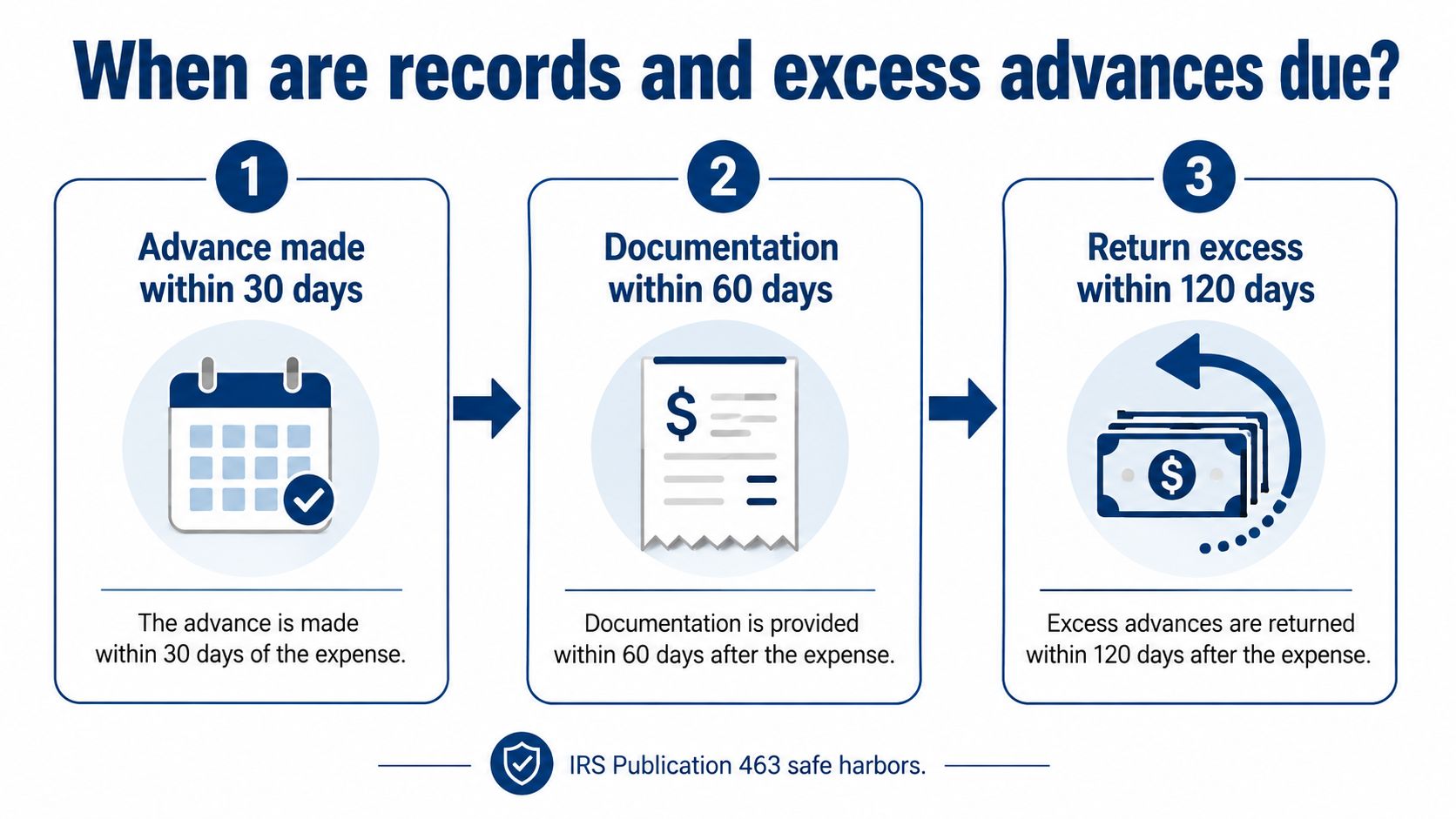
IRS Publication 463 describes federal timing safe harbors under which an advance is made within 30 days of the expense, documentation is provided within 60 days after the expense is paid or incurred, and excess is returned within 120 days. There's also an alternate method built on periodic statements. Your sample should pick deadlines that meet these benchmarks and apply the same clock to owner-employees as to everyone else.
The flow below puts the three benchmarks in order.
The Safe Harbor Benchmarks and the Statement Alternative
The current edition of IRS Publication 463 treats accounting within 60 days after an expense is paid or incurred and returning excess reimbursement within 120 days after the expense is paid or incurred as reasonable-period benchmarks. Under the alternate periodic-statement method, the employer issues a statement at least quarterly and the employee accounts for or repays outstanding amounts within 120 days of that statement.
Read those numbers the right way. They're federal timing guidelines for what's a reasonable period, not permission to keep an unsupported advance until the last day, and not a New York or New Jersey filing deadline. A well-run plan asks for reports monthly and treats the safe harbor as the outer limit, not the target. Because the figures are federal and reviewed by the IRS over time, cite the current edition of Publication 463 in your policy rather than an internal memo, so anyone can check the benchmark against the live publication.
The safe harbor is a ceiling, not a schedule. Monthly reports keep you comfortably inside it.
Good record habits make those deadlines easy to hit. Keeping receipts, invoices, and logs filed by month as they arrive, the same discipline behind sound invoice organization for small business owners, means the expense report assembles itself instead of becoming an archaeology project two months later.
What a Missed Deadline Changes
After a missed deadline, the unsubstantiated or unreturned portion is no longer an accountable plan payment. It doesn't lose that status only if someone notices. The policy's payroll rule takes over, and the amount is handled as wages. That's the consequence your sample should state in plain terms, so an owner who sits on receipts understands what the delay costs in treatment, not just in tidiness.
Keep two different clocks separate in your sample. The deadline to submit a report is governed by the federal benchmarks. The company's reimbursement payday is your own choice. You can pay weekly or monthly, whichever fits your cash flow, as long as submission and repayment still meet the federal clocks. Confusing the two is how owners end up thinking a monthly payday excuses a report submitted four months late. It doesn't.
How Does an Owner Submit Expenses and Get Reimbursed?
A monthly cycle runs the policy from a personal payment to a posted reimbursement, with each step tied to a bookkeeping result. The routine below is written so a bookkeeper can run it without interpreting the policy each time. The deadlines come from the timing rules already covered, so this section focuses on sequence and posting.
The Seven-Step Monthly Routine
- Pay and capture the same day: The owner pays a company cost personally and keeps the receipt, or starts the mileage line that day.
- Complete the form on time: Within the policy deadline, the owner fills in the amount, date, place, purpose, and support, and separates any personal portion before submitting.
- Approve the report: The report is approved under the policy, including the single-owner control of attaching support and filing it with corporate records.
- Pay only what's substantiated: The company pays the substantiated amount from the business account and files the form with the receipt.
- Post to expense categories: Bookkeeping posts the payment to mileage, travel, supplies, or the other expense accounts, not to shareholder distributions or wages.
- Clear any open advance: An open advance is reduced by the substantiated amount, and any leftover is repaid to the company or moved to payroll under the policy rule.
- Reconcile at year end: The company reconciles advances, checks that every reimbursement has support, and confirms nothing coded as a distribution was really a reimbursement, or the reverse.
IRS Publication 463, 2024 edition, describes an advance within 30 days of incurring an expense, adequate documentation within 60 days after paying or incurring it, and return of excess amounts within 120 days. The benchmarks appear in the table below as a reference for the routine.
| Event | Federal benchmark | What the sample should say |
|---|---|---|
| Advance before the expense | Within 30 days of when the expense is incurred | Do not fund open-ended draws |
| Substantiation | Within 60 days after the expense is paid or incurred | Reports after the window are not treated as timely |
| Return of excess | Within 120 days after the expense is paid or incurred | Unreturned excess leaves the accountable plan |
| Periodic statement alternative | Statement at least quarterly, then account or repay within 120 days of the statement | Use one method and apply it to owner-employees |
The Routine in Practice
Say the electrical contractor buys materials on a personal card between customer draws. She submits the receipts with the job named on each line, the company reimburses the substantiated total from the business account, and bookkeeping posts it to job supplies. If she'd taken an advance for the purchase, the reimbursement clears that advance instead of increasing her wages. The money movement looks ordinary because the paper behind it is complete.
A corporate credit card doesn't skip any of this. When the company pays the card directly, the same fields are required for each charge, because the card statement shows a vendor and an amount but not a business purpose. Companies that create consistent employee reimbursement policies apply one standard to personal payments, advances, and company card charges alike, which keeps owner spending from drifting into a separate, looser track.
Do Mileage Rates and Multi-State Costs Change the Sample?
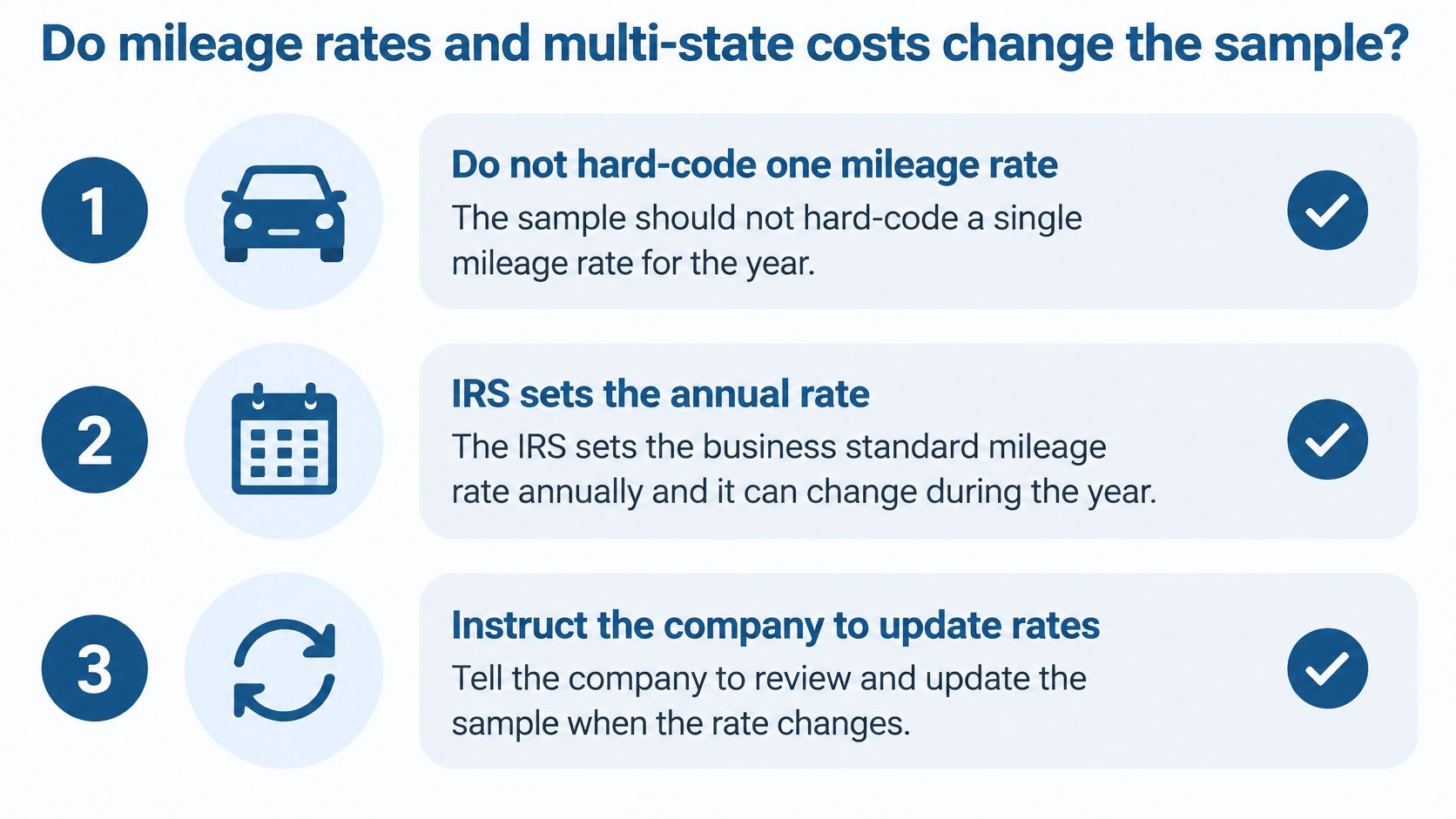
A useful mileage clause works like an operating rule, not a number printed once and forgotten. The IRS publishes a business standard mileage rate each year, and the company should confirm the current rate in the IRS notice or publication for that year before paying a claim. Keep the applicable rate with each trip entry so the reimbursement can be traced to the rule in effect when the trip occurred.
The checklist below summarizes three habits for keeping mileage reimbursements current.
Mileage Records That Survive a Rate Change
Record the trip date, origin, destination, business purpose, miles, vehicle, rate, and reimbursement amount on each mileage line. When the rate changes, trips before the change retain the earlier rate, while later trips use the new one. Keeping the rate beside each trip makes the calculation easy to follow without rebuilding the log later. An auto mileage log organized around these fields is more useful than a year-end odometer estimate.
The policy should explain how to handle a rate change: check the current IRS notice or publication, update the rate used for new trips, and preserve the old rate on earlier entries. That instruction gives the person approving claims a clear process to follow.
Keep a line-by-line mileage reimbursement distinct from a flat monthly allowance. A flat payment that is not adequately supported may fail accountable plan treatment and become taxable wages. A mileage log connects the payment to actual business trips rather than leaving it as an unexplained allowance.
Entity, Currency, and State Complications
Cross-border and multi-state activity does not remove the federal accountable plan requirements. For a foreign-owned U.S. business, the policy should identify the U.S. entity making the reimbursement, the currency shown on a foreign receipt, and the conversion rate used in the company's records. Those details help the books show which entity paid the cost and its amount in dollars.
The same principle applies when an owner travels across state lines. A transportation business with trips between New York and New Jersey should ensure the reimbursement is paid by the right company and recorded in that entity's books. State tax treatment may differ, so a policy should not present one state's rule as applying nationwide or assume every state follows federal treatment. For cross-border reimbursements, the IRS page on nonresident aliens and the accountable plan rules provides guidance on the federal rules.
What Mistakes Make Reimbursements Taxable Wages?
A signed plan doesn't protect reimbursements that miss the business-connection, substantiation, or excess-return tests, and those amounts are treated as nonaccountable wages for federal income-tax withholding and employment-tax purposes. The popular assumption is that adopting the document settles the question. It doesn't. The records decide.
| Question | Accountable amount | Nonaccountable amount |
|---|---|---|
| In the employee's gross income | No | Yes |
| Reported as Form W-2 wages | No | Yes |
| Federal income-tax withholding and employment taxes | Generally no | Yes |
| What the company must keep | Receipts, log, and proof excess was returned | The wage record for the unsupported amount |
| What a journal entry alone proves | Nothing | Nothing |
A Short Diagnostic, With One Fix Each
- Signed policy, no monthly reports: Start the submission cycle. The policy can't substantiate anything by itself.
- Vague "miscellaneous expenses" lines: Replace them with amount, time, place, and purpose. IRS guidance on accountable and nonaccountable plans rejects vague categories such as "miscellaneous expenses" and expects enough detail to identify the expense and its connection to the employer's business.
- Owner draws labeled as reimbursements with no receipts: Recode only when support exists. Otherwise treat the amounts as wages or distributions as the facts require, and don't invent a reclass entry to fix the label.
- Unreturned advances: Repay them to the company or run them through payroll. Leaving them open is the failure itself.
- Personal and business use on one bill with no split: Reimburse only the supported business portion, whether it's a phone bill or a vehicle cost.
- Year-end money movement with no contemporaneous log: The reasonable-period rules have already failed by the time the entry is made. A December reconstruction doesn't cure a March expense with no record.
- Assuming the owner can deduct the same costs on a personal return instead: Don't rely on that as the fallback. The sample's job is the corporate reimbursement, and fixing the plan is the cleaner path.
These failures cluster where personal and business use mix. A construction owner fuels a truck used on weekends, a trucking or livery owner runs personal errands in the work vehicle, a restaurant owner buys supplies alongside household groceries, and a rental owner pays a contractor from a personal account. Each case needs the split made at submission, not estimated later. Owners sorting out which payments belong on payroll also need their salary itself set correctly, which is why reimbursement cleanup often pairs with a review of what reasonable compensation means for an S corporation owner.
The decision is simple. If more than one row of the comparison above is failing in your current books, adopt the sample and rebuild the current year's records before adding new expense categories.
Is My Accountable Plan Sample Ready to Adopt?
Adopt the sample only when all five checks below are true, and if draws, allowances, or missing logs already sit in this year's books, fix those before relying on the plan. A signed sample doesn't rewrite past payments.
- Three federal tests stated: The policy requires a business connection, substantiation within a reasonable period, and return of excess amounts.
- Form matches the expense table: Every category you reimburse has fields for its record.
- Deadlines meet the benchmarks: Your submission and repayment deadlines fall inside the Publication 463 safe harbors.
- Mileage can change: Each mileage line stores its own rate and names the paying entity.
- Unreturned amounts have a payroll path: The policy says unsupported amounts become wages.
If all five are true, run the monthly cycle. If not, separate substantiated costs from amounts that belong on payroll before year end. Blue Sage Tax and Accounting Inc., an accounting firm, can review that separation with you. Our S-corporation service includes an accountable plan for home office, mileage, and owner reimbursements, and our process has three steps: a free consultation call, a fixed quote in writing before anything starts, and then filing with a projection before year end. Book your free consultation call today.
This article is general information and not tax advice for your specific situation.
If your S corporation reimbursements currently run on memory and card statements, we can help you put a written accountable plan, a matching expense form, and a monthly submission routine in place that fits how your business spends. Visit Blue Sage Tax & Accounting Inc. to see how our S-corporation service handles home office, mileage, and owner reimbursements alongside your corporate return and payroll.