
A U.S. person must file an FBAR for a calendar year when they have a financial interest in, signature authority over, or other authority over foreign financial accounts whose combined value exceeded $10,000 at any time that year. This is a federal reporting requirement that can apply to individuals and domestic entities.
Could you need to report an account even if its year-end balance is small, or none of the money belongs to you? Yes. Account ownership, signing authority, and peak balances matter more than many readers expect.
Table of Contents
- Do I Need to File an FBAR?
- How Does the $10,000 Threshold Add Up Across Accounts?
- Does Signature Authority Alone Trigger an FBAR?
- Do Joint, Business, and Trust Accounts Change My Filing?
- When Is the FBAR Due and Where Do I File It?
- What Penalties Apply to a Late or Missed FBAR?
- What Should I Do Before the Next FBAR Deadline?
Do I Need to File an FBAR?
Do you need to file an FBAR? Usually, the answer depends on three tests: whether you are a U.S. person, whether a foreign account is connected to you through ownership or authority, and whether the total value of reportable accounts went over $10,000 at any point during the calendar year. The IRS's FBAR guidance covers individuals and domestic entities.
The threshold is a peak-balance test, not a December 31 snapshot. For example, an account that briefly held $11,000 during the year may count even if withdrawals left only $2,000 at year-end. The next section explains how balances across accounts are combined.
Start by identifying who could have a filing obligation. An individual and a domestic entity may each need to assess the same account separately.
Who counts as a U.S. person for FBAR purposes?
The filer categories below follow the IRS guidance. These examples identify situations to review, not automatic filing outcomes.
| Filer type | Typical examples | What to check |
|---|---|---|
| U.S. citizen | Individual living in the U.S. or abroad | Personal and joint accounts, plus accounts with signing authority |
| U.S. resident, including resident aliens | Green-card holder or person meeting U.S. residency tests | Foreign accounts held personally or through a U.S. business |
| Domestic corporation | C corporation or S corporation | Foreign accounts the company owns or controls |
| Domestic partnership or LLC | Partnership or single-member or multi-member domestic LLC | Accounts held by the entity and each person's ownership or authority |
| Trust | U.S. trust | Trust-held accounts and the trustee's authority |
| Estate | Estate of a U.S. person | Foreign accounts held during administration |
Check each potential filer separately for each calendar year. For instance, a domestic company may have its own reporting obligation, while an owner may separately need to assess personal accounts or accounts over which they have authority. One filing does not automatically cover the other.
Common accounts to review include foreign bank, brokerage, and mutual fund accounts. Also check inherited savings and business investment accounts, even if you do not use them for everyday transactions. Confirm the rules for the relevant reporting year with current IRS guidance.
How Does the $10,000 Threshold Add Up Across Accounts?
The threshold applies across reportable foreign accounts, not separately to each account and not merely to the year-end balance. Several modest accounts can create a filing obligation together, as the IRS explains in its foreign-account reporting guidance.
Think of your accounts as buckets. Looking at each bucket separately can miss the aggregate amount, while looking only at the end of the year can miss money that passed through earlier.
A useful review therefore starts with account records, not a recollection of what remained after withdrawals.

Which balance scenarios can trigger filing?
The following hypothetical scenarios illustrate the historical threshold discussed above. The checking-and-brokerage arithmetic and full-value treatment of jointly owned accounts follow the IRS's FBAR examination guidance.
| Scenario | Account values at peak | Combined peak | Threshold met |
|---|---|---|---|
| Checking and brokerage in the same year | $7,000 and $4,000 | $11,000 | Yes |
| Two accounts that never combine above the threshold | Both remain modest throughout the year | Does not exceed the threshold | No |
| Sale proceeds parked abroad for three weeks | Temporary deposit pushes covered balances above the threshold | Above the threshold | Yes |
| Joint account shared 50/50 by two spouses | $15,000 total balance | $15,000 counted by each owner | Yes, for each owner, subject to applicable filing exceptions |
Don't assume that peaks occurring on different dates eliminate reporting. Gather each account's maximum value and apply the aggregation instructions, rather than using a year-end snapshot or informally netting transfers between accounts.
Balances must be expressed in U.S. dollars, so currency conversion matters near the threshold. Sale proceeds, a bonus transfer, or an inheritance can affect the analysis even when the money stays abroad only briefly.
Practical rule: A short stay in an account doesn't make a deposit irrelevant to the annual reporting test.
Consider a contractor with $400,000 in hypothetical gross annual revenue. Revenue isn't the FBAR threshold measure. The contractor needs account-balance information for the relevant business and personal filing analyses, whatever the business earns.
Foreign-asset reporting on a tax return raises a separate question. See the explanation of Form 8938 and foreign financial asset reporting rather than assuming that one disclosure replaces another.
Does Signature Authority Alone Trigger an FBAR?
Yes, signature or other authority can create an obligation even if you own none of the money. The relevant question is whether you can control the disposition of account assets through direct communication with the financial institution, subject to applicable exceptions.
The IRS's FBAR reference guide explains signature authority and reporting exceptions. Ownership and control are different routes into the filing analysis.
A business account review should therefore include authorized signers, not just owners.

What does this mean for employees and family signers?
Suppose a bookkeeper at a U.S. LLC can instruct a foreign bank to wire money from the company's operating account. The funds belong to the LLC, but the bookkeeper's authority still needs review. The company has its own filing analysis.
The same issue can affect managers, corporate officers, employees of multinational businesses, and someone authorized to move money for a relative. A job title alone doesn't answer the question. Review what the person can in fact direct the institution to do.
Potential exceptions or exclusions include:
- Specified officers and employees: Certain employees or officers of federally regulated banks or publicly traded corporations may qualify under particular conditions.
- Military banking facilities: Certain accounts maintained at U.S. military banking facilities operated by U.S. financial institutions are generally excluded.
- Certain U.S. retirement-plan accounts: Specific exclusions can apply, but they shouldn't be generalized to every foreign retirement arrangement.
These categories aren't blanket exemptions for employees, military personnel, or retirement savers. Check the precise conditions before relying on one.
Signature authority isn't a loophole that lets a person ignore an account because the company owns the funds. Determine the authority account by account and year by year, including when that authority began or ended.
Do Joint, Business, and Trust Accounts Change My Filing?
The same account can be relevant to more than one filer. An ownership structure doesn't automatically remove an account from reporting, and it can create a need to coordinate separate analyses.
The IRS's explanation of foreign-account reporting identifies domestic entities as potential filers and distinguishes financial interests from signature authority. Apply those principles to the legal owner and the people connected to each account.
- Joint accounts: Each joint owner generally has a financial interest and reports the full value, not merely their economic share. The spouse example above illustrates why dividing a balance between owners can produce the wrong result. Confirm whether any specific spouse-filing exception applies before deciding how to submit.
- Business accounts: An LLC, S corporation, or partnership evaluates accounts on its own behalf. An owner or manager may also need an individual analysis because of ownership or authority. Don't assume that owning a business automatically settles which business accounts belong on the owner's report.
- Trusts and estates: A domestic trust or estate can itself qualify as a U.S. person. Review accounts held during the reporting period and identify trustees or other people with relevant authority.
- Foreign trusts: A U.S. person's treatment of trust-held accounts depends on their interest, authority, and the trust's structure. Trace those relationships before deciding whether the accounts belong in that person's review.
How should multiple filers coordinate?
Build an account register showing the legal owner, joint owners, authorized signers, and financial institution. Then identify which individual or entity needs to evaluate each account.
Reporting the same account for different filers isn't necessarily an error. Omitting it because someone else reports it can be.
For example, a family business might have a company-owned foreign account, an owner who can authorize transfers, and an employee who processes payments. Their relationships aren't interchangeable, even though they concern the same money.
The goal is coordinated reporting, not splitting an account value among everyone involved. Resolve ownership and authority first, then apply each filer's requirements.
When Is the FBAR Due and Where Do I File It?
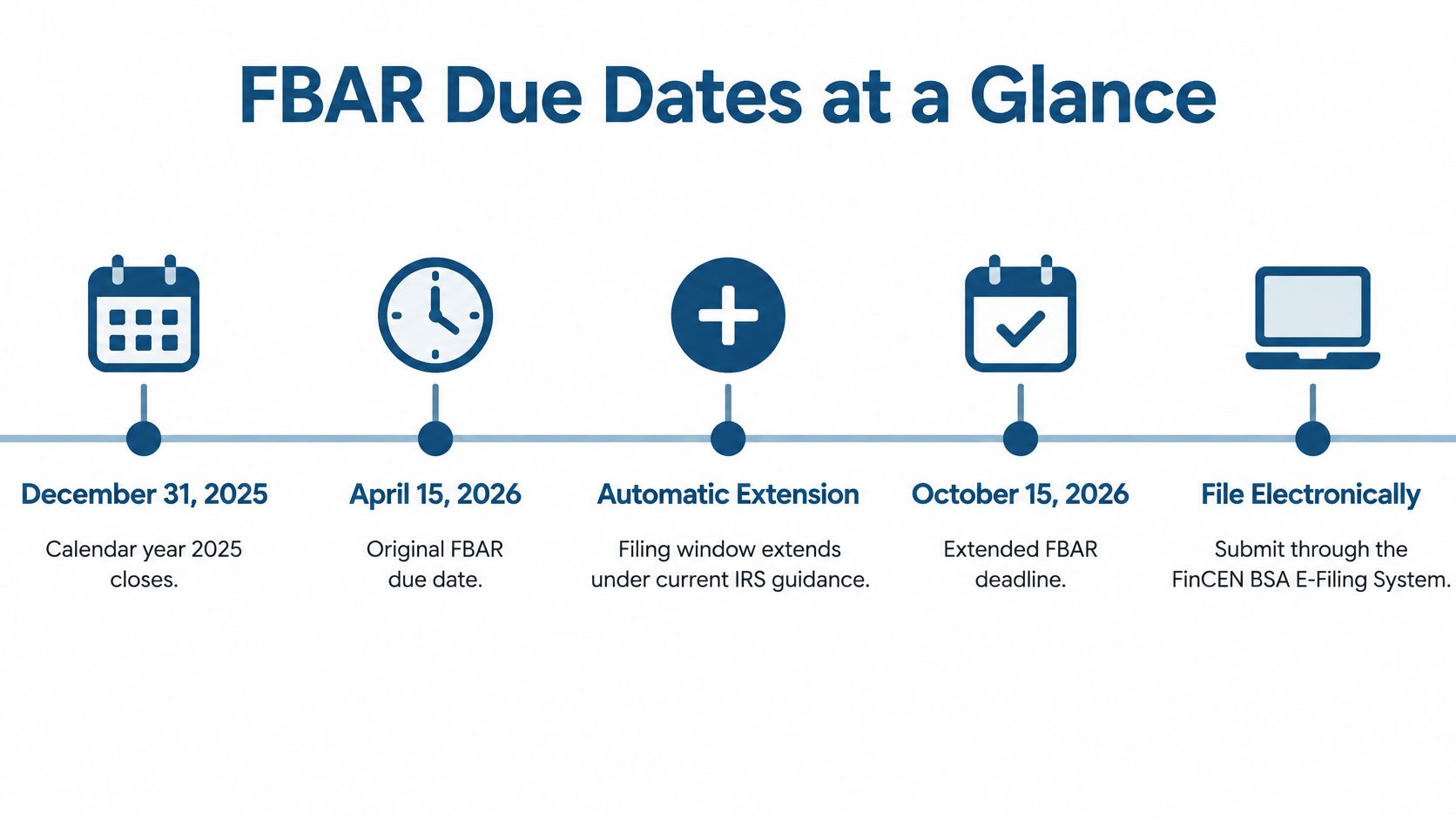
When is your FBAR due, and where should it go? The FBAR for a calendar year is due the following April 15. If you miss that date, an automatic extension gives you until October 15, with no separate extension request. For the 2025 reporting year, the dates are April 15, 2026, and October 15, 2026. FinCEN's FBAR filing guidance explains the due date and automatic extension.
What do I submit and retain?
Submit the FBAR electronically through FinCEN's BSA E-Filing System. It is a separate filing from your federal income-tax return. Reporting foreign interest or dividends on that return does not count as filing an FBAR, as the IRS foreign-account fact sheet explains.
| Item | What applies | Jurisdiction |
|---|---|---|
| Reporting period | Calendar year, such as 2025 | Federal |
| Original due date | April 15 of the following year | Federal |
| Automatic extension | October 15 of the following year | Federal |
| Filing method | Electronic submission through FinCEN's BSA E-Filing System | Federal |
| Records retention | Generally five years from the due date | Federal |
| State filings | No separate state FBAR; foreign-income tax treatment requires separate review | State (varies) |
Keep records showing the account name and number, institution name and address, account type, and greatest value during the year. Monthly statements can help establish the peak balance, even if the account held much less on December 31.
For example, a New Jersey restaurant owner with a location in New York State and a reportable foreign supplier account files the FBAR federally. Neither state receives the FBAR, though the owner should separately review how each state treats foreign income.
The accompanying video offers another way to review the filing process.
Identify the calendar year, use its April 15 due date or October 15 automatic extension, and submit through FinCEN's system. Filing your income-tax return does not file the FBAR.
What Penalties Apply to a Late or Missed FBAR?
FBAR penalties depend in part on whether the failure was non-willful or willful. A non-willful violation generally involves a failure that was not intentional. A willful violation involves a knowing failure or, in some cases, a person's conscious disregard of the filing requirement. The distinction matters: willful violations can carry substantially higher civil penalties and, in serious cases, criminal consequences.
Civil penalties may apply to each violation. For a non-willful violation, the statutory maximum is adjusted for inflation and may be waived when the filer has reasonable cause and the account was properly reported. Willful violations can carry a penalty of up to the greater of a set statutory amount, adjusted for inflation, or 50% of the account balance when the violation occurred. The applicable amount depends on the facts and current law.
Should I simply submit the missing reports?
Delinquent FBAR submission procedures exist for some people who have not filed but reported all income from their foreign accounts and are not under an examination or investigation. If you discover a missed filing, act promptly. Seek professional help to identify the correct procedure, and do not delay submission while waiting to confirm every detail.
A late filing does not automatically qualify for penalty relief. For example, omitted accounts tied to unreported income may require a different response from accounts whose income was properly reported. A tax professional can help assess the filing history, available procedures, and whether legal advice is appropriate. No adviser can guarantee a particular penalty outcome.
What Should I Do Before the Next FBAR Deadline?
Start with a complete account inventory, then determine the filing obligations for each person and entity. Records first, filing conclusions second is a practical approach when accounts overlap.
Use this checklist to organize the review.
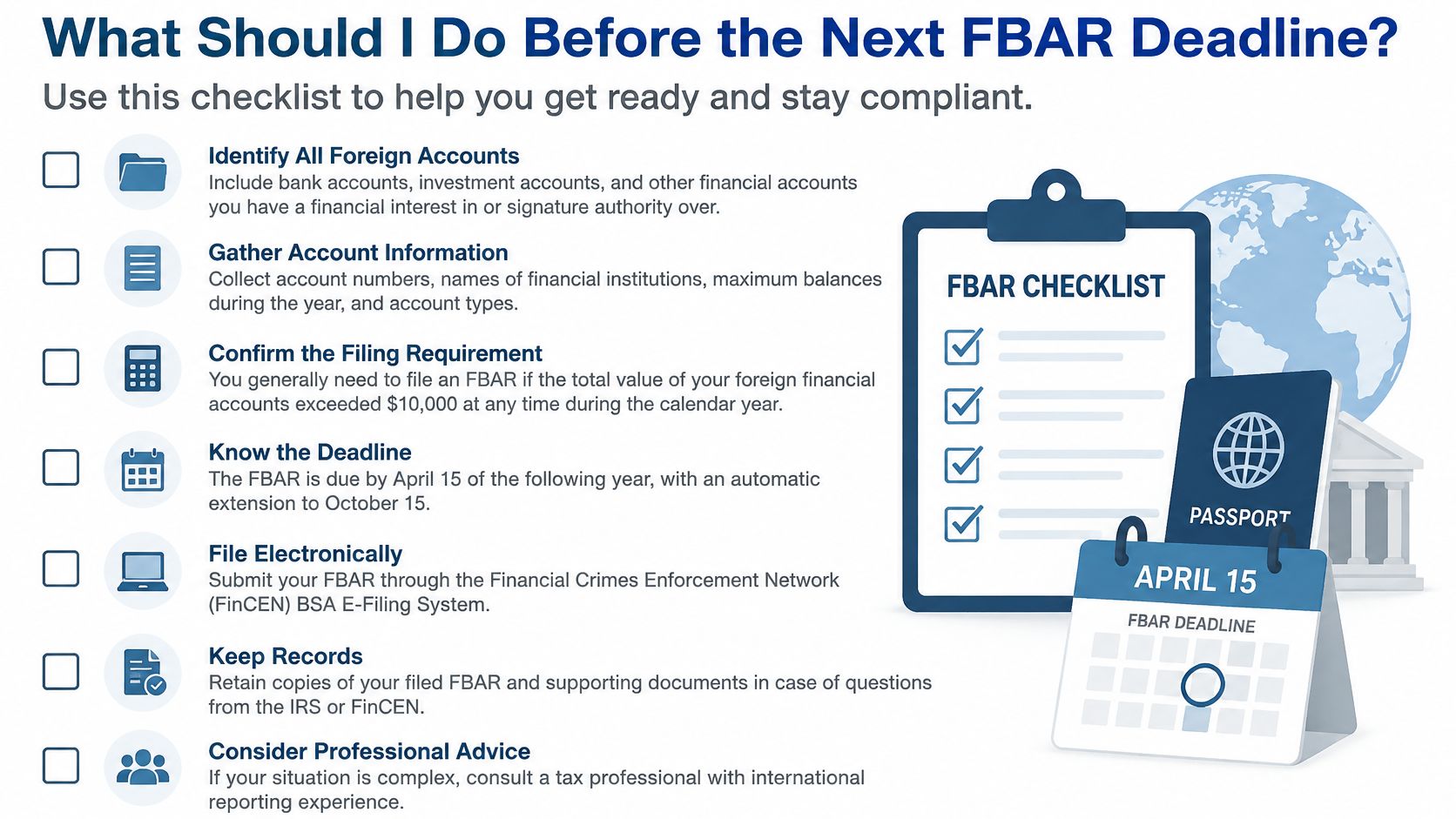
- List every foreign financial account. Record the institution, account type, account number, owners, and anyone with signing authority.
- Obtain records for each calendar year. Use monthly or transaction-level statements to establish maximum balances rather than relying solely on closing statements.
- Convert and group the balances. Express account values in U.S. dollars and organize them by individual, entity, and other relevant signer.
- Run each filer's annual threshold test. Apply the aggregate test discussed above to the appropriate accounts, without dividing joint balances incorrectly.
- Verify exceptions. Match the actual facts to the specific requirements instead of assuming that employment or account labels establish an exemption.
- Confirm the applicable deadline. Check current guidance for the reporting year and any extension.
- Submit through the BSA E-Filing System. If earlier reports are missing, evaluate delinquent-filing options before acting.
What should I bring to a professional review?
Bring statements, ownership documents, signing-authority records, prior FBAR submissions, and relevant tax returns. Identify accounts that closed or changed owners during the year so they aren't overlooked.
A coordinated cross-border tax and accounting review can address FBAR questions alongside expat, nonresident, and foreign-owned U.S. business filings. Those related returns don't replace the account-reporting analysis, but reviewing them together can help identify inconsistencies.
For help organizing foreign-account records and evaluating filing responsibilities, visit Blue Sage Tax & Accounting Inc., an accounting firm serving owner-operated businesses, self-employed professionals, and expat clients. Its services include FBAR, expat and nonresident returns, and foreign-owned U.S. business compliance, with proactive tax projections and direct access to the firm's owner. Book your free consultation call today.
This article is general information and not tax advice for your specific situation.