If you're asking when to pay quarterly taxes in 2026, the standard federal estimated-tax deadlines are April 15, June 15, and September 15, 2026, and January 15, 2027. The payment periods aren't four equal quarters: they cover different spans of the year, so the amount due can depend on when you earned the income. If your revenue is seasonal or arrives late, don't automatically divide your annual estimate into four equal checks. (IRS estimated-tax guidance)
Table of Contents
- Who Owes Quarterly Taxes and the 2026 Federal Calendar
- The Two Safe Harbors That Stop an Underpayment Penalty
- Equal Installments vs. the Annualized Income Method
- How to Run Your Own Quarterly Projection
- Layering in New York City and New Jersey
- Common Mistakes That Trigger Penalties and How to Avoid Them
Who Owes Quarterly Taxes and the 2026 Federal Calendar
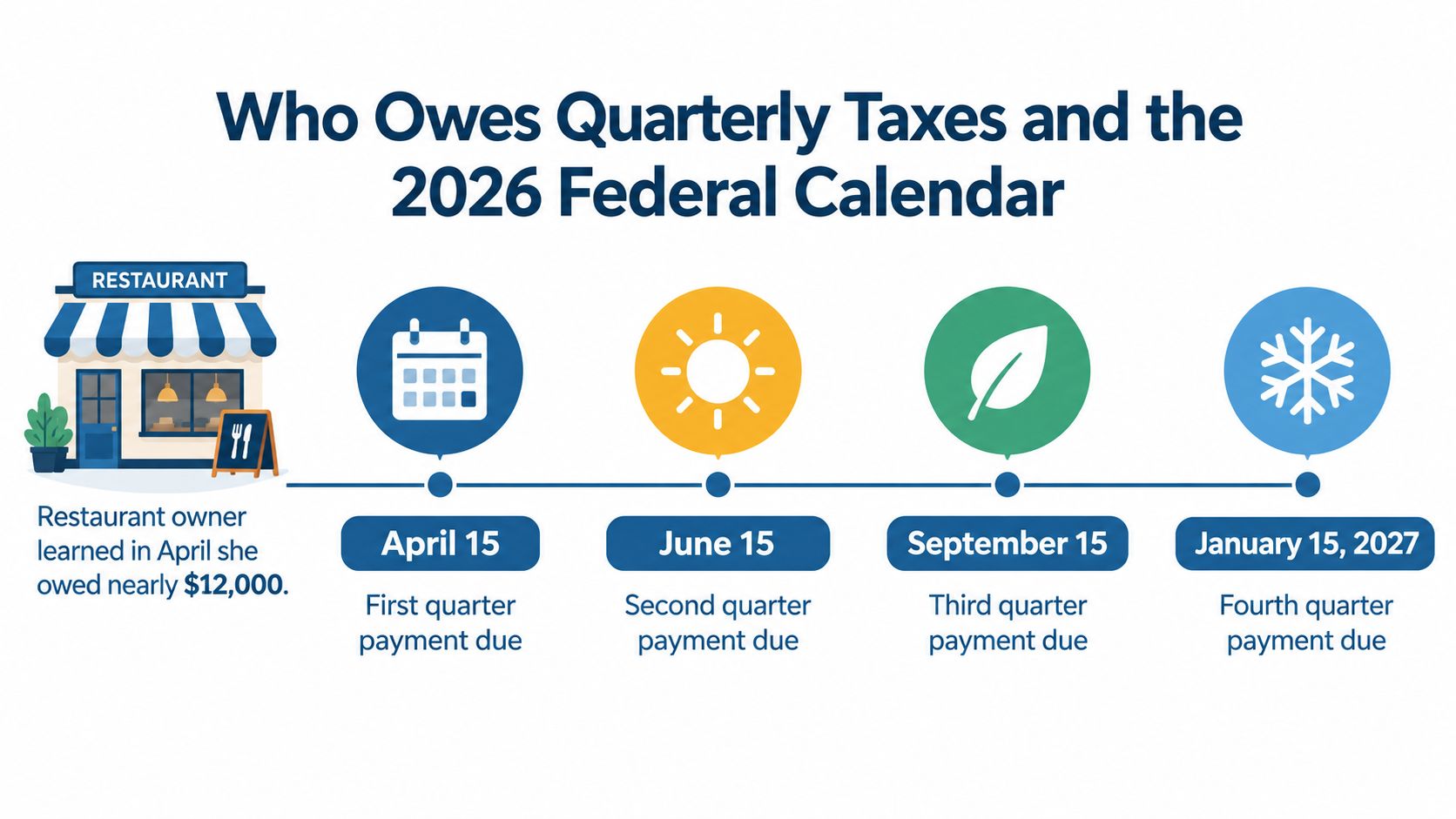
A Bayside restaurant owner who earned 60 percent of her receipts between June and September still faced an April installment calculated on the January through March period. The bill landed months before the busy season produced the cash to pay it. That is the quarterly-tax problem for owner-operators. The IRS expects money as income arrives, and an even four-way split rarely matches how a seasonal business earns.
Estimated tax applies if you are self-employed, run a pass-through business, or receive income that withholding does not fully cover. The practical question is how much was due for each period, not just which dates to circle.
For calendar-year taxpayers, the federal periods and deadlines are:
- January 1 through March 31: payment due April 15, 2026.
- April 1 through May 31: payment due June 15, 2026.
- June 1 through August 31: payment due September 15, 2026.
- September 1 through December 31: payment due January 15, 2027.
Notice the spacing. These are not four equal quarters. The IRS assesses estimated-tax liability period by period, so income that starts flowing in June changes what was required back in April (IRS estimated-tax guidance). An owner who assumes each installment carries the same weight either overpays early and starves the business of cash, or underpays and invites a penalty.
Two scheduling details matter. A deadline falling on a weekend or legal holiday moves to the next business day, and fiscal-year filers follow dates tied to their own fiscal year rather than this calendar. IRS Publication 505 spells out both rules.
My advice to owners of restaurants, construction firms, transportation companies, professional practices, S corporations, and LLCs is the same every year: project taxable income as the year unfolds. Splitting last year's tax into four identical checks is the shortcut that gets seasonal businesses in trouble.
The Two Safe Harbors That Stop an Underpayment Penalty
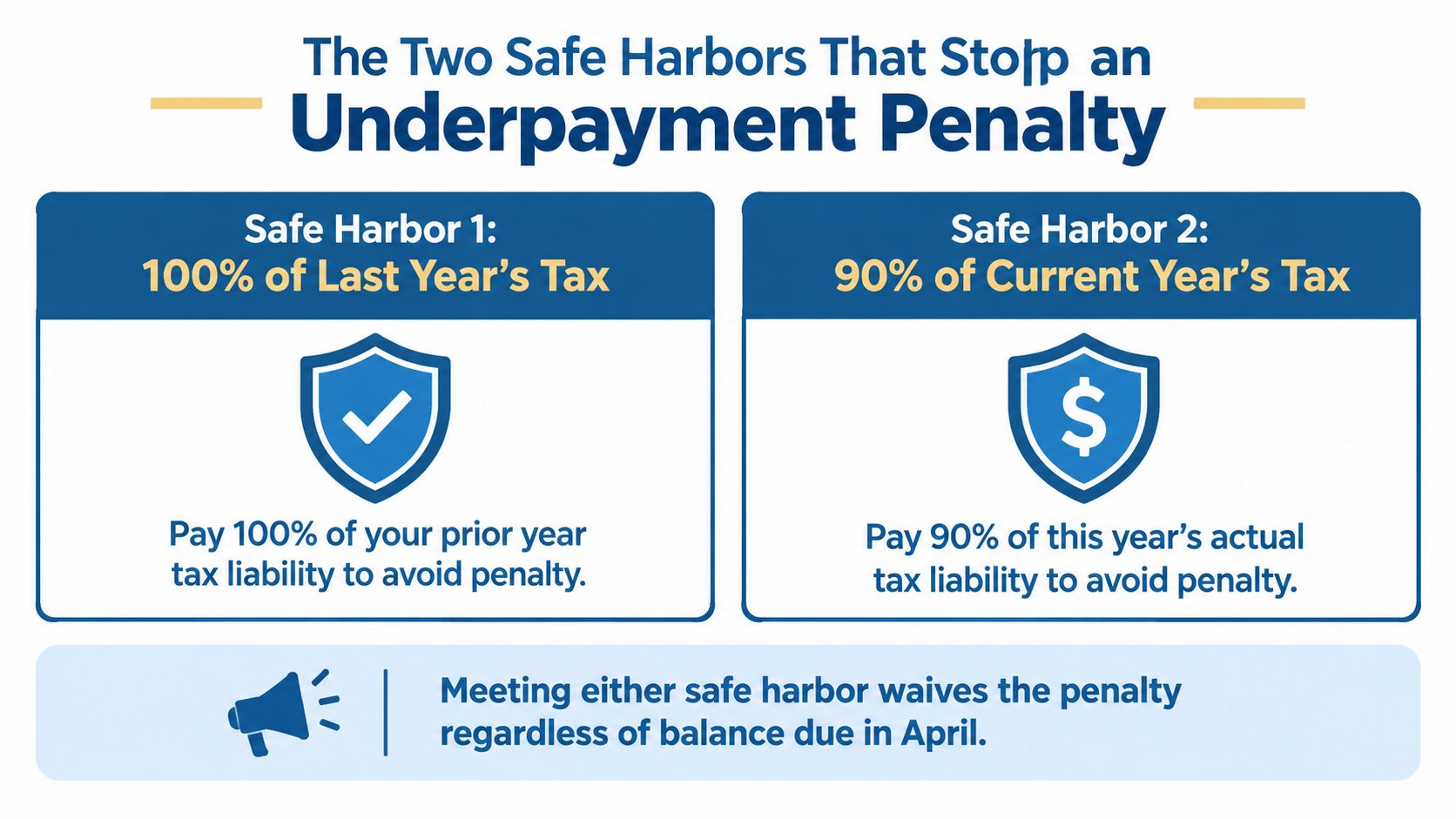
Know the number before you argue about timing. The required annual payment is generally the smaller of 90% of the tax on this year's return or 100% of last year's tax, with the prior-year piece rising to 110% when last year's adjusted gross income exceeded $150,000 (IRS Form 1040-ES guidance). Hit that target through estimated payments, withholding, or both, and the federal underpayment penalty generally stops being the fight.
Withholding is the cleanest lever because it can come from a spouse's W-2, an S corporation salary, or year-end payroll rather than four cash calls. A freelance designer married to a wage earner may already satisfy an individual safe harbor through withholding. A contractor with no payroll has to write estimated checks. Do not mix lanes: owner withholding can help the individual return, while payroll-tax deposits remain a separate obligation.
Why one missed installment can still matter
The penalty is measured installment by installment, and IRS Publication 505 describes the charge as tied to each required period and how long the shortfall stays open. A big catch-up payment in December can reduce the cost, but it does not prove the April or June installment was met. Refund years can still hide a weak quarter.
Practical rule: If last year gives a cheap, reliable ceiling, use it. If income is jumping or collapsing, manage to the 90% current-year target and revisit annualization only when receipts bunch up.
For a closer look at the mechanics, review how to avoid an underpayment penalty. Bring last year's return, current projections, and payment dates; guesswork is what turns a safe harbor into a penalty letter.
Equal Installments vs. the Annualized Income Method
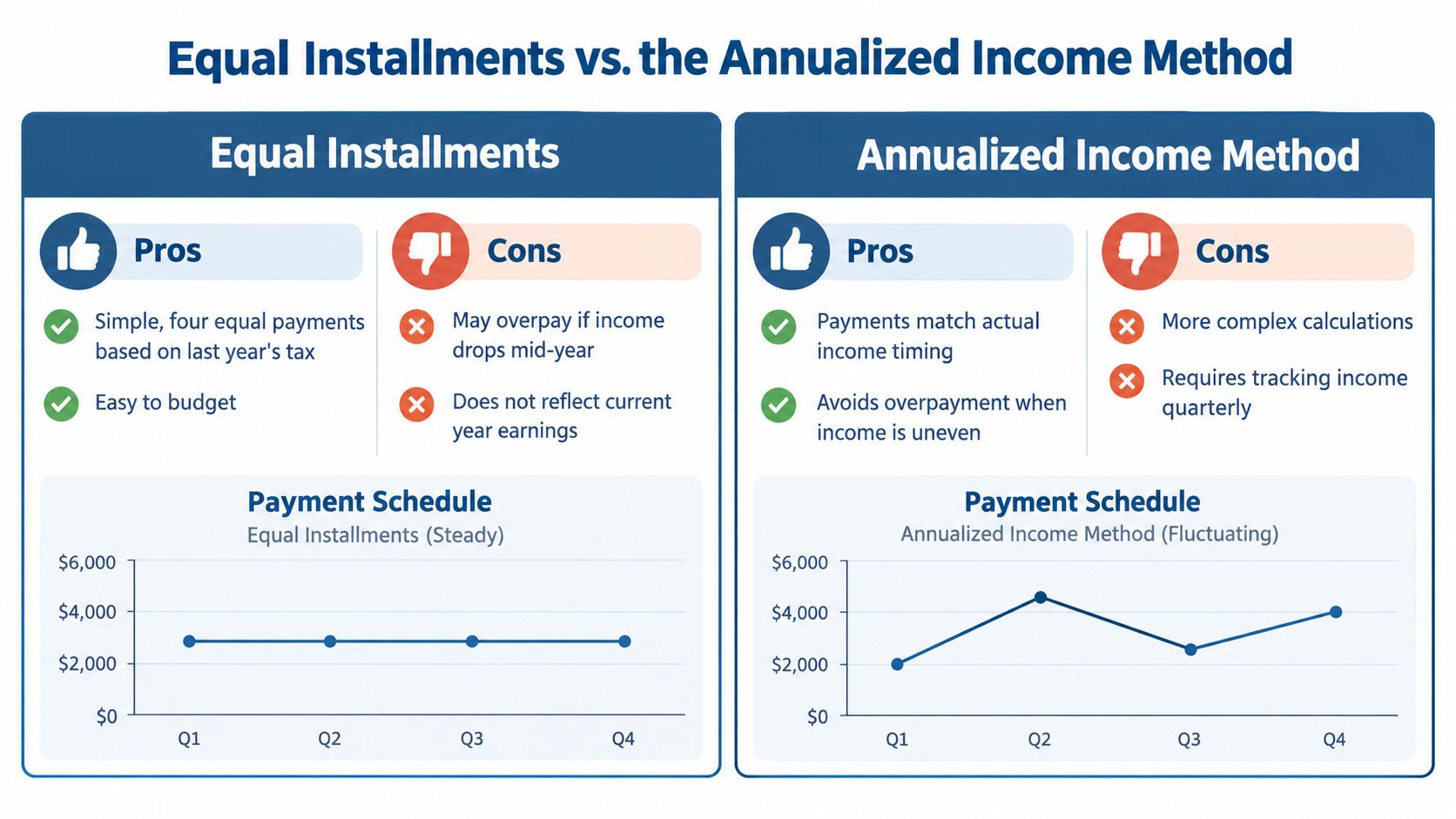
A Union City contractor who bills 70% of his work between June and November is the classic case. Under four equal installments, he owes a full April payment even though his first large invoice does not clear until July. He either borrows against the slow months or falls behind on a quarter his books say should be cheap.
The annualized income installment method corrects that mismatch. It recalculates each required installment from cumulative taxable income at fixed checkpoints rather than assuming even earnings. For this contractor, annualizing shrinks the April requirement and shifts the obligation into the later periods that generated the revenue, the same treatment IRS guidance points to for seasonal businesses and large late-year capital gains. (IRS Publication 505)
Choose based on when income arrives
The four IRS periods matter more than the label "quarterly." A restaurant riding a tourism season, a contractor paid through project draws, and a professional collecting a December bonus will each produce a different installment pattern, and none of them resembles a firm with flat monthly revenue.
- Stable income: Equal installments are easier to budget and administer.
- Uneven income: Annualizing usually wins, especially when a large share of earnings lands in later periods.
- Unclear pattern: Update the projection at each checkpoint and decide period by period.
Annualizing costs more in bookkeeping. You need period-by-period records and the Schedule AI computation on Form 2210 to support each installment. For owner-operators with bunched receipts, that paperwork buys real cash-flow relief; paying a uniform amount because it feels tidy is how profitable businesses end up borrowing to cover a tax bill.
How to Run Your Own Quarterly Projection
Take a Queens catering owner who books most revenue around spring weddings and December events. A projection built only from gross receipts will overstate the tax due, while one copied from last year can miss a new contract, higher expenses, or additional withholding. Start with the year-to-date books and update the tax inputs at every deadline.

Use this workflow before each payment date:
- Close the period: Bring the books current through the applicable period-end date. If the books are unfinished, use a supportable estimate and identify which figures may change.
- Update the tax picture: Review revenue, deductible expenses, depreciation, owner compensation, pass-through income, credits, and withholding.
- Project the remaining year: Estimate income and deductions for the periods still open, then separate expected activity from speculation.
- Calculate the installment: Use the standard estimated-tax worksheet when income is relatively steady. For uneven earnings, follow the Schedule AI instructions for Form 2210 so each payment reflects the period that produced the income.
- Reconcile and pay: Compare the cumulative amount required with payments already made, withholding, and credits. Pay the remaining shortfall by the deadline and save the worksheet with your records.
The biggest mistake is treating bank deposits as taxable income. Your projection needs the profit figure after deductible business costs, plus the other income, deductions, withholding, and credits that affect the return. Keep federal estimates distinct from New York and New York City obligations; the next section addresses those payments separately.
For help organizing household cash around irregular business receipts, Peaceful Mindful Pocket budgeting tips offers a practical framework. Blue Sage Tax and Accounting Inc. also provides a quarterly estimated tax calculator for testing payment assumptions. Review the inputs before relying on the result.
This walkthrough shows how to close the period and update the tax inputs before each deadline:
Layering in New York City and New Jersey
Federal estimated payments don't settle every state or local obligation. If you have income connected to New York, New Jersey, or another jurisdiction, evaluate each jurisdiction's requirements separately and keep its payments distinct from federal estimates.
For New Jersey individuals, the 2026 estimated-payment dates are April 15, June 15, and September 15, 2026, and January 15, 2027. New Jersey allows estimated payments in four equal installments, or the full estimated amount on or before April 15, 2026. If a New Jersey deadline falls on a weekend or legal holiday, payment is due the next business day. These are New Jersey rules, not a substitute for federal or New York requirements. (New Jersey 2026 estimated-tax instructions)
Keep payroll deposits separate
An S corporation's wage withholding may count toward an owner's individual safe-harbor calculation, but employment-tax deposits and corporate payroll filings follow separate rules. Don't treat a payroll deposit as an estimated-income-tax payment without checking how it's reported and applied. (IRS Form 1040-ES guidance)
For a multi-state calendar, list each federal period deadline, then add the corresponding New Jersey and any applicable New York or New York City payment separately. Confirm each jurisdiction's amount and payment instructions rather than assuming one check covers them all. This is especially important when business activity or personal income crosses state lines.
Common Mistakes That Trigger Penalties and How to Avoid Them
The most persistent mistake I see is treating "quarterly" as four equal three-month periods. The federal payment periods aren't equal, and the penalty runs installment by installment. A large January payment doesn't erase a June shortfall, because each period is computed separately. As noted earlier, the annualized income method exists precisely because profitable years rarely produce even cash flow.
Other avoidable errors: assuming a spouse's W-2 withholding covers the joint safe harbor without running the numbers, skipping an installment because revenue was soft that quarter, and waiting until return prep to discover income was concentrated in the fourth quarter. That last one is the worst. By then, every correction window has closed.
Set a calendar reminder for each deadline and file payment confirmations with your tax records. If you use recurring payments through IRS Direct Pay or EFTPS, verify the date and amount before each transfer. An instruction set up last January reflects last year's projection, not this year's.
Don't wait for a notice to tell you that an earlier installment was short. Reconcile the required amount with payments already made while the period is still fresh in your books.
One more pattern worth breaking: owner-operators who pay the full annual estimate in December and assume they're done. The tax got paid, but the first three installments still show as underpaid, and the penalty clock ran all year. If income bunches late, annualize. If it's steady, keep equal installments. Match the method to the cash flow, not the calendar.
At year-end, check whether your withholding and timely estimates meet the applicable safe harbor, and review any remaining shortfall with a tax professional. Blue Sage Tax and Accounting Inc. provides year-round tax planning and quarterly projections for business owners and individuals with multi-state filing needs. Book your free consultation call today.
This article is general information and not tax advice for your specific situation.