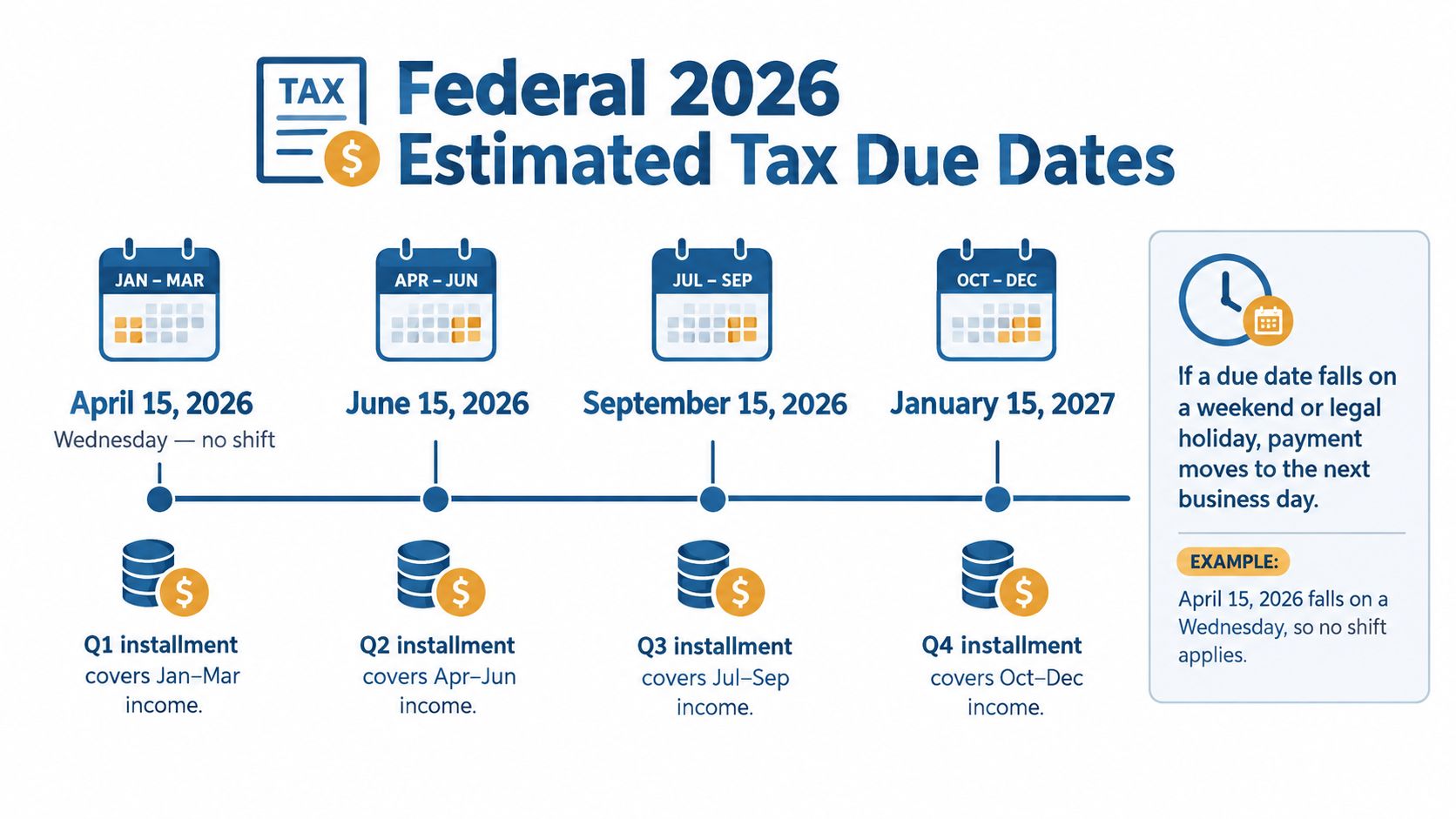
April 15, June 15, September 15, and January 15 of the following year are the standard federal estimated tax due dates. For 2026, the first installment is due April 15, 2026, followed by June 15, September 15, and January 15, 2027. The bigger question isn't just when are estimated taxes due, but whether each payment matches the income period and method the IRS uses to measure underpayment.
Table of Contents
- When Are Estimated Taxes Due in 2026 and Who Has to Pay
- How Much Should You Pay Each Quarter to Stay Safe
- How Federal and New York Estimated Tax Dates Compare
- What to Do When Your Income Arrives Unevenly
- How Underpayment Penalties Work and How to Fix Them
- How to Plan Around the Four Due Dates All Year
When Are Estimated Taxes Due in 2026 and Who Has to Pay
Are you treating the four federal due dates as a complete tax plan? For 2026, estimated payments are due April 15, June 15, September 15, 2026, and January 15, 2027. Each installment covers a different income period. If a deadline falls on a Saturday, Sunday, or legal holiday, the IRS generally moves it to the next business day. April 15 falls on a Wednesday in 2026, so the first deadline stays in place. Check the IRS estimated taxes topic page before submitting a payment.
Estimated tax is a pay-as-you-go obligation, not a single April bill. The IRS expects tax payments as income is earned. That rule matters when money comes from a business, investments, rent, or pass-through distributions instead of payroll withholding. Payment timing follows the applicable income period, not just the day cash reaches your account. The IRS pay-as-you-go explanation explains the framework.
Who usually needs estimated payments
For an owner-operated business, start with these tests:
- Sole proprietors and single-member LLC owners: estimate whether business profit, after deductions and credits, will leave an individual balance due.
- Partners and S corporation shareholders: check whether pass-through income or the K-1, rather than distributions alone, would leave tax unpaid after withholding.
- C corporations expecting at least $500 in tax liability: determine whether the corporation meets that threshold under its corporate estimated-tax rules.
- Landlords and investors: project rental, dividend, interest, and capital-gain income that has no withholding, especially in a high-income year.
- W-2 employees with freelance income: compare the extra tax on freelance profit with the additional amount payroll withholding will cover.
Spouses filing jointly should run the same review across both returns. Estates and trusts with $1,000 or more in tax also have separate estimated-tax rules.
The dates are only the starting point. A $250K–$5M owner-operated business must track each income period, select a defensible safe-harbor method, and coordinate federal payments with New York State and New York City calendars. Equal checks can be wrong when profits arrive unevenly.
How Much Should You Pay Each Quarter to Stay Safe
The practical answer is to choose a method before income starts moving. The main federal approaches are paying 90% of current-year tax, paying 100% of prior-year tax, or paying 110% of prior-year tax when prior-year adjusted gross income exceeded $150,000, subject to the applicable IRS rules. The IRS Publication 505 annualized-income guidance also allows installments based on income earned during each period instead of equal payments.
Consider a New York contractor with $400,000 in revenue, $220,000 of profit in 2025, and projected profit of $300,000 in 2026. If the contractor's prior-year tax figure is $40,000, the higher-income prior-year method would require $44,000 for the year, or $11,000 per installment, assuming withholding and credits don't change the calculation. The 90% current-year method requires updated projections, and the later installments may need to rise if the contractor's 2026 profit accelerates.
| Safe-Harbor Test | Calculation | Annual Amount | Quarterly Payment |
|---|---|---|---|
| Current-year method | 90% of projected 2026 tax | Must be projected | Must be recalculated |
| Prior-year method | 110% of $40,000 prior-year tax | $44,000 | $11,000 |
| Annualized method | Income, deductions, and credits by period | Varies by period | Varies by period |
I generally prefer the prior-year method for predictability, but it can leave a large balance due when income jumps. A taxpayer may also qualify for the de minimis exception when prior-year tax was $1,000 or less, depending on the full facts. Withholding counts too, including withholding from a first-time required minimum distribution from an IRA, so a carefully timed withholding election may satisfy part of a safe harbor without another quarterly check. For a customized calculation, use the quarterly estimated tax calculator.
How Federal and New York Estimated Tax Dates Compare
Are your federal, New York State, and New York City payments due on the same schedule? The four dates often line up, but they start a compliance process, not finish it. An owner-operated business earning $250K to $5M may owe through separate taxpayer accounts, forms, and payment systems.
| Quarter | Federal IRS | New York State | New York City |
|---|---|---|---|
| First installment | April 15, 2026 | April 15, 2026 | Use the applicable NYC estimated-tax form, such as NYC-202E for UBT or NYC-400 for GCT |
| Second installment | June 15, 2026 | June 15, 2026 | Use the applicable NYC estimated-tax form and pay through the NYC Department of Finance |
| Third installment | September 15, 2026 | September 15, 2026 | Use the applicable NYC estimated-tax form and payment channel |
| Final installment | January 15, 2027 | January 15, 2027 | Follow the applicable NYC form and tax-specific deadline |
Federal dates follow the IRS weekend-and-holiday shift rule. New York State uses the dates above, subject to its own weekend and holiday adjustments. Review the New York State estimated tax instructions before submitting a payment. New York City does not offer one universal estimated-tax calendar for every business. UBT and GCT obligations can use different forms, accounts, and procedures, including NYC-202E for UBT and NYC-400 for GCT estimated payments.
A Queens owner cannot send one check and consider the job done. Confirm the jurisdiction, account, installment amount, form, payment channel, and confirmation number for each payment. The federal deadline can be satisfied while a New York payment remains late.
Practical rule: Treat each due date as four separate checkpoints: federal, New York State, New York City, and any other state where the business operates.
For a restaurant owner filing in New York and New Jersey, the same income projection should inform both states, but each state's filing instructions and payment system still require separate verification. That matters when profit arrives unevenly or the business changes its quarterly projection.
What to Do When Your Income Arrives Unevenly
Equal installments are a poor fit for seasonal businesses. A Queens restaurant owner might gross $180,000 between June and August and only $20,000 during the rest of the year. Paying the same amount in every period can drain cash during slow months even though the annual income eventually supports the liability.
The IRS annualized income installment method addresses that mismatch. You use actual income, deductions, and credits through each period, then calculate the required installment based on the income available at that point. The IRS describes this approach in Publication 505, and the calculation is generally reported through Form 2210 and Schedule AI.
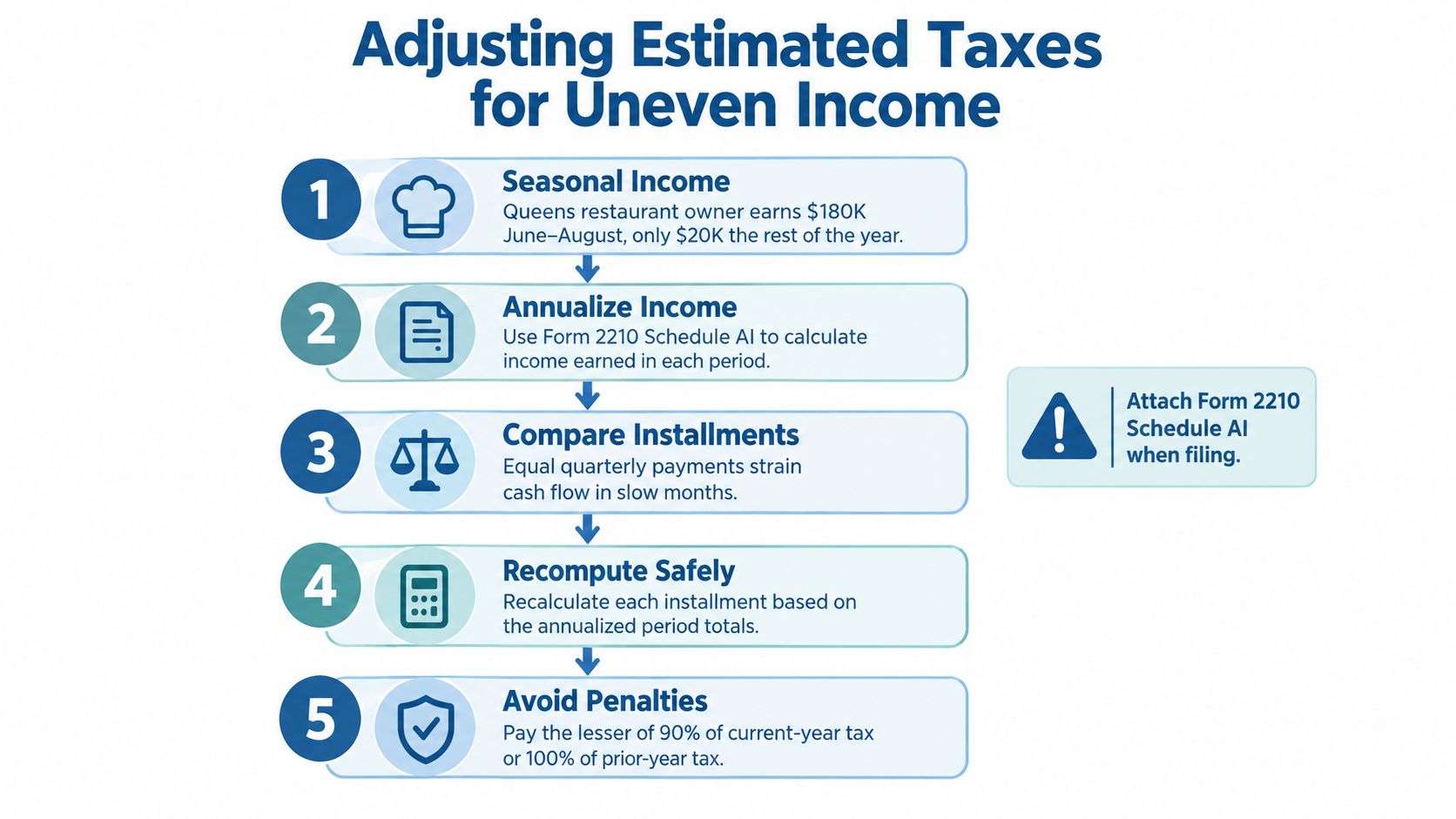
The cumulative periods used for annualization are January through April, January through May, January through August, and January through December, corresponding to the IRS installment calculations of 22.5%, 45%, 67.5%, and 90% of the annual requirement. Those figures and mechanics come from the IRS annualized-income rules, not a general cash-flow shortcut. A back-loaded restaurant can therefore owe less in early periods and more after the busy season, provided the books support the calculation.
Paying 25% each time is easier, but it may be unnecessarily painful for a seasonal operator. Annualization demands clean bookkeeping, accurate period cutoffs, and supporting records if the return is examined. The IRS Form 1040-ES instructions also explain that a major change in income, deductions, additional taxes, or credits after March 31 can require a recalculation under the annualized method.
How Underpayment Penalties Work and How to Fix Them
An underpayment penalty is measured by installment period, not just by comparing your total payments with your final tax bill. You can receive a refund when filing and still face a penalty if one required installment was too small or late. The IRS's estimated tax business guidance emphasizes that the amount paid by each period matters.
A missed payment should be corrected promptly. Review the applicable safe harbor, determine which installment was short, and prepare Form 2210 when the calculation requires it. In some cases, you can leave Form 2210 blank and let the IRS calculate the penalty, but that isn't the right choice when you need to explain annualized income, withholding timing, or a waiver.
| Safe-Harbor Test | Payment Required | Best For |
|---|---|---|
| Current-year tax | At least 90% of current-year tax | Income that can be projected reliably |
| Prior-year tax | 100% of prior-year tax | Stable income and predictable payments |
| Higher-income prior-year rule | 110% of prior-year tax when applicable | Higher-income taxpayers seeking a fixed target |
| Annualized income | Amount based on income through each period | Seasonal or sharply uneven earnings |
For practical prevention ideas, WP TieOut penalty avoidance tips offer a useful supplement to the IRS instructions. If the penalty resulted from reasonable cause, a taxpayer may request abatement by letter or Form 843. Death, illness, casualty, or reliance on incorrect professional advice can support a request, but the facts and documentation matter. A professional review often produces a clearer explanation than a rushed taxpayer-written letter. Blue Sage Tax & Accounting Inc. also handles estimated tax penalty review and avoidance.
How to Plan Around the Four Due Dates All Year
Are you treating each estimated-tax deadline as the finish line? That approach misses the underlying work. Use every date as a checkpoint: pull a profit-and-loss statement by March 25, project the full year, and set the first installment before April 15. Review the numbers again before June, September, and January. The IRS estimated-tax FAQ confirms the recurring calendar, but your current projection decides whether the scheduled payment still fits.
For an owner-operated business in the $250,000 to $5 million range, review these items between deadlines:
- Compare year-to-date profit: Measure actual net profit against the projection, not gross revenue alone.
- Revisit owner compensation: S corporation shareholders need a reasonable compensation analysis before treating remaining cash as distributions.
- Update deductions: Retirement contributions, health insurance, and the Section 199A pass-through deduction can change the tax estimate.
- Include pass-through income: Partnerships should include expected K-1 income instead of waiting for the final filing.
- Coordinate jurisdictions: Use one projection for federal, New York State, New York City, and New Jersey obligations, then submit each payment through the correct system.
Uneven income requires more than dividing an annual estimate into four equal payments. Annualize income through each period when revenue rises and falls sharply. That approach can align payments with the income that produced them and expose a shortfall before the next deadline.
Sole proprietors may have flexibility to make a SEP-IRA contribution later in the year, but model the deduction before relying on it. S corporation owners should not use an informal distribution target as a substitute for documented compensation analysis.
The payment date is visible. The mid-quarter review determines the tax decision.
Blue Sage Tax & Accounting Inc. builds the quarterly projections described here, so each review produces a number instead of a guess. Book your free consultation call today.
This article is general information and not tax advice for your specific situation.