Form 2290 is generally due on the last day of the month following the month a taxable heavy highway vehicle is first used on public highways, so vehicles first used in July are due August 31 each year.
But what happens when you add a truck after your fleet's annual return is already filed? That's where treating this federal tax as a single annual appointment can cause trouble. The better approach is a vehicle-by-vehicle calendar that tracks first highway use, mileage, and changes in taxable gross weight.
Table of Contents
- When Is Form 2290 Due Each Year?
- What Is the Form 2290 Due Date for Each Month of First Use?
- Which Vehicles Need to File Form 2290?
- How Do You File and Pay Form 2290 on Time?
- What Happens If Form 2290 Is Late or Changes Midyear?
- What Should Owners and Fleet Managers Do Before Each Deadline?
When Is Form 2290 Due Each Year?
The federal filing deadline follows each taxable vehicle's first month of public-highway use, rather than a universal date for every truck. An annual fleet filing doesn't automatically cover vehicles you put into service afterward.
The IRS instructions for the 2025–2026 reporting period establish a tax period beginning July 1, 2025, and ending June 30, 2026, with filing generally due by the last day of the month after first highway use. Vehicles entering service later in that period are subject to prorated tax rather than being treated as though they operated for the full period.
Why registration reminders aren't enough
Your registration renewal notice is an administrative reminder, not the starting point for the federal filing calendar. If your bookkeeper waits for that notice before asking when a truck entered service, the filing deadline may already have passed.
A truck operating at the start of the tax period and another added later can therefore require different filing dates, even when the same company owns both.
Practical rule: Assign the deadline when the dispatcher records first highway use, not when the registration paperwork reaches the office.
This discussion covers federal Form 2290 under IRS rules. State registration requirements and state heavy-vehicle taxes are separate. Tax amounts adjust annually, so no tax amounts are listed here; use the instructions for the applicable reporting period when calculating liability.
What Is the Form 2290 Due Date for Each Month of First Use?
Find the month the vehicle first runs on a public highway, then use the following month's deadline. Purchase dates, delivery paperwork, and registration renewals don't replace the actual highway-use date.
The IRS Form 2290 instructions provide the recurring monthly schedule below and specify that a deadline falling on a Saturday, Sunday, or legal holiday moves to the next business day. These are the standard calendar dates for each reporting period, before that adjustment.
Form 2290 due date by month of first highway use
| First month of highway use | Form 2290 due by | Note |
|---|---|---|
| July | August 31 | Annual deadline for the July-to-June period; full-period tax applies unless suspended or exempt |
| August | September 30 | Tax prorated for the months remaining in the period |
| September | October 31 | Tax prorated for the months remaining in the period |
| October | November 30 | Tax prorated for the months remaining in the period |
| November | December 31 | Tax prorated for the months remaining in the period |
| December | January 31 | Tax prorated for the months remaining in the period |
| January | Last day of February | Tax prorated for the months remaining in the period |
| February | March 31 | Tax prorated for the months remaining in the period |
| March | April 30 | Tax prorated for the months remaining in the period |
| April | May 31 | Tax prorated for the months remaining in the period |
| May | June 30 | Tax prorated for the months remaining in the period |
| June | July 31 | Last month of the period; due after the period closes |
The table distinguishes the first-use month from the filing month. The final row also shows why closing the tax-period file too early can leave a late-added vehicle unreported.
For a January first-use scenario in the 2025–2026 period, February 28, 2026, is the calendar month-end, not the adjusted filing date. Because that date falls on a Saturday, apply the next-business-day rule before entering the deadline in your calendar.
Turn dispatch records into a filing date
The IRS's online instructions identify taxable heavy highway vehicles as those with a taxable gross weight of 55,000 pounds or more, including applicable trucks, buses, and trailers registered or required to be registered in the owner's name.
Say a general contractor with about $400,000 in annual revenue adds a dump truck meeting that weight threshold. If it first runs on a public highway in March 2026, its return and payment are generally due April 30, 2026. The contractor's revenue doesn't determine the deadline; the truck's first-use month does.
Use this sequence for each addition:
- Confirm taxable gross weight. Don't substitute an informal description such as “heavy-duty truck.”
- Find the first public-road date. Check dispatch records, delivery records, and the driver's trip log.
- Identify the calendar month. Record it in the vehicle's tax file.
- Find the following month's final day. Use the table as the starting point.
- Check weekends and legal holidays. Adjust the calendar entry before setting reminders.
- Calculate the applicable prorated tax. Use the correct reporting-period instructions.
A purchase invoice alone won't establish first highway use. If delivery involved highway operation, investigate that trip rather than automatically using the first customer job as the starting date.
Which Vehicles Need to File Form 2290?
A return is generally required for a qualifying heavy highway vehicle meeting the taxable-weight rule, used on public highways, and registered or required to be registered in the owner's name. Applicable trucks, buses, and trailers can fall within that scope; a vehicle's business label alone doesn't settle the question.
Low mileage can suspend the tax without eliminating the return. The IRS guidance on when Form 2290 taxes are due explains that vehicles expected to travel 5,000 miles or fewer during the period, or 7,500 miles or fewer for qualifying farm vehicles, generally must still be reported even though no tax is payable for that period.
Check filing duty separately from tax due
Say a hauling company expects a tractor to travel about 4,800 public-highway miles during the reporting period. Assuming it qualifies for suspension, the owner still reports it rather than leaving it off the return. Proof of filing may be needed for state registration despite the absence of a tax payment.
Before deciding whether to file, check:
- Taxable gross weight: Confirm the applicable classification.
- Public-highway use: Establish whether and when the vehicle operated.
- Registration responsibility: Identify whose name the vehicle is registered or required to be registered in.
- Expected mileage: Document the basis for claiming suspension.
A suspended vehicle belongs on the compliance calendar, not on a list of trucks the office can ignore.
For operators assessing a box truck's broader operating requirements, Peak Transport's box truck compliance checklist is a useful companion resource. Keep that operational review separate from the federal tax determination.
Suspension is conditional. If actual use outgrows the mileage expectation, the owner must reassess the tax rather than relying indefinitely on the original filing.
How Do You File and Pay Form 2290 on Time?
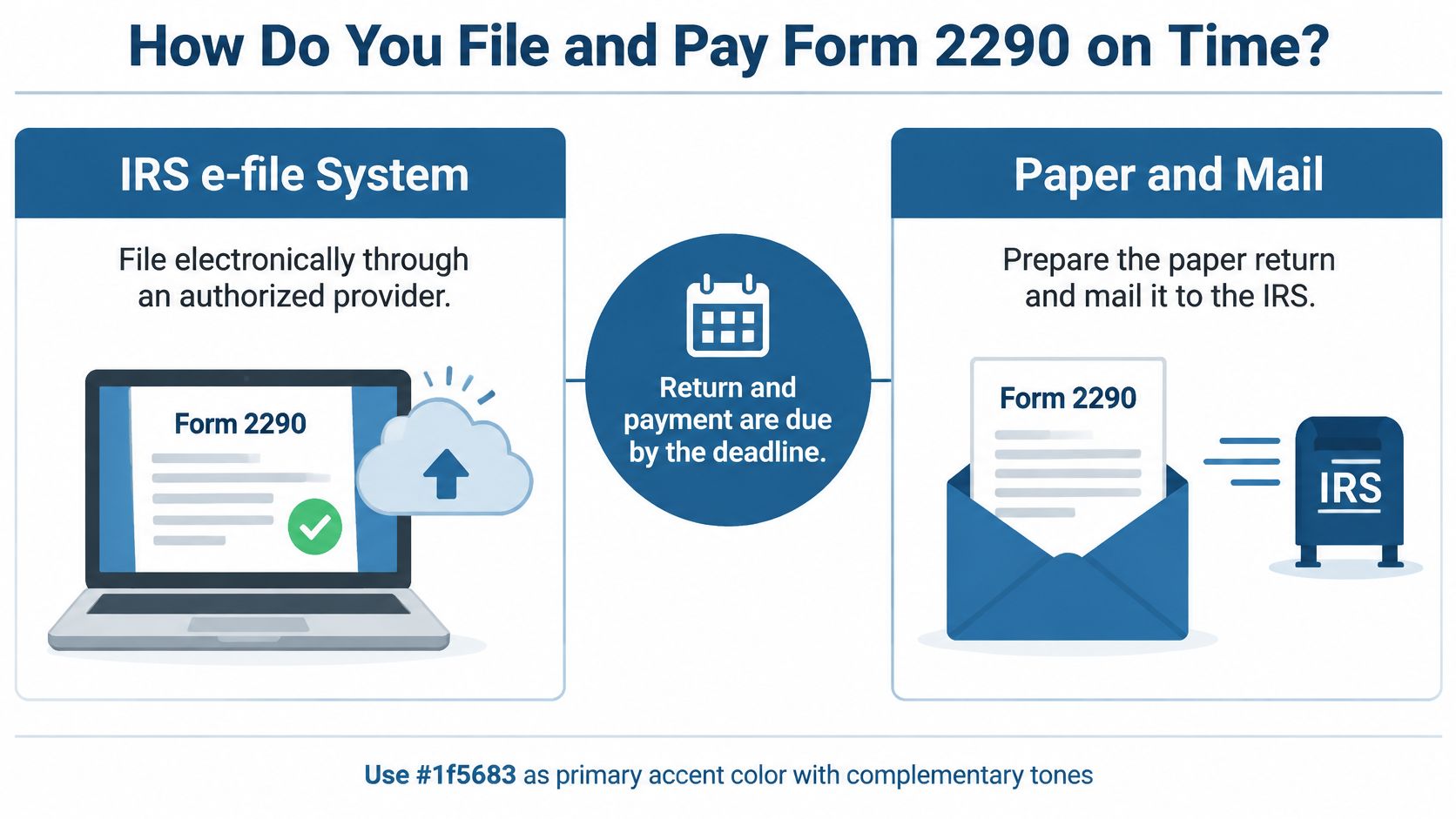
You can file electronically through an authorized provider or, where permitted, prepare a paper return and mail it to the IRS. Both the return and the payment must meet the applicable deadline; submitting one doesn't establish that the other is complete.
Choose the filing route early enough to obtain usable proof for registration.
Electronic filing versus paper
Electronic filing provides an acknowledgment after acceptance. A transmission receipt alone isn't the same as acceptance, so check the return's status and resolve any rejection.
Paper filing requires mailing the completed return and allowing for the IRS to return a stamped Schedule 1. Don't choose paper solely because you already have a printed form if your registration timetable leaves little room for processing and mail delivery. Also check whether electronic filing is mandatory for your filing circumstances.
Payment and proof are separate checks
Use a payment method allowed by the current reporting-period instructions. If you're using a filing provider, distinguish its service charge from the federal tax payment and confirm that the payment authorization contains the correct account information.
Keep the accepted return, stamped Schedule 1 or electronic proof, payment confirmation, and supporting first-use record together. Match the vehicle identification number on the proof to the vehicle being registered before forwarding it to the registration office.
If you're sorting several federal excise-tax obligations, this explanation of what Form 720 is used for can help distinguish that separate return from the heavy-vehicle filing.
For an additional walkthrough of the filing topic, use the video below.
What Happens If Form 2290 Is Late or Changes Midyear?
Late filing or payment can lead to penalties and interest under federal IRS rules. A vehicle that changes after filing can also require an amended return, even though the original return was submitted on time.
Say a seasonal landscaping operator reports a truck as suspended, then takes on more hauling work in autumn. The IRS Form 2290 document addresses suspension for vehicles expected to travel no more than 5,000 public-highway miles, or 7,500 miles for agricultural vehicles, and amendment obligations when a suspended vehicle exceeds the applicable limit. The operator needs to address that change rather than wait for the next annual filing.
A filing confirmation doesn't end the monitoring job.

Handle missed filings and operating changes differently
A missed filing calls for prompt correction of the overdue return and payment. Late-filing and late-payment consequences are separate, and interest can run on unpaid tax from the due date. Penalty amounts aren't listed here because statutory rules and adjustments can change; check the current instructions.
A taxable-gross-weight increase needs a different review. It can create additional tax for the remaining months and require an amended filing under the IRS instructions.
Monitoring habit: Have dispatch report mileage changes and the equipment manager report heavier configurations to the person preparing the returns.
Delayed filing may also hold up registration proof. For broader steps after discovering an overdue obligation, see what to do if you miss a tax deadline.
What Should Owners and Fleet Managers Do Before Each Deadline?
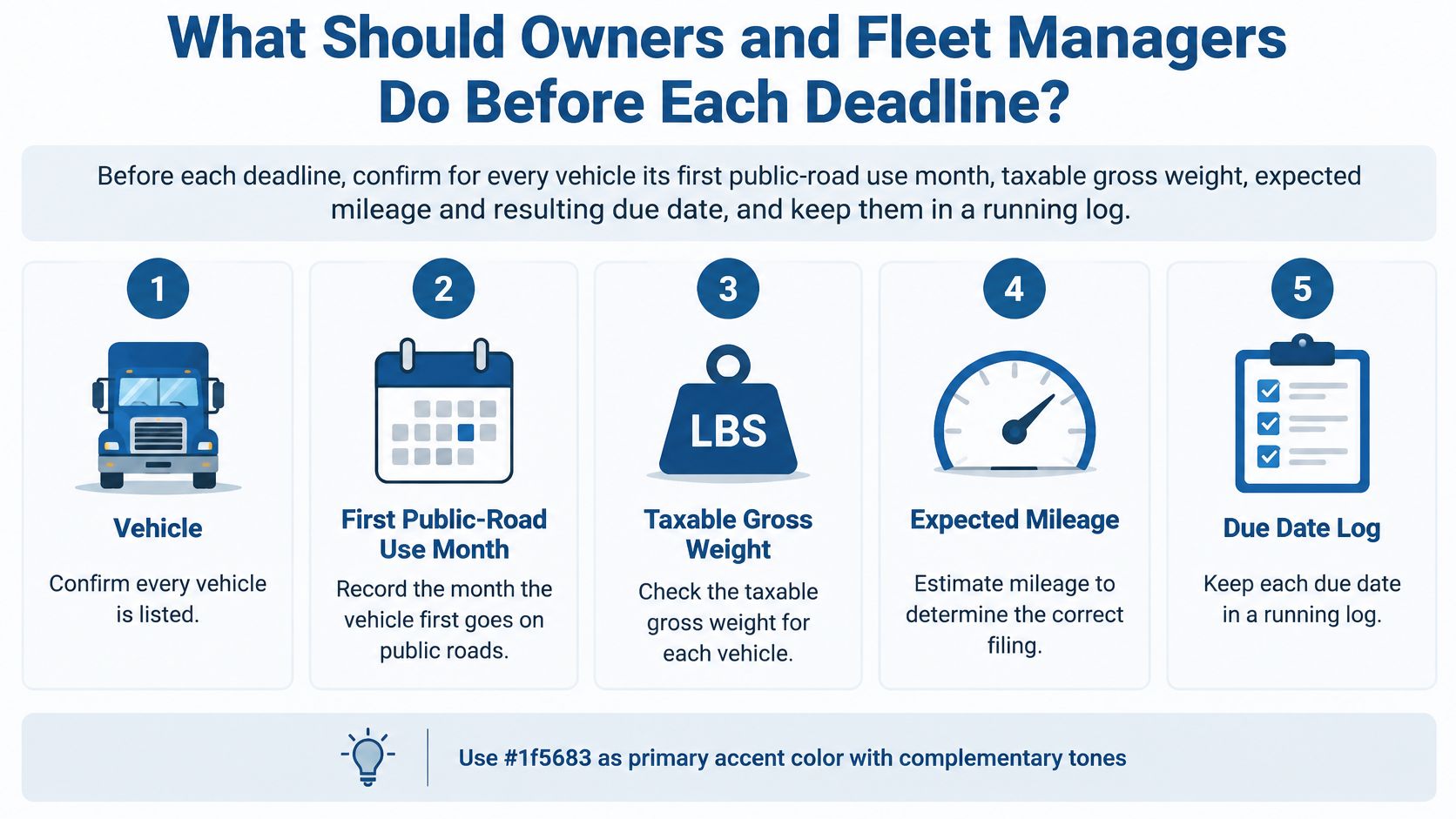
Treat the due date as a vehicle-by-vehicle calendar, not one date on the wall. A unit that enters service midyear starts its own clock, so the working tool is a running log that records each vehicle's first public-road-use month, taxable gross weight, expected mileage, and the due date those facts produce. Give one named person ownership of that log. Updates should follow operational events, a truck entering service, a heavier configuration, a route pattern pushing mileage upward, rather than waiting for the accountant's annual request.
Use the checklist below as the handoff between dispatch, bookkeeping, and whoever authorizes tax payments.
Keep a filing-ready vehicle file
Prepare the following before starting the return:
- Vehicle identification number: Match it to registration and ownership records.
- Taxable gross weight: Retain the supporting configuration details.
- First public-road-use date: Save the dispatch or trip record.
- Monthly mileage totals: Reconcile driver records with the fleet system.
- Adjusted due-date calendar: Include weekend and legal-holiday checks.
- Payment method: Confirm authorization and account details.
- Prior Schedule 1 proof: Keep accepted filing records accessible.
A spreadsheet can work for a small fleet if someone owns the updates. Fleet-management software earns its cost only when the office exports and reviews the records; buying the tool doesn't assign the responsibility.
Escalate changes before filing
Contact a tax advisor when you add a vehicle midyear, mileage approaches the applicable suspension limit, taxable gross weight changes, or an IRS or state notice arrives. Registering in multiple states also warrants a review of separate state requirements; the federal filing alone doesn't settle them.
Operational changes can reach beyond tax. When hauling activity shifts, insurance costs and classifications may deserve a fresh look. Florida All Risk Insurance's guide to truck insurance costs by operation gives useful context for that conversation, though insurance categories are not federal tax rules.
The durable answer to "when are 2290s due" is a maintained calendar tied to actual vehicles. Keep it next to the dispatch and mileage records your team already updates.
Blue Sage Tax and Accounting Inc. is an accounting firm that can help owners and fleet managers organize a vehicle-by-vehicle compliance calendar and prepare related tax filings. Visit Blue Sage Tax & Accounting Inc. to learn about its tax preparation and year-round planning services. Book a consultation call to discuss your vehicle compliance calendar.
This article is general information and not tax advice for your specific situation.