Nonprofit accounting is fund-based financial reporting under FASB rules that tracks restricted and unrestricted dollars and supports the annual IRS filing a charity makes, often through the Form 990 family. In the United States, that framework sits inside nonprofit reporting rules first formalized in 1993 and significantly updated by ASU 2016-14 in August 2016, and the organizations filing those IRS returns represented $2.26 trillion in revenue and $3.22 trillion in assets in 2013.
That answer surprises people because they often think the field exists mainly because nonprofits “don't aim to make a profit.” That's only part of the story. The reason nonprofit accounting exists is accountability. If a donor gives money for a youth program, a scholarship fund, or a building project, the board needs records that prove the money went where it was supposed to go.
A simple way to picture it is a kitchen pantry. You can store flour, rice, coffee, and sugar in the same room, but you still keep them in separate jars so nobody mistakes one for another. Nonprofit accounting works the same way. A charity may have one bank account, but inside the accounting records it still needs separate tracking for general operating money, grant money, and endowment-related funds.
Table of Contents
- What Is Nonprofit Accounting and Why Does It Exist
- How Restricted and Unrestricted Funds Actually Work
- The Three Financial Statements Every Nonprofit Produces
- How Nonprofit Accounting Differs From For-Profit Accounting
- Which Tax and Compliance Filings Your Organization Must Submit
- Practical Tips for Nonprofit Leaders, Bookkeepers, and Donors
What Is Nonprofit Accounting and Why Does It Exist
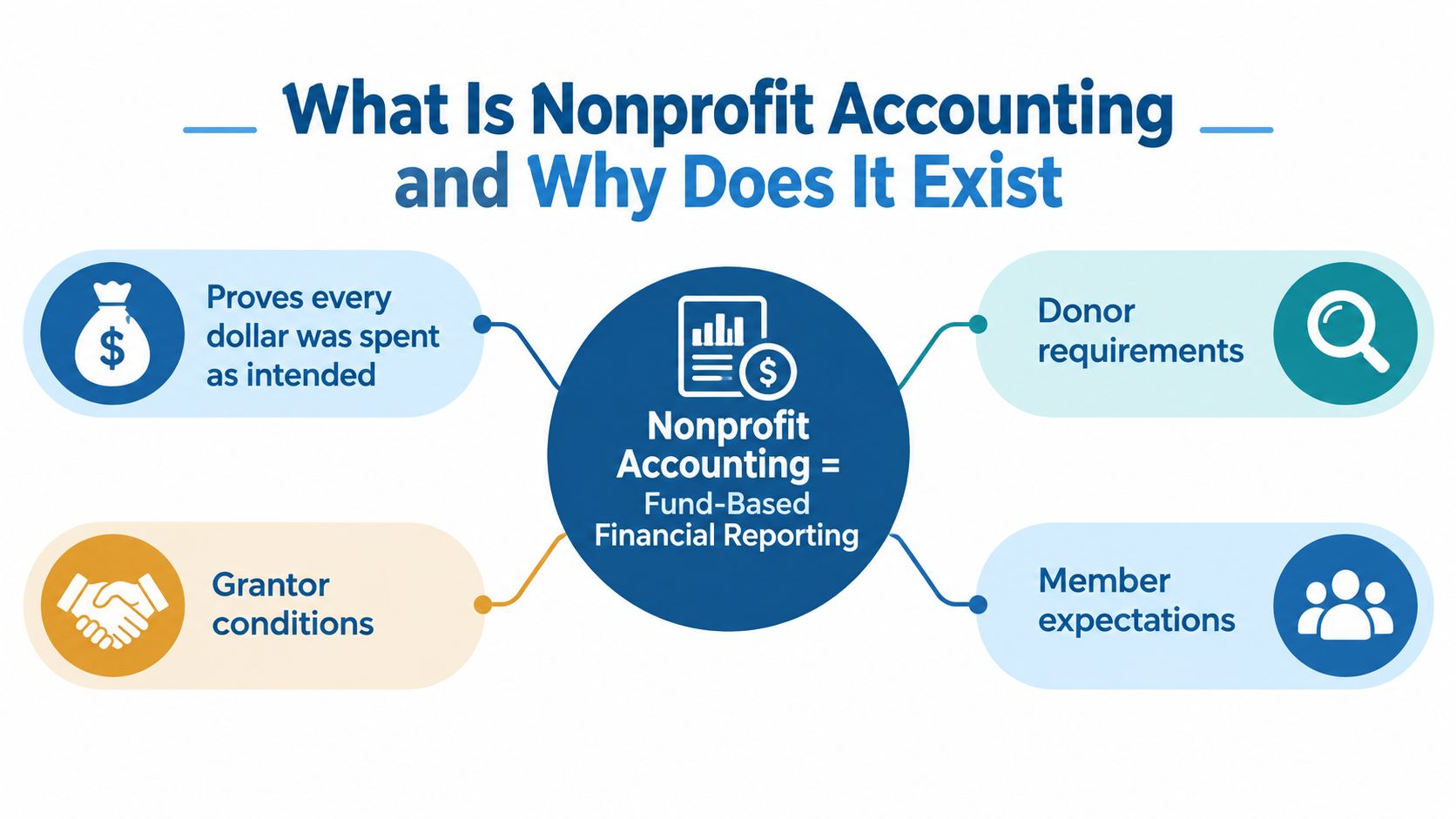
How does a small charity prove that a tutoring grant paid for tutoring, not the electric bill? Nonprofit accounting exists to answer that question. It is the system a tax-exempt organization uses to record, classify, and report money so the board, donors, grantmakers, regulators, and the public can see whether each dollar was used the way it was promised.
That accountability focus is the part new board members often miss. A nonprofit can have one checking account and still have several different kinds of money inside its records. The job of accounting is to label those dollars correctly, follow the rules attached to them, and produce reports that hold up when someone asks for proof.
Under U.S. rules, nonprofit reporting was formalized with FASB Statement No. 117 in 1993 and later updated by ASU 2016-14 in August 2016. That update changed how not-for-profit entities present their financial statements, and it still shapes how organizations prepare reports under ASC 958 today (FASB ASU 2016-14).
Why the field is bigger than bookkeeping
Bookkeeping captures what happened. Nonprofit accounting answers whether the organization can explain it.
A bookkeeper may record a $25,000 deposit correctly. Nonprofit accounting asks three more questions. Was it a general donation, a grant limited to a program, or money the board set aside for a future need? The answer affects the financial statements, the audit trail, and the annual IRS return.
That link to IRS filing is practical, not theoretical. Many charities in the United States must file some version of the Form 990 family, and those filings ask for more than a check register. They ask for revenue categories, expense reporting, governance disclosures, and a picture of the organization's financial position. If the accounting records are messy, the Form 990 will be messy too.
Practical rule: If your accounting system cannot show where restricted money came from, what it can be used for, and whether the restriction has been met, it is not doing the job nonprofit accounting is supposed to do.
The pantry analogy boards usually remember
Nonprofit accounting works like labeled pantry containers. The food is all in one kitchen, but flour, coffee, and sugar still need separate containers so nobody uses the wrong ingredient by mistake.
Suppose a community nonprofit receives:
- General donations that can pay rent, payroll, or insurance
- A youth program grant that can only support tutoring
- A capital campaign gift meant for renovating a building
Those dollars may arrive in the same month and even land in the same bank account. The bank balance tells you how much cash the charity has. The accounting records tell you how much of that cash is available for general use. That distinction is why nonprofit accounting exists. It gives the board a way to show, and not just assume, that restricted dollars were kept for their intended purpose.
How Restricted and Unrestricted Funds Actually Work
Restricted and unrestricted funds are tracked separately because not every dollar is equally available to spend. Under current U.S. GAAP for nonprofits, financial statements present only two net asset classes: net assets without donor restrictions and net assets with donor restrictions.
That two-class model replaced the older unrestricted, temporarily restricted, and permanently restricted presentation. Donor-restricted gifts must stay separate until the stated purpose, time condition, or perpetuity requirement has been satisfied (GAAP overview for nonprofits).
A concrete example
Say a donor gives $100,000 to a charity:
- $60,000 is restricted for after-school tutoring
- $40,000 is unrestricted for the annual fund
At the time of the gift, the organization records the two amounts in different net asset classes. The tutoring money sits in with donor restrictions. The annual fund money sits in without donor restrictions.
Now assume the charity pays $5,000 of tutoring staff salary that qualifies under the restriction. That spending doesn't mean the accounting “uses cash.” It means the organization has met part of the donor's purpose condition. The accounting records then show a release from restriction.
| Restricted vs. Unrestricted Funds in Practice | With Donor Restriction | Without Donor Restriction |
|---|---|---|
| Receipt of $60,000 tutoring gift | Increase | No change |
| Receipt of $40,000 annual fund gift | No change | Increase |
| Payment of $5,000 tutoring salary | Condition met for part of restricted funds | Expense recorded in operating activity |
| Release tied to tutoring purpose | Decrease through reclassification | Increase through reclassification |
What confuses people most
Many people think “restricted” means the cash itself sits in a different bank account. Sometimes it does. Often it doesn't. The separation happens in the accounting records.
Fund accounting exists for that reason. It separates resources by donor-imposed restrictions, and when the condition is met, the release from restriction is recorded on the Statement of Activities as a net asset reclassification (fund accounting explanation).
Restricted money can start in one bucket and later move to another, but only after the nonprofit has actually met the donor's stated purpose or time condition.
The Three Financial Statements Every Nonprofit Produces
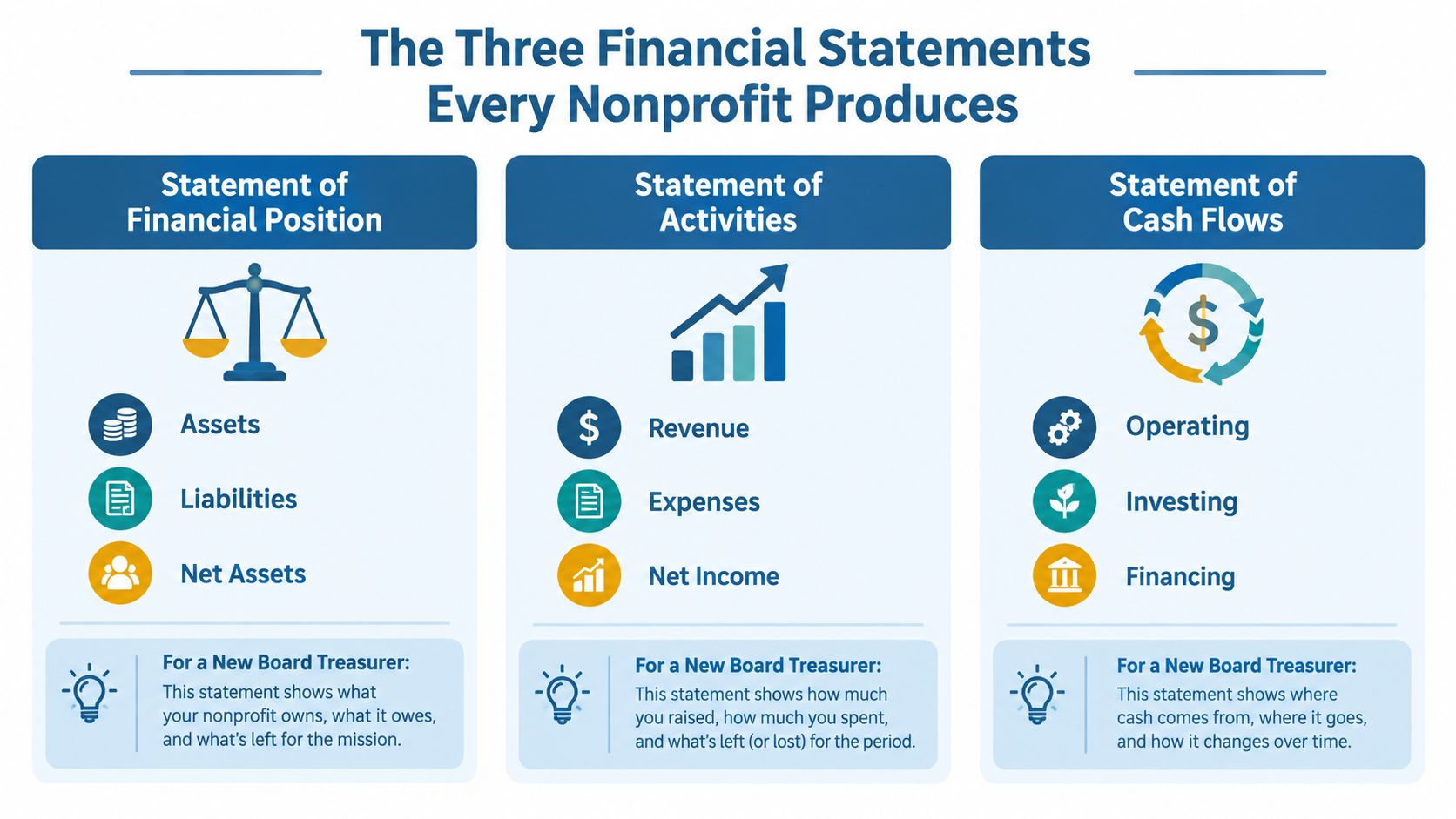
Every nonprofit produces financial statements that show what it owns, what it owes, how its net assets changed, and how cash moved. For a new board member, the easiest way to read them is to ask three questions: What do we have today? What changed this year? Where did the cash go?
A small charity's accounting usually feeds three core statements that answer those questions.
Statement of Financial Position
This is the nonprofit version of a balance sheet. It shows assets, liabilities, and net assets as of one date.
Common line items include:
- Cash
- Pledges receivable
- Accounts payable
- Net assets with donor restrictions
- Net assets without donor restrictions
For a grantor or auditor, this statement proves whether the organization has liquid resources, unpaid obligations, and restricted balances that can't be spent on general operations.
A useful companion to this statement is the charity's expense presentation, because newer guidance keeps pushing nonprofits toward clearer disaggregation of where money goes rather than broad buckets (discussion of current nonprofit accounting changes).
Statement of Activities
This is the nonprofit parallel to an income statement. It shows revenue, expenses, and changes in net assets over a period.
A small organization may report items such as:
- Contribution revenue
- Grant revenue
- Program expenses
- Management and general expenses
- Fundraising expenses
- Net assets released from restriction
This is often the first report a board member should read. It answers whether mission spending matched the organization's funding and whether restricted support was used for the right purpose during the year.
Here's a helpful walk-through before looking at a sample set of statements.
Statement of Cash Flows
This report explains cash movement through operating, investing, and financing activities. It matters because an organization can look healthy on paper and still struggle to make payroll if cash arrives late.
Boards often focus on surplus or deficit first. Cash flow tells you whether the organization can actually fund next month's operations while waiting on grants, pledges, or reimbursements.
How Nonprofit Accounting Differs From For-Profit Accounting
Nonprofit and for-profit accounting use many of the same mechanics, but they answer different questions. A business asks, “Did we earn profit for owners?” A nonprofit asks, “Did we steward resources according to mission and restrictions?”
That's why the reports look familiar but the logic behind them is different. If you want a technical reference point, Blue Sage Tax and Accounting Inc. maintains a page on nonprofit accounting standards that outlines the framework at a higher level.
Side-by-side differences
| Nonprofit vs. For-Profit Accounting at a Glance | Nonprofit | For-Profit |
|---|---|---|
| Accounting Feature | Nonprofit | For-Profit |
| Equity section | Net assets by restriction class | Owner equity or retained earnings |
| Core concern | Donor accountability and mission use | Profitability and return to owners |
| Internal structure | Fund accounting is common | Departmental or product-line tracking is common |
| Revenue lens | Contributions, grants, exchange revenue | Sales and service revenue |
| Year-end reading | Stewardship and compliance | Profit and value creation |
What that means in practice
If a restaurant owner in New York and New Jersey looks at two-state books, they're usually trying to understand margin, payroll burden, and tax exposure. If a charity board looks at nonprofit books, it's usually trying to confirm whether grant funds, annual donations, and endowment-related resources were used as promised.
Nonprofits also replace the familiar idea of retained earnings with net assets. A year-end surplus doesn't get distributed to owners because there aren't any shareholders waiting for dividends. The board uses that surplus to support the mission, strengthen reserves, or cover future program needs.
Which Tax and Compliance Filings Your Organization Must Submit
Nonprofits still file annual returns, even when they don't owe federal income tax on most activities. The filing required depends on the organization's size and structure, and the accounting records need to support those filings during the year rather than after the fact.
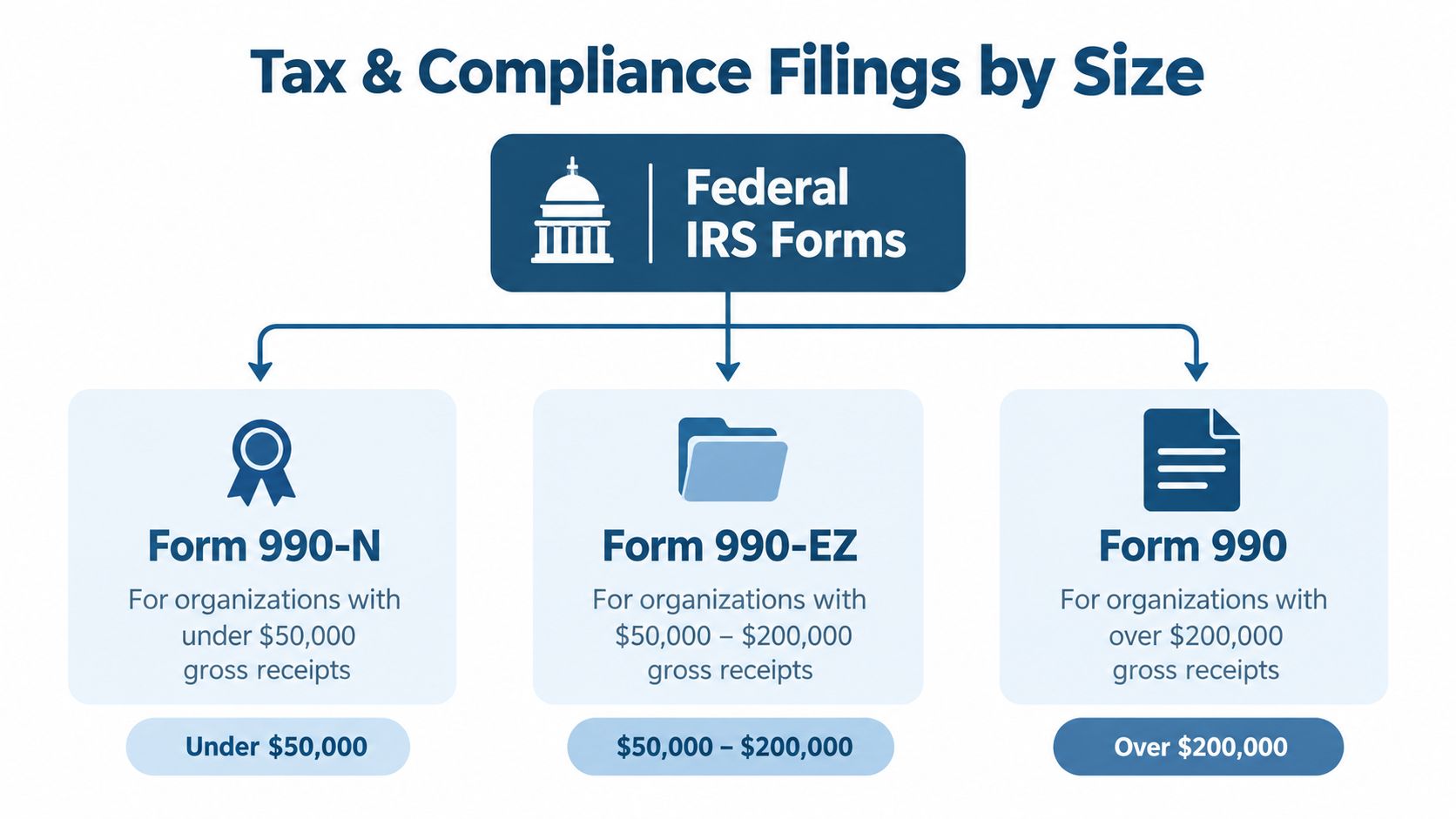
At the federal level, the IRS says organizations with annual gross receipts normally of $50,000 or less can generally file Form 990-N, and it's due every year by the 15th day of the 5th month after the end of the tax year (IRS Form 990-N filing requirement).
Federal filings most charities see
The Form 990 family generally includes:
- Form 990-N for very small exempt organizations
- Form 990-EZ for mid-sized organizations
- Form 990 for larger organizations
- Form 990-PF for private foundations
If you need a filing walkthrough, Blue Sage Tax and Accounting Inc. has a guide on how to file Form 990.
The full Form 990 isn't just a tax return. It asks for disclosures on donor-restricted endowments, quasi-endowments, donor-advised fund distributions, and related schedules such as Schedule D, which means the accounting system has to preserve that detail throughout the year (IRS Form 990 instructions and schedules).
State and local filings
If your organization operates in New York State or New York City, don't assume the federal filing is the only annual task. State charitable registration filings and local exemption-related filings may also apply, depending on the organization's structure, activity, and property footprint.
If the nonprofit earns income from activities outside its exempt purpose, it may also need to look at Form 990-T for unrelated business income. That issue is fact-specific, so it's usually best reviewed alongside the books before year-end.
Practical Tips for Nonprofit Leaders, Bookkeepers, and Donors
The most useful nonprofit accounting habits are the ones that keep restricted dollars visible all year, not just at audit or filing time. If you're a board member, executive director, or bookkeeper, the goal is a system that shows purpose, timing, and documentation without heroic cleanup at year-end.
For context, the sector is large enough that small process failures can turn into big trust problems. In 2012, 501(c)(3) public charities accounted for $1.65 trillion in revenue, $1.56 trillion in expenses, and $2.99 trillion in assets, while separate IRS statistics show that in 2011 nonprofit charitable organizations reported $1.6 trillion in total revenue, $1.5 trillion in expenses, and nearly three-quarters of revenue, about $1.2 trillion, from program services (sector financial footprint under nonprofit reporting guidance).
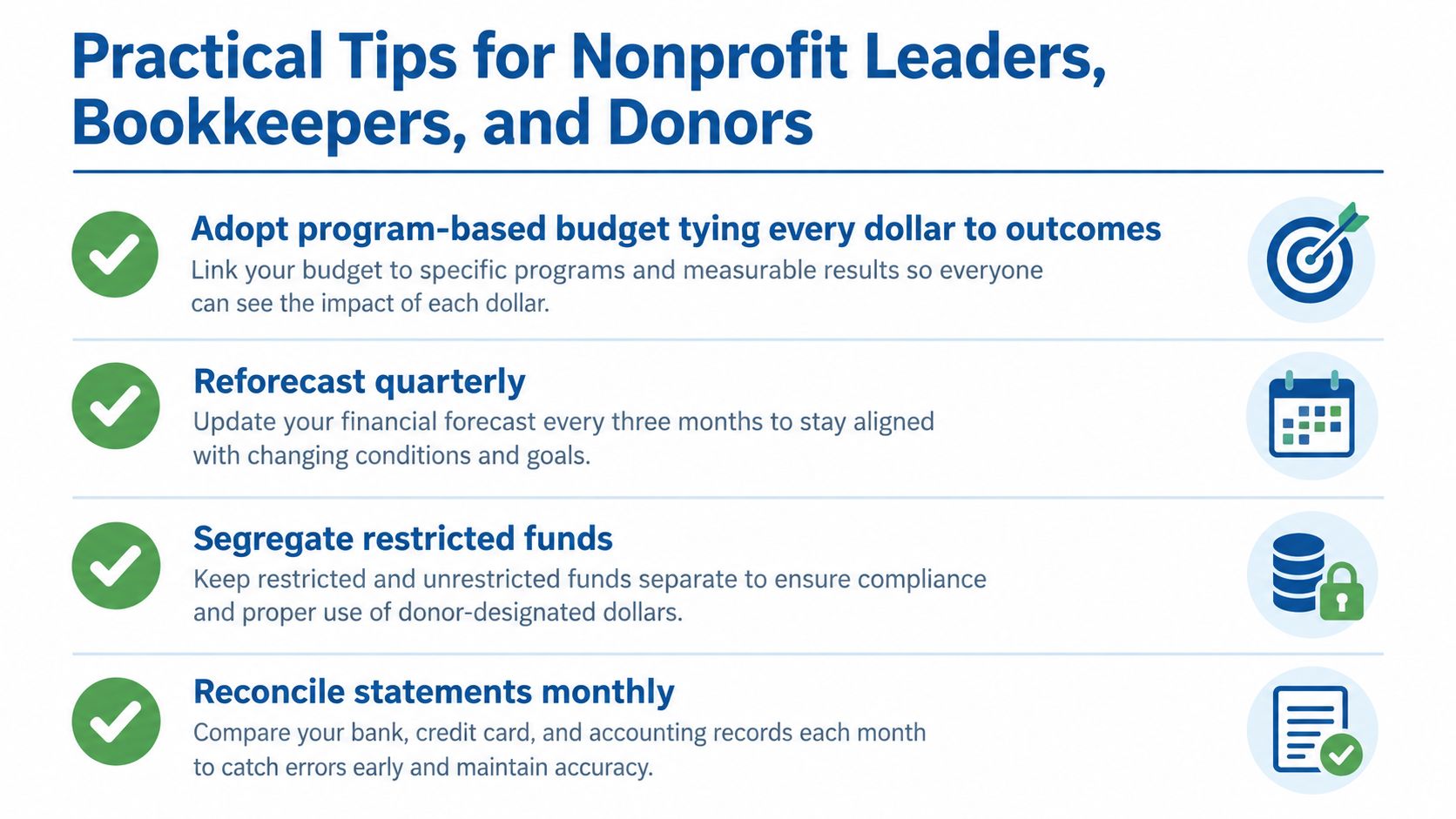
A short checklist you can act on this quarter
- Build the budget by program: Don't start with one big overhead bucket. Start with programs, grants, and restricted projects, then layer in shared costs.
- Reforecast during the year: Restricted grants can shift. A budget approved once isn't enough if program timing changes.
- Separate duties around cash: One person shouldn't handle deposits, record the transactions, and reconcile the bank account alone.
- Reconcile monthly: If grant receivables, donor pledges, or releases from restriction are stale, you'll usually find the problem in the monthly close.
- Use software that fits the job: QuickBooks for Nonprofits, Aplos, and Sage Intacct are common accounting options. Bloomerang and Salesforce NPSP are common donor CRM choices.
- Keep filing support as you go: Waiting until return season to rebuild donor restrictions, endowment activity, or functional expenses usually creates avoidable cleanup.
What changed recently
Current rule changes are another reason not to treat nonprofit accounting as static. In the last year, published guidance highlighted several developments affecting controllers and bookkeepers, including the Single Audit threshold increasing to $1 million for fiscal years ending September 30, 2025 and later, ASU 2023-08 for crypto assets at fair value, and ASU 2025-05 creating a practical expedient for certain short-term receivables (2025 and 2026 nonprofit accounting changes).
Donors and board members don't need every journal entry. They do need a reporting system that can answer a basic question quickly: where did this restricted money go, and can we prove it?
For donors, one practical step is to review an organization's publicly available IRS filings before giving. For leaders, the parallel step is to make sure those filings match the story the organization tells funders during the year.
Blue Sage Tax & Accounting Inc. helps organizations and business owners with bookkeeping, tax filings, and year-round financial reporting that supports returns such as the Form 990 family and the records behind them. If your team needs cleaner books, better restriction tracking, or help getting year-end filings organized, visit Blue Sage Tax & Accounting Inc.. Book your free consultation call today.
This article is general information and not tax advice for your specific situation.