A multi-member LLC is a limited liability company owned by two or more members. For federal tax purposes, a domestic LLC with at least two members defaults to partnership classification unless the company elects corporate treatment.
That distinction matters if you're forming a business with a partner, adding an investor, or operating across New York and New Jersey. The LLC is created under state law, while federal tax rules determine how the business files, how income reaches the members, and whether the owners are treated as self-employed. A contractor, restaurant owner, or real estate investor can have the right legal structure and still miss a state filing, misunderstand a K-1, or assume a federal exemption eliminates every compliance obligation.
Table of Contents
- What Is a Multi-Member LLC
- How Multi-Member LLCs Are Taxed by Default
- Operating Agreement Essentials
- Multi-Member LLC vs Single-Member LLC vs S-Corporation
- New York and New Jersey Filing Requirements
- Compliance Checklist and Next Steps
What Is a Multi-Member LLC
A multi-member LLC is a state-law business entity owned by two or more members. Those members may be individuals, corporations, partnerships, or other legally recognized entities. The company generally owns its assets, signs contracts, and takes on business obligations separately from the people or entities that hold membership interests. The IRS describes the federal classification of a multi-member LLC, but that tax classification doesn't change the fact that the LLC itself is formed under state law.
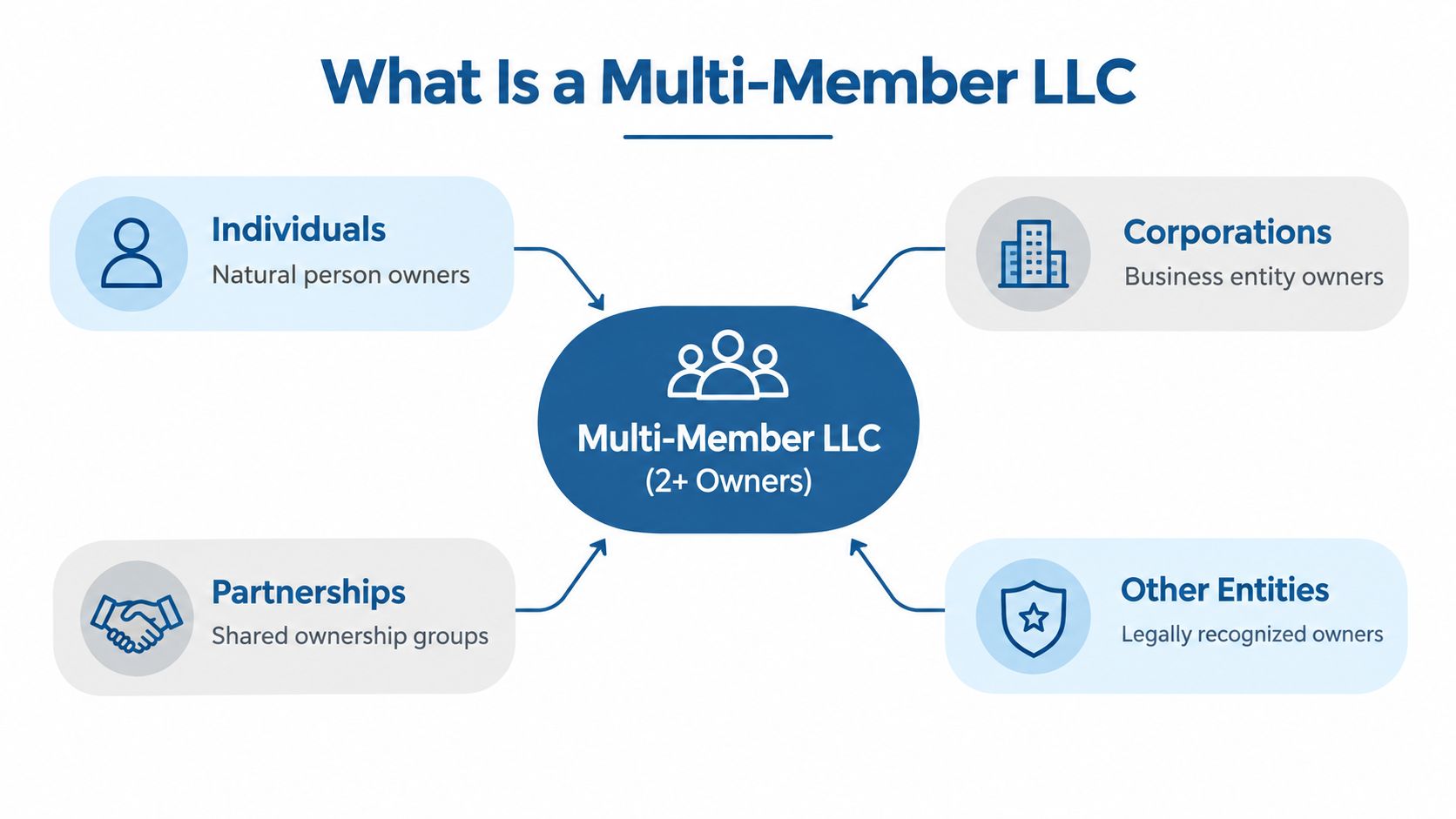
Think of the structure as two separate layers:
- Legal layer: The state creates the LLC, and the entity generally stands between ordinary business debts and the members' personal assets.
- Tax layer: The IRS classifies the LLC, usually as a partnership by default when it has at least two members, unless the company elects corporate treatment.
- Governance layer: The operating agreement determines how the members share profits, vote, contribute money, and handle disagreements.
Limited liability isn't unlimited immunity. A personal guarantee, direct personal wrongdoing, commingling personal and company funds, inadequate records, or failure to maintain the business as a separate entity can create legal and collection risks. The members need to treat the LLC as a real business, not just a name on an organizational filing.
The operating agreement is especially important because ownership isn't only about who contributed money. It should explain ownership percentages, profit and loss allocations, voting rights, management responsibilities, and exit procedures. Two members might contribute different amounts of capital but agree to a different economic arrangement. That agreement gives the business a written operating framework instead of leaving major decisions to memory or informal conversations.
How Multi-Member LLCs Are Taxed by Default
A domestic LLC with at least two members is generally treated by the IRS as a partnership for federal income-tax purposes, unless it files Form 8832 to elect corporate classification. The LLC remains a state-created legal structure, while the federal classification determines which return the business files and how income is reported. The IRS explains this default classification and election process.
Under the default approach, the LLC generally files Form 1065, U.S. Return of Partnership Income. The entity ordinarily doesn't pay federal income tax on its operating profit. Instead, it issues each member a Schedule K-1, which reports that member's allocated share of income, deductions, credits, and other reportable items. Members generally include those allocated amounts on their own federal tax returns.
That creates a point many new owners miss: taxable income and cash distributions aren't the same thing. Suppose a contractor has $400,000 in revenue and the LLC retains cash for equipment, payroll, or working capital. A member may still receive taxable income on a K-1 even if the company doesn't distribute enough cash to cover the member's personal tax bill. The exact result depends on expenses, allocations, the operating agreement, and other facts, so estimated tax planning should use projected distributive income rather than distributions alone.
What determines each member's share
The operating agreement, ownership percentages, capital contributions, and profit-sharing provisions all matter. A 50 percent ownership interest may not automatically answer every allocation question, particularly if the agreement contains special allocations. Those provisions may need to satisfy partnership tax rules, so the members shouldn't assume that any allocation is acceptable just because everyone signed the agreement.
Members who perform services for a partnership-classified LLC are generally treated as self-employed rather than employees for federal tax purposes. That affects how owners think about payroll, estimated payments, retirement planning, and cash withdrawals.
The LLC can instead elect corporate taxation by filing Form 8832. That choice can change filing, payroll, and owner-compensation requirements. It doesn't turn the state-law LLC into a corporation, and it isn't a decision to make from a single tax comparison. The owners should model the expected income, compensation, payroll administration, and state consequences before making an election. For a broader explanation of the federal partnership process, see how partnerships are taxed.
Operating Agreement Essentials
A multi-member LLC needs a written operating agreement that answers the questions co-owners will face before money or relationships become strained. The document should establish who owns what, who controls which decisions, how members receive economic benefits, and what happens when someone wants to leave.
Cornell's explanation of LLC member rights and liability protection describes the central balance. Members generally have management control similar to a general partner while retaining liability protection similar to a limited partner. The LLC, rather than the individual member, normally contracts, owns business assets, incurs operating obligations, and serves as the primary defendant for ordinary business debts.

At a minimum, discuss these subjects in the agreement:
- Ownership and contributions: Record each member's interest, initial capital contribution, future funding obligations, and treatment of member loans.
- Management and voting: State whether the LLC is member-managed or manager-managed, which decisions require member approval, and who may sign contracts or borrow money.
- Profits and losses: Describe distributions and tax allocations separately. Economic ownership and tax allocations aren't always interchangeable.
- Membership changes: Set rules for admitting a new member, removing a member, transferring an interest, or handling a death or bankruptcy.
- Buyouts and disputes: Establish valuation procedures, payment terms, deadlock procedures, and what happens if members disagree about a major transaction.
Members should also understand the limits of liability protection. Using a personal credit card for business expenses once may not determine the legal result, but routinely mixing accounts, failing to keep records, signing personal guarantees, or treating company assets as personal property can weaken the separation. Maintain a business bank account, document major decisions, and sign contracts in the LLC's name.
For a practical overview of provisions commonly included in this document, what an operating agreement covers can serve as a useful reference. Blue Sage also provides information about multi-member LLC agreements for owners reviewing their governance and tax-allocation needs.
Multi-Member LLC vs Single-Member LLC vs S-Corporation
The ownership count changes the default federal filing path, but it doesn't tell you which structure will work best. A single-member LLC generally has one owner and is disregarded for federal income-tax purposes by default. A multi-member LLC generally files as a partnership, while an LLC that elects S-corporation treatment follows the S-corporation rules.
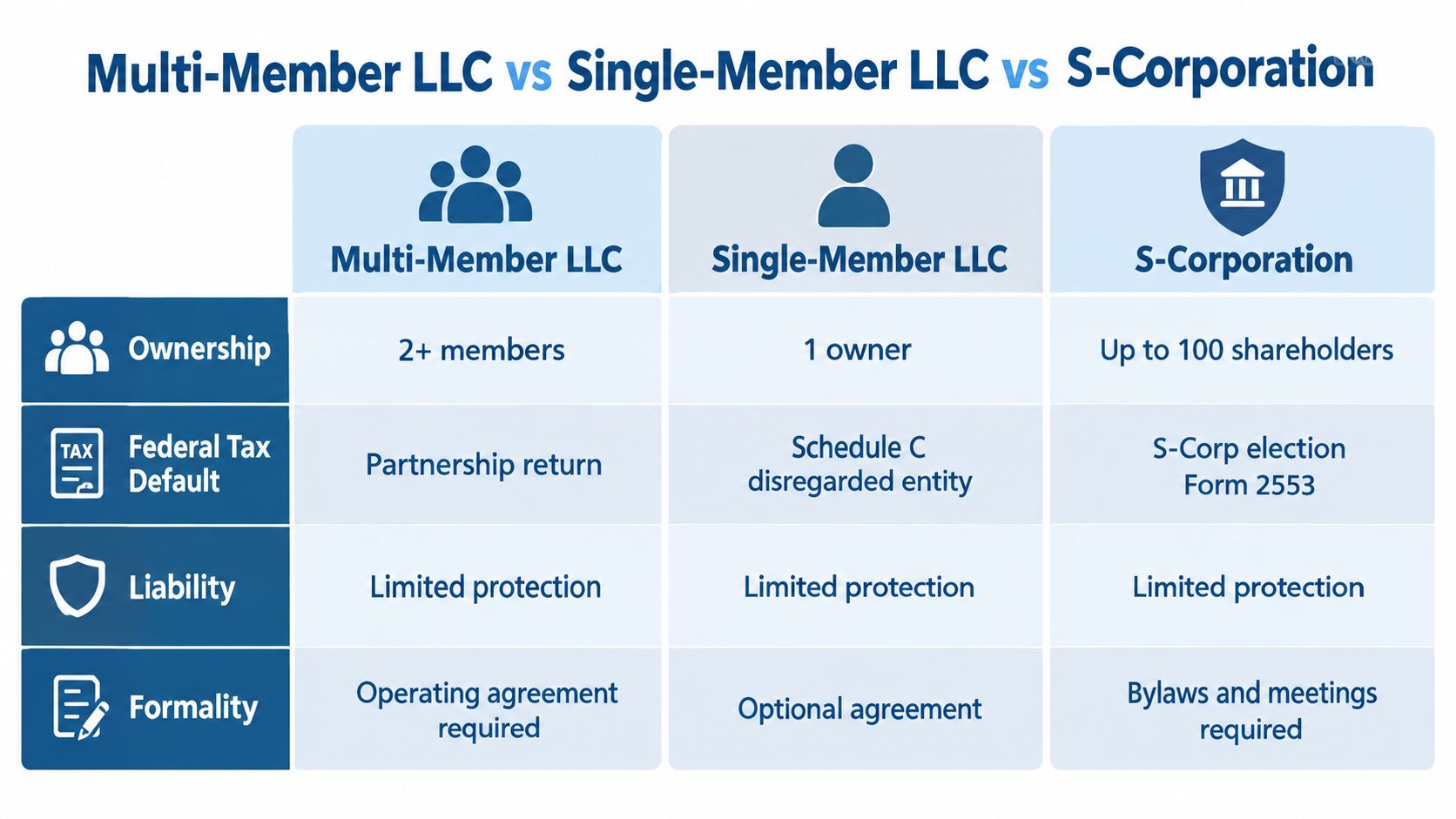
| Structure | Ownership and default federal treatment | Owner compensation and administration |
|---|---|---|
| Single-member LLC | One member. Generally disregarded for federal income-tax purposes unless an election changes that treatment. | The owner typically reports business activity through the applicable individual return process. |
| Multi-member LLC | Two or more members. Generally classified as a partnership, with Form 1065 and Schedule K-1 reporting. | Members performing services are generally self-employed rather than employees. |
| S-corporation taxation | An eligible entity elects S-corporation treatment under the applicable IRS rules. | Owner-employees generally require reasonable compensation analysis, payroll processing, and W-2 reporting. |
Both LLC structures can provide limited liability when properly formed and maintained. The difference is ownership, governance, and default tax reporting. An S-corporation election doesn't replace the LLC's operating agreement, state obligations, bookkeeping, or payroll responsibilities.
A growing business should compare more than the headline tax rate. Ask whether the owners can support payroll administration, whether compensation needs to be documented, how profits will be divided, and whether the members need flexibility that partnership taxation can provide. An election may fit one business and create unnecessary work for another.
New York and New Jersey Filing Requirements
Federal partnership classification doesn't eliminate state filing obligations. A business operating in New York and New Jersey must identify where income is sourced, which members have residency connections, and which state forms apply.
Consider a contractor with $400,000 in revenue whose projects include work in both states. The federal return may report the LLC's overall partnership activity, but the owners still need records that support the income attributable to each jurisdiction. Revenue alone doesn't determine every state tax result, because expenses, sourcing rules, residency, and the nature of the work also matter.
In New York State, certain partnerships and LLCs file Form IT-204-LL and pay an annual filing fee generally based on New York-source gross income for the immediately preceding tax year, rather than total nationwide revenue. New York's instructions state that an LLC or LLP with no New York-source gross income in the preceding tax year owes a $25 filing fee, while a regular partnership with New York-source gross income below $1,000,000 has no New York State filing fee under the applicable table. Form IT-204-LL is generally due by the 15th day of the third month after the close of the tax year. See the New York State annual filing fee guidance for the applicable rules.
In New Jersey, a partnership-classified LLC must file Form NJ-1065 when it has New Jersey-source income or at least one New Jersey-resident partner. New Jersey taxes partners on their shares of partnership income and gains whether or not those amounts are distributed. A qualifying LLC may also elect New Jersey's Pass-Through Business Alternative Income Tax at the entity level when the federal classification and member requirements are met. The election is annual and must be made by the original return due date, such as March 15 for calendar-year filers. The New Jersey partnership tax guidance provides the state-specific details.
Compliance Checklist and Next Steps
Start with the LLC's state formation documents and operating agreement, then confirm the federal classification and whether Form 1065 and K-1 reporting apply. Review New York-source and New Jersey-source activity separately when a restaurant owner or contractor operates in both states.
FinCEN's current rule narrowed beneficial-ownership reporting. U.S.-created entities, including domestic LLCs, are exempt under the 2025 interim final rule, while certain foreign entities registered to do business in the United States can remain subject to reporting. The FinCEN beneficial ownership information rule fact sheet also explains that there is no annual BOI report for exempt U.S. companies. That exemption doesn't remove state annual reports, partnership returns, payroll, sales-tax, or foreign-owner obligations.
Use bookkeeping records that separate member contributions, distributions, loans, and operating expenses. Resources on preparing statements for bookkeeping can help owners organize the bank information their tax preparer needs.
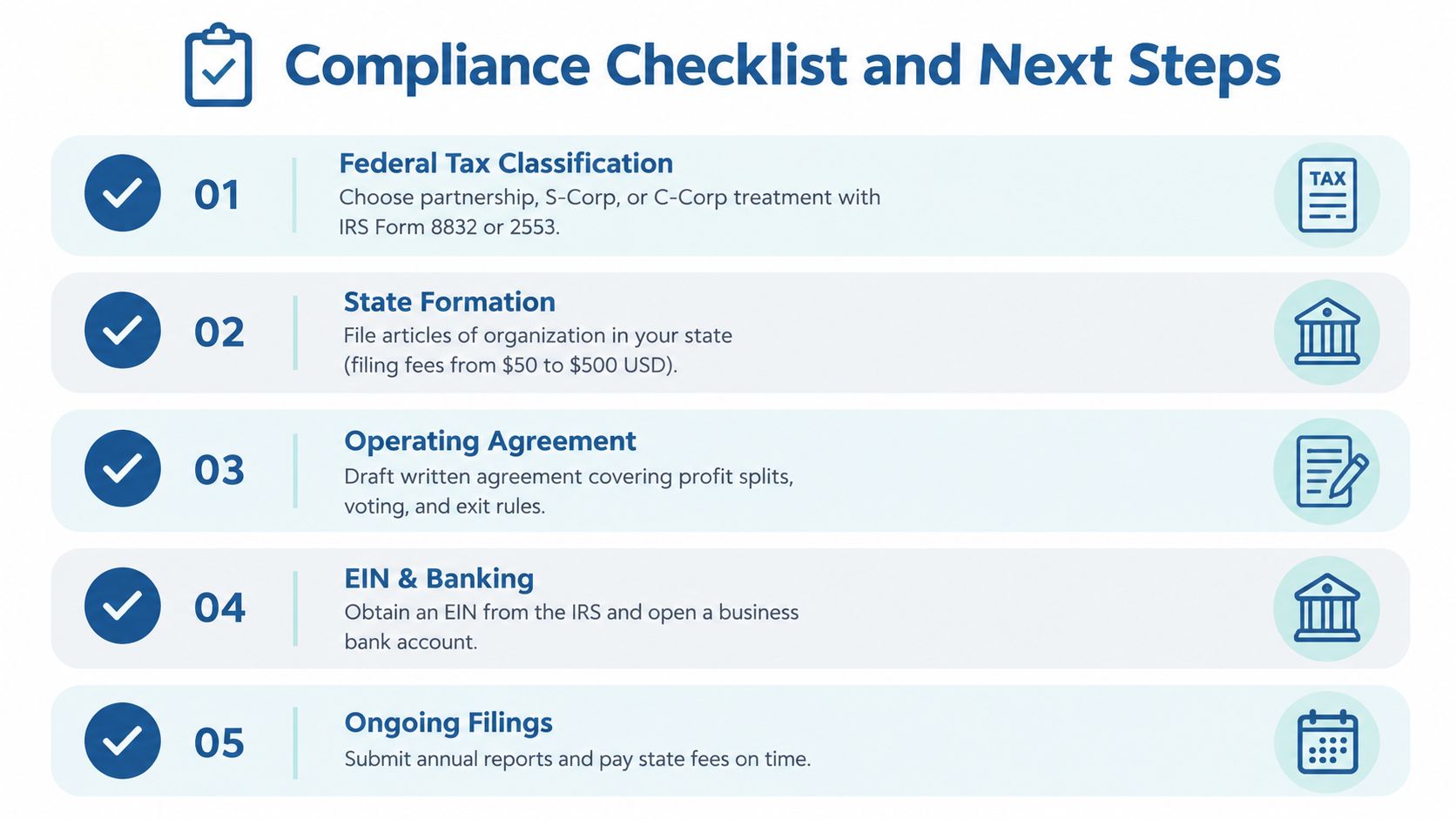
A contractor with $400,000 in revenue should model estimated payments from projected K-1 income, not cash distributions alone. A restaurant filing in New York and New Jersey should track each state's source income and filing triggers before the returns are prepared.
Book your free consultation call today through Blue Sage Tax & Accounting Inc. to discuss partnership reporting, multi-state filings, bookkeeping, payroll, and tax projections for your multi-member LLC. You can book your free consultation call today to review the entity's current classification and upcoming compliance decisions.
This article is general information and not tax advice for your specific situation.