
The popular advice is wrong: a high federal estate-tax exemption doesn't make ultra high net worth tax planning easier. It shifts the work toward coordinating income timing, capital gains, entity reporting, trusts, and state exposure. For 2026, the federal estate and gift tax exemption is $15 million per person, with portability potentially bringing a married couple's combined federal exemption to $30 million, while New York's basic exclusion amount is $7,350,000. Both amounts adjust under their respective rules, so a plan that works federally can still fail at the state level. Federal 2026 trust and estate updates and New York estate tax guidance show why the key question is not just how to reduce an estate, but how to coordinate every entity, income stream, and jurisdiction before a filing deadline or liquidity event.
Table of Contents
- Why the 2026 Exemption Makes Planning Harder
- The Family Office Shift and the Reporting Bottleneck
- How Trusts and Gifting Shift Future Appreciation
- Federal Portability vs New York Estate Tax Rules
- Proactive Projections for Business Exits and Liquidity
- Checklist for Engaging the Right Accounting Firm
Why the 2026 Exemption Makes Planning Harder
The 2026 problem is not estate tax. It is whether your income, withholding, and entity reporting line up before the year closes. A family can sit comfortably below the federal threshold and still create a mess through pass-through income, bonus timing, state-source income, and trust activity that no one reconciled early enough.
The federal exemption remains $15 million per person for 2026, with inflation adjustments beginning in 2027. That matters, but it does not simplify the operating work. It shifts attention away from basic estate-tax minimization and toward the harder job of coordinating income timing, capital gains, New York exposure, and clean reporting across every entity and trust.
A business owner with an operating company, rental properties, concentrated stock, and private investments may look “safe” on the estate side and still face serious tax leakage during the year. The same is true for a contractor with $400,000 in revenue who also has pass-through income, payroll, estimated payments, retirement contributions, and state filings. The exemption does nothing to align those moving parts.
The tax risks that replace the old headline
Gift planning still gets attention because the exemption gets the headlines. The more expensive mistakes usually happen earlier, in ordinary cash flow and reporting decisions.
- Income timing: A poorly timed Roth conversion or large gain realization can push income into a higher bracket and distort other calculations.
- Withholding gaps: Bonuses, pass-through income, and investment gains often do not generate enough withholding to cover the final liability.
- Estimated payments: Owners who rely on annual filing often find quarterly payments were based on stale income or ownership assumptions.
- State exposure: Moving between states, operating in multiple states, or keeping state-source income creates obligations that federal planning does not solve.
Recent financial coverage shows wealthy taxpayers shifting attention toward income and capital-gains planning, including tax-loss harvesting, state-level exposure, Roth conversion timing, bonus withholding, and income-related Medicare surcharges. The CNBC coverage of 2026 wealth tax planning points to the right response. Build a projection process that catches problems before they hit a filing deadline.
Practical rule: Treat the federal exemption as one input in the plan. Do not treat it as the plan.
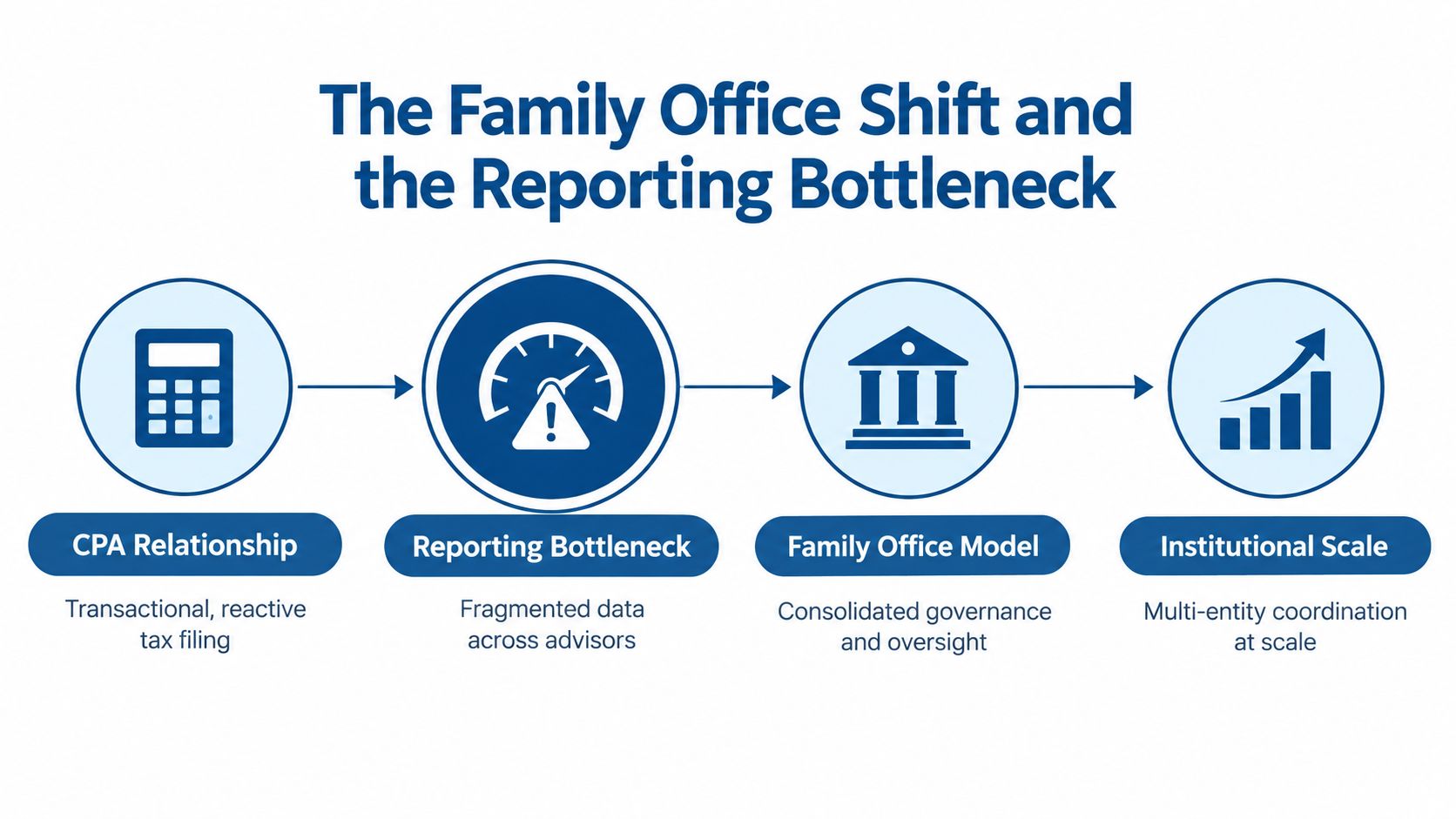
The Family Office Shift and the Reporting Bottleneck
Ultra-high-net-worth households rarely hold wealth in one place. Operating businesses, LLCs, partnerships, trusts, private funds, real estate entities, and investment accounts all sit in the same structure, and that complexity creates reporting risk fast. Industry reporting on ultra-high-net-worth households places the UHNW threshold at $30 million or more in net worth or investable assets and estimates roughly 426,000 to 460,000 UHNW individuals worldwide with about $49 trillion in combined investable wealth. The United States accounts for about 167,000, or roughly 40%, of that total.
A family office is the answer when one preparer can no longer keep up. It gives the family one operating hub for tax, estate, investment, accounting, philanthropy, administration, and governance. Family office governance guidance points in the same direction, families need integrated oversight, not disconnected filing. That shift is not cosmetic, it is the difference between reactive compliance and controlled decision-making.
Why clean data matters more than another strategy
The core bottleneck is consolidated reporting. Trust books do not always match beneficiary statements. An LLC may code expenses differently from the operating company. Private-market statements may show up after estimated payments were already set. The family office may know the assets exist, but still lack a current view of basis, ownership, distributions, and state sourcing.
That problem shows up in smaller families too. A business owner with entities in more than one state can have revenue in one company, payroll in another, and investments in a separate account. If ownership records are stale or the accounting arrives late, the tax projection becomes a backward-looking filing exercise. It stops being a planning tool.
The fix is a recurring reporting process that forces the numbers to agree before filing season. It should reconcile entity ownership, income classification, state sourcing, and tax timing. That means trusts, LLCs, partnerships, corporations, and personally held assets all sit in one reporting rhythm, with estimated payments, withholding, distributions, transactions, and year-end adjustments reviewed together.
Families that want a tighter operating model should treat family office tax planning services as part of the larger coordination stack, not as a standalone fix. The accounting team, investment professionals, attorneys, and family office staff need defined roles and one shared reporting calendar. Without that, the structure looks complex on paper and sloppy in practice.
How Trusts and Gifting Shift Future Appreciation
The central question is not whether a trust exists. It is whether the family is using the trust to move future appreciation out of the taxable estate while keeping the reporting clean across entities, states, and generations. Revocable trusts usually do not change estate inclusion because the grantor still controls the assets. Irrevocable structures do.
That distinction matters most for UHNW families with operating businesses, partnerships, and investment entities spread across multiple states. A transfer that looks sensible on paper can create a reporting mess if ownership records, valuation support, and income timing are not aligned. PNC's trust and estate planning guidance separates revocable arrangements from irrevocable gifting structures for that reason.
The structural trade-off
Irrevocable trusts can shift appreciation out of the taxable estate, but they also give up flexibility. Once assets move, the grantor should expect tighter limits on control, access, and changes to the structure. That is the trade-off. If the asset is likely to appreciate sharply, the transfer may be worth it. If the family still needs liquidity or decision rights, the structure may be wrong.
Before funding a trust, the team should answer five questions without ambiguity:
- What asset is moving? Rapidly appreciating interests usually justify a different approach than cash or slow-growth property.
- Who needs access? A trust for descendants should not be funded with assets the grantor may still need.
- Who controls distributions? Trustee authority and distribution standards shape both administration and family expectations.
- How will the records work? Gift tax reporting, valuation support, funding records, and later transactions must line up.
- Does it fit the larger plan? Gifting has to match succession, liquidity, and investment decisions.
The GST layer can turn a good transfer into a bad one if it is ignored. Federal GST tax applies to transfers to people more than one generation below the transferor, and private-wealth guidance identifies a 40% GST rate. U.S. Bank's family estate planning guidance makes the point plainly, the trust's GST status has to be reviewed before assets are aimed at grandchildren or a dynasty structure.
Do not fund first and sort out GST later. The legal documents, accounting records, gift reporting, and trust administration need to tell the same story from day one.
Federal Portability vs New York Estate Tax Rules
Federal portability can let a surviving spouse use a deceased spouse's unused federal estate-tax exclusion, but only if the federal filing rules are handled correctly. New York State does not allow portability of unused New York estate-tax exclusion, so the survivor cannot add the deceased spouse's unused New York amount to their own. New York planning guidance on portability and the state estate tax makes that split clear.
For New York estates of decedents dying on or after January 1, 2026, the basic exclusion amount is scheduled to be $7,350,000 through December 31, 2026, subject to the state's annual adjustment. Estates at or below that amount generally owe no New York estate tax, but the filing posture still needs to be coordinated with the rest of the family's balance sheet and reporting.
The 2026 comparison
Amounts shown are 2026 scheduled amounts under current federal and New York rules and remain subject to statutory adjustment.
| Jurisdiction | 2026 Exemption Limit | Spousal Portability Allowed |
|---|---|---|
| Federal | $15 million per person, adjusted under federal rules | Yes, potentially, subject to federal requirements |
| New York State | $7,350,000, adjusted annually | No |
That gap changes the planning conversation for a New York couple. Title ownership, trust funding, which spouse holds appreciating assets, and whether the plan depends on survivor access all matter more than a simple election on a tax return. A structure that works federally can still fail New York's estate-tax rules if the documents and asset ownership are not aligned.
The bigger issue is coordination. Multi-entity families need clean reporting across trusts, operating companies, and investment entities, or the estate file becomes a reconstruction project. A New York resident with New Jersey or other state ties also needs a separate review of domicile, asset location, business activity, and filing duties. For that reason, many families bring in local support such as Hire Virtual Legal Assistants in New York to keep documents, deadlines, and recordkeeping organized while counsel and tax advisors handle the legal and tax positions.
If you want a plain-language review of the state threshold, start with New York State estate tax exemption planning. The federal and New York systems should be modeled together before the first death, not untangled after the estate return is already due.
Proactive Projections for Business Exits and Liquidity
A business exit does not solve a coordination problem. It exposes one. An owner selling a closely held company may also receive pass-through income, hold concentrated stock, and live in one state while the company operates in another. Tax work should start before transaction documents are final. Entity structure, basis, estimated payments, state sourcing, and gain timing can change the final result.

The projection must connect the proposed transaction to the full tax year. It should bring together ordinary business income, investment gains and losses, withholding, estimated payments, charitable activity, retirement planning, and obligations in every relevant state. For families with trusts, operating companies, and investment entities, the model also needs a clean consolidated view so income is not reconstructed from disconnected records.
Use the model to test the decisions that can still change the outcome. What changes if the closing moves? A transaction completed in one tax year can produce a different timing result from one completed in another. Which entity reports the income? That answer can affect basis, allocations, state filings, and the owner's personal return.
Are payments tracking the revised income? A major gain can make earlier estimates obsolete. Can losses be harvested appropriately? Selling selected investments at a loss may be considered alongside gain realization during volatile markets, but the timing and replacement strategy require careful review. What state exposure remains? Moving, selling a business, or operating across state lines does not automatically remove prior filing obligations.
Annual filing should confirm the plan, not reveal the transaction's tax impact. Wealth planning for high net worth individuals can help owners consider the broader financial consequences of a sale. The tax projection still must rest on the actual entities, transaction documents, ownership records, and jurisdictions involved.
The same discipline applies to a smaller owner. A contractor with $400,000 in revenue may not be preparing for a sale, yet a new contract, equipment purchase, entity change, or large distribution can alter estimated payments and state obligations. Proactive modeling gives any owner a control system for income that changes during the year.
Counsel and investment advisors should review the transaction plan with the accounting firm. The accountant can model tax consequences and reporting requirements, but should not claim to be a valuation advisor, M&A advisor, or legal provider without offering those services.
Checklist for Engaging the Right Accounting Firm
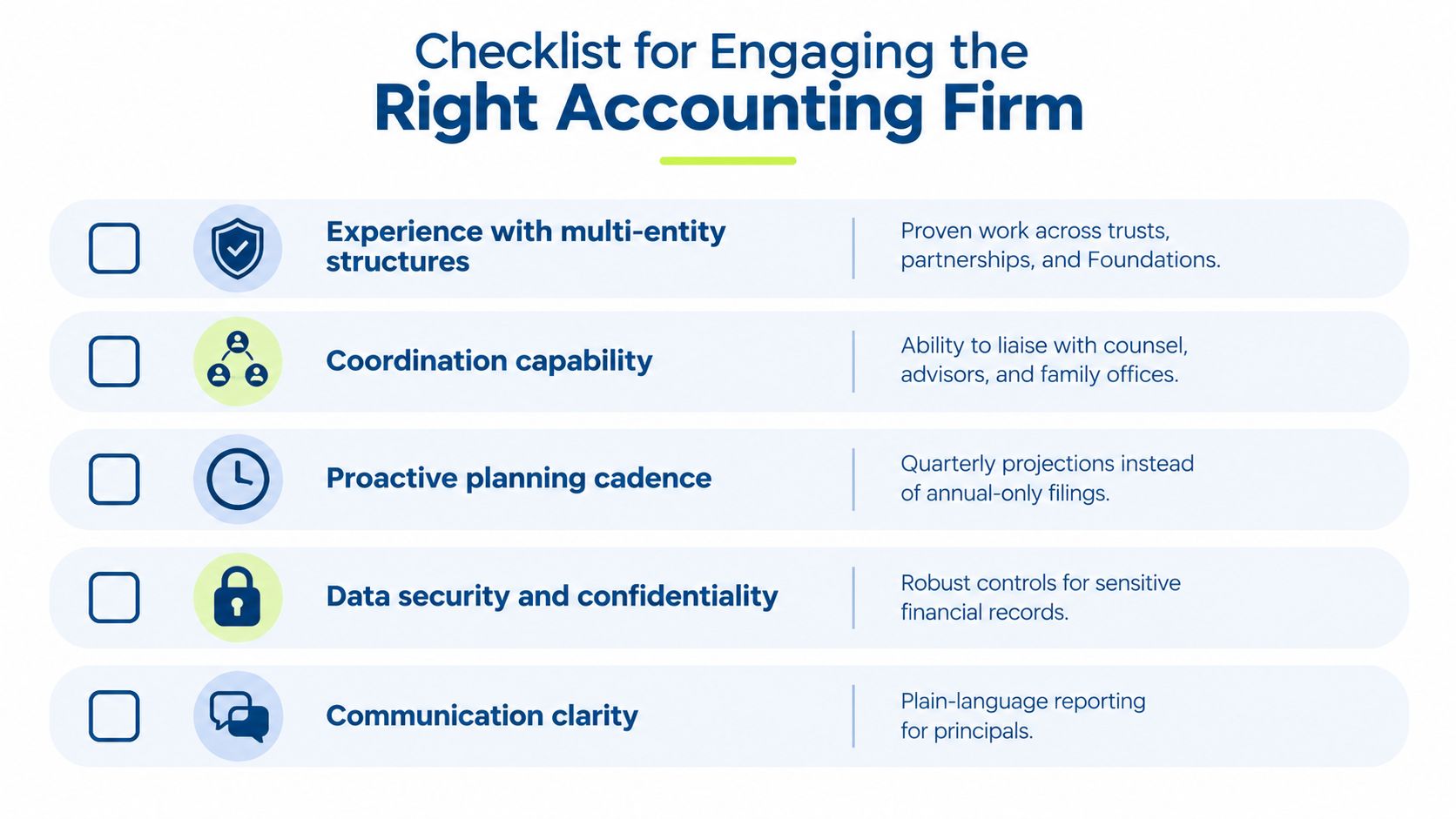
Choose an accounting firm based on operating capability, not a polished promise about tax savings. UHNW tax planning requires clean information, direct communication, multi-state knowledge, and projections that are updated before decisions become irreversible.
Ask these questions before engagement:
- Who will review the work? You should know whether the owner or a senior advisor will be directly available, rather than relying on an anonymous handoff.
- Can the team reconcile multiple entities? Ask how it handles trusts, LLCs, S corporations, partnerships, operating companies, investment accounts, and private-market statements.
- How often are projections updated? Annual-only filing is insufficient when income, ownership, or transactions change during the year.
- What states does the firm handle? A restaurant owner filing in two states needs more than a federal return and a home-state filing.
- How are records secured? Sensitive financial information requires clear controls for document sharing, storage, access, and retention.
- What does the firm not provide? Confirm whether legal services, valuations, audits, reviews, compilations, or transaction advisory work must come from other professionals.
The reporting process matters
Request a sample reporting calendar. It should identify when bookkeeping closes, when investment documents are collected, when entity books are reconciled, when projections are updated, and when estimated payments are reviewed. If the firm can't explain that cadence clearly, it probably relies too heavily on historical return preparation.
You should also ask how the firm communicates uncertainty. A responsible projection distinguishes confirmed figures from assumptions, identifies missing documents, and shows how a transaction or change in income affects the result. It won't guarantee an outcome, and it won't hide unresolved state or entity issues behind a single headline number.
Blue Sage Tax & Accounting Inc. provides tax preparation, year-round tax planning, quarterly projections, multi-state filings, bookkeeping, entity analysis, trust and estate returns, and related compliance support, with direct access to the firm's owner. Those services can fit an owner or family structure that needs coordinated reporting rather than annual filing alone.
Blue Sage Tax & Accounting Inc. works with business owners, investors, self-employed professionals, and multi-state filers on year-round projections, entity reporting, trust and estate returns, and coordinated tax compliance. Visit Blue Sage Tax & Accounting Inc. to review the firm's services, then Book your free consultation call today.
This article is general information and not tax advice for your specific situation.