
A family member serving as executor or trustee often discovers that trust and estate accounting is far more than recording deposits and paying bills. It is the disciplined process of tracking assets, income, principal, expenses, distributions, taxes, and beneficiary allocations so the fiduciary can preserve trust property, report income accurately, and explain every transaction. The work may include federal Form 1041 reporting, state fiduciary returns, estimated-tax projections, and a final reconciliation.
The need exists even when no federal estate tax is due. For tax year 2022, the IRS reported approximately 3.2 million Form 1041 returns, representing about $542 billion of income and $89 billion in distributions. By contrast, approximately 0.2% of decedents filed a federal estate-tax return, showing that fiduciary accounting reaches far beyond estate-tax filings. IRS fiduciary income-tax data explains the scale and the limits of the filing population.
Table of Contents
- What is trust and estate accounting
- How do you allocate income versus principal
- What are the Form 1041 reporting requirements
- When do New York and New Jersey require fiduciary returns
- How should a trustee plan for estimated taxes
- Should a family member act as the sole trustee
What is trust and estate accounting
Trust and estate accounting is the specialized system for recording, classifying, reconciling, and reporting financial activity for a trust or estate. It separates principal from income, tracks payments and distributions, preserves documentation, and connects the fiduciary's books with tax returns and beneficiary statements.
For a nonprofessional executor or trustee, the workload usually begins with an inventory of assets and liabilities. It continues through bank reconciliations, investment activity, real estate income, professional fees, tax payments, reimbursements, and beneficiary distributions. A spreadsheet may work for a simple estate with limited activity, but it becomes fragile when assets are sold, multiple beneficiaries receive different amounts, or the administration crosses tax years.
What the records need to show
A defensible accounting should allow another person to answer four questions:
- What came into the entity: Interest, dividends, rent, business income, sale proceeds, refunds, and other receipts.
- What went out: Taxes, professional fees, repairs, insurance, investment costs, distributions, and other payments.
- Who benefited: The trust or estate, a specific beneficiary, or the fiduciary acting in an individual capacity.
- How the transaction was classified: Principal, fiduciary accounting income, taxable income, deductible expense, or an amount excluded from distributable net income.
The fiduciary also needs to distinguish entity-level tax reporting from beneficiary-level reporting. A trust or estate may report income on Form 1041 while passing certain items to beneficiaries through Schedule K-1. Those records must agree with the underlying transaction detail.
Court and state requirements vary. Someone administering an estate outside New York may benefit from reviewing Texas probate accounting rules alongside local counsel's advice. For ongoing administration, trust administration services can help organize fiduciary books, tax reporting, and beneficiary allocations without replacing legal advice.
How do you allocate income versus principal
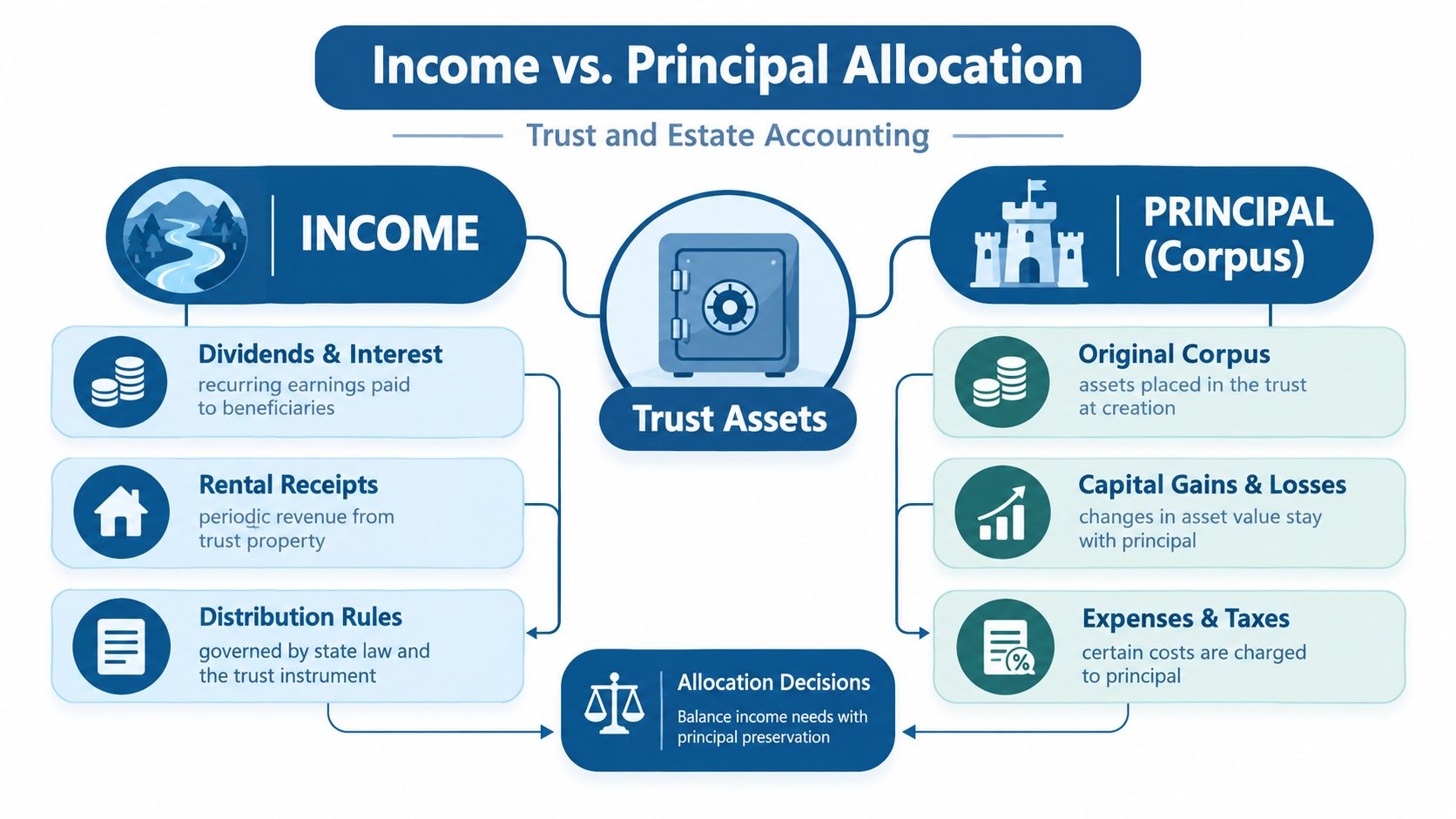
Income generally represents the earnings available to current income beneficiaries, while principal, also called corpus, represents the property preserved for the trust or estate and its remainder beneficiaries. The governing instrument and applicable state law determine the classification, so a cash receipt cannot be classified correctly by looking only at the bank statement.
The distinction matters because the same investment decision can affect beneficiaries differently. Interest or recurring rent may be allocated to income, while the original asset and changes in its capital value may remain principal. Expenses may also require allocation rather than being assigned automatically to whichever account paid them.
Why the legal framework matters
The Uniform Law Commission first proposed a Uniform Principal and Income Act in 1931, issued a second version in 1962, and adopted a substantially revised version in 1997. The earlier versions were adopted in 41 states. Most states rely on some version of the 1997 Act, with later amendments in 2000 and 2008, while the Uniform Fiduciary Income and Principal Act was approved in 2018. This historical overview of principal and income law describes how the framework developed.
The 1997 Act expanded a trustee's ability to adjust allocations between principal and income when necessary to administer the trust fairly, even if the document doesn't expressly authorize that adjustment. That power doesn't eliminate judgment. It requires the trustee to document why an allocation was made and apply the governing standard consistently.
Consider a trust that owns rental property. Rent may be treated as income, while a major improvement, sale proceeds, or certain taxes may affect principal. A business dividend, management fee, or capital gain may require a different analysis. The practical rule is simple: code each receipt and expense at the transaction level, then review ambiguous items against the trust document and state law.
Practical rule: A balanced bank account doesn't prove that the accounting is fair. The classification of each transaction is what explains how current and remainder beneficiaries were treated.
What are the Form 1041 reporting requirements
Form 1041 is the federal income-tax return used by a fiduciary for a domestic decedent's estate, trust, or bankruptcy estate. It reports fiduciary income, deductions, gains, losses, distributions, and related tax liability, while Schedule K-1 communicates each beneficiary's reportable share.
The central compliance risk is assuming that every cash distribution is automatically deductible. The fiduciary must reconcile the accounting distribution, the Form 1041 distribution deduction, and each beneficiary's K-1 before filing.
Build the books around the tax return
A transaction-level chart of accounts should identify more than a payee and amount. It should capture:
- Income category: Interest, dividends, rental income, business income, or other receipts.
- Beneficiary allocation: The beneficiary connected to the distribution or income item.
- DNI treatment: Whether the amount is included in distributable net income.
- Principal or income classification: The fiduciary accounting treatment under the governing rules.
- Supporting evidence: Statements, invoices, settlement documents, checks, and payment confirmations.
Schedule K-1 must include each beneficiary's share of income and directly apportioned deductions from business, rental-real-estate, and other rental activities. That makes it risky to post a single undifferentiated “beneficiary distributions” account. The books need enough detail to explain both the fiduciary return and the beneficiary statements.
For practical bookkeeping discipline, expense categorization tips for accountants can help reinforce consistent coding habits, although fiduciary classifications still require review under the trust document, tax rules, and applicable state law.
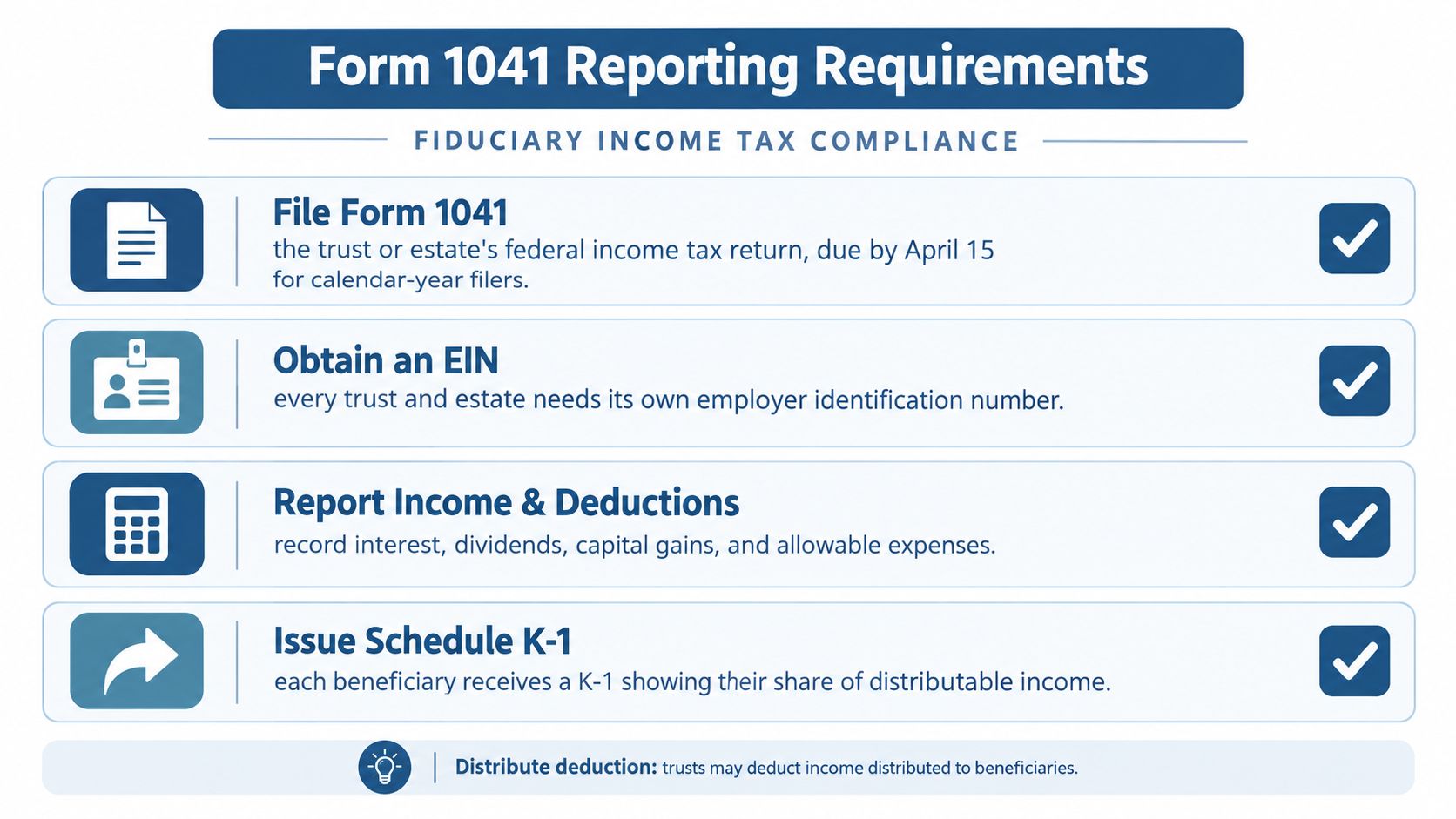
A useful filing workflow is to close the books, reconcile every fiduciary bank account, review principal and income allocations, calculate distributable net income, prepare the Form 1041, and then compare each K-1 with both the return and the accounting ledger. Fixing a classification error before filing is easier than explaining inconsistent beneficiary reporting afterward.
When do New York and New Jersey require fiduciary returns
New York and New Jersey fiduciary income-tax rules are separate from federal estate-tax rules. A federal estate-tax filing may not be required, yet the estate or trust may still need a state income-tax return because it earned income, held local property, or distributed reportable income to beneficiaries.
New Jersey generally requires a resident estate or trust to file Form NJ-1041 when gross income exceeds $10,000 for the tax year. A nonresident estate or trust with New Jersey-source income generally must file when gross income from all sources exceeds $10,000. The New Jersey fiduciary income-tax guidance also requires Schedule NJK-1 for each beneficiary when a return is required.
New York reporting follows a different package
New York fiduciary income-tax reporting uses Form IT-205 and requires federal information. The fiduciary must submit a copy of the federal Schedule K-1 from Form 1041 for each beneficiary. New York State's Form IT-205 instructions connect the state filing to the federal beneficiary allocations, but New York's residency, source-income, and fiduciary rules still need separate analysis.
Don't confuse a state fiduciary income-tax filing with Form 706, the federal estate-tax return. For deaths in 2026, the federal Form 706 filing threshold is $15,000,000, and the amount is year-specific. A portability election may require Form 706 even when the estate is below the ordinary threshold, and the ordinary due date is nine months after death, with a possible extension of up to six months. The IRS estate-tax FAQs provide the federal rules.
A restaurant owner filing in both New York and New Jersey may already understand multi-state business compliance, but an estate with a New Jersey rental property and New York beneficiaries presents a different problem. The fiduciary must track the source of income, the entity's residency, federal K-1 information, and each state's filing package. A “no federal estate tax” conclusion doesn't answer those questions.
How should a trustee plan for estimated taxes
A trustee should project fiduciary income during the year, not wait until the books are closed. Investment income may arrive unevenly, a property sale can create a late-year gain, and a distribution can change the relationship between entity-level income and beneficiary reporting.
For 2025, the IRS reported 3,187,009 estate and trust income-tax returns and 755,971 Form 1041-ES filings, with Form 1041-ES filings increasing 28.5% from the prior year. The IRS tax statistics report also states that estimated-tax requirements generally apply when expected tax after credits is at least $1,000 and withholding and credits fall below the applicable safe-harbor threshold.
Treat projections as a recurring process
A practical projection should begin with the latest bank, brokerage, rental, and business records. The fiduciary or accounting firm can then update the estimate when a material event changes the expected taxable income.
Review the projection after:
- A significant asset sale: A late sale of rental property or securities may create taxable gain and change cash requirements.
- An irregular income payment: A large dividend, partnership allocation, or business distribution can make an earlier estimate obsolete.
- A major distribution: The timing and character of distributions may affect the fiduciary return and beneficiary K-1 reporting.
- A substantial deductible expense: Professional fees, repairs, or administration costs may affect the projected result, subject to tax and fiduciary allocation rules.
Trusts can reach the 37% federal income-tax rate at relatively low undistributed-income levels, so leaving cash in the trust without modeling the tax effect can produce an unpleasant liability. That doesn't mean a trustee should distribute property solely for tax reasons. The distribution must comply with the governing instrument, fiduciary duties, liquidity needs, and beneficiary circumstances.
This guide to estimated tax payments offers additional context on projection mechanics. The accounting record should support the projection, and the projection should inform decisions about liquidity, distributions, and tax payments.
Should a family member act as the sole trustee
A family member can serve as trustee or executor, but legal authority doesn't automatically provide the technical capacity to maintain books, classify income, prepare beneficiary statements, and reconcile the final account. Sole administration works best when the family fiduciary retains decision-making authority while assigning specialized accounting and tax tasks to a qualified professional.
Survey data reflects the tension. In 2025, 55% of respondents said clients were more likely to use individual rather than corporate trustees, while 8% said clients used corporate trustees exclusively. The same survey reported that appointing a trusted adviser, professional trustee, co-trustee, or executor increased by 13% in 2025. The 2025 trust and estate trends report suggests that families still value personal relationships while increasingly recognizing the need for support.
Divide responsibility deliberately
The family trustee may decide whether to sell property, approve a distribution, communicate with beneficiaries, and exercise discretion granted by the document. An accounting firm can maintain the ledger, reconcile accounts, prepare Form 1041 and state fiduciary returns, calculate distributable net income, and prepare Schedule K-1 forms.
Before hiring help, collect the trust or will, amendments, prior returns, EIN documentation, bank and brokerage statements, asset inventories, appraisals, property records, invoices, distribution approvals, and correspondence with beneficiaries. Separate personal expenses from fiduciary expenses immediately. Reimbursements should have a clear receipt, purpose, authorization, and accounting entry.
A professional accountant doesn't replace the trustee's judgment. The accountant creates the records that let the trustee exercise that judgment transparently.
The need for support remains substantial even when filing volumes change. IRS data shows fiduciary income-tax returns fell from 3,370,406 in 2023 to 3,165,460 in 2024, while estate-tax returns fell from 49,633 to 31,516. Those figures don't show that administration became simple. They may instead make it easier for a family to overlook a filing or documentation obligation.
Blue Sage Tax & Accounting Inc. provides fiduciary accounting support, including income and principal tracking, distribution reconciliation, Form 1041 preparation, and beneficiary Schedule K-1 preparation. The right arrangement depends on the document, the assets, the beneficiaries, and the states involved.
Blue Sage Tax & Accounting Inc. can help organize trust and estate records, prepare fiduciary returns, reconcile distributions, and project tax obligations before deadlines arrive. Visit Blue Sage Tax & Accounting Inc. to review the service options, then Book your free consultation call today.
This article is general information and not tax advice for your specific situation.