A contractor in Queens finishes a strong month, sees several 1099-NEC forms arrive, and still doesn't know what to set aside or whether quarterly payments are required. The answer is straightforward: 1099 contractor taxes generally include federal income tax and self-employment tax on business profit, not the amount printed on Form 1099-NEC. You report receipts and allowable expenses on Schedule C, calculate self-employment tax on Schedule SE when net earnings reach $400 or more, and separately review New York, New York City, New Jersey, or other state obligations. A payer's 1099 reporting duty is separate from your duty to report every dollar earned. (IRS guidance on Form 1099-NEC and independent contractors)
Table of Contents
- What counts as a 1099 contractor for tax purposes
- How federal self-employment tax and income tax actually work
- When and how to make quarterly estimated payments
- Common Schedule C deductions and what you actually have to document
- New York, NYC, and multi-state tax layers for contractors
- LLC, S-Corp, and retirement options worth considering
- Year-round workflow and what to do next
What counts as a 1099 contractor for tax purposes
Before calculating taxes, separate three questions: who is treated as self-employed, what the payer reports, and when you must pay your tax. Receiving Form 1099-NEC usually means the payer treated you as a nonemployee, but the form itself doesn't decide your worker classification or create your tax bill.
For federal tax purposes, the IRS looks primarily at the hiring party's right to control and direct how the work is performed. A contract label, payment method, or fixed schedule doesn't settle the issue. If the facts show that you're operating an independent trade or business, you generally report gross receipts and deductible business expenses on Schedule C. If the business controls the details like an employer, the relationship may need a closer classification review. (IRS explanation of worker status and Form SS-8)
Use this practical self-check
- Direction: An employee usually follows the business's instructions about how work is done. A contractor generally controls the method and means.
- Tools and costs: A contractor commonly carries business expenses and may provide tools, equipment, insurance, or materials.
- Hours and workflow: Set shifts, close supervision, and ongoing control can point toward employment. Defined deliverables and autonomy support contractor treatment.
- Benefits: Employees may qualify for employer benefits. Genuine contractors generally don't receive employee benefits.
A 1099 is an information return, not a tax bill. You must report service income even if a client doesn't issue the form, and you must report the full business receipts rather than blindly copying one form into your return. For payments made before 2026, a business generally reported at least $600 paid during the calendar year for services on Form 1099-NEC. For payments made after December 31, 2025, IRS guidance states that the payer reporting threshold becomes $2,000. That change affects the payer's filing obligation, not your obligation to report income. (IRS Publication 1099)
Keep signed agreements, invoices, payment records, and notes about the services performed. A simple resource such as PDFWix for freelance paperwork can help organize agreements and supporting paperwork, but it won't replace a classification analysis. If you're comparing employee and contractor treatment, review W-2 contractor versus 1099 contractor before assuming the payer's form settles the question.
How federal self-employment tax and income tax actually work
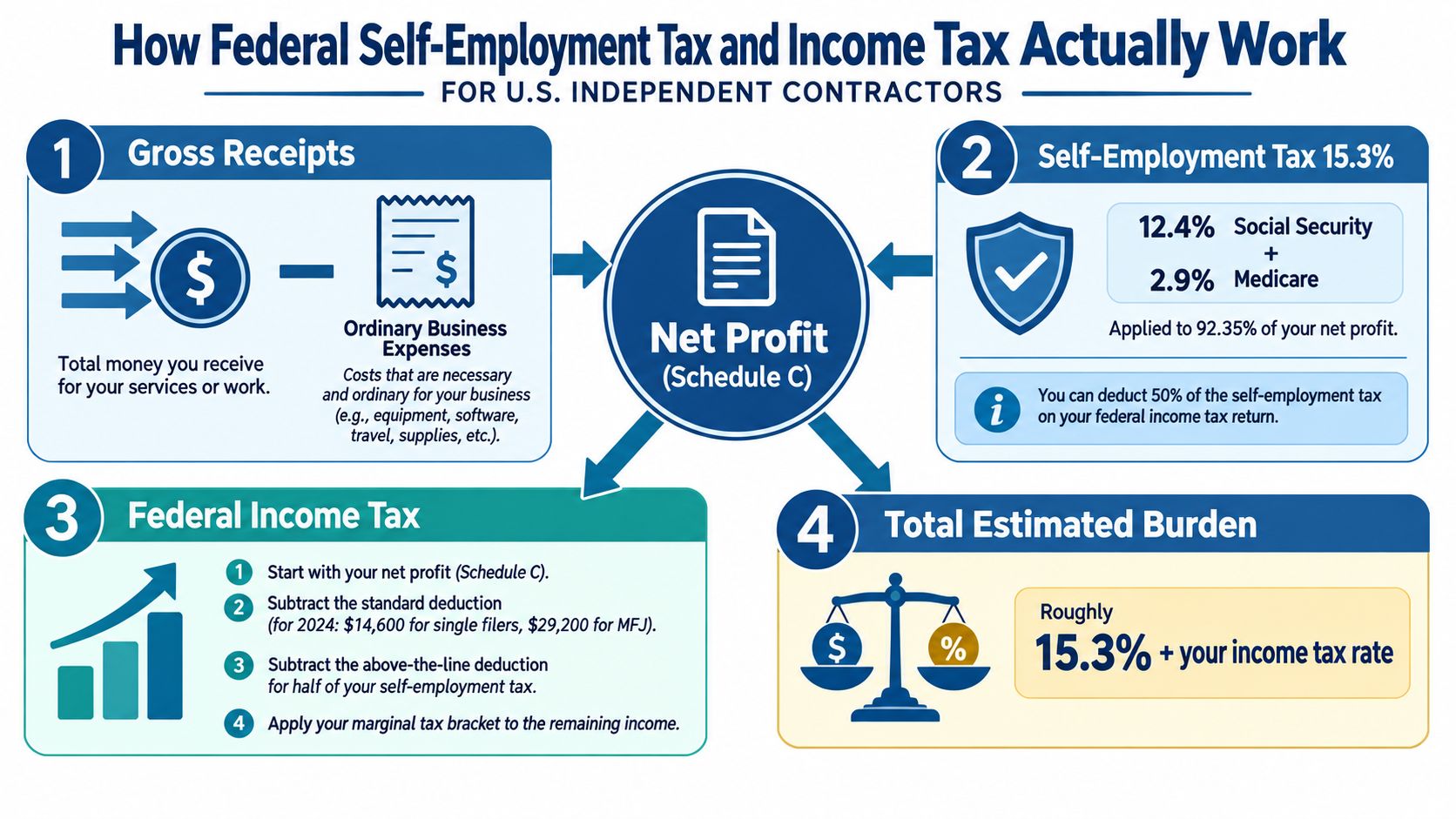
Federal income tax and self-employment tax are two parallel calculations. Schedule C starts with gross receipts, subtracts allowable business expenses, and produces net profit. Schedule SE then uses the self-employment earnings calculation to determine Social Security and Medicare obligations, while the net profit also feeds the federal income-tax calculation on Form 1040. (IRS Schedule C instructions)
Start with profit, not the 1099 box
Consider a construction contractor with $400,000 in revenue and $260,000 in documented business expenses. The resulting $140,000 net profit is the economic figure that drives the tax analysis. The 1099-NEC forms might not equal $400,000. A client might issue a late form, omit a form, or report an amount that doesn't match the contractor's books. The contractor still reconciles all collected revenue and reports the actual business receipts.
Schedule C deductions can change the profit figure. Advertising, supplies, wages, depreciation, qualified business use of a home, and contract labor can be relevant categories when they are ordinary, necessary, and properly documented. Personal expenses don't become deductible because a client paid you on Form 1099-NEC.
Understand the two federal stacks
The first stack is self-employment tax. Net earnings of $400 or more generally trigger the requirement to calculate and pay it. The standard rate is 15.3%, consisting of 12.4% for Social Security and 2.9% for Medicare. Schedule SE applies the statutory calculation to self-employment earnings, rather than just multiplying the gross 1099 amount by the headline rate. (IRS self-employment tax guidance)
The second stack is federal income tax on taxable income. The IRS permits an adjustment for one-half of self-employment tax when determining income subject to federal income tax. That adjustment doesn't erase self-employment tax. It only affects the income-tax calculation.
For a contractor with uneven construction receipts, a year-to-date projection is more useful than a guess based on the largest 1099. Track collected revenue, categorized expenses, net profit, household income, withholding, and credits. Then use the projection to plan federal and state payments. For a deeper calculation walkthrough, see how to calculate self-employment tax.
When and how to make quarterly estimated payments
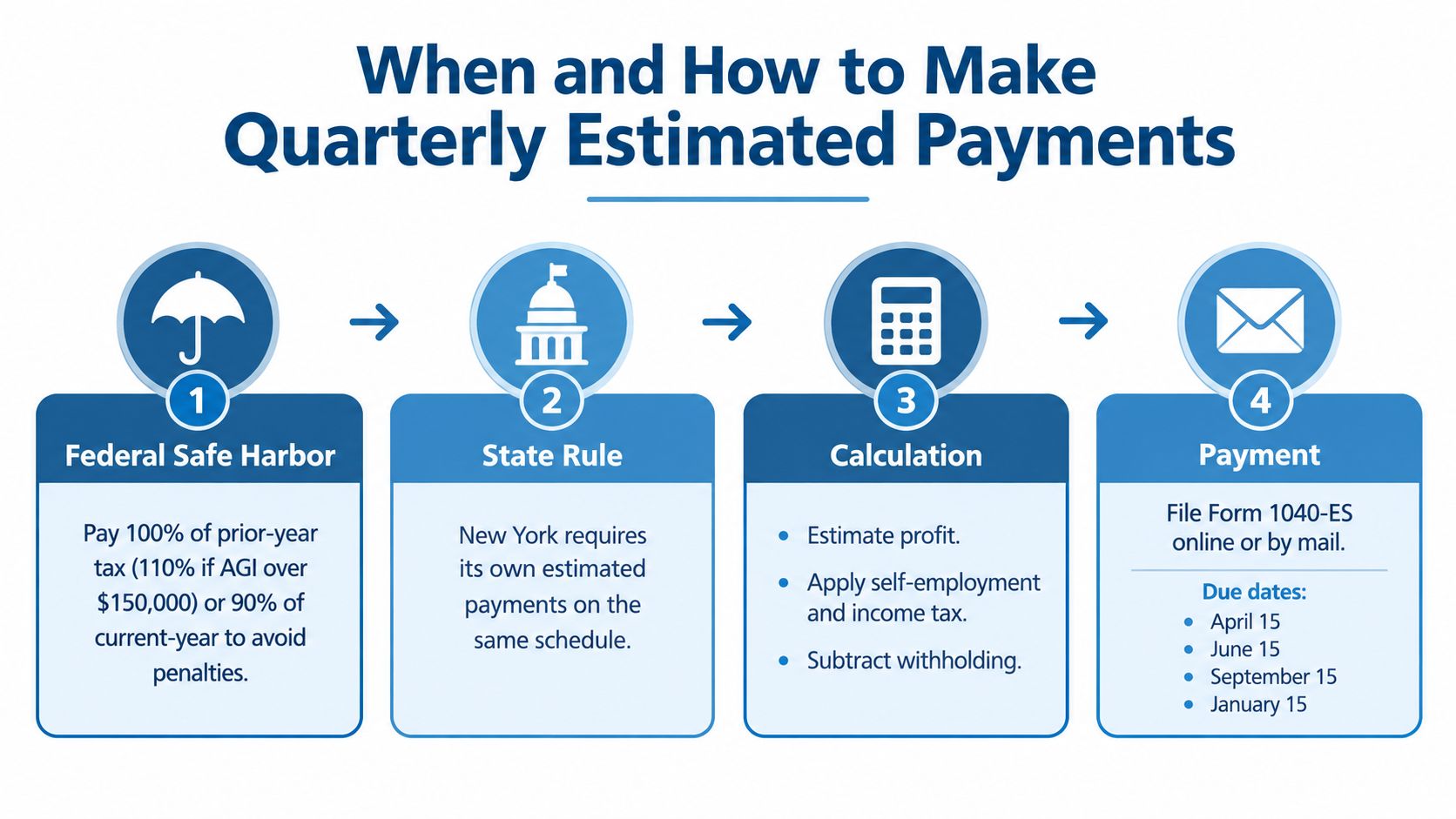
For the 2026 federal tax year, estimated tax is generally required when you expect to owe at least $1,000 after withholding and credits, and your withholding and credits will be less than the smaller of 90% of your 2026 tax or 100% of your 2025 tax. The 2025 comparison must come from a return covering a full 12-month year. This is a federal safe-harbor framework, and state rules can differ. (IRS Publication 505 for 2026 estimated-tax rules)
Use Form 1040-ES or an approved electronic payment method to make federal estimated payments. The commonly used federal schedule is April 15, June 15, September 15, and January 15, subject to adjustment when a date falls on a weekend or federal holiday. Check the applicable tax year's IRS instructions before sending a payment.
Practical rule: Quarterly payments aren't automatically required just because you received a 1099.
W-2 withholding can replace separate estimates
A contractor who also has a W-2 job, or whose spouse has one, may be able to increase federal withholding on Form W-4 from that paycheck. That withholding can cover the side-business income tax and self-employment tax, potentially removing the need for separate federal estimated payments. The key is to combine the W-2 withholding with projected contractor profit, credits, and household income rather than treating the 1099 activity in isolation. (IRS guidance for gig-work taxes)
A livery operator with irregular receipts shouldn't divide one annual guess into four identical checks without reviewing timing. If a high-profit period occurs early and receipts fall later, the projection should reflect when income and expenses arose. The IRS says required installments that aren't paid on time can create an underpayment penalty.
Run a monthly projection
Use a simple monthly process:
- Reconcile collected deposits to invoices and platform records.
- Categorize ordinary business expenses and flag missing documentation.
- Update Schedule C profit and estimated Schedule SE liability.
- Add W-2 withholding, prior payments, credits, and state obligations.
- Record the next payment amount and date in the business calendar.
This workflow gives you an amount and a date instead of a vague instruction to “save for taxes.”
Common Schedule C deductions and what you actually have to document
A deduction is only as strong as the file behind it. The IRS identifies categories that can include advertising, supplies, wages, depreciation, qualified business use of a home, and contract labor, but the expense must relate to the business and be supported by records. (IRS Schedule C instructions)
A vehicle illustrates the problem. A plumber who uses a van for jobs should keep mileage or vehicle-use logs, invoices, payment records, and a business-purpose note. A fuel receipt by itself doesn't establish how much of the vehicle use was business-related. Personal errands and business trips need to remain distinguishable.
A home office requires the same discipline. Record the business area, the relevant home expenses, and how the space is used. A room that doubles as a family room won't automatically qualify merely because you sometimes answer client calls there. Preserve the measurements and a clear description of the business use.
Records to maintain each month
- Receipts and invoices: Keep the vendor, date, amount, and business reason.
- Payment records: Reconcile card, bank, cash, and platform deposits.
- Vehicle logs: Record date, destination, business purpose, and business use.
- Asset documents: Preserve purchase records for equipment and other depreciable property.
- Mixed-use notes: Explain the business portion of a phone, vehicle, or other shared cost.
The categories that most often fall apart under review are mileage, home-office square footage, meals, and mixed-use phones and vehicles. Contractors should keep a separate business bank account and, where practical, a separate business credit card. That separation makes it easier to reconcile 1099 forms to deposits and identify income that wasn't reported on a form.
For a practical reference on organizing receipts, receipt recordkeeping rules for freelancers can supplement your bookkeeping process. It doesn't turn a personal expense into a business deduction, and no app can supply a missing business purpose.
New York, NYC, and multi-state tax layers for contractors
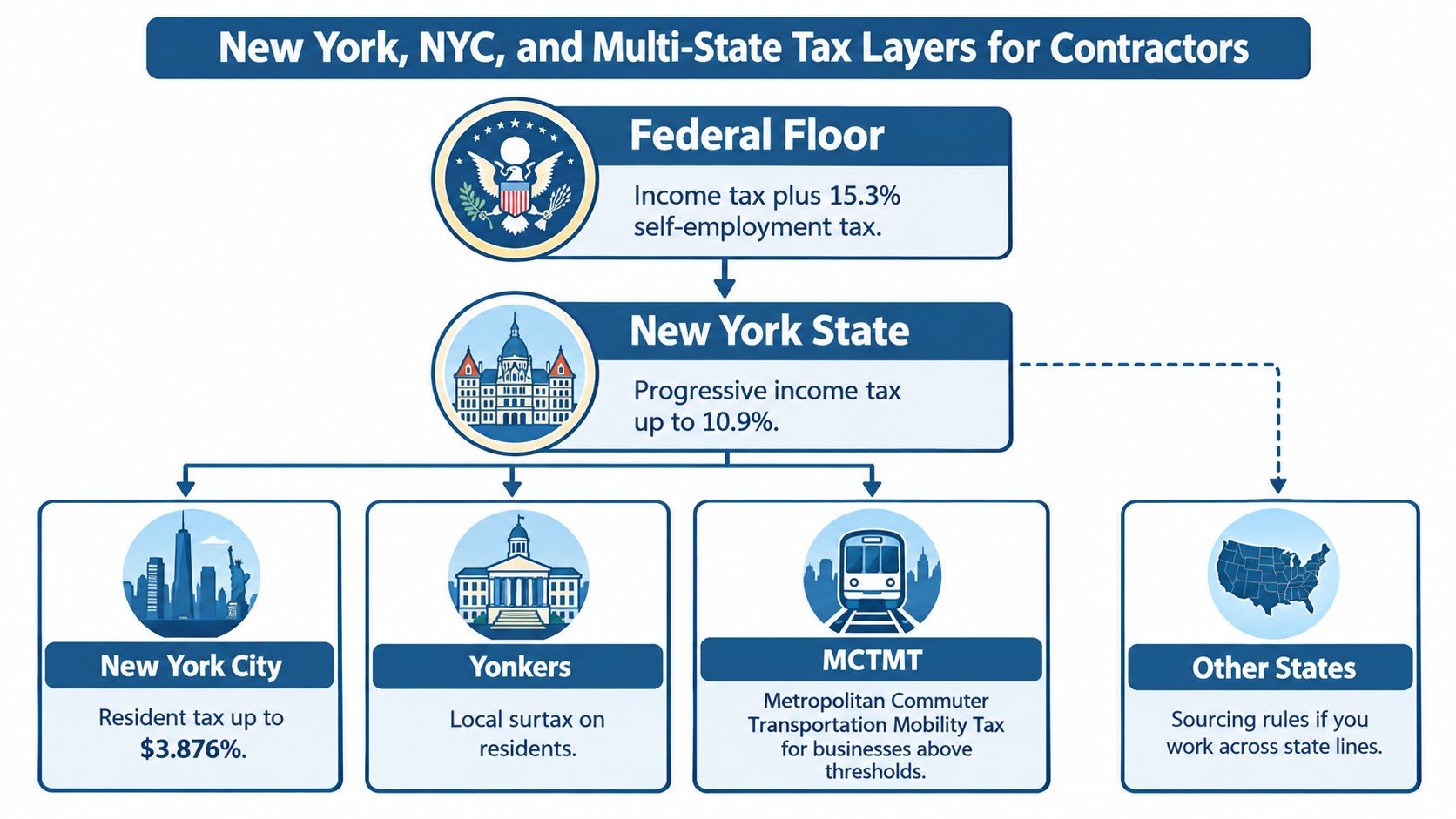
Federal tax is only the floor for a contractor working in New York. A nonresident who earns income from a business, trade, profession, or occupation carried on in New York State may need New York estimated payments even while living in New Jersey. New York estimated payments can be made electronically or with Form IT-2105. For 2026, New York generally says an individual doesn't need estimated payments when expected remaining New York State, New York City, and Yonkers tax is below the applicable $300 amount, subject to the state's requirements and exceptions. (New York estimated-tax resource center)
New York Form IT-2105 covers more than New York State income tax. The calculation can include expected New York State, New York City, and Yonkers tax after withholding, other estimated payments, partnership or S-corporation payments made on the taxpayer's behalf, and available credits. New York City residents and Yonkers residents have local considerations, and the Metropolitan Commuter Transportation Mobility Tax can create additional issues for qualifying businesses. (New York Form IT-2105 instructions)
Apply the rule to the work, not just the home address
A Bayside plumber who performs jobs in New York generally starts with federal reporting, then reviews New York State and applicable NYC obligations based on residence, source, and business facts. A New Jersey-based driver who regularly performs New York-source work shouldn't assume that living outside New York removes the New York filing question.
A restaurant owner operating in two states needs a sourcing analysis rather than one blended return. The owner may need a federal return, a New York return such as Form IT-203 when filing as a nonresident, and the other state's required filing. Withholding, credits, business location, and where services were performed affect the state calculations.
Don't copy New York's $300 threshold into another state's return. State and local estimated-tax rules differ, and amounts and thresholds adjust annually. Start by listing every state where the business earns source income, then identify the applicable nonresident or resident return and estimated-payment form.
LLC, S-Corp, and retirement options worth considering
Entity choice comes after you understand the profit, payroll, and filing workload. A sole proprietor and a single-member LLC generally begin with pass-through reporting, while a multi-member LLC commonly follows partnership treatment unless it elects otherwise. An S-corporation election adds payroll and reasonable-compensation responsibilities, so it isn't a shortcut based only on revenue.
| Structure | Paperwork and payroll | Owner compensation | Retirement-plan capacity | Key planning issue |
|---|---|---|---|---|
| Sole proprietor | Schedule C bookkeeping and individual filing, no separate owner payroll | Owner takes business draws, not wages from the sole proprietorship | May consider a Solo 401(k) or SEP-IRA, subject to applicable rules | Simplicity versus self-employment-tax and liability considerations |
| Single-member LLC | Usually similar federal income-tax reporting unless an election is made, plus entity records | Owner draws under default treatment, payroll if a different tax election applies | May consider a Solo 401(k) or SEP-IRA | State fees, legal separation, and whether the default remains appropriate |
| S-corporation election | Separate business return, payroll system, payroll filings, and corporate records | Owner-employee needs reasonable compensation before distributions | Retirement contributions depend on eligible compensation and plan design | Payroll cost, reasonable-compensation exposure, and state compliance |
Retirement capacity depends on plan type, earned income, compensation, and the owner's role. A Solo 401(k) and SEP-IRA aren't interchangeable, and an S-corporation owner must coordinate contributions with payroll compensation rather than treating every distribution as wages.
The right question is not “Which entity avoids tax?” Ask instead: What profit pattern, owner workload, payroll burden, state cost, and retirement objective justify the structure? An election can often be revisited, so review the default annually as the business changes.
Year-round workflow and what to do next
A workable tax system starts with bookkeeping, not a last-minute stack of 1099 forms. Each quarter, review collected revenue and categorized expenses, update Schedule C profit, calculate the federal Schedule SE impact, and determine whether Form 1040-ES or New York Form IT-2105 payments are due.
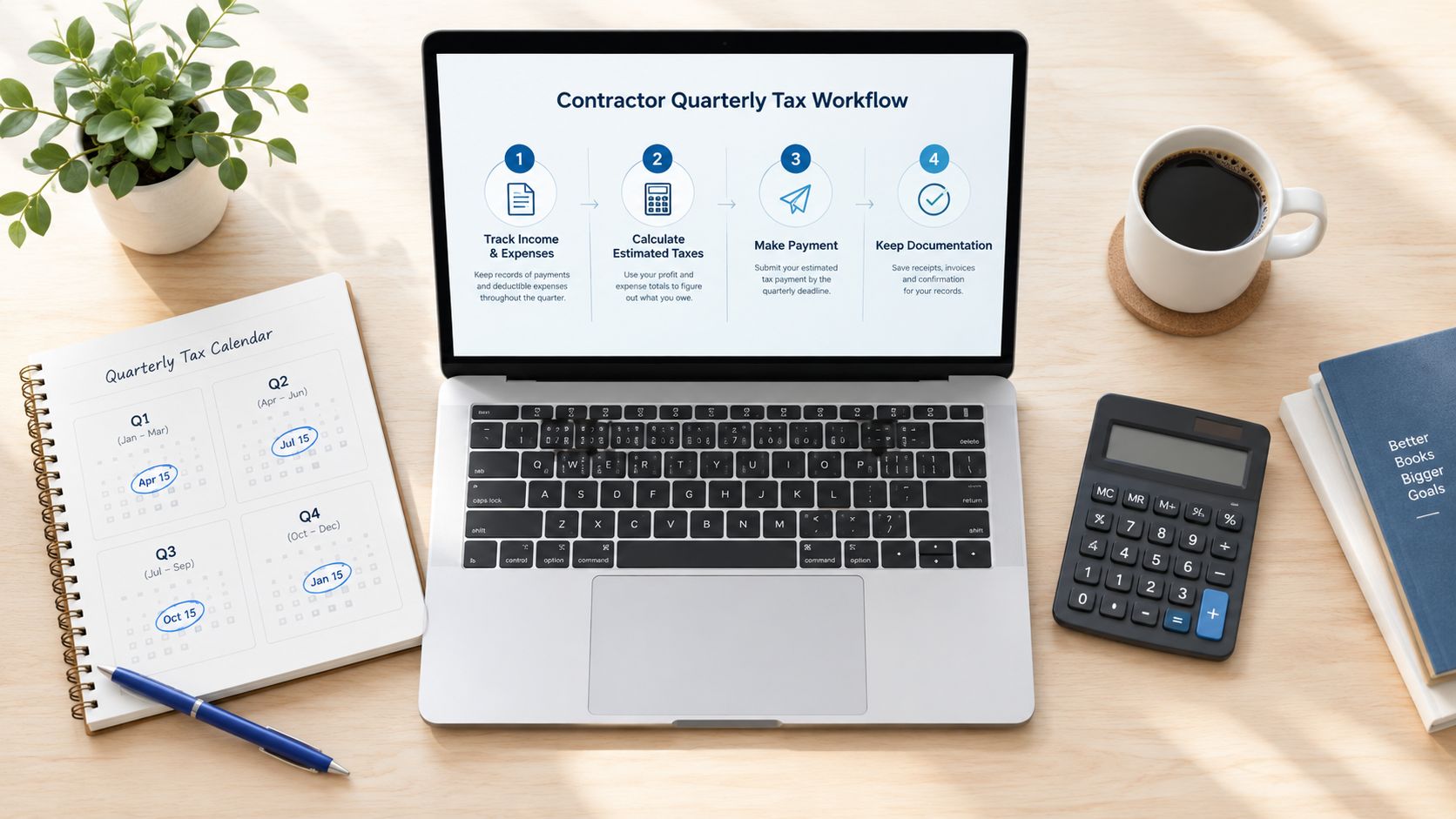
Use this four-part handoff for your bookkeeper or tax preparer:
- Profit walk: Reconcile deposits, invoices, platform statements, and expenses. Deliver an updated Schedule C profit figure.
- Payment calculation: Project federal income tax and Schedule SE, then review Form 1040-ES, New York Form IT-2105, W-2 withholding, and credits. Deliver the amount and payment date.
- 1099 reconciliation: Compare every Form 1099-NEC with the books. Add receipts that lack a form and correct payer errors rather than changing the books to match a bad document.
- December review: Project the full year, review entity and retirement decisions, and identify missing records before tax preparation begins.
Contractors who use prepaid business cards can also review prepaid card accounting as part of a receipt and transaction-control process. The tool doesn't replace tax classification or professional review, but clean transaction data makes the year-end reconciliation more reliable.
A short video can reinforce the payment workflow after you've reviewed the numbers:
Blue Sage Tax and Accounting Inc. provides tax preparation, quarterly projections, bookkeeping, multi-state filings, payroll, and entity planning for contractors and owner-operated businesses. Book your free consultation call today.
Blue Sage Tax & Accounting Inc. can help reconcile your 1099 income, build federal and New York payment projections, and review whether your current entity and bookkeeping workflow fit the business. Visit Blue Sage Tax & Accounting Inc. to start a focused conversation about your contractor tax filings and year-round process.
This article is general information and not tax advice for your specific situation.