
Under U.S. federal rules, a house flip is generally taxed as ordinary business income when the seller is treated as a dealer who holds homes primarily for sale to customers. An investor's gain may qualify for capital-gain treatment depending on the holding period and the purpose of the purchase, and the one-year holding rule alone does not decide the result.
Ask yourself this before you model the deal. If you buy, renovate, and resell, does waiting past one year automatically turn that profit into a long-term capital gain? Plenty of write-ups talk as if the calendar is the whole test. It isn't. The federal question is whether you held the property as an investment or as inventory for sale to customers. A contractor who flips between jobs, a one-time investor, and an LLC that repeats the pattern can land in different places even when the calendar looks similar. The figure a projection should use is taxable profit after adjusted cost, not the gap between what you paid and what you sold for.
Table of Contents
- How Is Profit From Flipping a House Taxed?
- How Do the IRS Tell a Dealer From an Investor?
- How Does Flip Profit Affect Your Tax Rate and Self-Employment Tax?
- Which Costs Raise Your Cost Basis in a Flip?
- Do Transfer Taxes and State Filings Apply to a Flip?
- What Should You Do Before Selling a Flip?
How Is Profit From Flipping a House Taxed?
Profit from tax on flipping a house is generally ordinary business income when you are treated as a dealer holding property primarily for resale. If you held the property as an investment, a qualifying gain may be a capital gain, and a sale after more than one year may qualify for long-term treatment while a sale after one year or less is generally short-term and taxed at ordinary income rates. That one-year line does not convert dealer profit into long-term capital gain.
The IRS explanation of basis and home sales draws the split this way. A person who regularly buys and improves homes primarily for resale may be treated as holding property for sale to customers in the ordinary course of a trade or business. In that case the profit is business income. For an investment holding, the taxable gain is generally the amount realized on sale minus the property's adjusted basis, including eligible acquisition and improvement costs, with selling expenses also affecting the calculation.
Why the home-sale exclusion usually misses a flip
The commonly advertised home-sale exclusion usually does not protect a typical flip. The same IRS guidance requires ownership and use of the property as a principal residence for at least 24 months during the five years before sale, with a potential exclusion of up to $250,000 for an eligible individual or $500,000 for certain married couples filing jointly. A short renovation-and-resale project normally does not meet that ownership-and-use test. Living in the house for a few months while the kitchen is open does not, by itself, create a principal residence.
Three situations get mixed together online, and they are not the same:
- Occasional investor: You bought to hold for investment, then sold. Capital-gain rules may apply, and the holding period can separate short-term from long-term treatment.
- Construction professional: You buy and improve homes primarily for resale in the ordinary course of the trade. Profit is generally business income, even if one house sat longer than a year.
- Repeat LLC or contractor entity: The entity keeps buying, renovating, and reselling. Entity choice does not automatically change the character of that profit.
Practical rule: Sort the facts into dealer, investor, or a mix of both before you pick a rate. The rest of the federal math follows that classification.
Thresholds and dollar amounts in the federal rules adjust over time, so a projection should use the figures for the year of the sale. Federal character comes first. State and local transfer taxes and income filings sit on top of that, and a New York or New Jersey rule is not a national rule. Investors who hold for appreciation sometimes look next at find ways to lower investment taxes. Those ideas assume investment property. They do not rewrite a dealer flip into a capital asset.
How Do the IRS Tell a Dealer From an Investor?
The IRS asks whether the property is inventory held primarily for sale to customers in the ordinary course of a trade or business, or a capital asset held for investment. If it is inventory, profit is ordinary business income, and holding period alone does not turn dealer property into long-term capital-gain property. Classification comes from facts and circumstances, not from one bright-line test.
Think of a bakery and a family kitchen. The bakery's bread is the product. Selling loaves is the business. A family that sells an old oven is disposing of equipment it used, not stocking a shelf. A flip can look like either story. The IRS discussion of sales and other dispositions of assets treats property held primarily for sale to customers as something other than a capital asset. Intent at acquisition, how often you buy and sell, how much you renovate, how you market the house, and whether flipping is an ongoing business all feed that judgment.
What the side-by-side actually changes
| Factor | Dealer (inventory) | Investor (capital asset) |
|---|---|---|
| Why you acquired it | Primarily to resell to customers | To hold for investment or rental income |
| How often you transact | A pattern of buys and sales | Occasional dispositions |
| Renovation activity | Work aimed at a quicker resale | Improvements consistent with holding |
| Marketing | Listed and promoted as product for sale | A sale of an investment holding |
| Ongoing business | Flipping is the trade, or part of it | No regular resale operation |
| Holding period | Does not convert the profit into long-term capital gain | More than one year may support long-term treatment for a qualifying gain |
Briefly renting the house, or waiting a few extra months to close, is not by itself a guaranteed change in classification. Documentation has to support a stated investment purpose. A lease that starts after you already listed the property for sale tells a thinner story than records showing you bought to collect rent and later changed plans for a documented reason.
Canada shows the same principle from outside the U.S. system. For dispositions on or after January 1, 2023, the federal Residential Property Flipping Rule generally applies when a Canadian housing unit, or a right to acquire one, is owned for less than 365 consecutive days. When the rule applies, the profit is deemed business income and is fully included, and the principal-residence exemption is unavailable. The 365-day line is not a safe harbor for every sale, because property already treated as business inventory can be business income under other rules. Specified life events, including death, a household addition, separation, serious illness or disability, employment relocation, involuntary job loss, insolvency, and destruction or expropriation, can take a rapid sale outside that rule. That statute is Canadian, not American. It still shows why a short hold can trigger ordinary-income treatment even when the seller calls the deal an investment.
For an owner-operated LLC or S corporation, picking the entity does not automatically change the character of the underlying profit. The business should track acquisition cost, capitalized renovation costs, permits, financing, carrying costs, selling costs, and distributions separately. A projection estimates taxable profit from adjusted inventory cost, then layers closing timing, estimated payments, and state filings on top.
How Does Flip Profit Affect Your Tax Rate and Self-Employment Tax?
Dealer profit is taxed as ordinary income under the regular federal rate structure, and an individual who runs the flips directly can also owe self-employment tax on that same net profit. Investor profit that qualifies as a capital gain follows capital-gain rules instead, and long-term versus short-term treatment still depends on holding the property as an investment. Classification changes the federal picture. It does not hand you a single flat rate.
The chart below separates those layers before the dollar math gets messy.
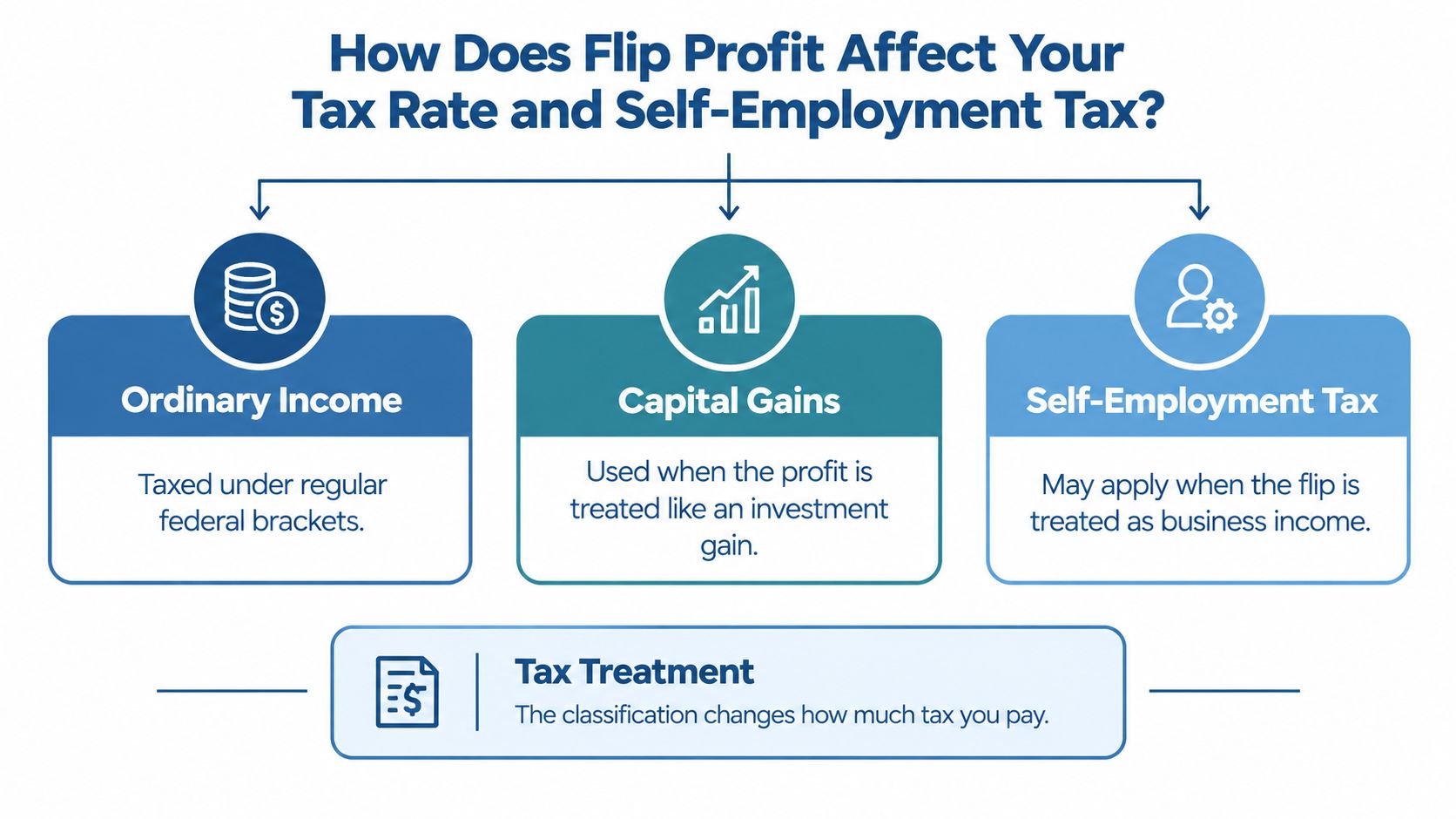
Two federal layers on one net profit
The Texas Real Estate Research Center's overview of flipping and federal tax describes dealer net income as subject to regular income tax plus the 15.3% self-employment-tax rate, and it distinguishes that treatment from an investor's short-term capital gain. The 15.3% figure combines the Social Security and Medicare components. The Social Security portion is subject to an annual wage-base limit that changes by tax year, so a current-year calculation has to use the applicable IRS threshold rather than a leftover number from an older return. Whether the profit is included in self-employment earnings depends on the business classification and on the property's role as inventory.
Take an electrician with $400,000 in annual trade revenue who completes one flip in the same year. Trade income is already in the ordinary-income stack. If the flip is dealer inventory, the flip's net profit can stack on that same return and can also fall into self-employment tax, subject to that year's wage base. If the same person had held a rental for investment and later sold it, the character of that sale can differ, and depreciation recapture is a rental-or-investment issue, not an inventory issue. A weekend of Airbnb between demo and listing does not, by itself, create that rental history.
Estimated payments belong in the project calendar, not in the month after closing. Profit often lands in one quarter while carrying costs were paid across several. Projecting the year, including the trade income and the flip, is how you see whether quarterly payments need to rise before the sale funds hit the account. A practical walk-through of the self-employment layer is in this guide to how to calculate self-employment tax. Higher-income owners who also have wages, equity pay, or several entities often need a wider projection. David J. Greiner's tax strategy guide is one place to see how those layers interact beyond a single resale.
If you want the dealer-versus-investor split explained out loud, this video covers how resale profit gets characterized.
Ordinary income and self-employment tax can both apply to the same dealer profit. Capital-gain treatment is a different path, and it has to be earned by the facts, not by a closing date alone.
Which Costs Raise Your Cost Basis in a Flip?
The profit you project is amount realized minus adjusted cost, not sale price minus purchase price. For a dealer, that adjusted cost is closer to inventory cost. Acquisition costs, capitalized renovation, permits, financing tied to the project, and carrying costs can all build what you subtract. Leave them off the ledger and the taxable number is fiction.
ATTOM's third-quarter 2025 home flipping report reported that flipped homes represented 6.8% of U.S. home sales in that quarter, while the typical flip produced a $60,000 gross spread before renovation, financing, selling, and tax costs. That gross spread is not taxable profit. A useful projection starts from adjusted inventory cost and only then subtracts the costs that actually belong in the deal.
What goes into basis, and what comes off the sale
Walk one property without inventing a tidy round number. You buy the house and pay acquisition costs that belong in basis, not in a miscellaneous bucket. You replace the roof and rebuild a bathroom. Those are capital improvements that add to basis when they are part of the rehab, not routine touch-ups that merely keep a rental in ordinary condition. You pay the lender while the house is dark. Financing and carrying costs during the project generally build the cost you recover, rather than vanishing as a forgotten monthly draft. You sell, and commissions plus legal fees reduce the amount realized. They are not a casual list of ordinary deductions you drop onto a Schedule C because they appeared on the closing statement.
Records have to separate the categories:
- Capital improvements: A kitchen replacement or structural work that adds to basis. Local cost context, such as published Bronx kitchen renovation costs, is useful for budgeting the job. It is not a substitute for your invoices.
- Routine repairs: Work that keeps property in ordinary condition, which may be treated differently when the property is a rental rather than inventory held for sale.
- Selling expenses: Commissions and legal fees that reduce the amount realized.
- Carrying items: Interest, insurance, and similar costs during the hold, tracked to the property rather than dumped into a general overhead account.
A ledger you can actually close
Keep one ledger per property. Date every invoice. Update a running basis total before each estimated payment, not after the buyer's wire arrives. If a contractor invoice covers two houses, split it when you pay it. A single bank account for three flips will not reconstruct basis six months later when a notice asks which roof belonged to which address.
The same discipline applies to each of the three cases. The occasional investor's adjusted basis still drives the gain. The electrician's one flip still needs inventory cost, not a back-of-the-envelope spread. The LLC that repeats the pattern needs that ledger on every address, because the character of the profit and the size of the profit are separate questions.
Do Transfer Taxes and State Filings Apply to a Flip?
Yes, when the property is in a state or city that taxes the transfer, and those charges can reduce cash at closing even though they are not the same thing as federal income tax on the profit. New York State and New York City rules below are New York rules only. Other states write their own transfer and income rules, and you should not copy a New York percentage onto a sale in another state.
Closing paperwork is where those charges show up, next to the commission and the payoff.

What a New York closing can add
New York's real estate transfer tax page states that New York State imposes a real estate transfer tax when consideration exceeds $500, generally at $2 per $500, or 0.4%, of consideration. Residential conveyances of $1 million or more also face a 1% mansion tax, and qualifying residential conveyances of $3 million or more can incur an additional base tax. In New York City, the Real Property Transfer Tax generally applies to taxable transfers exceeding $25,000. A flip's closing statement should be reviewed for both state and city transfer-tax obligations rather than treating every closing charge as an income-tax deduction. These taxes are tied to the transfer itself and can reduce cash proceeds even when the income-tax calculation is based on net business profit. A closer look at how the city layer works is on this page about New York City real estate tax.
Nonresidents selling certain New York real property may also need to calculate and pay estimated New York personal income tax on the gain or loss. Residency and sourcing matter for a multi-state owner. A New Jersey resident selling a Queens house is not in the same filing position as a New York resident selling that same house, even when the federal dealer analysis is identical.
Before you list, answer these state-level questions:
- Where is the property? Transfer tax follows the jurisdiction of the conveyance, not the address on your driver's license.
- Where do you reside? Your resident state may tax the profit and then allow a credit, and the forms differ.
- What is the consideration? New York's thresholds above are tied to consideration, so a price change late in contract can change the transfer-tax line.
- What does the closing statement label? City tax, state tax, and brokerage commission are different lines. Do not net them into one "closing cost" before anyone has classified them.
Model purchase costs, renovation and carrying costs, broker commissions, legal fees, transfer taxes, financing costs, and a realistic sale price on a realistic closing date. The projection fails when it uses last year's price and ignores a mansion-tax threshold the contract is about to cross.
What Should You Do Before Selling a Flip?
Before you accept an offer, document why you acquired the property, keep the cost records current, project the tax for the year of sale, and list every state that can tax the transfer or the income. Doing that after closing leaves you guessing at estimates you can no longer time.
The checklist below is the short version of that pre-sale routine.
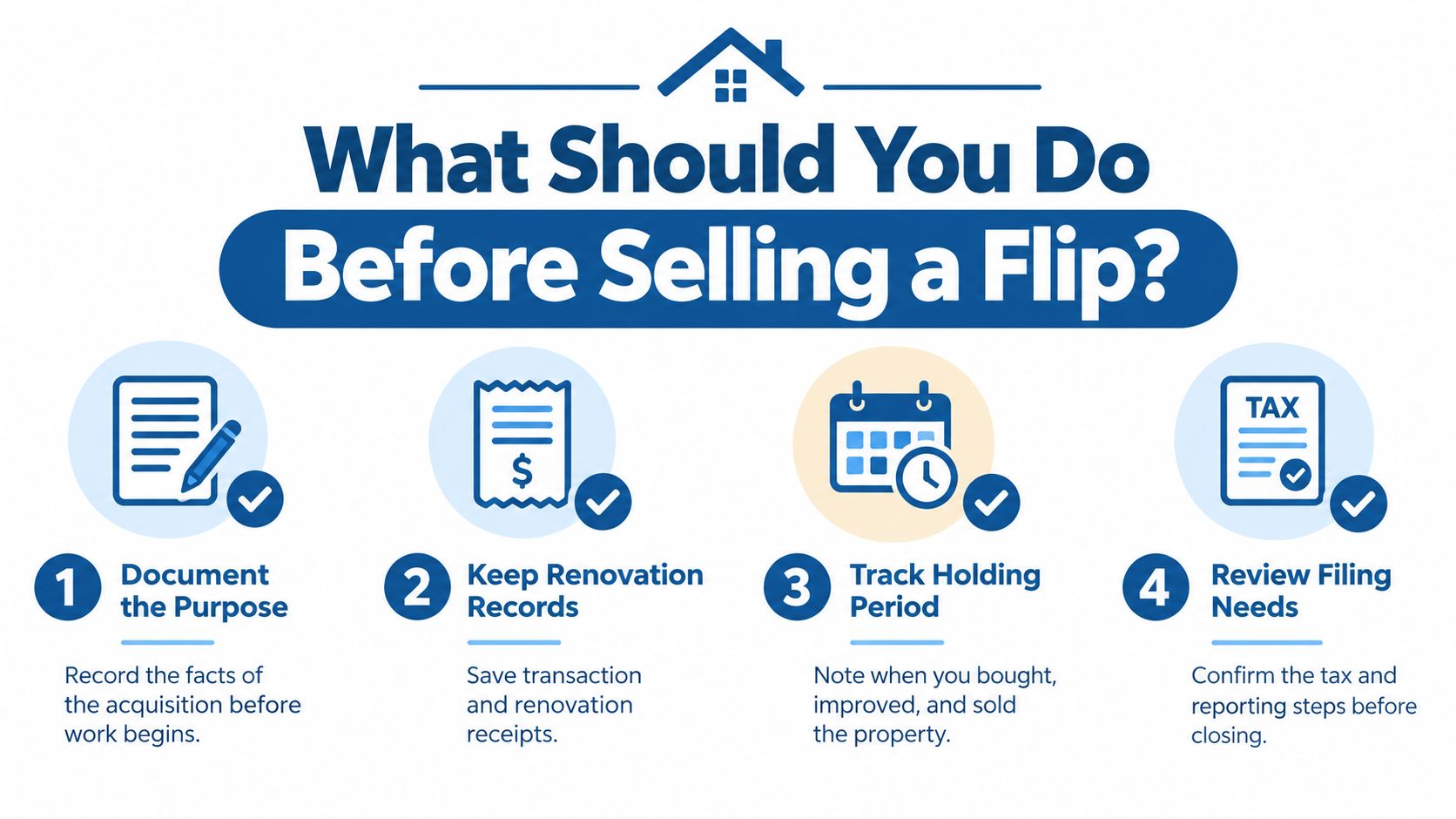
A pre-sale routine that matches the facts
Document the purpose. Write down the acquisition facts before work begins. A note that you bought the house to rent, with a lease draft and a holding plan, reads differently from a note that you bought it to list in ninety days. You cannot retrofit that story from text messages after the staging photos go up.
Keep renovation records. Save the purchase file, permits, draw schedules, and invoices against the property ledger described above. If you are the contractor doing the labor, record what the entity paid and what you contributed. Unwritten sweat equity does not create basis.
Project before the closing date. Estimate taxable profit from adjusted cost, then estimate federal income tax and, where the activity is yours individually, self-employment tax. Add transfer taxes that reduce cash. Update the projection when the contract price changes. Quarterly payments during the project are easier to correct than a surprise balance the following spring.
Name every state involved. The state where the property or the business activity sits, and your resident state, can both matter. Returns, allocation, and credits depend on the states in the file. New Jersey's gross income tax forms include Schedule DOP and related forms for reporting net gains or income from the disposition of property, which shows New Jersey has its own reporting mechanism for property-disposition income. That is a New Jersey mechanism, not a template for every other state. A person flipping across state lines should evaluate both the property state and the resident state before assuming one return covers the sale.
Blue Sage Tax and Accounting Inc., an accounting firm, builds this kind of review as a year-round projection so you see an estimated number before year-end, with direct access to the firm's owner rather than a handoff after the return is already filed. The review covers classification, the profit figure that is not the gross spread, estimated payments, and the state filings the property triggers. It does not promise a lower bill. The result depends on your facts.
A classification review and a projected tax figure before you sign the closing documents is the practical next step. Service details for real-estate investors and owner-operated businesses are on the firm's site if you want to see how projections, multi-state returns, and entity questions are handled together.
Blue Sage Tax & Accounting Inc. helps contractors, LLC owners, and real-estate investors project the federal and state tax on a flip before closing, including dealer-versus-investor classification and the costs that drive profit. If you want that review on a live property, visit Blue Sage Tax & Accounting Inc. and Book your free consultation call today. This article is general information and not tax advice for your specific situation.