Selling rental property generally creates two federal tax layers, long-term capital gains on appreciation and up to 25% tax on unrecaptured Section 1250 depreciation recapture, with additional state tax depending on the jurisdiction. A landlord in Queens, for example, may need to account for federal tax, New York State tax, and potentially New York City tax after the sale.
You may be looking at a closing statement that shows a respectable sale price but still leaves you wondering why the taxable gain seems so large. The answer usually starts with depreciation. Deductions claimed during ownership reduce your adjusted basis, so the IRS may tax part of the sale gain separately from the appreciation you see in the property's market value.
Table of Contents
- What Tax Do You Owe When Selling Rental Property
- How Is Your Gain Calculated and Characterized
- Why Does Depreciation Recapture Increase Your Bill
- Should You Use a 1031 Exchange Installment Sale or Other Strategy
- What Do Realistic Sale Scenarios Look Like
- How to Time Document and Plan Your Rental Sale
What Tax Do You Owe When Selling Rental Property
You may owe federal long-term capital gains tax on appreciation, depreciation-related tax on unrecaptured Section 1250 gain, and state or local tax based on where you live, where the property sits, and which jurisdictions require a filing. Federal long-term capital gain is generally taxed at 0%, 15%, or 20%, depending on income, while unrecaptured Section 1250 gain generally has a 25% federal cap for qualifying real property held after May 6, 1997. The IRS explanation of depreciation and rental property sales describes why depreciation can make the final bill larger than expected.
A rental sale isn't treated exactly like the sale of a personal residence. The IRS generally doesn't let you exclude the portion of gain tied to depreciation allowed or allowable after May 6, 1997, even when other home-sale rules might apply. That rule is explained in the IRS guidance on depreciation-related gain.
For a New York owner, federal calculations are only part of the projection. New York State and New York City rules can affect the final filing, while New Jersey may become relevant if you live there and own rental property in New York or another state. The right starting point is a sale projection before you list the property, not a tax calculation after the closing funds arrive.
Practical rule: Treat the sale as a tax event with multiple layers, not as one capital-gains percentage applied to the net check.
How Is Your Gain Calculated and Characterized
Your gain begins with the property's amount realized, generally the sale proceeds after selling costs, compared with its adjusted basis. Adjusted basis usually starts with what you paid, increases for qualifying capital improvements, and decreases for depreciation allowed or allowable during the rental period.
Think of basis as your remaining tax investment in the property. If you bought a building, added a qualifying improvement, and claimed depreciation over the years, your basis is no longer the original purchase price. The lower basis can create taxable gain even when the property's market appreciation appears modest.
What belongs in adjusted basis
Keep the records that support each part of the calculation:
- Original cost: Preserve the purchase documents and eligible acquisition costs.
- Capital improvements: Add qualifying additions or renovations that increase the property's value or useful life.
- Accumulated depreciation: Reconcile depreciation claimed, along with depreciation that was allowable even if it wasn't claimed.
- Selling costs: Review commissions, legal fees, and other disposition costs for their effect on the amount realized.
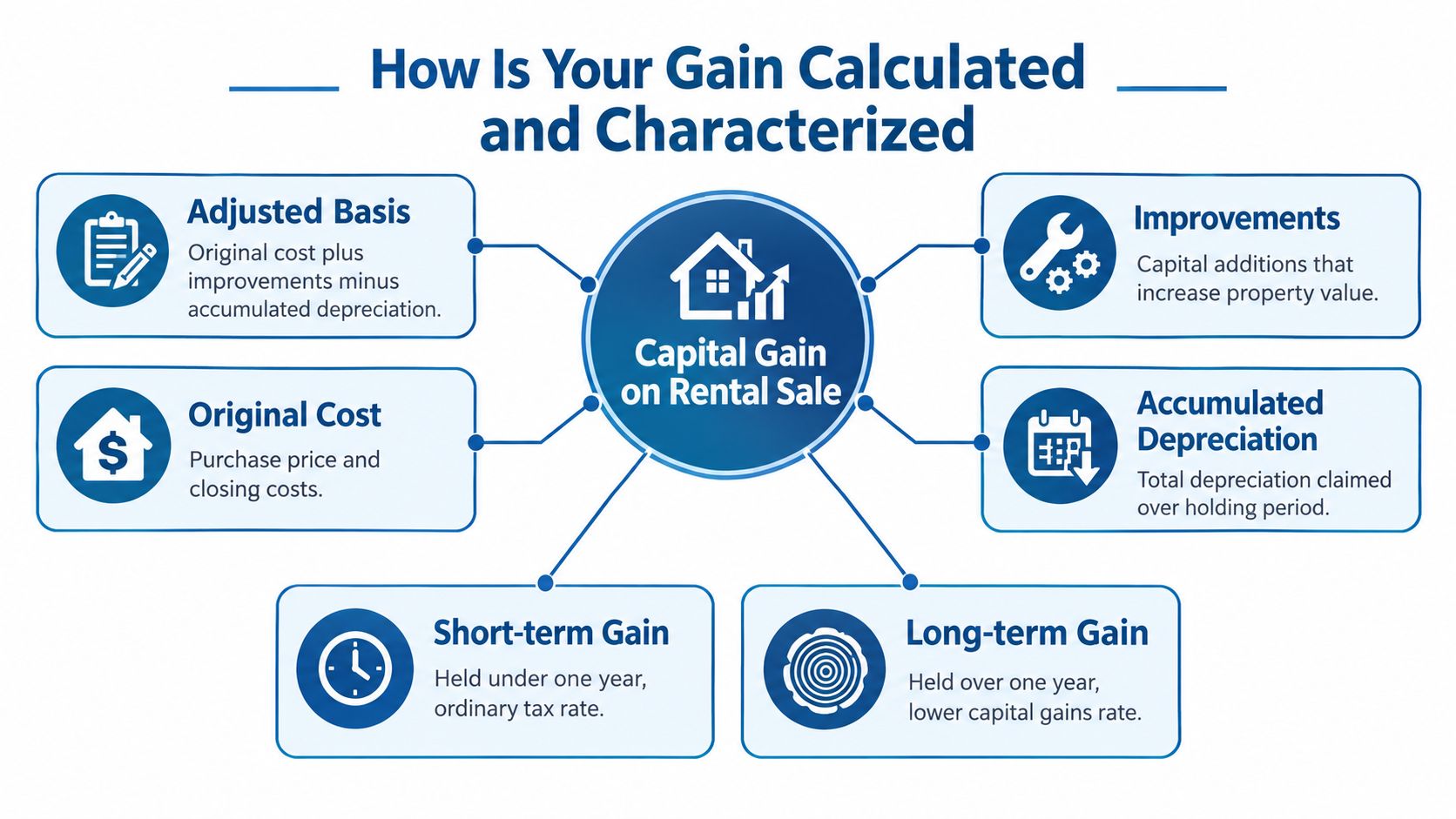
For federal purposes, the holding period also matters. Property held for more than one year generally produces long-term gain treatment, while property held for one year or less may produce short-term treatment under ordinary income rules. The remaining gain after the depreciation component is separated generally falls under long-term capital-gains rules when the holding period qualifies.
The calculation needs to be rebuilt from the records, not guessed from the property's current value. Annual tax return adjustments, improvements, refinancing records, and prior depreciation schedules can all affect the result.
Why Does Depreciation Recapture Increase Your Bill
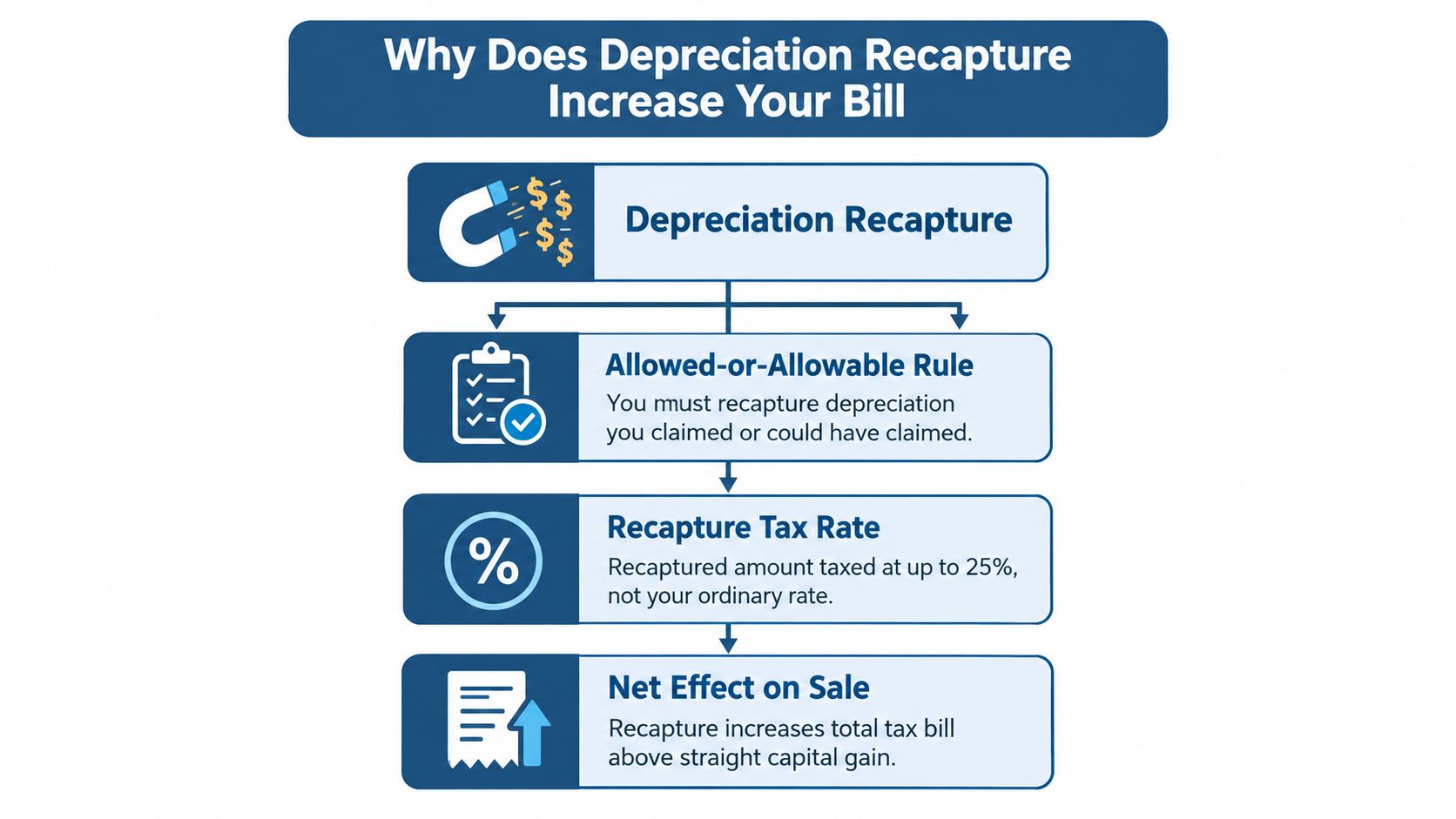
Depreciation recapture increases the bill because the IRS may tax depreciation-related gain separately from ordinary appreciation. For property sold after May 6, 1997, unrecaptured Section 1250 gain generally applies to straight-line depreciation on qualifying real property and may be taxed at up to 25%, as described in the IRS depreciation recapture guidance.
The critical rule is allowed or allowable depreciation. You generally must account for depreciation you claimed and depreciation you could have claimed. That means skipping depreciation on an old return doesn't necessarily remove the future recapture issue. The depreciation amount can remain relevant when the property is sold.
Why a loss may not eliminate recapture
Suppose a rental's market value declined, but prior depreciation reduced its tax basis even further. You could have little overall gain, or even a loss measured against your original cost, while still having a depreciation-related gain under the tax rules. This is why a sale analysis must compare the selling price with adjusted basis rather than only comparing the sale price with the purchase price.
Cost segregation can add another layer. A study may move certain shorter-life components into categories that receive faster deductions during ownership. On sale, some of those assets may create Section 1245 ordinary-income recapture, rather than fitting entirely into the Section 1250 framework. The real estate tax discussion of cost segregation and sale treatment explains why the headline capital-gains rates don't tell the whole story.
A home-sale exclusion generally doesn't shelter depreciation-related gain. The IRS Section 121 explanation confirms that qualifying main-home treatment can exclude much of a gain in some circumstances, but depreciation and nonqualified-use rules remain separate issues.
For a deeper review of the mechanics, see depreciation recapture for real estate.
Should You Use a 1031 Exchange Installment Sale or Other Strategy
A 1031 exchange may defer gain, but it doesn't happen automatically and doesn't erase the underlying tax history. You must satisfy the applicable replacement-property, timing, and like-kind requirements, and any boot or non-like-kind value can create current recognition. The IRS describes these rules in Publication 544 on sales and exchanges.
An installment sale may spread recognition of eligible gain as payments arrive, but the treatment of depreciation recapture requires separate analysis. Passive losses also matter. Suspended passive losses may become available when the entire activity is disposed of in a fully taxable transaction, but the result depends on the ownership structure, other passive activities, and the nature of the sale.
Which option fits the transaction
| Strategy | When It May Help | Key Requirement | Watch Out For |
|---|---|---|---|
| 1031 exchange | You intend to remain invested in rental or business real estate | Qualifying replacement property and strict exchange procedures | Boot, missed requirements, and prior depreciation still need review |
| Installment sale | The buyer will pay over time | A properly structured deferred-payment transaction | Depreciation-related recognition and buyer-credit risk |
| Taxable sale with projection | You need liquidity or don't want replacement property | Accurate basis, depreciation, and selling-cost records | Tax may arise in multiple layers during the sale year |
| Sale with passive-loss review | You have suspended losses from the activity | Confirm the activity and disposition qualify | Loss release may interact with other passive income and deductions |
New York State and New York City treatment must be modeled separately from federal treatment. A New York resident selling New Jersey property, or a New Jersey resident selling New York property, may face filing obligations in more than one state and may need to review resident credits or nonresident sourcing. Don't assume a federal deferral automatically produces the same state result.
For a practical overview of the transaction structure, review what a 1031 exchange is.
What Do Realistic Sale Scenarios Look Like
Consider a Queens owner who held a two-family rental for twelve years. The owner bought the property, completed several qualifying improvements, and claimed depreciation on each eligible return. Before listing, the owner should gather the purchase closing statement, improvement invoices, depreciation schedules, and prior returns.
The projection would separate the expected sale result into distinct pieces. The first is the gain created by the difference between the selling proceeds and adjusted basis. The second is the depreciation-related portion, which may be subject to the unrecaptured Section 1250 rules. The owner's New York State and New York City position would then be reviewed separately from the federal calculation.

Now consider a small retail rental where the owner used cost segregation early in the holding period. The accelerated deductions may have improved cash flow during ownership, but the sale requires an asset-by-asset review. Shorter-life components can carry Section 1245 recapture treatment, while building depreciation may fall under Section 1250 rules.
The useful question isn't “What capital-gains rate will I pay?” It's “Which parts of this transaction are capital gain, depreciation recapture, ordinary-income recapture, or potentially released passive loss?”
These scenarios also show why missing records create practical risk. If prior returns don't match the depreciation schedule, or improvement receipts are unavailable, the preparer may need to reconstruct the basis before filing. A year-end projection from Blue Sage Tax and Accounting Inc., an accounting firm, can organize the federal, New York, and multi-state pieces before the closing date.
How to Time Document and Plan Your Rental Sale
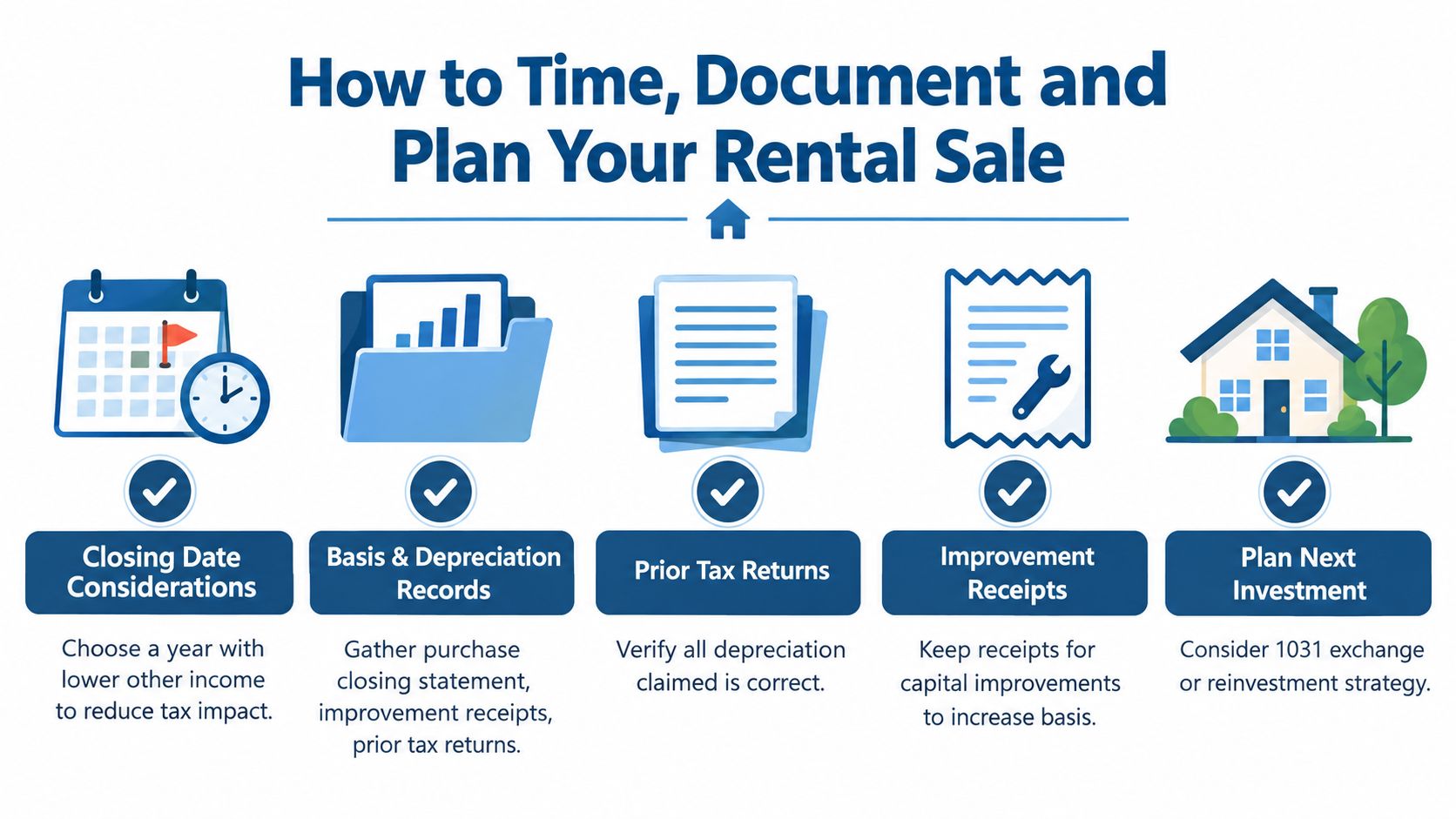
Start planning before signing a listing agreement. The closing year can affect the interaction with other income, passive losses, and state filing obligations, although the best timing depends on your full tax picture and the rules in effect for that tax year. Federal and state amounts and thresholds can adjust annually, so confirm current-year treatment rather than relying on an old estimate.
Use a working file that includes:
- Basis records: Purchase documents, closing statements, refinancing records, and capital improvement receipts.
- Depreciation history: Prior returns, depreciation schedules, and any cost segregation report.
- Transaction costs: Proposed commission, legal fees, transfer costs, and other sale expenses.
- State information: Residency details, property location, and prior filings for New York State, New York City, New Jersey, or other jurisdictions.
- Next-step plans: Replacement property intentions, installment terms, or a decision to take taxable-sale proceeds.
Blue Sage Tax and Accounting Inc. can prepare sale projections, review basis and depreciation records, and coordinate rental-property sale reporting with broader federal and state filings. Book your free consultation call today.
Blue Sage Tax & Accounting Inc. helps real estate investors evaluate rental sales, depreciation recapture, passive-loss records, and New York or multi-state filing needs before the transaction closes. Visit Blue Sage Tax & Accounting Inc. to discuss a projection based on your property records and planned sale.
This article is general information and not tax advice for your specific situation.