
If you're sorting rent deposits, mortgage statements, and repair receipts for your Brooklyn duplex, rental income belongs on federal Schedule E, generally with income, expenses, and depreciation reported separately for each property. Individual landlords use the resulting profit or allowable loss in preparing Form 1040, but a rental loss isn't automatically deductible against wages or business income. The IRS Schedule E instructions establish the reporting framework. The practical job is to separate what tenants paid, what you spent operating the rental, and what requires different tax treatment.
Table of Contents
- What Schedule E Asks a Landlord to Report
- How Rental Income and Expenses Flow Through the Form
- Repairs Versus Improvements and Why the Distinction Matters
- Passive Activity Rules and the Active Participation Allowance
- Mistakes That Trigger IRS Questions on Rental Returns
- Documents to Pull Together Before You File
- Looking Beyond April and When to Bring in a Pro
What Schedule E Asks a Landlord to Report
Schedule E asks landlords to identify the property and its use before reporting rents, expense categories, and depreciation. Federal reporting is the focus here; a Queens mailing address or Brooklyn property doesn't make the federal form a New York tax calculation.
Start with the property-identification and use fields: the address, property type, and rental-versus-personal-use information. Those entries aren't administrative filler. They provide context for whether the expenses below belong entirely to the rental activity or require allocation.
The reporting sequence is easier to follow when income and deductions remain visibly separate.
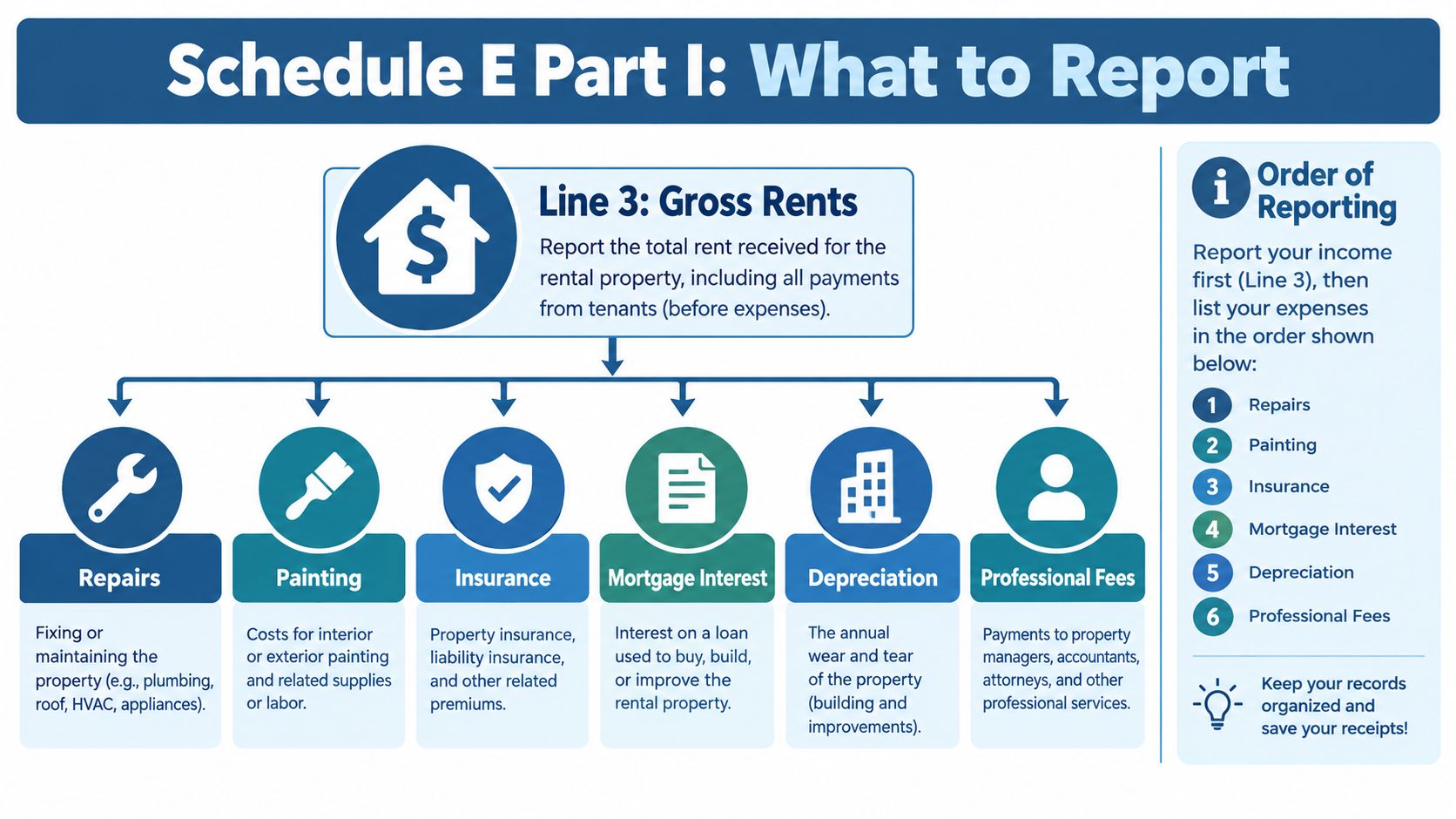
Match your books to the tax categories
Use distinct accounts for rent, property taxes, insurance, mortgage interest, management fees, repairs, and capital projects. Don't put every payment related to the building into a single property-expense account and expect the bank statement to explain it.
Schedule E also covers royalties and income or losses from partnerships, S corporations, estates, trusts, and certain mortgage investment conduits. That broader scope is why identifying how you own the property belongs at the beginning of the filing process, not after entering expenses.
A clean rental ledger should explain the property's activity without requiring someone to reconstruct it from payment descriptions.
For an additional bookkeeping perspective, Royal LePage Brookside Realty's resource on bookkeeping for BC landlords is a useful companion. Treat it as a Canadian bookkeeping resource, not authority for federal, New York State, or New York City tax treatment.
How Rental Income and Expenses Flow Through the Form
Begin with rental receipts, subtract properly classified operating expenses, and account for depreciation separately. The resulting tax profit or loss can differ from cash flow, and loss limitations can further change what reaches the individual federal return.
Consider an illustrative two-unit Brooklyn duplex owned by a Queens landlord, with both apartments rented. This isn't a client case study: it's a way to follow the same property through the filing process without assuming invented financial results.
The landlord starts with the tenant ledger and reconciles it to deposits. Rental receipts, deposits, and other tenant payments should remain separately identifiable rather than being combined into one unexplained income total.
Follow the activity, not just the bank balance
| Record | What the filing review needs to establish |
|---|---|
| Tenant ledger | Which payments belong to rental receipts and which need separate classification |
| Mortgage statement | The mortgage-interest amount rather than an undifferentiated mortgage-payment total |
| Operating invoices | Property taxes, insurance, management fees, and qualifying repairs |
| Capital-project records | Costs that shouldn't be buried in current operating expenses |
| Depreciation schedule | The annual deduction calculated from the property's tax records |
The duplex may generate positive operating cash flow while showing a smaller tax profit after depreciation. IRS Publication 527 explains depreciation and property-by-property reporting: qualifying income-producing property costs are generally recovered through yearly depreciation deductions, and ordinary rentals with basic services are generally reported in Schedule E, Part I.
Now change the scenario: the owner occupies one apartment. Don't assume every building expense belongs to the rental because the property has a tenant. Identify direct rental costs, shared costs, and personal-use periods before calculating the result.
Practical distinction: A property's cash surplus tells you whether it funded its bills. Its Schedule E result answers a different question.
For properties that also serve as vacation homes, Global's discussion of deductions for vacation property owners offers related reading. Mixed use deserves a separate review rather than a quick adjustment to the duplex calculation.
Repairs Versus Improvements and Why the Distinction Matters
A landlord's own labor isn't deductible, even when the landlord is a skilled contractor. Current rental expenses and capital improvements also receive different treatment, so a paid invoice alone doesn't establish an immediate deduction.
Consider a contractor landlord who repaints the apartments between tenants and installs a replacement water heater. The contractor buys materials, performs the work personally, and prepares an internal invoice showing what an outside customer would have paid.
The workmanship may be professional. The value assigned to personal labor still isn't a deductible rental expense, under the federal distinction described in the Schedule E instructions cited above.
The image illustrates the kind of project that needs more than a single bookkeeping label.

Separate who did the work from what the work accomplished
- Owner's time: Don't create a deduction by multiplying personal hours by a contractor billing rate.
- Purchased materials and hired labor: Retain the receipts and invoices, then determine whether they relate to current work or a capital project.
- Replacement projects: Describe the scope clearly. A vague invoice marked maintenance doesn't resolve the classification of a water heater or roof project.
Capital improvements generally require recovery through depreciation rather than an immediate expense deduction. The temptation is to classify the entire project as repairs because that produces a larger current deduction. The opposite shortcut, capitalizing every maintenance invoice, can also produce the wrong treatment.
Review before posting: Ask whether the work restores ordinary condition or forms part of a broader upgrade. Use that question to flag the invoice for review, not as a substitute for applying the tax rules.
Keep contracts, photographs, and itemized invoices together. The firm's guide to tax deductions for real estate investors provides related context without turning every improvement decision into a guess at filing time.
Passive Activity Rules and the Active Participation Allowance
A Schedule E loss doesn't automatically offset wages or profits from an operating business. Federal passive-activity rules determine whether the loss is currently usable, qualifies for an exception, or must carry forward.
Congress established the framework in the Tax Reform Act of 1986, and the 1993 amendment added an exception for qualifying real-estate professionals, as explained in the federal regulations describing the passive-activity framework. Qualifying generally requires more than 750 hours in real-property trades or businesses and more than half of total personal-service time in those businesses, plus material participation in the rental activity.
The diagram separates the main pathways, but the return must apply the rules to the owner's actual circumstances.
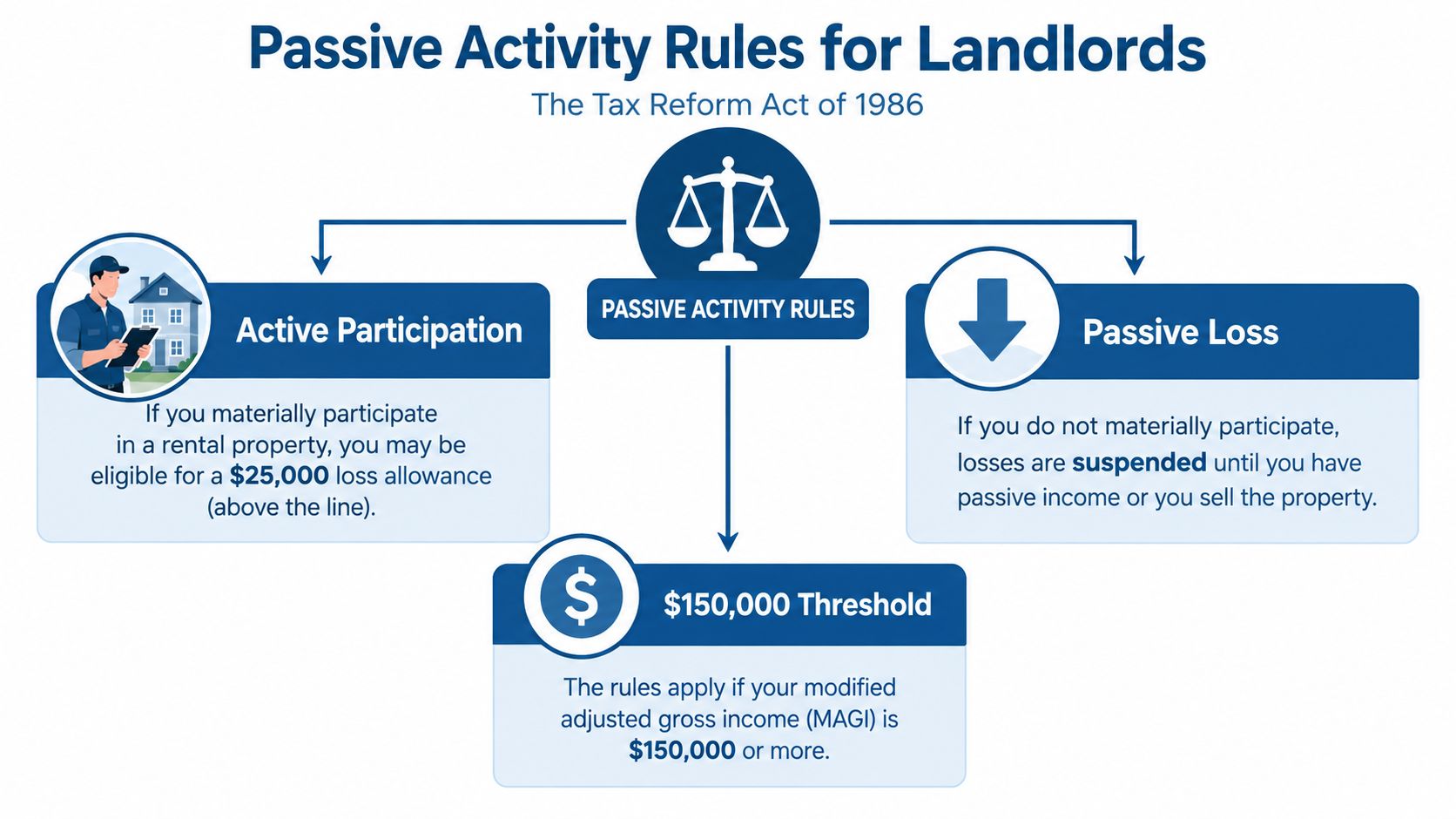
Active participation isn't real-estate-professional status
For a 2026 federal return, check the applicable filing-year instructions for the special allowance of up to $25,000, which is subject to active-participation requirements, income limitations, and phaseout rules described in IRS Publication 925. Check amounts and provisions annually rather than assuming they remain unchanged; this allowance isn't a promise that every landlord can deduct the full amount.
For the duplex owner, decisions about tenants, repairs, and management should be documented rather than summarized later as being involved. A contractor's occupation alone doesn't establish real-estate-professional status. The time tests and rental material-participation requirement need their own support.
Married taxpayers filing separately who lived together at any time during the year can't use the special allowance under the IRS guidance cited above. Other married-filing-separately circumstances require their own review.
A suspended loss still needs tracking
Losses disallowed by the passive rules generally carry forward. Previously disallowed losses may generally become usable upon disposing of the entire activity interest in a fully taxable transaction, subject to the applicable requirements.
That distinction is worth understanding before treating a depreciation-driven duplex loss as an offset to the owner's contracting income. The passive activity loss rules guide addresses that analysis in more depth.
For another way to follow the topic, the video below can supplement the written explanation.
Mistakes That Trigger IRS Questions on Rental Returns
The defensible question isn't which expense guarantees an IRS notice. It's whether the landlord can support the amount, property use, classification, and tax treatment if the IRS asks.
There's no basis here to rank Schedule E entries by audit frequency. A large deduction isn't automatically wrong, and a small deduction isn't automatically safe. The weakest entries are those the records can't explain.
Use the checklist as a review tool, not a prediction of which returns the IRS will examine.
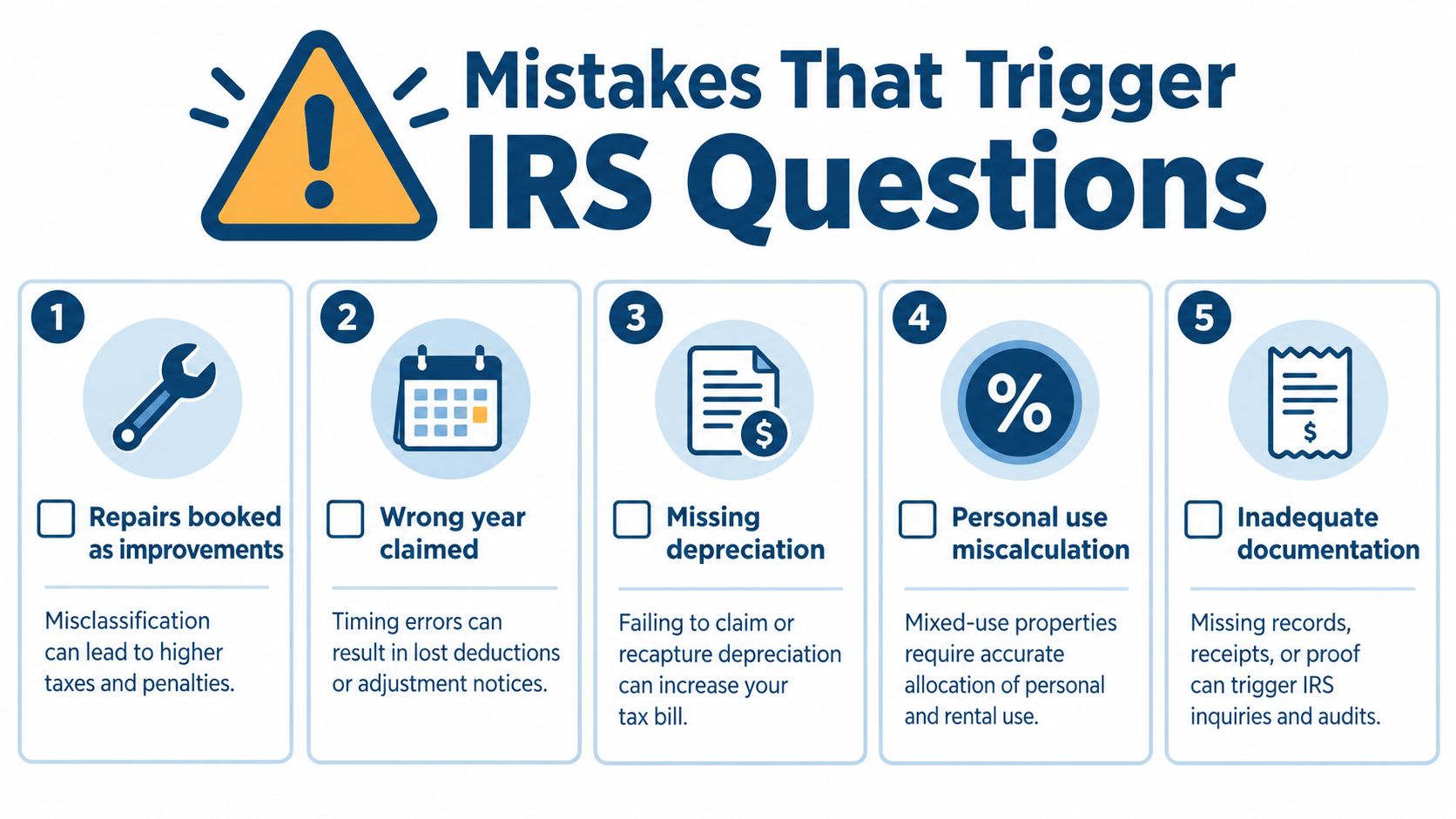
Review explanations before reviewing totals
- Unclear project descriptions: Obtain detail beyond renovation or maintenance so the preparer can evaluate the work.
- Unexplained annual changes: Identify whether the difference reflects vacancy, a project, ownership changes, or incomplete records.
- Unsupported property use: Reconcile the use information with leases and the owner's calendar.
- Disconnected depreciation records: Compare the current schedule with prior filings and acquisition documents.
The depreciation guidance discussed earlier matters even when the rental appears profitable. Don't omit the depreciation review because the return already shows an acceptable result.
Also consider depreciation recapture risk before selling. That calls for a transaction-specific review, not a guessed recapture rate or an assumption that skipping a deduction avoids a later tax issue. Preserve the history needed to evaluate the sale.
An invoice and proof of payment answer different questions: the invoice describes the work, while the payment record supports what was paid. Neither should have to stand alone when both are available.
Documents to Pull Together Before You File
Gather property-specific income records, expense support, ownership documents, and prior tax schedules before preparing Schedule E. A spreadsheet total is useful, but it doesn't replace the records behind it.
For the duplex, organize the file by address and then by category. Keep tenant records distinct from project records so the preparer can follow receipts and spending without sorting unrelated documents.
Build a reusable filing checklist
- Rent records: Leases, annual rent roll, tenant payment ledger, bank statements, and separately identified deposit activity.
- Financing and operating costs: Lender interest statements, property tax bills, insurance documents, and management statements.
- Work performed: Repair invoices, contractor payment records, project contracts, and supporting photographs where useful.
- Property history: Purchase and closing documents, prior returns, depreciation schedules, and improvement records.
- Use and participation: Rental calendars, owner-use logs, and participation records relevant to the loss treatment being claimed.
Resolve gaps before sending the file
Compare the rent roll with the bank activity and investigate differences rather than forcing them into miscellaneous income. Ask property managers for statements early enough to resolve missing payments, reimbursements, or unclear descriptions.
Review contractor information-reporting obligations separately. Don't assume that an invoice settles those obligations, or apply a remembered threshold without checking the relevant federal filing-year requirements.
For short-term-rental operators considering outside bookkeeping support, CS Outsource's page on bookkeeping services for Airbnb hosts is one resource to evaluate. Whatever system or provider you use, ask whether its reports preserve property-level detail and supporting documents.
A filing-ready package should let someone trace a return entry back to its evidence without asking you to remember what happened.
Looking Beyond April and When to Bring in a Pro
Bring in an accounting firm when ownership, mixed use, improvements, or loss limitations make the rental more than a straightforward annual ledger. Year-round projections are particularly useful when the landlord also earns business income and needs to understand the combined federal and state picture.
A contractor who owns the Brooklyn duplex shouldn't evaluate the rental deduction in isolation from the contracting business. The question is whether the rental result is usable, what other restrictions apply, and how the whole individual return looks before year-end.
Make decisions while the records are current
Record projects when they happen, preserve the dates and documents needed for depreciation review, and flag changes in property use immediately. Preparing a projection before year-end gives the owner time to discuss the expected result rather than discovering it during spring filing.
New York State, New York City, and multi-state treatment need separate attention. A federal Schedule E calculation doesn't, by itself, resolve residency, nonresident reporting, or obligations connected with a property in another state.
A spreadsheet may be enough for an uncomplicated rental with complete records. Outside support becomes more useful when the owner can no longer reliably reconcile receipts, explain project costs, or maintain the tax history.
The useful deliverable isn't just a completed form. It's a supported rental calculation, a maintained depreciation and loss history, and a projection that connects the property to the owner's broader finances.
For help connecting your rental records with individual tax preparation, bookkeeping, and year-round projections, visit Blue Sage Tax & Accounting Inc., an accounting firm based in Bayside, Queens. Bring your rent ledger, prior return, and depreciation schedule so the discussion can focus on your Schedule E questions. Book your free consultation call today.
This article is general information and not tax advice for your specific situation.