
The IRS sets no fixed percentage or minimum dollar amount for reasonable compensation for S corp owners. Under the federal facts-and-circumstances test, the salary should match the value of the services the owner performs, not a preset share of revenue or leftover profit.
Popular salary-splitting shortcuts start with the wrong question. Instead of asking how much profit you can classify as distributions, ask what your business would pay someone else to perform your work, function by function.
Table of Contents
- What Is Reasonable Compensation for an S Corp Owner?
- Which Factors Decide a Defensible Owner Salary?
- How Do You Calculate a Defensible Salary, Step by Step?
- What Records Should Back Up Your Salary?
- How Do Distributions and Payroll Taxes Interact With Salary?
- Which Owner Scenario Fits Your Business, and When Should You Review Pay?
What Is Reasonable Compensation for an S Corp Owner?
Reasonable compensation is pay for the owner's labor, evaluated against the work performed and the circumstances of the business. It isn't automatically equal to business profit, and ownership alone doesn't establish the appropriate wage.
The IRS guidance on S corporation employees, shareholders, and corporate officers states that corporate officers who perform more than minor services and receive, or are entitled to receive, payment are generally employees whose compensation is subject to federal employment taxes. Payments to those officers must be treated as wages to the extent they represent reasonable compensation for services.
Think of a contractor who hires a lead tradesperson and a project manager. Their pay reflects their skills, workload, and responsibilities, not whatever happens to remain in the checking account after suppliers are paid. An owner doing those jobs needs a similarly work-focused analysis.
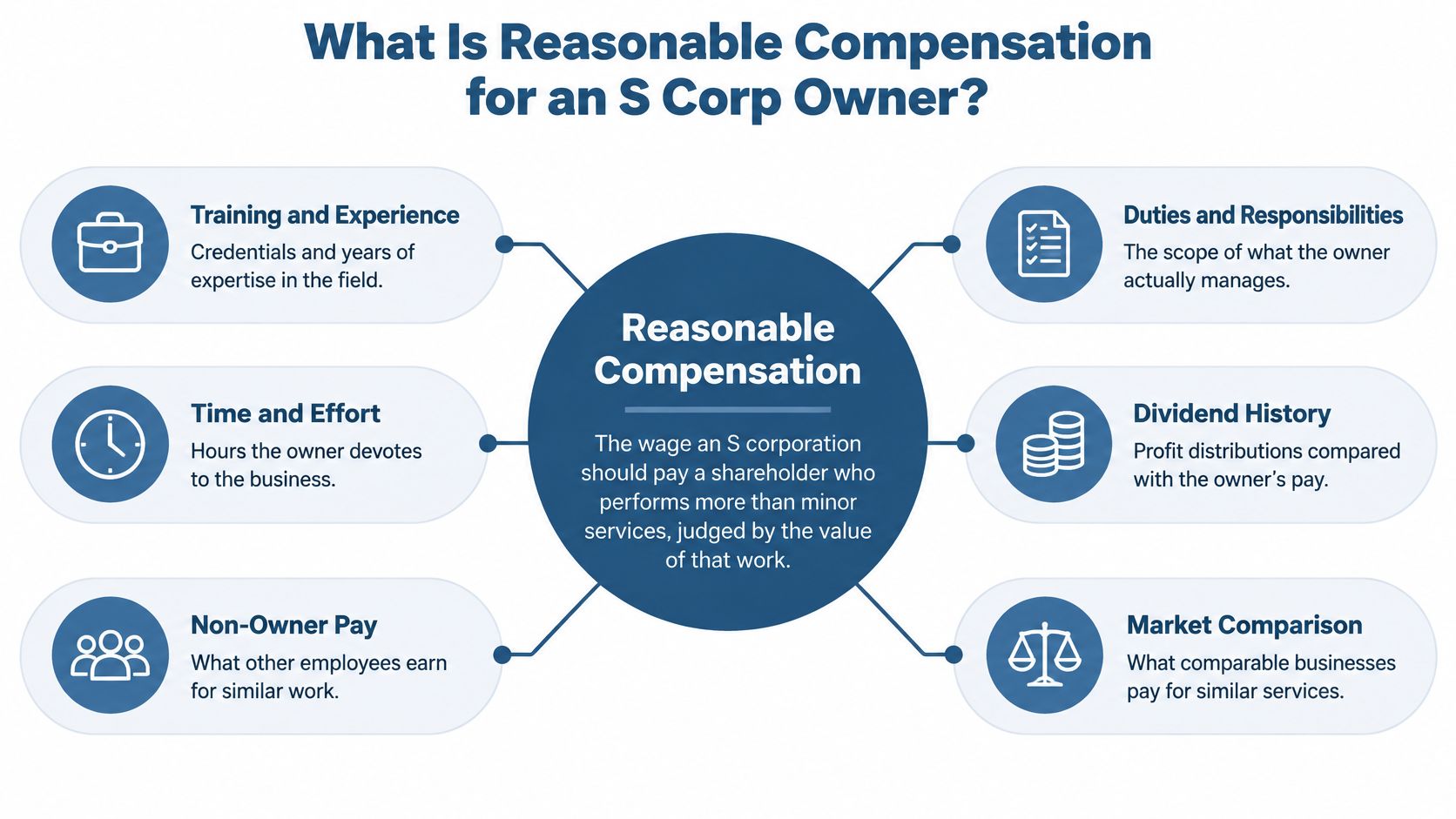
The following diagram highlights the main categories of evidence used to evaluate that work.
Does business profit determine the salary?
Profit is relevant context, but it isn't the price of the owner's labor. Employees, equipment, established systems, and invested capital may contribute to earnings alongside the owner's services.
A strong year doesn't automatically justify assigning all profit to salary. Conversely, a weak year doesn't automatically justify zero wages when the owner continued working and received payments from the corporation.
Practical test: If you run crews, sell jobs, treat patients, drive routes, or supervise production, identify the employee functions you perform before deciding how to pay yourself.
This is a federal standard that applies nationally. State payroll registration, withholding, and unemployment requirements are separate questions and need their own review.
Which Factors Decide a Defensible Owner Salary?
No single factor determines a defensible salary. The IRS and courts consider the owner's qualifications and work alongside comparable pay, company compensation practices, and distribution history, as described in the IRS guidance on S corporation compensation.
Use this working checklist to connect each factor to evidence rather than relying on a general statement that the salary seems fair.
| Factor | What to document | Owner-operator example |
|---|---|---|
| Training and experience | Licensing, credentials, and years in the trade | Master electrician with management responsibilities |
| Duties and responsibilities | Written job description listing actual functions | Owner estimates jobs, supervises crews, and signs contracts |
| Time and effort | Logged hours by function across the year | Time split between fieldwork and office administration |
| Pay to non-owner employees | Wage schedules for comparable staff | Lead technician and office manager pay ranges |
| Timing and method of bonuses | Written bonus policy with criteria and payment dates | Year-end bonus tied to a written formula |
| Comparable-business pay | Wage data for similar roles in the same area and trade | Occupational wage data for the owner's trade |
| Written compensation arrangements | Shareholder or board resolution setting pay and effective date | Signed annual resolution before the pay period |
| Dividend history | Prior distributions and whether wages were paid | Several years of large distributions with no wages |
| Compensation formula | Any formula the company uses and evidence it was followed | A percentage-based formula, if one exists, applied consistently |
Which evidence deserves the closest attention?
For a trade contractor, distinguish hands-on production from estimating and supervision. Comparing the owner only with a field technician can miss responsibility for scheduling, pricing, and managing other workers.
For a restaurant owner, identify whether the work resembles a general manager, shift supervisor, bookkeeper, or a combination. Being available to answer an occasional question isn't the same workload as managing service every day.
For a physician or dentist, clinical qualifications and patient-care responsibilities are central to selecting comparables. Administrative duties should be identified separately rather than assuming every working hour has the same replacement cost.
Comparable means comparable in substance, not just in title. A salary listing for a manager with broad hiring and operating authority may be a poor match for someone who supervises a small shift.
A weak entry in the checklist doesn't automatically make the salary unreasonable. The more concerning pattern is substantial owner services paired with high distributions, little payroll, and no documented explanation across the relevant factors.
How Do You Calculate a Defensible Salary, Step by Step?
There's no statutory salary formula, so a practical method is to estimate the market replacement cost of each function the owner performs. Use that estimate as evidence within the broader facts-and-circumstances analysis, not as an IRS-approved calculation or guaranteed result.
The IRS fact sheet on S corporation officer compensation identifies duties, time and effort, training, comparable-business pay, and company compensation practices as relevant considerations. A function-based worksheet puts those considerations into a usable process.
This visual summarizes the market-based approach.
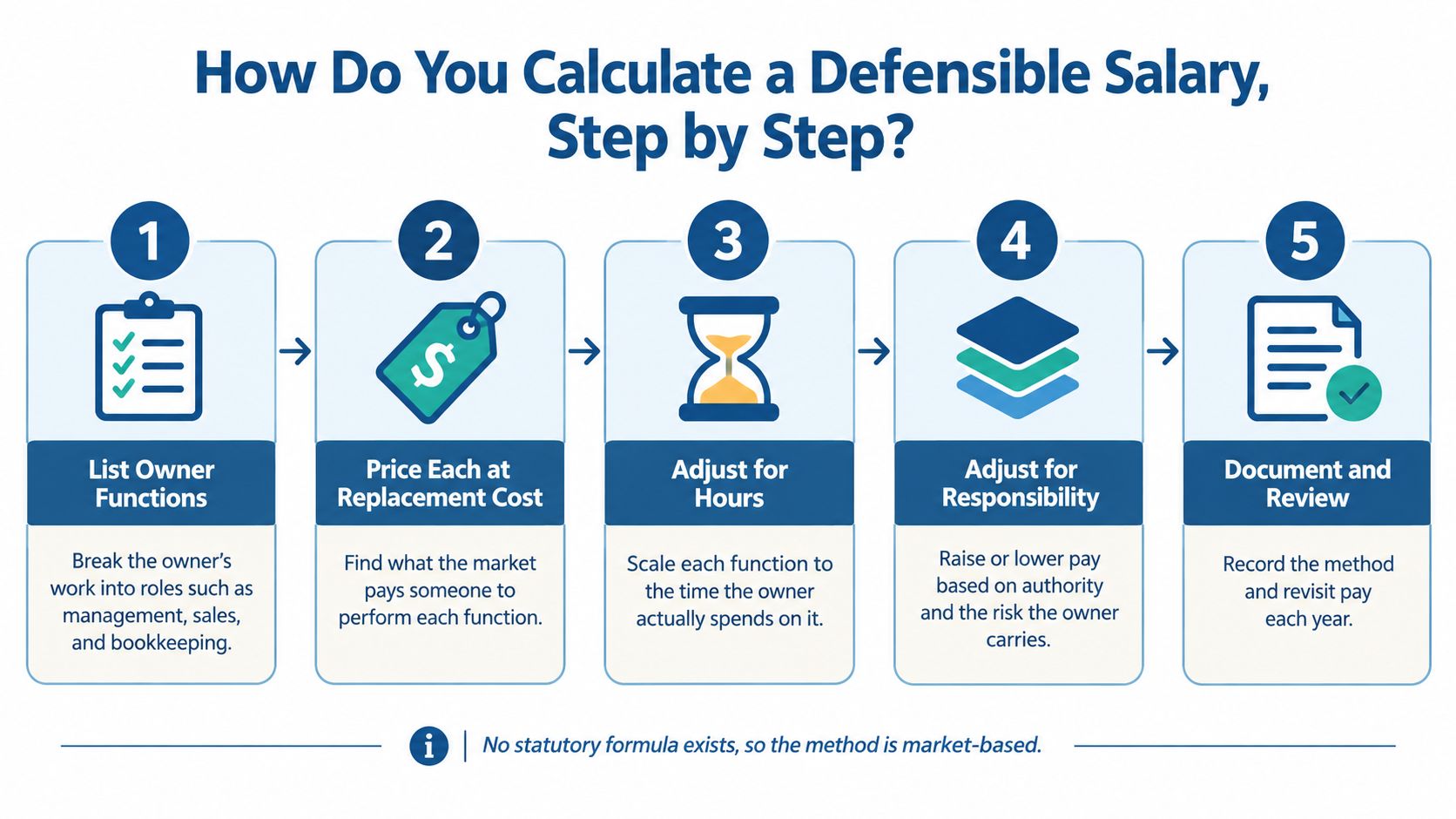
List every function you perform. Separate field production, sales, project management, administration, and licensed professional services because each may have a different market value. Use actual tasks rather than a broad title such as president.
Estimate time by function. Use a calendar, scheduling software, or a time log to distinguish production work from management and administrative work. Account for seasonal changes so a busy stretch doesn't become the assumed workload for the entire year.
Find credible replacement-cost evidence. Review Bureau of Labor Statistics occupational wage data and comparable local job postings for each role. Check the duties, location, and whether compensation includes benefits or bonuses before treating a listing as comparable.
Adjust for actual responsibility. Consider experience, business size, location, supervisory authority, and accountability for results because similar titles can describe different jobs. Document the reason for each adjustment rather than selecting the highest available figure.
Check affordability and internal consistency. Compare the proposed compensation with the company's financial condition and what similarly situated employees earn. If the result doesn't fit, investigate the mismatch instead of silently reducing the salary to a preferred number.
Approve the decision and establish a review process. Record the salary, effective date, supporting method, and any bonus arrangement before issuing the applicable pay. Revisit the decision annually and when the owner's duties materially change.
Why don't revenue percentages work as a substitute?
Revenue measures sales, not labor. A business buying expensive materials can have substantial revenue without requiring the same owner workload as a service business generating revenue mainly through the owner's personal work.
Profit percentages have a similar weakness. Equipment costs, staffing changes, and pricing can change profit even when the owner's duties stay largely unchanged.
Price the work first. Use the company's financial results to test the decision, not to replace the work analysis.
Blue Sage Tax and Accounting Inc., an accounting firm, includes reasonable compensation analysis in its S-corporation services.
For another explanation of the salary-setting process, the following video provides additional context.
What Records Should Back Up Your Salary?
Keep records showing what work you performed, how you selected the pay, and what the company's condition was when you made the decision. Prepare the file as part of running the business, not only after someone questions the salary.
The IRS discussion of wage compensation for S corporation officers emphasizes the facts-and-circumstances approach, including duties, time devoted, company condition, comparable compensation, and pay practices. Your records should make those facts understandable to someone unfamiliar with your business.
- Dated owner job description: Identify actual functions, supervisory responsibilities, and specialized work.
- Time records by function: Keep calendar entries or activity logs during the year rather than reconstructing everything afterward.
- Comparable wage evidence: Save the source, publication or access date, geography, job description, and compensation information used.
- Non-owner pay schedule: Retain wage rates and role descriptions for employees whose duties overlap with yours.
- Written salary decision: Keep the shareholder or board resolution, effective date, and explanation of the selected amount.
- Bonus documentation: Preserve the policy, calculation, approval, and payment record.
- Payroll records: Show that approved wages were processed through payroll, with the corresponding reporting and payment records.
- Profitability summary: Retain a concise comparison of the company's results before and after owner compensation.
Keep the file useful during the year
Record role changes when they happen. If you hire a project manager and stop supervising jobs, note which responsibilities transferred and when; if you take over a departing employee's workload, document that change too.
For any midyear adjustment, retain the old salary, new salary, effective date, and business reason. Keep those decisions connected to your small-business payroll setup and procedures so the approved pay and actual payroll agree.
A spreadsheet with clearly labeled tabs can be sufficient for organizing the analysis. Store the underlying wage reports and signed decisions alongside it, because a spreadsheet total without its supporting assumptions is difficult to evaluate.
These records support the salary decision; they don't guarantee acceptance. They also make the next annual review faster because you can update changed facts instead of rebuilding the entire analysis.
How Do Distributions and Payroll Taxes Interact With Salary?
Distributions are not a way to price an owner's labor. An S corporation must pay reasonable wages for the services the owner performs before treating remaining payments as distributions. If payments labeled as distributions are in fact compensation for substantial services, the IRS may reclassify them as wages, leading to additional federal employment taxes, interest, and penalties.
Historical disputes illustrate how courts have evaluated salary evidence. The following case amounts are summarized in a Tax Adviser discussion of reasonable compensation.
| Case and year | Pay position | Outcome |
|---|---|---|
| David E. Watson, P.C. v. United States, tax years 2002 and 2003 | Stated salary of $24,000 in each year, while the business generated significantly more income | Court found $91,044 reasonable annually and reclassified $67,044 per year of distributions as wages, resulting in additional employment taxes, interest, and penalties |
| Sean McAlary Ltd. Inc., tax year 2006 | $240,000 received; IRS initially treated $100,755 as reasonable compensation using an implied rate of $48.44 per hour | Tax Court found the estimate aggressive and set compensation at $40 per hour, or $83,200 annually |
These are historical findings, not current salary thresholds. They do not set a salary for another owner. The practical question is what it would cost to replace the owner's specific work, function by function, not what share of revenue or leftover profit the owner receives.
The owner's chosen salary and the cash left over are not the test; the value of the services is.
What can happen beyond the payroll adjustment?
The IRS guidance on paying yourself explains that underpaid officer compensation may require adjustments to income and expense amounts on both the corporation's return and the shareholder's individual return. The corrections depend on the facts; there is no universal adjustment method or predetermined outcome.
A reclassification can affect payroll reporting and the tax treatment of shareholder payments at the same time. For operating procedures, see HireAccountants' guide to payroll tax compliance. The income-tax treatment of distributions is a separate issue from valuing the owner's labor; see this guide to tax rates on S corporation distributions.
Federal compensation guidance applies nationally. Payroll withholding and unemployment requirements vary by state, so confirm the rules for each state where the owner works.
Which Owner Scenario Fits Your Business, and When Should You Review Pay?
The salary question is easier to answer when you price the owner's work function by function. A business label or revenue figure cannot tell you what those duties would cost to replace. The scenarios below show which records help distinguish the work.
These are hypothetical operating situations, not client results or compensation benchmarks.
| Business | Owner's main work | What to document |
|---|---|---|
| Specialty contractor with about $400,000 in annual revenue | Fieldwork, estimating, and job sales | Hours by function and the cost of hiring a lead technician and an estimator |
| Restaurant owner operating in New York and New Jersey | Front-of-house management, expediting, and bookkeeping oversight | Work location by state, state withholding setup, and wage data for each market |
| Physician or dentist with a professional practice | Clinical work plus administrative duties | Clinical hours and comparable practitioner pay, with administrative time logged separately |
| Trucking or livery owner-operator | Driving routes plus dispatch and administration | Driving hours separated from dispatch hours, with wage data for drivers and dispatchers |
What changes the analysis in practice?
For the hypothetical contractor, revenue does not set the salary. If the owner shifts from installing equipment to estimating and supervising subcontractors, the replacement roles change even if sales stay similar.
A restaurant owner should separate operating duties from ownership oversight. Running the dining room during service is different from reviewing financial statements after a manager handles daily operations.
For a clinician, log patient-care time separately from scheduling, hiring, and administration. A trucking owner should record driving and dispatch hours without counting overlapping time twice.
A planning file can keep these distinctions clear as duties change.

When should you revisit the decision?
Review the salary at least annually, and sooner when the owner's work changes materially. Hiring a manager, adding a crew, reducing clinical hours, or stepping away from driving can change which replacement roles and hours belong in the analysis.
- Review annually: Update the role description, workload assumptions, market comparisons, and written pay decision.
- Revisit material changes: Reassess compensation when duties, workload, business scale, or profitability changes materially.
- Confirm state payroll setup: Before the first payroll of the year, check applicable state requirements and update the setup if work locations have changed.
The goal is a salary decision supported by records: identify the work, show how you valued each function, and connect the approved amount to actual payroll.
Blue Sage Tax & Accounting Inc. offers reasonable compensation analysis, S-corporation compliance, payroll support, and year-round tax planning. Bring your owner duties, payroll history, and recent financial statements to discuss how your salary decision fits your business. Book a consultation call today.
This article is general information and not tax advice for your specific situation.