A professional corporation is a restricted corporate wrapper for licensed owners, while an LLC is a flexible legal form whose federal tax result depends on ownership and elections; neither shields an owner's own malpractice. An LLC with one owner generally defaults to disregarded treatment, while an LLC with multiple owners generally defaults to partnership treatment.
The counterintuitive part: a PC and an eligible LLC can elect comparable federal tax treatment. Don't choose a legal entity because someone calls it a tax-saving structure. First establish what your license allows, then model the tax election separately.
Table of Contents
- What Is the Difference Between a Professional Corporation and an LLC?
- Does a Professional Corporation Shield Malpractice Claims?
- What Does Forming and Maintaining Each Entity Involve?
- How Are Professional Corporations and LLCs Taxed?
- When Does an S Election Change Owner Pay?
- Which Licensed Practices Should Use Each Entity?
- How Do You Choose the Right Entity Now?
What Is the Difference Between a Professional Corporation and an LLC?
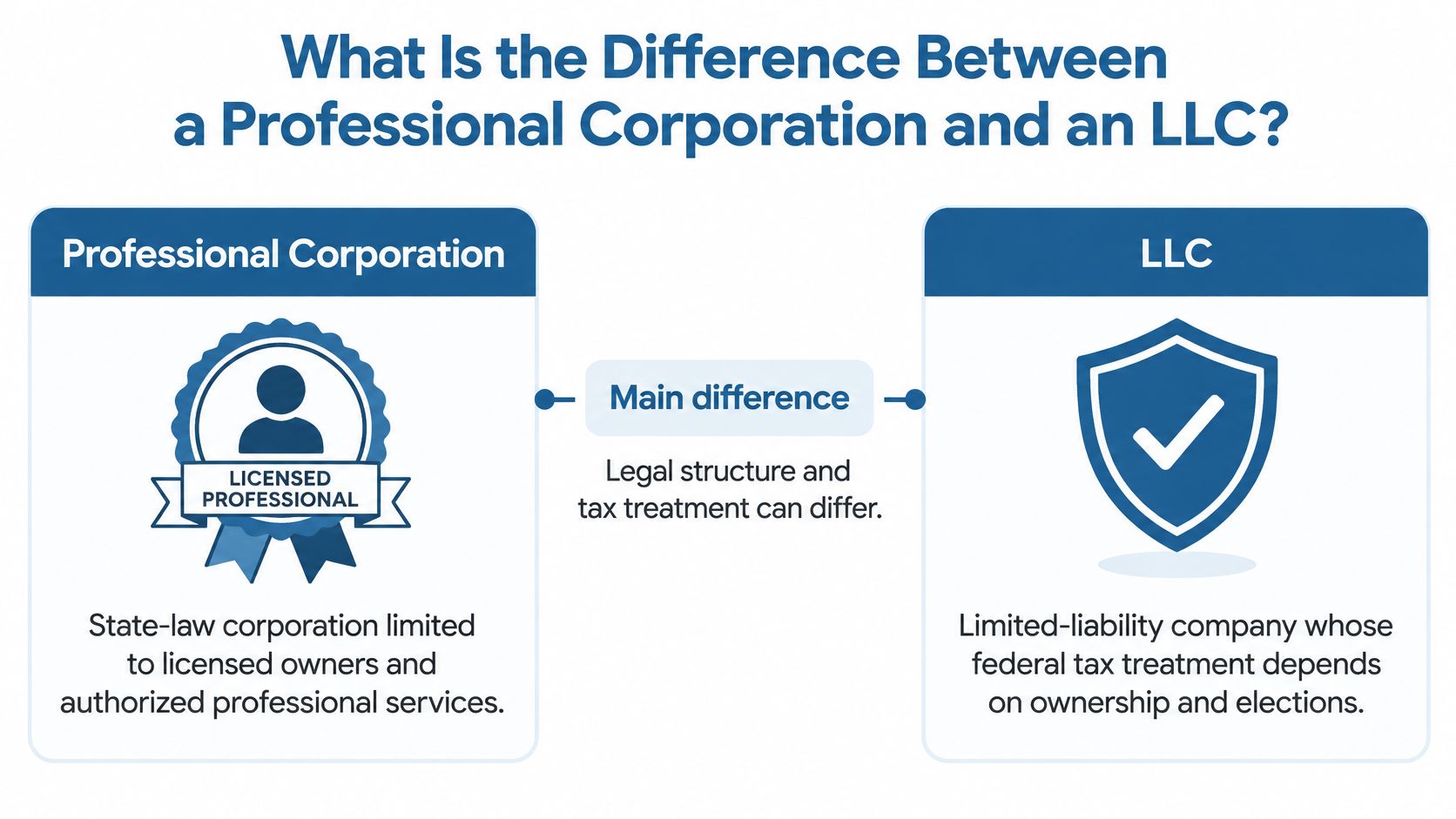
A professional corporation is a state-law corporation generally restricted to licensed owners and authorized professional services. An LLC offers more operating flexibility, but a professional LLC carries licensing restrictions that an ordinary LLC doesn't.
Professional corporation versus LLC at a glance
| Criterion | Professional corporation | LLC or professional LLC |
|---|---|---|
| State-law form | Corporation restricted to a licensed profession | Flexible limited-liability company; professional version where the state requires it |
| Who may own it | Generally licensed individuals in that profession | Ordinary LLC may allow broader owners; a professional LLC is limited to licensees |
| Permitted work | Authorized professional services, often one profession | Ordinary LLC may run any lawful business; a professional LLC is limited to licensed services |
| Default federal tax classification | C corporation unless a valid S election applies | Disregarded with one owner; partnership with multiple owners; corporate or S treatment by election |
| S election available | Yes, if eligibility rules are met | Yes for an eligible LLC, without first electing C status |
The federal distinction comes from ownership and elections, not branding: IRS Publication 3402 explains that a single-member LLC is generally disregarded, a multi-member LLC generally receives partnership treatment, and an LLC may elect corporate treatment.
For a New York dental practice owned entirely by licensed dentists, the ownership row is a licensing constraint, not an opportunity to admit an unlicensed investor through an ordinary LLC. New York's professional entity options include a professional service corporation, professional service LLC, and registered LLP.
Start with permission: Confirm the form is permitted in every state where the practice operates before comparing tax elections.
Blue Sage Tax and Accounting Inc., an accounting firm, includes entity structure review and election modeling in tax planning once the legal options are established.
Does a Professional Corporation Shield Malpractice Claims?
A professional corporation does not protect a licensed owner from liability for that owner's own malpractice. A PC or professional LLC may separate ordinary business obligations from personal assets, but the entity is not a substitute for professional liability insurance.
The American Bar Association's guidance on law-firm entities distinguishes ordinary business liability from an owner's personal liability for professional negligence. The same distinction matters when choosing an entity for a licensed practice.
| Risk | PC or professional LLC | What still applies |
|---|---|---|
| Ordinary business debts and vendor claims | Generally an entity-level shield if separateness is maintained | Personal guarantees and commingled funds can undermine it |
| The owner's own malpractice or regulatory misconduct | Not shielded | Professional liability insurance and licensing rules |
| Another owner's professional error | May keep the claim off the non-negligent owner's personal assets, subject to state law | The negligent owner remains exposed; insurance still matters |
For a New York dental practice with co-owners, an unpaid vendor invoice and a claim alleging negligent dental treatment raise different liability issues. The entity does not make those risks interchangeable. A solo architect also remains personally exposed to claims over their own design errors.
Keep administrative operations separate when required
A professional entity is limited to its licensed field. In New York, have an attorney review any proposed separate administrative or management-services company under the rules that apply to the profession and entity.
Personal guarantees and certain trust-fund payroll-tax obligations can also create personal exposure. Maintain separate bank accounts, sign contracts in the entity's name, and keep governance records. Read more about protecting assets from lawsuits.
What Does Forming and Maintaining Each Entity Involve?
Both entities require state formation filings, but a professional entity also must satisfy the applicable licensing requirements. Don't file a generic online LLC package before confirming that it's appropriate for your profession.
Use this sequence with your attorney and accountant:
- Confirm permission. Identify the permitted entity types in every state of practice and obtain any required professional approval.
- Choose a name that meets the state's professional naming requirements, not just one available in the business-name database.
- File the formation documents. Use the jurisdiction's required incorporation document for a PC or organization document for an LLC.
- Adopt bylaws or an operating agreement, maintain an owner register, and document meetings or written decisions as applicable.
- Establish the financial identity. Obtain an employer identification number and open a dedicated entity bank account.
- Calendar state filings, professional-license renewals, and applicable publication or notice requirements.
A PC may need licensing-board records alongside corporate filings. An LLC needs current ownership and operating records as well as applicable periodic state filings; less corporate formality doesn't mean no documentation.
Keep ownership-transfer provisions aligned with licensing rules. A retirement, death, or license suspension shouldn't leave the practice without a workable ownership plan.
Check current formation and maintenance fees with the relevant state filing office for the year involved. Costs reflect jurisdiction, entity type, and ownership structure. Formation documents and licensing opinions belong with an attorney because our accounting firm doesn't provide legal services.
How Are Professional Corporations and LLCs Taxed?
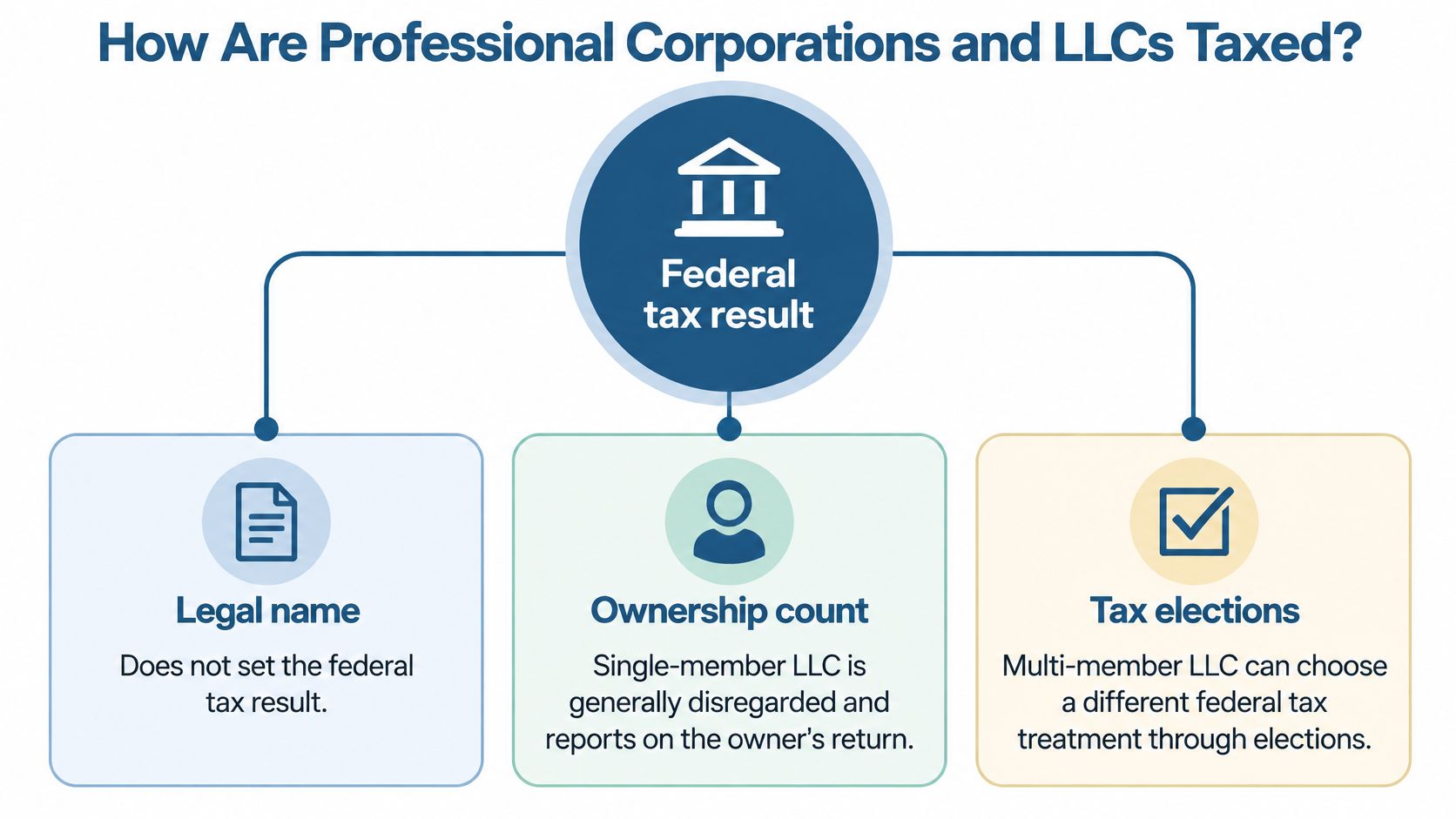
Federal tax classification determines the return and tax framework, not the letters after the practice's name. A default LLC generally reports through its owner or as a partnership, while a PC generally starts as a C corporation unless a valid election changes that treatment.
This visual separates the legal structure from its federal classification.
Federal return by tax classification
| Classification | Federal return |
|---|---|
| Single-member LLC, disregarded | Generally Schedule C on an individual owner's return for an operating professional practice |
| Multi-member LLC, partnership default | Form 1065 with a Schedule K-1 to each owner |
| S corporation, from a PC or eligible LLC | Form 1120-S with a Schedule K-1 to each owner |
| C corporation, the PC default | Form 1120 |
For federal elections, IRS Publication 542 explains that an LLC can elect corporate treatment using Form 8832, while an eligible LLC can elect S treatment using Form 2553 without first filing Form 8832. Default LLC treatment also generally means self-employment treatment for working owners, separate from the entity's liability shield.
Separate federal, state, and city obligations
New York State: Review state tax treatment and election requirements separately from federal treatment. New York City: A practice with city nexus must evaluate city filings because federal S treatment doesn't establish the same city pass-through result.
New Jersey: Check the applicable business returns, entity-level obligations, and minimum taxes for the tax year involved. Any applicable amounts or thresholds must be checked annually rather than carried forward unchanged.
Say a contractor earns $400,000 in revenue working across New York and New Jersey. That hypothetical business needs income allocation and an analysis of available credits for taxes paid elsewhere, not duplicate federal figures on unrelated state returns.
Our S-corporation service includes matching federal and state returns, multi-state filings, and New York City filings where nexus exists. For owners expanding west, Lerner & Weiss APC's guide to California LLC versus S corporation compliance illustrates why another state requires its own review.
This video adds context to the entity and tax-election distinction.
When Does an S Election Change Owner Pay?
An S election can provide federal pass-through treatment, but working owners must address payroll and reasonable compensation. Distributions beyond reasonable wages may receive different employment-tax treatment, but that doesn't guarantee a lower total tax bill.
We generally consider election modeling when net profit is consistently above roughly $40,000 to $60,000 annually. That's our screening guideline, not a federal threshold, an annually indexed amount, or a promise of savings.
Model the salary before the distributions
A solo therapist with irregular profit may find default LLC treatment and estimated payments more manageable. A stable practice that can fund reasonable wages, payroll administration, and distributions deserves a closer comparison, particularly after New York City taxes are included.
Our written reasonable compensation analysis considers duties, time commitment, and comparable professional pay. A token salary chosen to maximize distributions isn't a defensible approach.
- Check eligibility: Review eligible shareholders, the single-class-of-stock requirement, and election timing.
- Build payroll compliance: Set up payroll and quarterly filings, or review the existing payroll provider.
- Maintain owner reporting: Prepare the S-corporation return and shareholder schedules, track basis annually, and document eligible reimbursements through an accountable plan.
We provide qualifying late-election relief under Rev. Proc. 2013-30, but relief isn't automatic. Model the election for the tax year at issue; payroll, state treatment, and compliance costs can change the answer.
Which Licensed Practices Should Use Each Entity?
Use the form your licensing rules permit, then select the tax treatment. New York's professional entity options aren't a national menu and shouldn't be applied automatically to New Jersey.
The New York State Education Department permits licensed professionals to form a professional service corporation, professional service LLC, or registered LLP and generally restricts a professional entity to one professional service, with specified combinations involving architecture, land surveying, professional engineering, geology, and architecture.
- New York medical or dental practice: Start with the permitted professional structures and verify owner qualifications. Don't use an ordinary LLC to bypass professional restrictions.
- New York design practice: Check whether the proposed combination qualifies for a permitted professional-services exception before creating separate entities.
- New Jersey licensed practice: Confirm that profession's New Jersey entity and ownership rules independently, including requirements for operating across state lines.
- Unlicensed contractor or restaurant owner: Compare ordinary LLC and corporate structures instead. A PC isn't the relevant starting point.
Certain New York health professions face narrower restrictions. A professional LLC also isn't an unrestricted vehicle for outside investors.
A proposed management company or unlicensed investor changes the legal analysis. Obtain licensing advice before negotiating the ownership arrangement.
The filing work follows the permitted structure. We handle entity tax returns and S-corporation compliance, while the practice's attorney determines whether the ownership and services arrangement is lawful.
How Do You Choose the Right Entity Now?
Choose the legal form your license allows, then model the election against expected profit, owner pay, and filing jurisdictions. The professional corporation vs LLC decision should produce a workable compliance plan, not just a preferred abbreviation.
Use this decision path before authorizing filings.
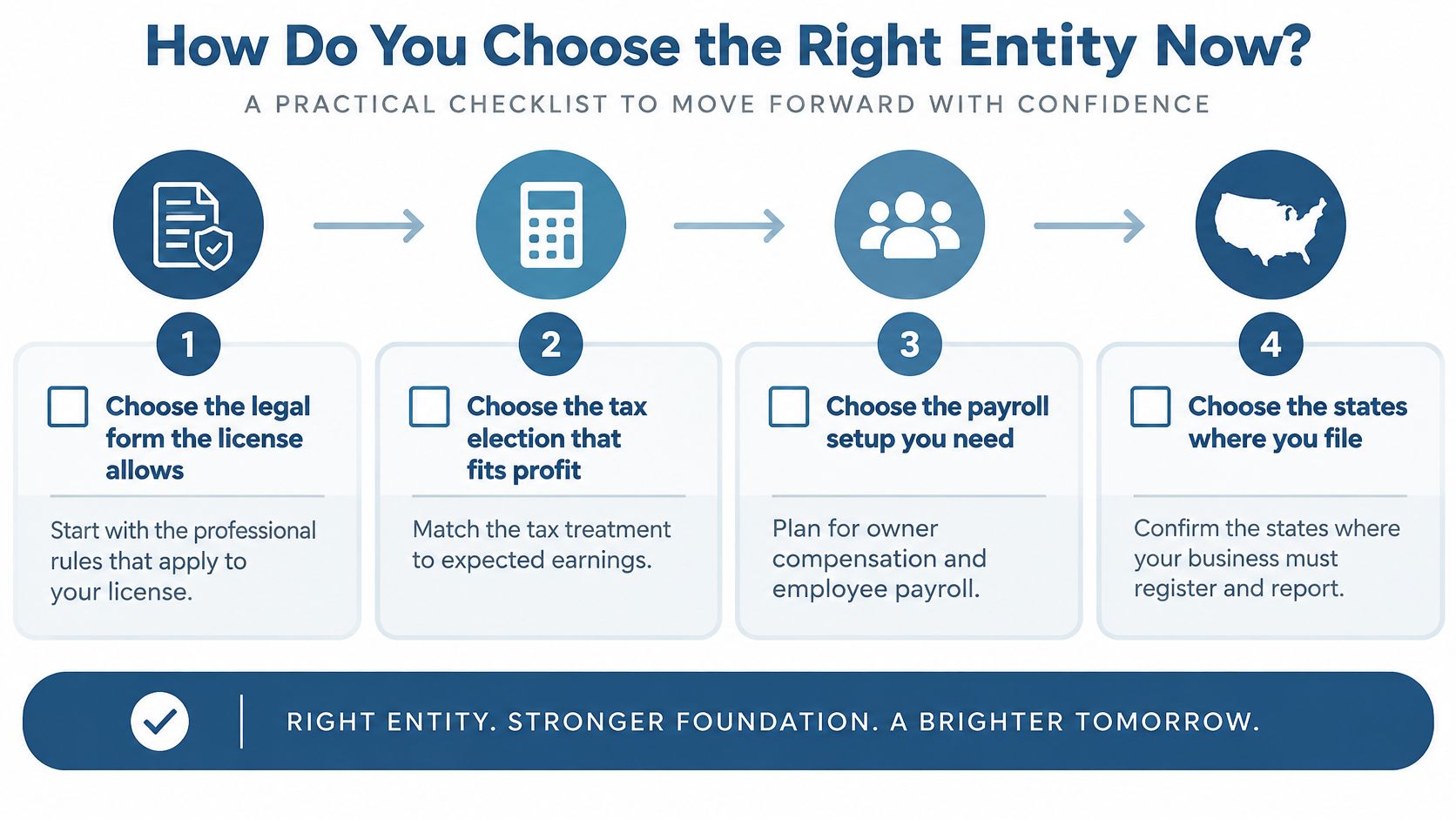
- Confirm permitted forms in every state of practice and identify every proposed owner's licensing status.
- Separate vendor obligations from professional claims, and retain appropriate insurance.
- Project profit and test whether the practice can support reasonable owner wages and distributions.
- Check New York State, New York City, and New Jersey obligations wherever applicable.
- Keep accounts, contracts, and ownership records consistent with the chosen structure.
We can review the structure and model elections, with S-Corporation Compliance, IRS and State Notices, Multi-State Filings, Tax Planning, and Bookkeeping available to support ongoing obligations. Keep formation documents and licensing opinions with your attorney.
Blue Sage Tax & Accounting Inc. offers entity structure review and election modeling to connect your permitted legal form with federal, state, and city tax compliance. Book your free consultation call today.
This article is general information and not tax advice for your specific situation.