
If paying yourself from LLC funds is just moving money to your personal account, why can you owe tax on profit you never withdrew? Because how cash moves and how profit is reported are separate decisions. A single-member LLC taxed by default pays its owner by draw, a multi-member LLC taxed as a partnership pays by distribution or guaranteed payment, and an LLC taxed as an S corporation pays a working owner a payroll salary first, then distributions.
Table of Contents
- How Do You Pay Yourself From an LLC?
- How Do Partners Pay Themselves From a Multi-Member LLC?
- How Much Salary Should an S-Corp Owner Take?
- How Much Cash Should You Hold Back Before Paying Yourself?
- Which Records Keep Owner Payments Defensible?
- Confirm Your Owner Pay Plan Before Year-End
How Do You Pay Yourself From an LLC?
For federal tax purposes, paying yourself from an LLC depends on the LLC's tax classification, not the LLC label. A single-member LLC is generally a disregarded entity by default, while a multi-member LLC is generally taxed as a partnership. An LLC electing S-corporation status follows different rules, and the IRS guidance on S-corporation employees and shareholders states that a shareholder performing more than minor services is an employee for federal employment-tax purposes.
Owner Payment Method by Federal Tax Status
| Tax status | How the owner is paid | Owner wages | Main federal return |
|---|---|---|---|
| Single-member LLC (default) | Owner draw from the business account | No W-2 wages | Schedule C and Schedule SE |
| Multi-member LLC (default) | Distributions and guaranteed payments | No W-2 wages for owner services | Form 1065 with a Schedule K-1 for each owner |
| LLC taxed as an S corporation | Salary through payroll, then distributions | W-2 wages required for services | Form 1120-S with a Schedule K-1 for each shareholder |
The table matters because owners in the two default categories generally don't receive W-2 wages for owner activity. Their share of taxable profit flows to the individual return, and a withdrawal isn't automatically the taxable event. You can owe tax when profit stays in the business, and a distribution can reduce capital or basis rather than create new income.
For S corporations, the sequence flips. The working shareholder must receive an appropriate and reasonable salary before non-wage distributions, and payments labeled distributions, dividends, or loan repayments can be treated as wages when they pay for services.
Confirm your classification from your last filed return or any election, such as Form 8832 or Form 2553, before choosing a pay method.
Once classification is clear, review the expenses that affect net earnings before you set a draw amount, including the deductions that reduce self-employment tax in Jumpstart Partners' calculator guide.
How Do Partners Pay Themselves From a Multi-Member LLC?
Partners in a multi-member LLC taxed as a partnership generally take distributions, not W-2 wages, and may also receive guaranteed payments for services. Guaranteed payments are reported as ordinary income whether or not the partnership is profitable. The governing document is your partnership or operating agreement, so I would read it before moving any cash.
Distribution or Guaranteed Payment
A distribution comes from available business cash and equity and reduces the partner's basis. It follows the ownership and allocation terms in the agreement. If cash isn't there, you don't manufacture a distribution by labeling a transfer that way.
A guaranteed payment compensates a partner for services under the agreement and may be owed even when profit is thin. That distinction creates cash risk. A valid payment term can still be unsafe if collections lag or staff payroll is due first.
Say two consultants own the LLC equally. They agree to a monthly guaranteed payment for each partner's client work, then take distributions only after the operating account covers staff costs and the partners' estimated taxes. That order separates pay for work from profit paid for ownership.
The partnership files Form 1065 and issues a Schedule K-1 to each partner showing income to report individually, whether or not cash was withdrawn. For the underlying filing mechanics, see our explanation of partnership taxation and partner reporting.
Keep three records together:
- Partnership agreement: Confirms who gets guaranteed payments and distributions, and when.
- Capital account statements: Show equity and basis after each transfer.
- Schedules K-1: Connect partnership income to each partner's return.
The S-corp salary rule doesn't apply here because partners aren't W-2 employees of the partnership for their owner services.
How Much Salary Should an S-Corp Owner Take?
An S-corp owner performing substantial services must receive reasonable compensation through payroll before taking non-wage distributions. The IRS sets no fixed percentage or formula, because the amount depends on facts and circumstances. According to the IRS guidance on S-corporation compensation, inadequate compensation can lead the IRS to reclassify distributions as wages.
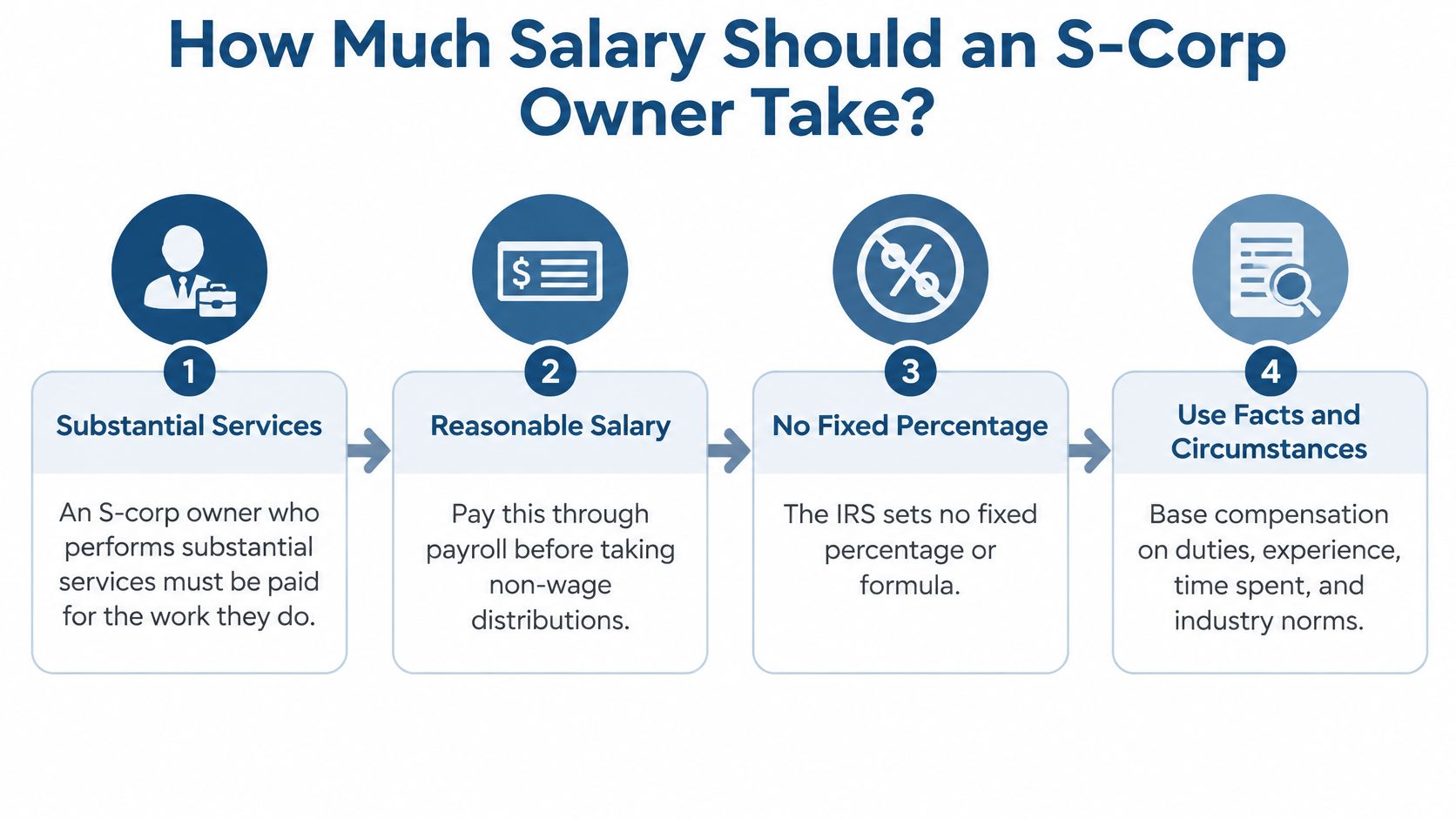
Follow these steps in order:
- Adopt a written policy: State how you'll set and review salary, because payroll needs a documented basis.
- Evaluate the job: Compare duties, hours, experience, market pay, location, and non-owner staff pay, because those facts support the number.
- Run payroll: Pay through payroll with Form W-2 reporting and required deposits, because a salary that isn't processed as wages isn't payroll compensation.
- Reconcile the books: Match payroll to the corporate records, because reconciliation shows whether cash and filings agree.
- Distribute last: Pay shareholder distributions only from available cash and stock basis, because distributions shouldn't fund cash the company needs for taxes or creditors.
Our detailed breakdown of reasonable compensation factors for S-corp owners goes deeper on documenting that range. For owners setting up the governing document, By Design Law's S corp operating agreement guide is a useful reference on putting roles and approvals in writing.
A zero-salary approach without documentation is a recurring risk. A salary set too high, by contrast, can reduce cash flexibility and lock the company into payroll it can't sustain in a slow period. Common failures include distributions while payroll is delinquent, confusing profit with distributable cash, and not tracking basis.
Keep compensation comparisons, role descriptions, payroll records, approvals, and cash-flow projections in one file. The S-corporation election is generally worth modeling once net profit is consistently above roughly $40,000 to $60,000 a year, depending on your circumstances.
How Much Cash Should You Hold Back Before Paying Yourself?
Taking less cash doesn't lower tax for a disregarded or partnership-taxed LLC, because tax follows net profit. Your decision is how much cash must stay behind before any transfer. Set that reserve first, then pay yourself from what's left.

The IRS self-employment tax guidance lists the federal rate at 15.3%, consisting of 12.4% for Social Security and 2.9% for Medicare. For 2026, the Social Security wage base is $184,500, and the Social Security component applies only up to that limit while Medicare applies to all covered net earnings. An additional 0.9% Medicare tax may apply above $200,000 for single filers or $250,000 for married couples filing jointly. These amounts apply to the years stated and adjust annually.
Profit Is Not the Same as Cash
Say a contractor has $400,000 in annual revenue but a slow quarter with late receivables and prepaid materials. The books may show taxable profit while the bank account can't support a normal draw. That's why timing matters:
- Monthly cash-flow review: Catches collection problems early, but doesn't replace a tax projection.
- Quarterly tax projection: Aligns reserves with estimated payments, but can miss a sudden cash crunch.
- Year-end profit review: Confirms final numbers, but it's too late to rebuild a reserve.
This short video walks through the reserve-first approach before an owner transfer.
Federally, the IRS estimated tax guidance says individuals, including sole proprietors, partners, and S corporation shareholders, generally must make estimated payments when they expect to owe at least $1,000 when filing. Estimated tax can cover federal income tax and self-employment tax for the applicable tax year.
New York State is separate. New York's estimated tax resource center explains that a nonresident with New York-source business income may need New York estimated payments, and New York partnerships and S corporations generally use Form IT-2658 for nonresident owners. Say a restaurant owner lives in New Jersey and operates in New York. Both personal estimates and entity-level payments may need review.
Build the reserve in four steps: list expected net profit, estimate federal and state liability, compare it with withholding, then set aside a fixed amount monthly. This planning fits owners whose income moves year to year, people surprised by a balance due in April, and people whose situation changed through a sale, a new state, a large bonus, or a first profitable year.
Which Records Keep Owner Payments Defensible?
Keep a separate business account and classify every owner transfer as a draw, distribution, salary, guaranteed payment, or reimbursement. The category drives the tax treatment. If the books can't show which category applies, the return preparer has to reconstruct intent from bank lines, and that reconstruction is where errors start.
For a single-member LLC, IRS Publication 3402 supports this workflow:
- Maintain a separate account: Keep business activity out of personal banking.
- Record equity draws: Book each transfer as an owner draw, not an expense.
- Confirm the reserve exists: Leave cash for operations, estimated taxes, and upcoming liabilities.
- Calculate taxable profit: Use the books, not the amount withdrawn.
- Report correctly: File business activity on Schedule C and self-employment tax on Schedule SE.
The owner of a disregarded single-member LLC generally isn't an employee of that LLC, so a W-2 for the owner is normally inappropriate under that classification. Treating withdrawals as deductible wages distorts profit. Owners who need help keeping monthly coding current can review the bookkeeping support from GRIT Virtual Assistants as one way to maintain clean records.
Monthly bookkeeping is the practical minimum if you make estimated tax payments, borrow, or plan around profit.
Common Owner-Pay Problems and Fixes
| Problem | Likely cause | Fix |
|---|---|---|
| Personal spending in the business account | Transfers not recorded as owner draws | Record each transfer as an equity draw and reconcile monthly |
| Profit looks wrong at tax time | Owner withdrawals booked as expenses | Reclassify them as draws and recalculate net profit |
| Salary looks too low for the role | No written compensation analysis | Document duties and comparable pay, then adjust payroll |
| Distributions taken while payroll is behind | Payroll reconciliation skipped | Catch up payroll filings and deposits before any distribution |
| Cash short for tax payments | Draws set without a reserve | Hold an estimated-tax reserve before each transfer |
Retain payroll records, compensation comparisons, reimbursement notes, and a monthly reconciliation of the owner equity account. Reconcile that account before tax season, not after the return is due.
Confirm Your Owner Pay Plan Before Year-End
Every owner transfer is really two decisions: how the cash moves and how the profit gets reported. Confirm both before your next transfer, along with your federal tax classification and the tax reserve you hold back first. A plan you can state in one page beats a year of guessing.
Start with your last filed return or any election on file, such as Form 8832 or Form 2553. Then write down the pay method, the monthly reserve for taxes and payroll, and the amount you may transfer after that reserve is held. That sequence keeps cash decisions and tax reporting aligned as income changes.
If you're taxed as an S corporation, document reasonable compensation before setting salary. Blue Sage Tax and Accounting Inc. can help S-corp owners with payroll setup and quarterly filings, or review an existing payroll provider, and the service includes a reasonable compensation analysis documented in writing.
Schedule the quarterly review now. A pay plan set in January may not fit September cash or profit, especially after a strong quarter or a slow one. Schedule a consultation call to review your pay plan before year-end.
This article is general information and not tax advice for your specific situation.
If your owner pay method, payroll salary, or tax reserve doesn't match your current classification and cash flow, Blue Sage Tax & Accounting Inc. can review the structure, model the numbers quarterly, and document the plan before year-end. The firm handles S-corporation compliance, partnership reporting, bookkeeping, and multi-state owner tax planning.