Which structure leaves more money with the owners, a partnership or an S corporation? Neither one carries its own federal income tax rate. Both pass business profit through to the owners' personal returns, and in most closely held companies both sit on top of the same LLC. What separates them is narrower and more practical: how the working owner gets paid, how much freedom the owners have to split profit unevenly, and how much filing and payroll work the business absorbs every year. Those three items decide the answer far more often than the headline tax treatment does.
Table of Contents
- Is a Partnership or S Corp Better for Your Business?
- How Do Partnership and S Corp Taxes Compare?
- Do S Corp Owners Pay Themselves a Salary?
- Can Partners Split Profits Differently Than Ownership?
- Which Returns and Filings Does Each Structure Require?
- Which Structure Fits Your Business Situation?
Is a Partnership or S Corp Better for Your Business?
A partnership generally suits owners who want flexible profit sharing and accept self-employment tax on an active partner's share of profit. An S corporation generally suits an owner who works in the business, can support reasonable W-2 wages and will run payroll on a schedule. Both pass business profit through to the owners' personal returns, so the entity label rarely settles the question by itself.
Everything below is federal unless a state is named. New York State and New York City rules appear only where they add a filing or change the arithmetic, and thresholds, deadlines and dollar amounts adjust annually, so confirm the figures for the tax year you're filing.
The partnership regime is mainstream, not a niche for two-person shops. IRS Statistics of Income data for tax year 2022 show partnerships filed more than 4.5 million Forms 1065, a 0.7% increase from 2021, and LLCs made up 72.7% of partnership returns. Real estate and rental businesses accounted for roughly 50.7% of all partnerships. In other words, most owners who use partnership taxation chose a classification on top of an LLC, not a different legal entity.
The three questions that decide it
- How does the working owner get paid? Wages through payroll, or a distributive share exposed to self-employment tax.
- Can profit be split unevenly? By agreement, within economic-effect rules, or strictly by stock ownership.
- What does compliance cost in hours? One information return, or that return plus payroll, withholding deposits and W-2s for the owner.
Answer those three questions, and the choice usually makes itself.
How Do Partnership and S Corp Taxes Compare?
Neither structure pays a separate federal income tax on business profit. The differences lie in how an owner's share of profit is taxed, whether owners can allocate profit differently from ownership, and who is allowed to own the business at all.
| Factor | Partnership | S corporation |
|---|---|---|
| Entity-level federal income tax | Generally none; income passes through to partners | Generally none; income passes through to shareholders |
| Owner's share of profit | Active partner's share generally subject to self-employment tax | Reasonable W-2 wages subject to payroll tax; non-wage distributions follow the rules |
| Profit allocation | Set by the partnership agreement, subject to economic-effect rules | Follows stock ownership |
| Classes of ownership | Flexible; the agreement can define multiple arrangements | Only one class of stock |
| Owner eligibility | Few statutory limits on who can be a partner | Generally no more than 100 shareholders; no partnerships, corporations or most nonresident aliens |
| Distributions | Governed by the partnership agreement and capital accounts | Generally proportional to stock ownership |
Notice what the table doesn't contain: a tax rate row. Because income lands on the owners' returns either way, the decision turns on what owners pay themselves and how profit moves between them, which is the heart of how partnerships are taxed.
The bottom half of that table is where deals break. The IRS analysis of Subchapter S eligibility confirms the restrictions: generally no more than 100 shareholders, only one class of stock, and no ownership by partnerships, corporations or most nonresident aliens. Meanwhile a partnership agreement can define multiple ownership and distribution arrangements, subject to tax rules.
Say two co-founders start a business. One puts in $200,000 of savings, the other puts in $20,000 and full-time work. The cash founder wants her capital back with a preferred return before any split. A partnership agreement can express that order of operations. An S corporation cannot, because both founders hold identical stock with identical economic rights.
Read the table as a filter, not a scorecard. If any row is a hard no for your ownership group, the decision is finished before the tax math starts.
Do S Corp Owners Pay Themselves a Salary?
An active partner's share of profit generally falls under self-employment tax. An S corporation shareholder-employee who provides more than minor services must take reasonable W-2 wages before any non-wage distribution. That is not a choice between a taxed structure and an untaxed one.

The IRS guidance on officer compensation states the position plainly: shareholder-employees providing more than minor services are employees for federal employment-tax purposes, and reasonable compensation must be paid before non-wage distributions. The Service can reclassify distributions as wages when they replace pay for services, so a token salary paired with large distributions invites a question the owner has to answer with evidence.
How to build a defensible salary
- Split profit by source. Separate what the owner's own services generate from what employees, equipment and invested capital generate.
- Document the role. Write down actual duties, weekly hours and the share of revenue the owner personally produces.
- Benchmark against the market. Compare that role with pay for similar work in the same industry and location.
- Run it through payroll every period. Consistent deposits plus a written record hold up far better than a number picked in April.
The payroll mechanics are where owners get caught, so it's worth seeing the sequence once before you set yours.
Take a general contractor with $400,000 in revenue who runs three crews, prices every job and handles the inspections. The owner's pay has to reflect that work, not a number chosen to minimize payroll tax. The same logic applies to a restaurant owner who covers the line three nights a week and to a dentist producing most of the practice's collections.
An improperly low salary creates audit and reclassification risk, and the S corporation adds recurring payroll filings and withholding responsibilities on top. Our S-corporation work includes a reasonable compensation analysis documented in writing, which is what turns a reasonable compensation position into something defensible rather than an assertion.
Can Partners Split Profits Differently Than Ownership?
Yes, within limits. A partnership can generally allocate profit and loss in percentages that differ from capital ownership, but only when the allocation has real economic consequences. An S corporation can't do it at all, because a single class of stock forces income and loss to follow share ownership.
The IRS working paper on partnership allocations frames the requirement as economic effect and substantiality. In plain terms, the allocation has to change what a partner can receive or bear, measured through book capital accounts and what happens on liquidation, and the result has to be substantial apart from its tax effects.
A three-owner example
Say three people form an LLC taxed as a partnership to run a fabrication shop. One contributes the machines, one contributes cash and expects a preferred return before anyone splits residual profit, and one contributes management time and brings in the customers. Preferred returns, targeted allocations and different capital account balances can all express that arrangement, and they should be written to match the deal the three of them struck. Put the same three people into an S corporation and the structure flattens them into identical shares.
The test in one line: if an allocation doesn't change what a partner walks away with in a liquidation, it doesn't change the tax result either.
An S corporation is simpler when ownership and profit sharing are proportional, because the standardized rules cut drafting and tracking work. Before choosing, model five things, not just the projected tax items.
- Capital account maintenance, including how contributed property gets booked.
- Liability allocation, since how debt is shared affects what each owner can deduct.
- Distribution timing, and whether the agreement requires tax distributions.
- Buyout terms for an owner who leaves, retires or dies.
- Multi-state reporting in every state where the business has nexus.
Partnership flexibility is real, but it depends on how capital is contributed and documented. A handshake split that never reaches the capital accounts creates problems no agreement language can fix later.
Which Returns and Filings Does Each Structure Require?
Both structures file an entity-level return plus owner-level reporting, and an S corporation adds W-2 payroll filings for shareholder-employees. New York layers its own entity returns on top of both.
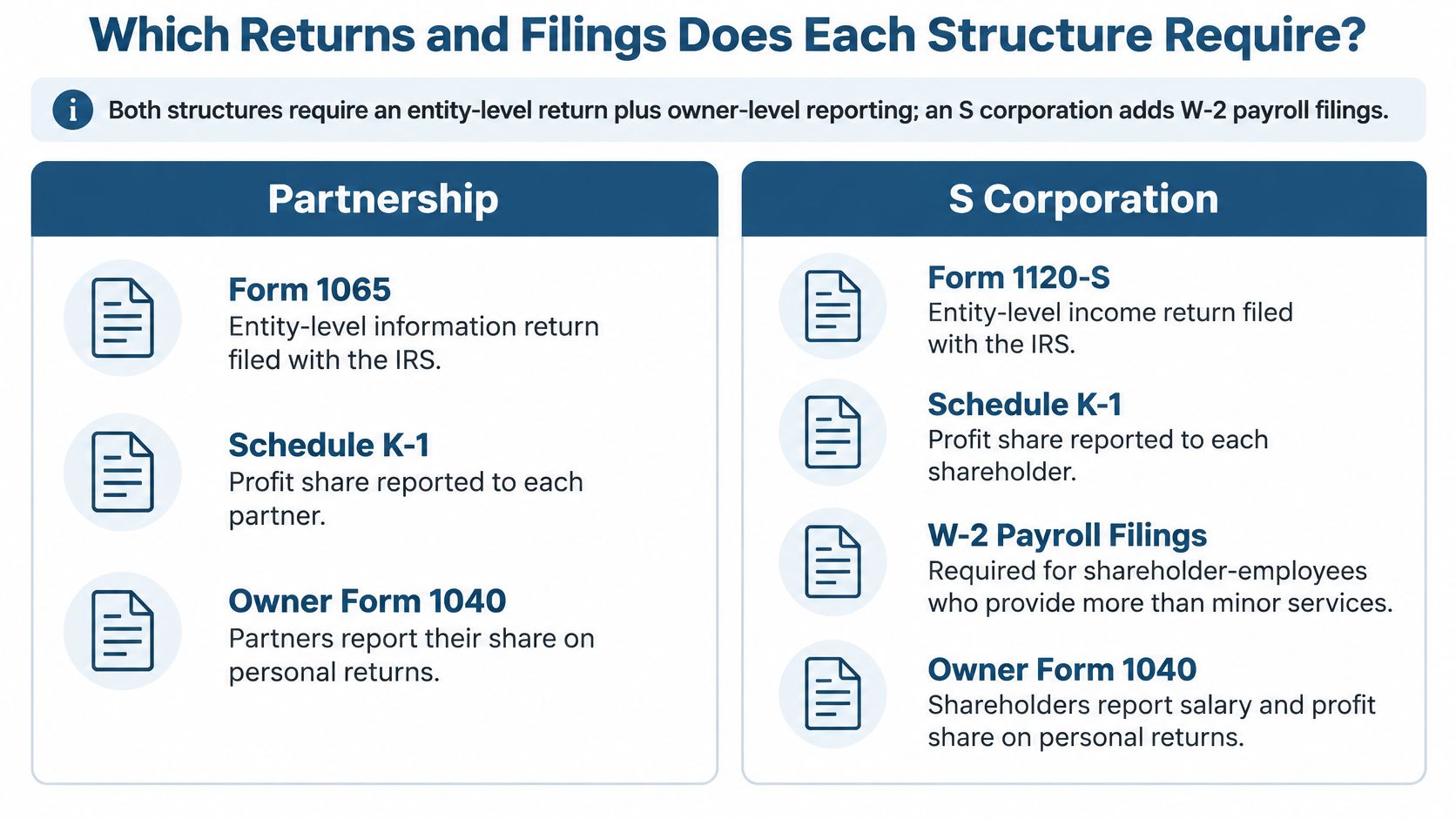
A partnership files Form 1065, which is generally an information return rather than an entity-level income tax return, while an S corporation files Form 1120-S and passes its taxable items to shareholders, as the IRS S corporation overview describes.
| Obligation | Partnership | S corporation | New York S corporation |
|---|---|---|---|
| Federal entity return | Form 1065 information return | Form 1120-S | Federal Form 1120-S filed with the New York return |
| Owner reporting | Schedule K-1 to each partner | Schedule K-1 to each shareholder | Schedule K-1 to each shareholder |
| Payroll | Generally none for active partners | W-2 wages and withholding for shareholder-employees | W-2 wages and withholding for shareholder-employees |
| New York entity return | Form IT-204 partnership return | Form CT-3-S | Form CT-3-S with Form CT-34-SH attached |
The New York column reflects a state rule, not a nationwide one. The New York Department of Taxation and Finance states that a New York general business S corporation files Form CT-3-S instead of the regular CT-3 return once New York S treatment applies, and the current CT-3-S materials require the federal Form 1120-S as filed plus Form CT-34-SH to be filed or attached. A federal pass-through election does not remove the state filing.
The bigger workload difference sits in payroll, not the annual return. A partnership's filing burden is mostly Form 1065 and its K-1s once a year. An S corporation adds quarterly payroll filings, year-end W-2s and a written reasonable compensation analysis behind the salary, which is ongoing work that has to stay current every quarter, not a once-a-year task.
Multi-state operations multiply the count further. A catering company with three kitchens in Queens and a commissary in New Jersey has to sort residency, allocate income to each state and claim credits for taxes paid elsewhere, and which returns are required follows from those facts. New York City filings apply where the business has nexus, and New Jersey runs its own rules that need checking for the year in question.
Before filing season, answer three questions: which states create nexus, who receives a K-1, and whether payroll for owner-employees is already set up. Our S-corporation service covers Form 1120-S preparation and e-filing for federal and state, payroll setup and quarterly filings or a review of your existing provider, and multi-state and New York City filings where nexus exists.
Which Structure Fits Your Business Situation?
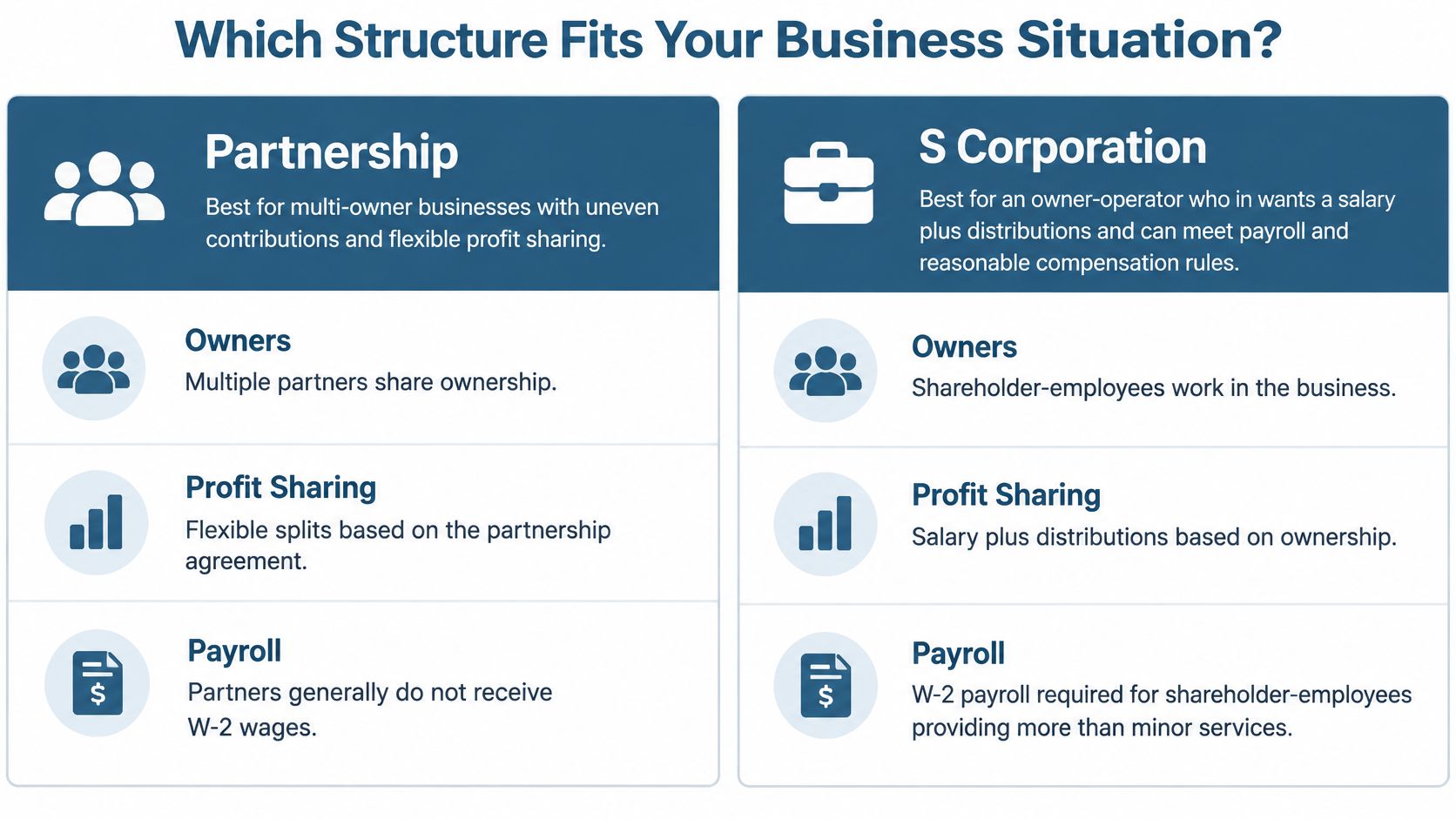
Three things settle this choice faster than the headline tax treatment: how the owners get paid, how profits split when contributions are uneven, and whether cash arrives before the tax bill does. A partnership generally fits multi-owner businesses with uneven capital and flexible profit sharing. An S corporation generally fits an owner-operator whose profit is steady enough to support reasonable W-2 wages and the payroll that goes with them.
The election is generally worth modeling once net profit sits consistently above roughly $40,000 to $60,000 a year. Below that, payroll cost and administrative work tend to eat the gap. Treat the range as a starting screen, then run your own numbers for the year ahead.
Three situations, three answers
A restaurant with two partners who put in different amounts of capital and want the cash investor repaid first points toward a partnership. The agreement carries the deal: a preferred return pays the cash investor back first, and the owners keep the ability to revisit splits as roles change.
A real estate investor holding rentals with several co-investors lands in partnership territory for the same reason. Uneven capital, preferred returns and changing investor lineups are exactly what the partnership rules handle. The S corporation's single-class-of-stock rule cannot replicate that flexibility, because the flexibility comes from how capital was contributed in the first place.
A trucking owner-operator who drives, dispatches and bids freight, with profit that has held steady for a few years, is the classic S corporation candidate: a documented salary, distributions above it, payroll running on schedule.
Pass-through taxation doesn't wait for the bank account. An owner can owe tax on profit the business kept for equipment, inventory or debt service.
Owner-operators get hurt most often in that gap, when the return shows profit the bank account never saw. The IRS pass-through explainer confirms the mechanism: partnerships and S corporations generally don't pay federal income tax at the entity level, so income reaches the owners' returns whether or not cash moves. Project distributions and estimated payments month by month, and put a written distribution policy in place before the first shortfall.
Readers still deciding whether to formalize a business at all face the setup question first, and a guide on registering as a sole trader is a reasonable starting point there. Once an entity exists and the profit is real, the owner-pay and allocation questions take over. Our tax planning includes an entity structure review and election modeling built on your actual numbers.
Blue Sage Tax & Accounting Inc. handles both sides of this decision: Form 1065 and Schedule K-1 packages for partnerships, and Form 1120-S with a documented reasonable compensation analysis for S corporations. If you're weighing an election for the coming year, we'll model it against your real profit, ownership and state footprint before you commit. Visit Blue Sage Tax & Accounting Inc. and book a consultation call today.
This article is general information and not tax advice for your specific situation.