A restaurant partner can receive a Schedule K-1 showing taxable income while having little or no cash in hand. Partnership accounting explains how the business calculates income, tracks each partner's capital and basis, allocates tax items, and reports those results through Form 1065 and Schedule K-1. For U.S. federal income tax, the partnership generally isn't taxed as a separate entity. Instead, partners report their distributive shares on their own returns, whether or not the partnership distributed cash.
Table of Contents
- What Partnership Accounting Actually Means for Your Business
- How Capital Accounts, Profit Allocations, and Guaranteed Payments Work
- Why Partner Basis Tracking Determines Your Tax Outcome
- How Tax Basis Versus Book Basis Can Affect Section 704 Rules
- Filing Form 1065 and Understanding Your Schedule K-1
- How Do Multi-State Partnerships Handle Compliance Pitfalls?
What Partnership Accounting Actually Means for Your Business
Partnership accounting is the system that connects the partnership's books to each partner's individual tax return. Under federal Subchapter K, a partnership generally isn't taxed as a separate entity. It files an information return, Form 1065, and passes income, deductions, gains, losses, and credits through to the partners, who report their separate shares. The statutory framework appears in 26 U.S.C. Subchapter K.
Consider a Queens restaurant owned by three partners. The restaurant may use its cash to purchase food, pay employees, repair equipment, and build a reserve for rent. At year-end, the partnership still calculates each owner's distributive share of taxable income under the partnership agreement. If the partners' agreement allocates income to one partner, that partner may owe federal tax on the reported share even if the partnership didn't distribute the corresponding cash.
That result often feels wrong to owners because they naturally think in terms of money received. Tax reporting asks a different question: what share of the partnership's taxable items belongs to each partner?

Why the partnership return matters
The partnership return is not just a tax bill for the entity. It provides the framework for calculating the partnership's taxable income and separately stating items that partners may need to report differently on their individual returns. The IRS describes Schedule K as the summary of the partners' shares, while each Schedule K-1 reports one partner's separate share. You can review the IRS overview of partnership tax filing and pass-through reporting.
The partnership agreement is central because it generally determines a partner's distributive share, subject to applicable tax rules. That means the accounting records must do more than show total sales, expenses, and net income. They must show how those results belong to specific partners.
Practical rule: A partnership's cash ledger, capital accounts, tax basis schedules, and K-1 allocations should tell the same story, even though they won't always show identical numbers.
A partner can therefore face several separate questions at once:
- How much did the business earn?
- How much income was allocated to that partner?
- How much cash was distributed?
- How did the partner's capital account change?
- How much adjusted basis remains available for losses or distributions?
Confusing those questions is one of the fastest ways to misunderstand a K-1.
How Capital Accounts, Profit Allocations, and Guaranteed Payments Work
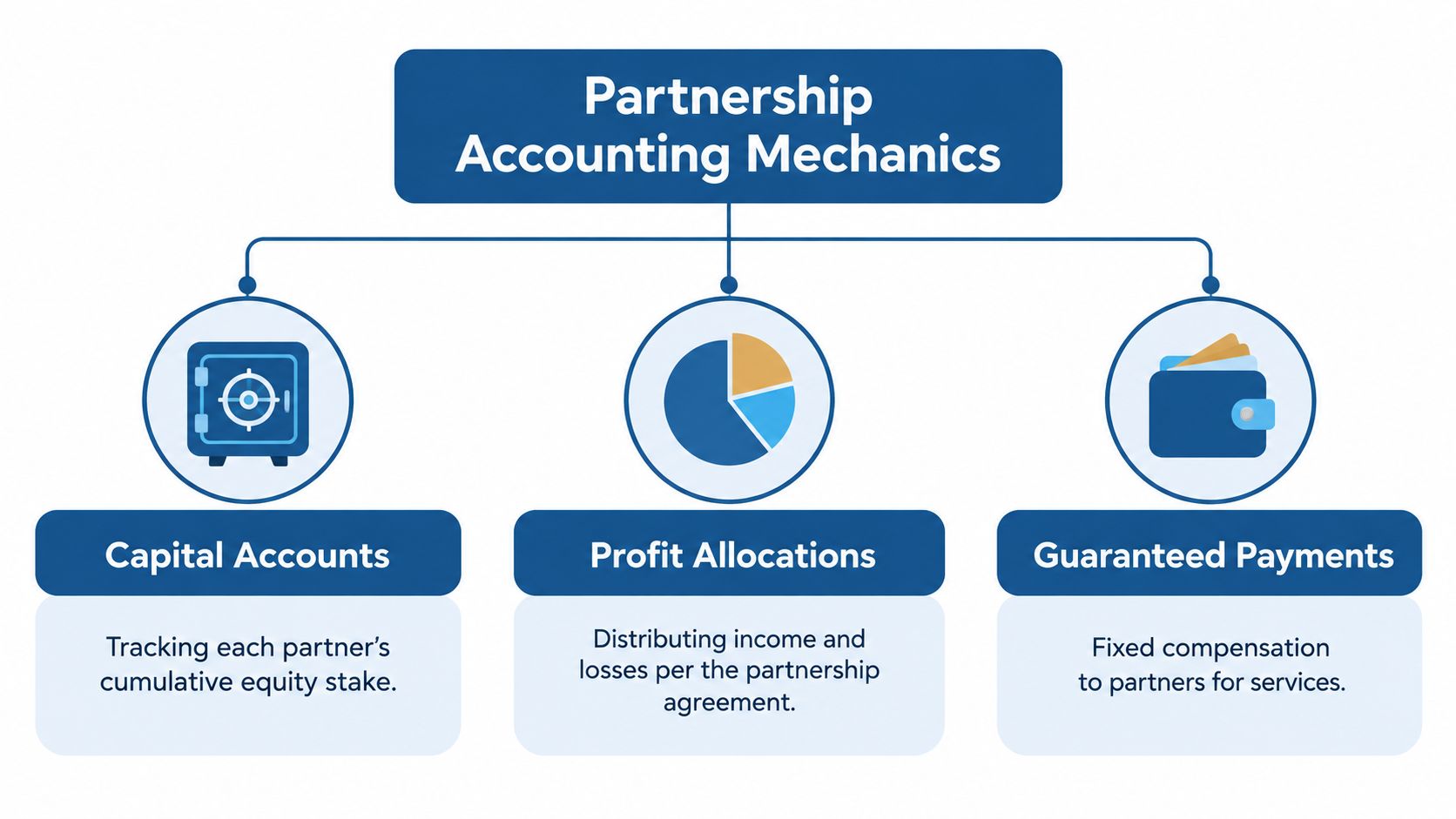
Capital accounts, profit allocations, and guaranteed payments are separate parts of partnership accounting. A capital account records a partner's economic investment, allocations assign the partnership's results, and guaranteed payments record amounts provided under the agreement for a partner's services or use of capital. These items affect one another, but each answers a different accounting question.
Capital accounts show the running equity picture
A capital account generally begins with what a partner contributes. It then changes as the partnership records income or loss, makes distributions, or processes other transactions affecting the partner's economic interest.
Consider a contractor partnership with two owners. One contributes cash and equipment. The other contributes substantial labor and manages projects. Their capital accounts can develop differently because contributions, profit allocations, and distributions may follow different proportions under the agreement.
The account also differs from the cash in the business bank account. The partnership may retain earnings, buy equipment, repay debt, or distribute cash unevenly. A capital account is a running record of economic position, so its balance does not necessarily show what the partner can withdraw today.
Profit allocations follow the agreement
The partnership agreement should explain how ordinary business income, separately stated items, and losses are assigned. Federal rules generally require the partnership to compute taxable income in a manner similar to an individual while separately stating income, deductions, credits, and other items that may receive partner-level treatment. Those amounts then flow to the partners under the agreement and applicable rules, including Section 702, as described in 26 C.F.R. Section 1.703-1.
For the contractor partnership, one owner might receive a fixed payment for managing projects, with remaining profit divided according to the negotiated ownership arrangement. The accounting team must classify each payment correctly. Recording every transfer as an “owner draw” can obscure whether the amount was compensation, a guaranteed payment, a distribution, or an allocation.
State filings add another layer. A restaurant partnership may allocate income among owners under its agreement while also tracking where business activity occurred for state reporting. Clean records should connect the agreement, books, federal return, and state schedules without treating one allocation formula as a substitute for every jurisdiction's rules.
Guaranteed payments need separate attention
A guaranteed payment is generally an amount the partnership agreement provides to a partner for services or the use of capital. It is handled separately from the partner's share of residual profit, which can affect how the amount appears on the partnership return and the partner's information statement.
The partnership should document:
- The agreement: What service or capital arrangement supports the payment?
- The timing: When did the partner become entitled to it?
- The allocation: How does it affect the partnership's remaining income?
- The reporting: Where should the amount appear on the partnership return and the partner's information statement?
A contractor who receives regular compensation for managing field crews may have a different tax profile from a partner who receives only residual profits. The partnership should model both arrangements before signing the agreement, then make sure the bookkeeping reflects the signed terms throughout the year.
The practical distinction is recorded in the transaction's purpose. A distribution transfers value to a partner, while an allocation assigns a tax or economic result. Either may occur without the other, so bookkeeping entries must preserve both the cash movement and the result assigned to each partner.
Why Partner Basis Tracking Determines Your Tax Outcome
Partner basis is the tax measurement that helps determine whether allocated losses are currently deductible and how later distributions or property transfers are treated. It starts with the partner's adjusted basis at the beginning of the partnership year, which the IRS says equals the partner's ending adjusted basis from the prior year. Contributions and allocated income generally increase the account, while distributions and allocated losses generally reduce it, subject to the applicable rules.
The IRS requires partnerships to report beginning and ending capital accounts using the tax-basis method. The reported changes include contributions, current-year net income or loss, withdrawals and distributions, and other increases or decreases determined consistently with partnership basis rules, as explained in the Schedule K-1 instructions.
Why a loss may not be deductible immediately
A construction partnership can allocate a loss to a partner who owns part of the business. That allocation doesn't automatically mean the partner can deduct the entire amount on the individual return. If the partner lacks sufficient adjusted basis, the loss may be limited or carried forward under the relevant limitation rules.
The practical review starts with the prior year's ending basis and then follows every change:
- Contributions and additional investments may increase basis.
- Allocated income and gain may increase basis.
- Cash or property distributions may decrease basis.
- Allocated losses and deductions may decrease basis.
- Partnership liabilities may affect a partner's basis depending on how the liability is allocated.
The final item is where many owners need help. A business loan shown on the partnership's books isn't automatically added to every partner's outside basis. The allocation depends on the liability rules and the partner's economic relationship to the debt.
Outside basis and inside basis are different records
Outside basis belongs to the partner's interest in the partnership. Inside basis generally refers to the partnership's tax basis in its assets. They connect, but they aren't the same number.
If a construction partnership buys a truck, the partnership tracks its tax basis in that truck. A partner separately tracks basis in the partnership interest. When the partnership borrows money, repays the loan, distributes property, or changes how liabilities are allocated, both sets of records may need review.
A partner who sees a loss on a K-1 but can't use it should ask for the basis schedule, not just the income statement. The same schedule can help explain why a cash distribution may be tax-free in one situation but may create gain in another.
For a focused explanation of the distinction, see this resource on inside basis versus outside basis. The key habit is to reconcile basis every year rather than recreate it when a partner sells an interest or receives a large distribution.
How Tax Basis Versus Book Basis Can Affect Section 704 Rules
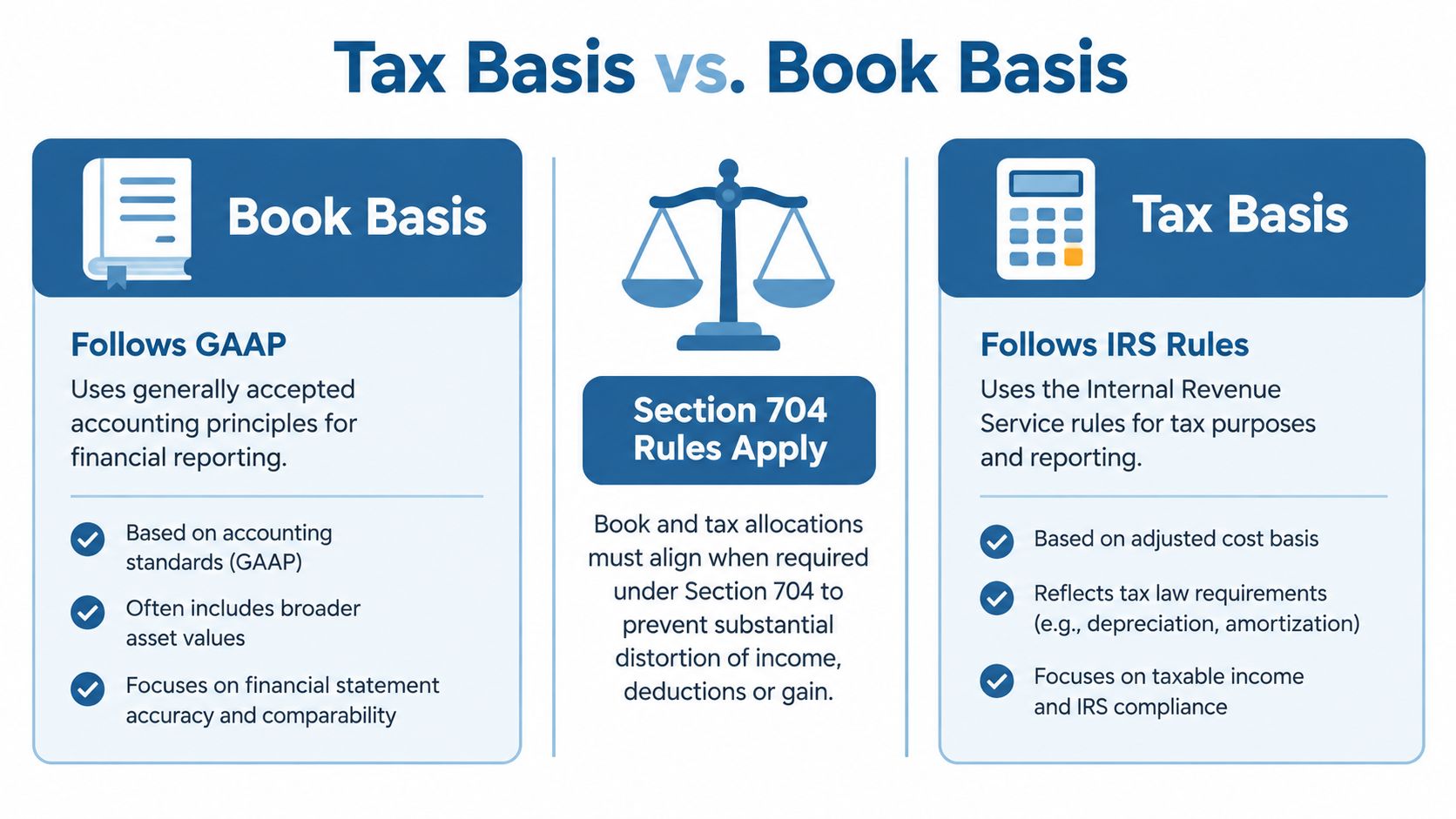
Book basis tracks financial reporting value, while tax basis follows federal rules used to calculate taxable income, gain, loss, and partner basis. Those records often diverge for the same asset. Section 704 rules become important when allocations must match the partners' economic arrangements, especially when property enters the partnership with a gap between its book value and tax basis.
A contributed building creates two stories
A restaurant owner contributes a building to a real estate partnership. The building's current economic value may differ substantially from the contributing partner's tax basis. The partnership must record that property for financial reporting and tax reporting, with schedules that preserve each value and explain the difference.
Book records may reflect the partnership's agreed economic value. Tax records preserve the relevant tax basis. Future depreciation, gain, and loss allocations then require careful tracking so appreciation or decline from before the contribution is assigned to the appropriate partner.
Section 704(b) and Section 704(c) analysis may apply. The partnership agreement, capital accounts, asset valuation, and allocation method should be reviewed together. A contractor who contributes appreciated equipment, for example, could receive an inaccurate result from a simple percentage split that ignores the property's history.
Accounting checkpoint: Ask whether the partnership tracks the asset's economic value, tax basis, and pre-contribution difference in separate but reconciled schedules.
Book and tax differences also arise from accounting methods, depreciation methods, timing, and other reporting choices. Partnerships choose their accounting and depreciation methods, so the tax preparer needs the underlying records, not only a trial balance. A partnership operating in several states should also identify which records support each jurisdiction's reporting position, since a clean federal reconciliation may still leave state filing questions. This guide to cash accounting and accrual accounting explains why revenue and expenses may appear in different periods under different accounting methods.
Partnership audit administration adds another layer. The centralized partnership audit regime enacted in 2015 generally provides for partnership-related adjustments to be determined, assessed, and collected at the partnership level. Form 1065 and Schedule K-1 continue to report partner capital and income, while an audit adjustment can require coordinated decisions by the partnership and its partners under the centralized partnership audit provisions.
Filing Form 1065 and Understanding Your Schedule K-1
A restaurant partnership can finish its books, divide the year's profit, and still produce incorrect partner tax reporting if its capital accounts, basis schedules, and allocation records do not agree. Form 1065 reports the partnership's results, Schedule K summarizes those results, and Schedule K-1 reports each partner's separate share. The partnership generally does not pay federal income tax at the entity level. Instead, it gives each partner a K-1 for reporting on the partner's own return, as described in the IRS partnership filing guidance.
Several partners means several K-1s, not one shared tax statement. Each K-1 should reflect the partner's agreed allocation of income, deductions, credits, contributions, distributions, and other reportable items. Ownership percentage is only one part of the explanation. A special allocation, guaranteed payment, liability change, or difference between book and tax capital can change what appears on an individual K-1.
What to review before the return is filed
Begin with the partnership agreement and its financial records. The preparer needs the current agreement and amendments, ownership details, contributions, distributions, loan activity, asset purchases, and prior-year return. Changes in ownership or special allocations should be identified before preparation starts, because they can affect both the allocation schedule and each partner's basis.
Use this review:
- Partner data: Confirm legal names, addresses, taxpayer identification information, ownership changes, and admission or withdrawal activity.
- Capital activity: Reconcile contributions, distributions, withdrawals, allocations, and ending capital accounts.
- Debt records: Identify borrowing, repayments, guarantees, and changes in liability allocations.
- Asset records: Separate book values, tax basis, depreciation, and property contributed by partners.
- K-1 comparison: Compare every K-1 with the partnership agreement and final allocation schedule.
- Partner delivery: Confirm that every partner receives the correct K-1 and understands that reported income may not come with a matching cash distribution.
A contractor may receive taxable income on a K-1 while cash remains in the business for equipment or payroll. If that partner also works across state lines, the federal K-1 may be only the starting point for state reporting. The records behind the allocation should show how the result was calculated, rather than relying on a percentage copied from the ownership table.
The IRS instructions for 2025 K-1 reporting use the tax-basis method for beginning and ending capital accounts. Updated Form 1065 and Schedule K-1 instructions were released in January 2026, so older workbooks and checklists may not match current reporting expectations.
Deadlines and corrections require current instructions
Federal filing deadlines depend on the partnership's tax year and applicable filing rules. Confirm the current instructions and extension requirements for the specific return instead of reusing a prior-year calendar.
A corrected K-1 may require a partner to review and amend an individual return. Differences among the partnership return, K-1s, and partner returns can generate notices even when the business activity itself is legitimate. For investment structures, this guide to K-1 forms for syndicators provides additional context. Keep the Form 1065 and Schedule K-1 instructions with the year-end accounting file.
How Do Multi-State Partnerships Handle Compliance Pitfalls?
A partnership operating in more than one state may need separate state analysis, reporting, and basis tracking for each jurisdiction. A contractor working in New York and New Jersey can face obligations tied to where the business operates, earns income, owns property, or has other state connections. The federal K-1 doesn't replace state filings, and a federal allocation can't always be copied into every state return without review.
A contractor with $400,000 in revenue who performs jobs in both states should maintain records showing where services were performed, where equipment was used, where employees worked, and which expenses belong to each activity. The business may need to consider state income allocation, apportionment, withholding, sales or use tax, and partner-level reporting. The correct filing pattern depends on the facts and the current rules in each state.
Why state records should connect to the federal books
The partnership's federal capital and basis schedules are the starting point, not necessarily the final state answer. States may require adjustments to income, depreciation, credits, loss utilization, or partner information. A partnership that tracks only one blended result can lose the detail needed to prepare a defensible multi-state return.
A restaurant owner filing in two states may also have different issues from a contractor. The restaurant may need to separate location-based sales, payroll, rent, and equipment activity. A real estate partnership may need to track property-specific income, debt, distributions, and state basis adjustments.
Keep a state-by-state workpaper that identifies:
- Operating activity: Where services, sales, payroll, and property activity occurred.
- Partner residence: Where each partner lived during the relevant tax year.
- Allocation method: How income and separately stated items were assigned.
- State adjustments: Which federal amounts require a state modification.
- Filing status: Which partnership and partner returns may be required.
- Reconciliations: How state schedules tie back to federal capital and basis records.
The partnership should also review how debt and property distributions affect state reporting. Recent IRS guidance says new Section 752 regulations and Form 7217 reporting apply to liabilities incurred or assumed on or after December 2, 2024, and to tax years beginning in 2024. The IRS released updated 2025 Form 1065 and Schedule K-1 instructions in January 2026, making older explanations of liability and distribution reporting potentially outdated. Review the IRS guidance on the updated partnership forms and Section 752 regulations.
Common errors owners can prevent
A partnership may file the federal return correctly and still have trouble because state records weren't maintained with the same discipline. Common problems include copying federal income into a state return without checking state adjustments, missing activity in a secondary state, failing to update partner addresses, and treating a distribution as a simple cash event when property or debt is involved.
Blue Sage Tax & Accounting Inc. works with owners on partnership returns, K-1 preparation, basis tracking, and multi-state filings. A practical year-end process should include a federal reconciliation, state activity review, partner basis update, capital account reconciliation, and confirmation that the current-year instructions were used.
Blue Sage Tax & Accounting Inc. helps business owners prepare Form 1065 returns, coordinate Schedule K-1 reporting, track partner basis, and address New York and New Jersey filing issues before they become year-end surprises. Visit Blue Sage Tax & Accounting Inc. to discuss your partnership accounting and multi-state compliance needs, then Book your free consultation call today.
This article is general information and not tax advice for your specific situation.