
Multiple state tax filing is the obligation to file income tax returns in more than one U.S. state when you have nexus there through residency, work location, business activity, or property. The exact duty depends on resident versus nonresident status and where each dollar of income is sourced.
think the question is, “Do I file in two states?” Often, that's not the first problem. The issue is that a move, a remote employee, a rental property, or a job performed across state lines can create withholding, payroll, registration, and sourcing mistakes before anyone even gets to the return itself.
Table of Contents
- What Multiple State Tax Filing Actually Means
- When Do You Need To File In Multiple States
- How Income Is Sourced And Allocated Across States
- State Tax Credits And Reciprocity Rules
- Common Mistakes In Multi-State Filing
- State-Specific Rules For New York New Jersey And Connecticut
- Planning Strategies And Compliance Checklist
What Multiple State Tax Filing Actually Means
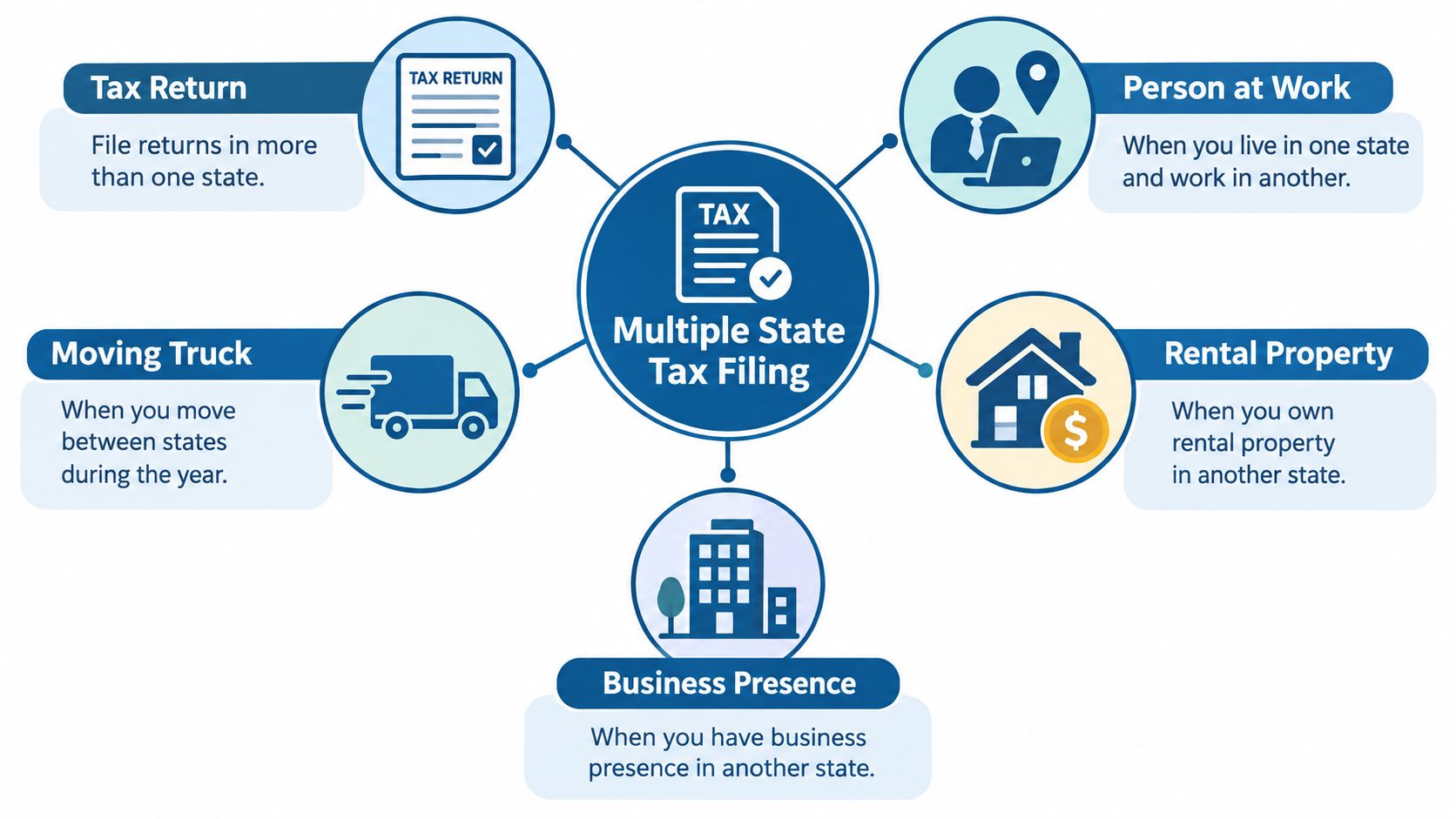
Multiple state tax filing means you may need to file income tax returns in more than one state because each state can tax income connected to that state. That connection is usually based on where you live, where you work, where your property sits, or where your business has enough activity to create nexus.
States don't use a single shared filing system. Once nexus exists, a state may tax only its fair share of income through apportionment, which is why multistate returns usually require separate registrations and a state by state sourcing analysis rather than one federal style filing (The Tax Adviser on nexus and apportionment).
What counts as a connection to a state
For an individual, the common triggers are straightforward:
- You lived there: Full-year residence or part-year residence usually creates a filing duty.
- You worked there: Wage income is often tied to where the work was physically performed.
- You owned income-producing property there: Rental income usually follows the property.
- You had business activity there: A sole proprietor, LLC owner, or S corporation shareholder may need filings in more than one state.
Practical rule: Think of each state as claiming a slice of your income for a different reason. One state may tax you because you live there. Another may tax you because you earned money there.
Why small business owners get tripped up
A contractor may live in New Jersey, perform jobs in New York, and own equipment stored in Pennsylvania. A restaurant owner may live in one state but operate payroll in another. A consultant may never rent office space outside a home state, yet still create filing obligations elsewhere because of employees, sales activity, or property.
That's why multiple state tax filing isn't just a “moved this year” issue. It's a how and where income was earned issue.
When Do You Need To File In Multiple States
You need to file in multiple states when your status or your activity gives more than one state a legal claim to part of your income. The usual starting point is whether you are a resident, part-year resident, or nonresident, then whether your work, property, or business operations created nexus in another state.
For businesses, physical presence isn't the whole story anymore. Many states use bright line factor presence standards, and a commonly cited threshold is $500,000 of in-state property, payroll, or sales, which can pull a business into filing even without a local office (SSRN paper on state corporate income tax compliance costs and nexus).
Resident, part-year resident, and nonresident
Here's the cleanest way to approach it.
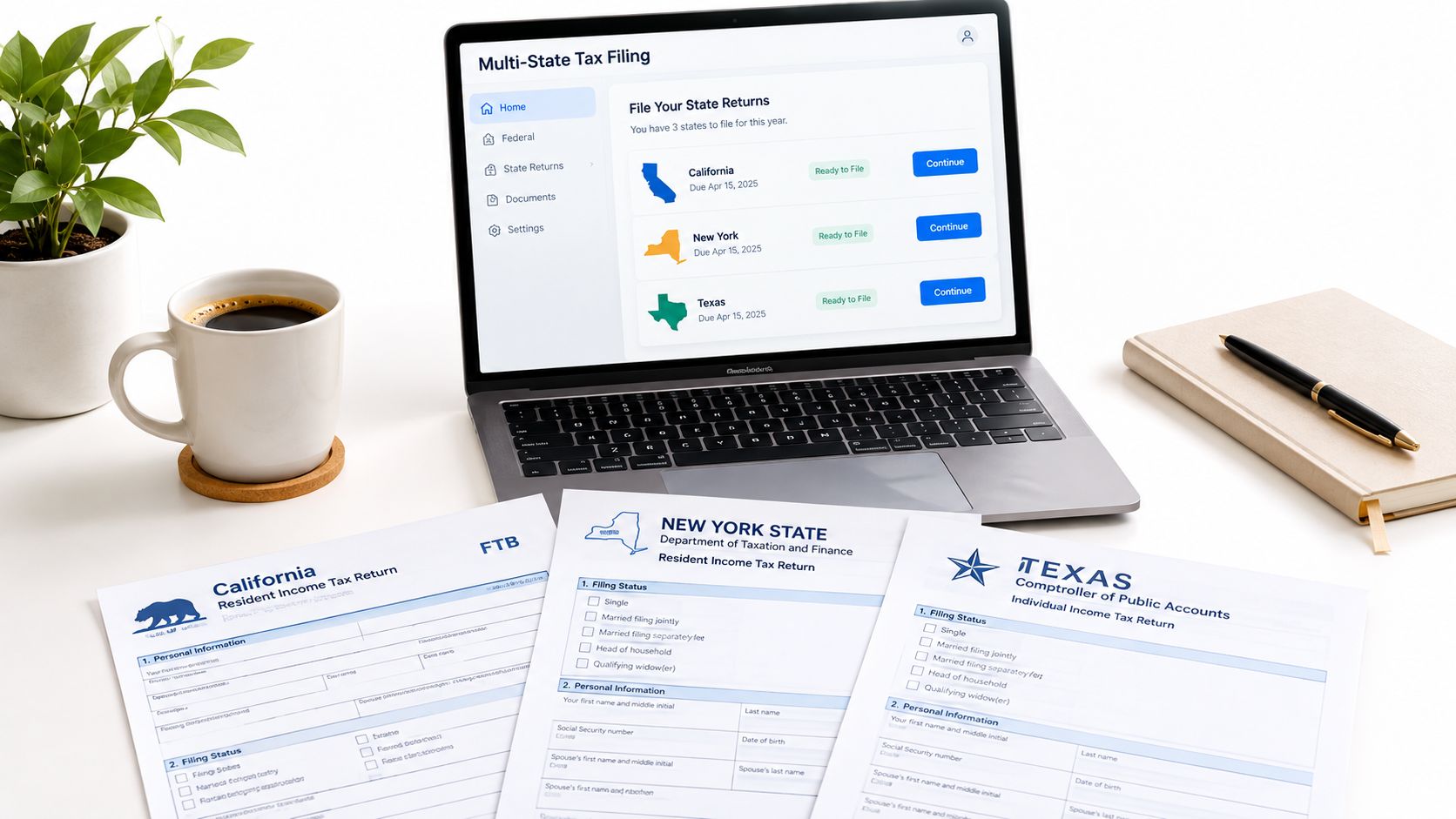
- Resident return: Usually reports your full income, subject to that state's rules.
- Nonresident return: Usually reports only income sourced to that state.
- Part-year resident return: Splits the year between resident and nonresident treatment.
That sounds simple until real life gets involved. If you moved midyear, your old state may still tax income earned while you were a resident there. Your new state may do the same for the rest of the year. If you also earned income in a third state, you may end up with three separate filing layers.
Common situations that trigger extra filings
A few realistic examples help:
- Contractor with $400,000 in revenue: If the contractor lives in one state, performs work in another, and has payroll or equipment in a third, the business and the owner may both have multistate issues.
- Landlord with one out-of-state rental: Even if the owner never moved, rental income can create a nonresident filing where the property is located.
- Remote service business with one employee across state lines: The employee's location may trigger payroll withholding and employer registration before anyone thinks about the annual return.
Many owners assume “I don't have an office there” ends the analysis. It often doesn't.
Sales tax is part of the bigger picture
If you sell remotely, state exposure can expand quickly. By 2021, 45 states and the District of Columbia enforced economic nexus rules for remote sellers, and a national review reported remote sales tax collections grew from $3.2 billion to more than $23 billion, a 621% increase (Zamp review of multi-state sales tax statistics). That figure is about sales tax, not income tax, but it shows the same broader trend. More states are asserting filing and remittance authority over out of state businesses.
How Income Is Sourced And Allocated Across States
States don't just ask whether you earned income. They ask where that income belongs. For wages and rentals, that usually means sourcing. For business income spread across multiple states, that often means apportionment.
If you miss this distinction, your return can be wrong even if you picked the right states.
Income types and typical sourcing rules
| Income Type | Typical Sourcing Rule |
|---|---|
| Wages | Usually sourced to the state where the work is physically performed |
| Rental income | Usually sourced to the state where the property is located |
| Business income from a multistate operation | Often divided under the state's apportionment formula |
| Pass-through income | Depends on the state's sourcing and entity rules |
Why apportionment changes the answer
Many states moved away from older equally weighted three factor formulas and toward sales heavy or single sales factor apportionment. Under these systems, the taxable share of business income depends on the ratio of in-state payroll, property, and or sales to total business factors, so remote employees, inventory, and customer location can materially change the state tax base (Journal of Accountancy on state apportionment formulas).
A small business owner feels this in practical ways:
- A remote employee may affect payroll factor.
- Inventory stored in another state may affect property factor.
- Customers located in another state may affect sales factor.
A simple business example
Say a consulting LLC is based in New Jersey. The owner works partly from New Jersey, has a remote employee in Connecticut, and serves clients in New York. The owner may think, “I run one business from one home office.”
The states may see it differently. One state may care about the employee. Another may care about customer sourced sales. A third may care about the owner's residency. That's why multiple state tax filing often starts with a mapping exercise, not with data entry.
Sourcing answers, “Which state gets this item of income?” Apportionment answers, “How much of the business income does each state get?”
State Tax Credits And Reciprocity Rules
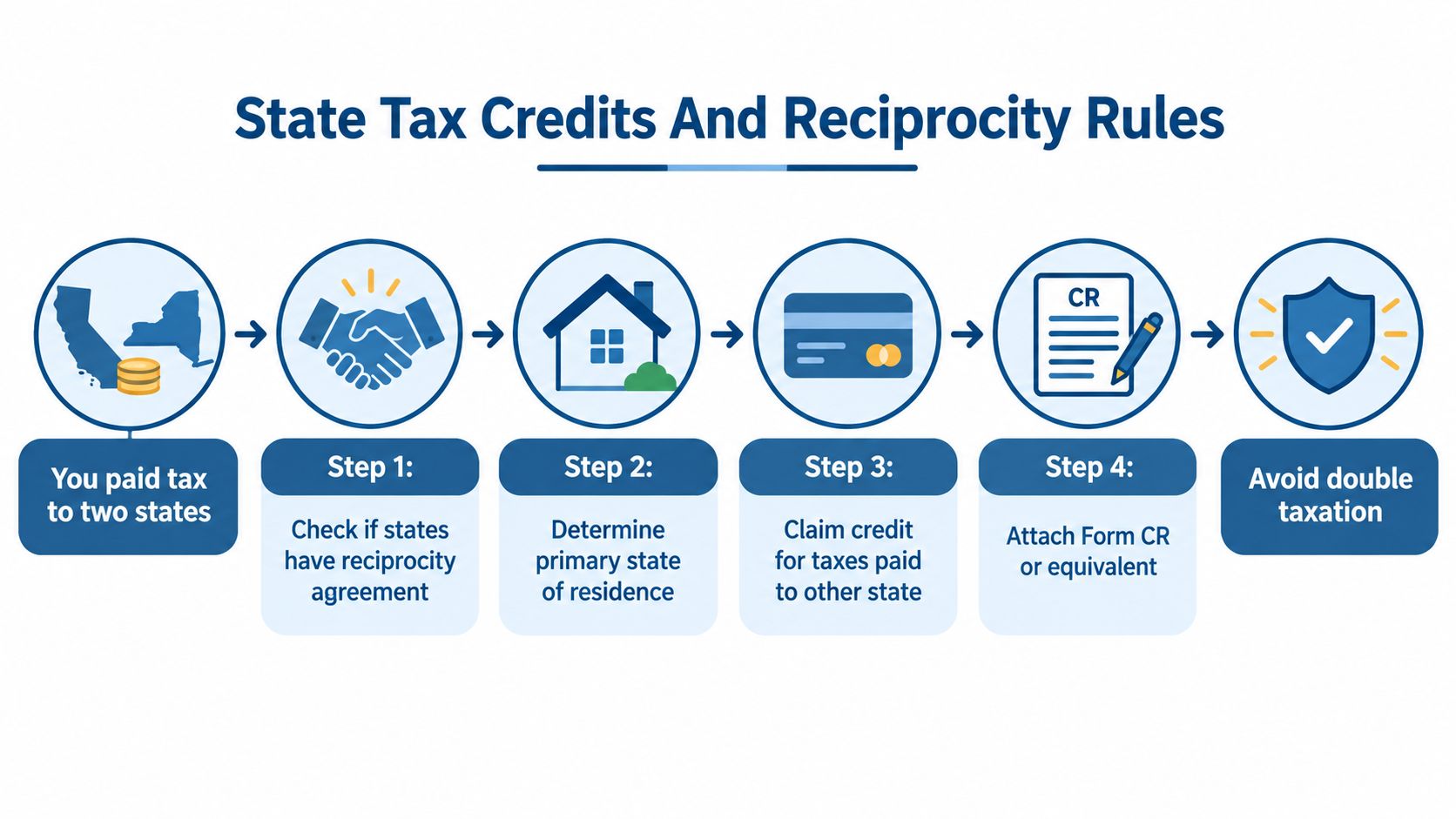
State tax credits and reciprocity rules help reduce double taxation, but they don't erase the need to file correctly. The usual sequence is to prepare the nonresident or source-state return first, then claim the credit on the resident return based on the actual tax owed to the other state.
The credit for taxes paid to another state is generally claimed on the resident return, not the nonresident return. The common rule is a cap equal to the lesser of the actual tax paid to the other state or the amount the resident state would have imposed on the same income, though calculations vary by state (summary of resident-state credit mechanics).
The filing order that usually works
Use this sequence:
- Prepare the source-state return first. You need the actual tax liability there.
- Then prepare the resident return. That's usually where the credit is claimed.
- Check reciprocity separately. Reciprocity can affect withholding, but it doesn't automatically answer every filing question.
Recent guidance aimed at taxpayers making a move stresses the same practical point. File the nonresident return first, then use the actual tax from that return when preparing the resident-state credit claim (credit sequencing guidance for people with income in another state).
Where people get confused
The confusion usually comes from mixing up three different ideas:
- Withholding: What an employer took out during the year.
- Tax liability: What the return says you owed.
- Credit: What your resident state allows after applying its own rules.
Withholding alone doesn't tell you whether the credit is correct. The return does.
Common Mistakes In Multi-State Filing
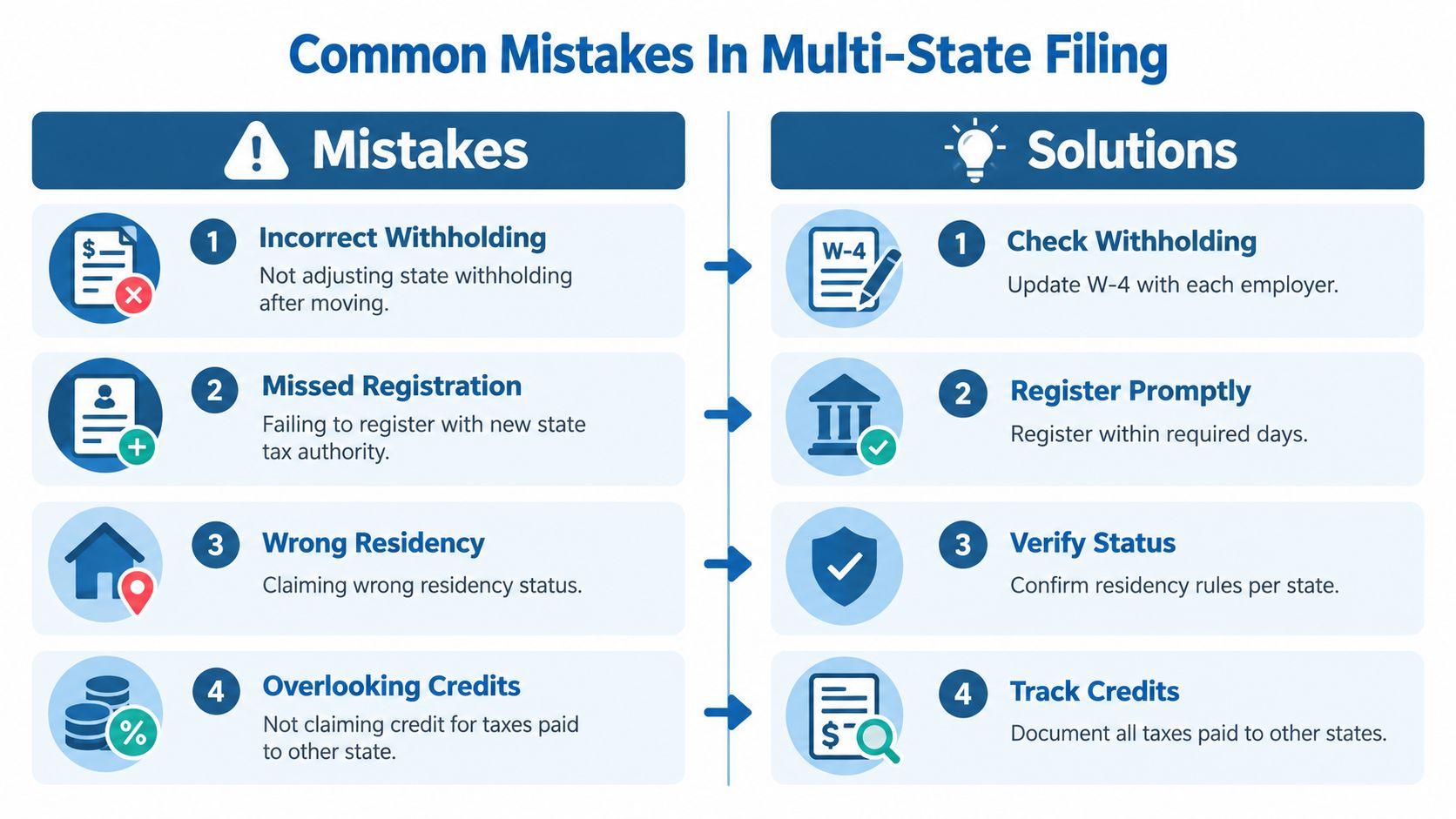
The biggest mistake usually isn't forgetting a second return. It's getting withholding, payroll, or state registration wrong before the return is prepared. A single remote employee can trigger employer nexus and payroll obligations, and many businesses don't catch that until a notice arrives or a payroll issue surfaces.
Recent coverage on multistate payroll compliance points out that multiple states can tax the same worker depending on physical work location, resident-state rules, and convenience-of-employer doctrines. The practical risk often sits with incorrect withholding and employer setup, not just with the employee's personal filing (Ogletree podcast discussion of payroll tax compliance for multistate employees).
Mistakes that show up again and again
- Payroll set to the wrong state: An employee moved, but the employer kept withholding for the old state.
- No registration in the employee's work state: The business had one remote worker and never registered there for payroll.
- Wrong residency treatment after a move: The taxpayer filed as a full-year resident when the year should have been split.
- Credit claimed in the wrong place: The taxpayer tried to claim the offset on the nonresident return instead of the resident return.
The part-year resident trap
Part-year residency is where many otherwise careful filers go off track. There is no single nationwide filing test, and filing thresholds, nonresident rules, and allocation rules vary by state. Independent guidance also highlights that multistate filing often comes from sourced income such as rentals, business property, or partnership and S corporation income, not just from moving across state lines (overview of multi-state return differences by state and income type).
A clean move date doesn't guarantee a clean tax split. States look at where income was earned, when residency changed, and what type of income you had.
A warning sign for business owners
If you have remote staff, a 1099-heavy operation, or jobs crossing state lines, don't treat payroll reports and income tax returns as separate projects. They connect. If payroll was wrong all year, the annual filing often becomes a cleanup exercise.
State-Specific Rules For New York New Jersey And Connecticut
New York, New Jersey, and Connecticut can all be part of the same filing picture, but they don't apply the rules in the same way. For tri-state filers, the biggest trouble spots are usually work location, part-year residency, and how credits interact with source income.
A contractor earning $400,000 in revenue may live in New Jersey, perform projects in New York, and hire help in Connecticut. A restaurant owner may live in one state while owning or operating in another. Those aren't exotic fact patterns around NYC. They're normal.
New York and New Jersey are rarely a simple two-return answer
For New York work, source-day counting and remote work treatment can matter a lot. For New Jersey residents, the resident return and credit mechanics often become the cleanup point after a New York nonresident filing. If you're dealing specifically with New York nonresident allocation, the New York State IT-203 instructions overview is a useful companion.
Connecticut can add another layer where wages, owner income, or pass-through activity touch the state. The filing answer depends on what type of income you had and where the work or property was located.
Part-year credits don't always work the way people expect
Part-year residents often assume a state gives one blended annual credit. Some states are narrower. Oregon's rule says a part-year resident figures the credit separately for the resident portion and nonresident portion, and Colorado allows a part-year resident credit only for tax accrued to another state on income derived from that state while the taxpayer was a Colorado resident, with proration where needed (Oregon administrative rule discussing part-year resident credit treatment and citing Colorado comparison).
That example matters even if you don't live in Oregon or Colorado. It shows the larger point. Part-year credit rules are state specific, and tri-state filers can't assume every state handles the split the same way.
Planning Strategies And Compliance Checklist
Good planning won't eliminate multiple state tax filing, but it can make the filing cleaner and reduce preventable errors. The practical goal is to identify where you must register, withhold, source income, and claim credits before year-end, not after notices arrive.
For sales tax and remote sellers, the state situation can vary widely. The same national review that tracked economic nexus adoption also reported an average combined state and local sales tax rate of 7.53%, with Louisiana at 10.11% (combined state and local sales tax figures in the multistate sales tax review). That's a sales tax example, but it shows why one business can face very different compliance demands across jurisdictions.
Planning moves that can help
Some decisions deserve review before filing season:
- Entity structure review: An S corporation, partnership, or sole proprietorship can create different state level issues depending on payroll, owner compensation, and filing footprint.
- Remote work policy: If employees work across state lines, someone should track where work is performed and whether payroll accounts are set up correctly.
- Documentation process: Keep job calendars, lease dates, move dates, payroll records, and property records together. State sourcing usually falls apart when the paperwork is scattered.
If you want filing dates in one place while building that process, Blue Sage Tax and Accounting Inc. maintains a state tax filing deadlines resource.
A short compliance checklist
Use this list before returns are prepared:
- Confirm residency status: Full-year, part-year, or nonresident is the first fork in the road.
- List every state touched by income: Wages, rentals, K-1 income, payroll, inventory, and customer activity all matter.
- Check registrations and payroll setup: Many employers miss a state entirely.
- Source income by category: Wages, rent, and business income rarely follow one universal rule.
- Prepare returns in the right order: Source-state first, resident-state second where a credit is involved.
- Review nexus annually: A new employee or a new market can change the filing map.
If your fact pattern includes remote employees, part-year moves, pass-through income, and more than one filing state, this usually stops being a software question and becomes a review question.
When those facts overlap, one option is to use a firm that handles part-year and nonresident returns, state registrations, withholding setup, and multi-state business filings in one workflow. That's one area Blue Sage Tax & Accounting Inc. works on with small business owners and contractors across states.
Blue Sage Tax & Accounting Inc. helps business owners and individuals sort out residency changes, nonresident filings, state credits, payroll setup, and multistate business reporting without treating every case like a generic two-state return. If your filing picture includes remote work, source income in another state, or business activity across state lines, Blue Sage Tax & Accounting Inc. can help you map the filings before they turn into notices. Book your free consultation call today.
This article is general information and not tax advice for your specific situation.