If your books show cash coming in and going out but leave you guessing about equipment, loans, inventory, or unpaid obligations, modified cash basis may be the practical middle ground. It starts with cash-basis bookkeeping, then adds selected accrual-style adjustments. That can make reports more useful for running the business, but it doesn't make them GAAP financial statements, and it doesn't guarantee a bank, surety, buyer, or investor will accept them.
The decision isn't just which method is easiest to maintain. It's which reports answer your questions and meet the needs of the people who'll rely on them.
Table of Contents
- What Modified Cash Basis Actually Means
- How Modified Cash Differs From Cash and Accrual
- Which Accrual Adjustments Businesses Actually Add
- Two Real Stories From the Owner Seat
- Who Will and Will Not Accept Modified Cash Statements
- Setting Up Modified Cash Without Creating New Ones
What Modified Cash Basis Actually Means
Modified cash basis starts with cash-basis bookkeeping, then adds selected accrual-style treatments for items such as fixed assets, loans, inventory, or long-term obligations. Ordinary revenue is generally recorded when cash is received, and ordinary expenses when cash is paid. The purpose is to keep the cash-flow view while making important noncash or long-term items visible. The IRS describes the underlying cash and accrual methods by when income and expenses are reported, but modified cash itself isn't one universally standardized framework with a required set of adjustments (IRS guidance on business accounting methods).
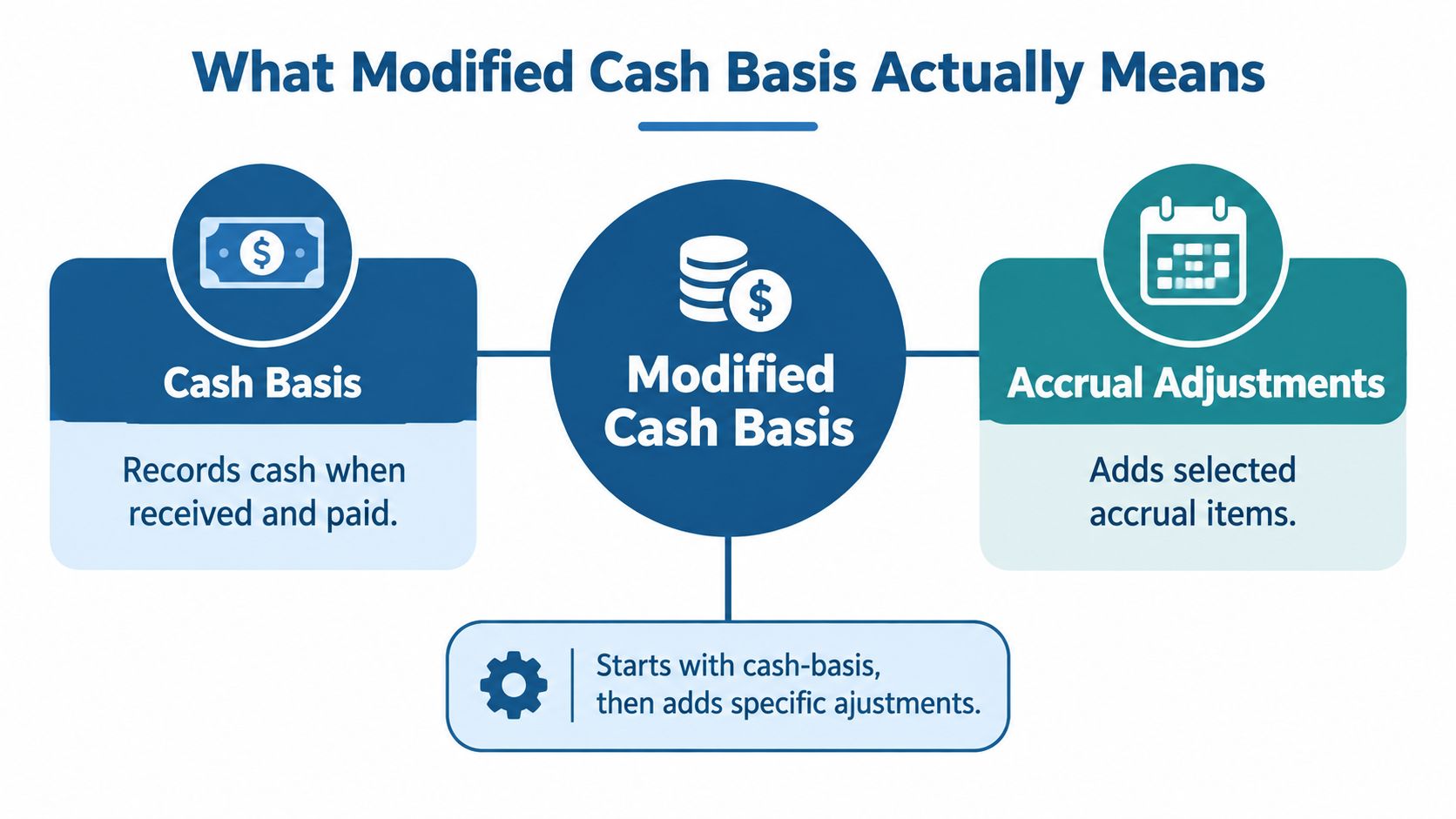
A business may already be using a version of the method without calling it that. For example, you might record customer payments when they hit the bank, record vendor bills when paid, but put a truck on the balance sheet and depreciate it over time. That's not pure cash accounting, because the truck's cost isn't treated solely as a cash expense. It's also not full accrual accounting, because ordinary revenue and expenses may still follow cash timing.
The flexibility is useful, but it comes with a responsibility: write down which items are treated on a cash basis and which receive accrual-style adjustments, then apply that policy consistently. Otherwise, a report may change from month to month because someone made different judgment calls. Clear disclosure matters too, especially when someone outside the business is going to read the statements.
Practical rule: Modified cash is a reporting choice, not a shortcut to GAAP. Its usefulness depends on the accounting policies behind it and whether the reader understands those policies.
Owners who want to see how transaction-level records can feed into broader financial reporting can review transaction-level data to unified finance reporting. The same principle applies here: the reports are only as helpful as the underlying records and the rules used to organize them.
How Modified Cash Differs From Cash and Accrual
Cash basis follows money received and paid. Accrual basis generally records revenue when earned and expenses when incurred. Modified cash retains cash timing for much of the routine activity, then adjusts selected items, so the result depends on the policy the business chooses.
Consider a business that provides a service in December but collects the customer's payment in January. It receives a vendor invoice before year-end but pays it afterward, finances a truck, owes employees for work completed near year-end, and makes a quarterly estimated tax payment. The methods won't necessarily show the same period's performance in the same way.
| Dimension | Cash Basis | Accrual Basis | Modified Cash Basis |
|---|---|---|---|
| Timing of income | Generally when received | Generally when earned | Usually when received, unless a policy adjusts the item |
| Timing of expenses | Generally when paid | Generally when incurred | Usually when paid, with selected accruals |
| Receivables and payables | Typically not recognized as ordinary balances | Generally recognized | May be recognized, depending on the documented policy |
| Fixed assets and depreciation | Cash outflow may dominate the reporting picture | Assets and depreciation are recorded | Often capitalizes long-lived assets and records depreciation |
| Inventory | May need special treatment depending on tax rules | Purchases and sales generally receive accrual treatment where required | Must be handled carefully, including applicable tax rules |
| Typical use | Simple cash tracking | More complete period-based reporting | Internal reporting that supplements a cash foundation |
The truck illustrates why the distinction matters. A cash-basis report may show a large payment when the business buys or pays for equipment. A modified cash report can instead show the truck as an asset and record depreciation over time, while also tracking the related debt. That can make operating results easier to interpret, but it doesn't mean every short-term item has been converted to accrual accounting.
The January customer payment and unpaid vendor bill present the reverse challenge. If the business leaves them cash-based, the December report may not show the service revenue or expense associated with that work. If the business recognizes receivables and payables, it needs a consistent rule for deciding when those balances are recorded and how they're reconciled.
If you're converting reports between methods, an accrual to cash conversion guide can help clarify the timing differences. Don't mistake a conversion schedule for a complete accounting policy, though. The policy still has to specify which transactions are adjusted and why.
Which Accrual Adjustments Businesses Actually Add
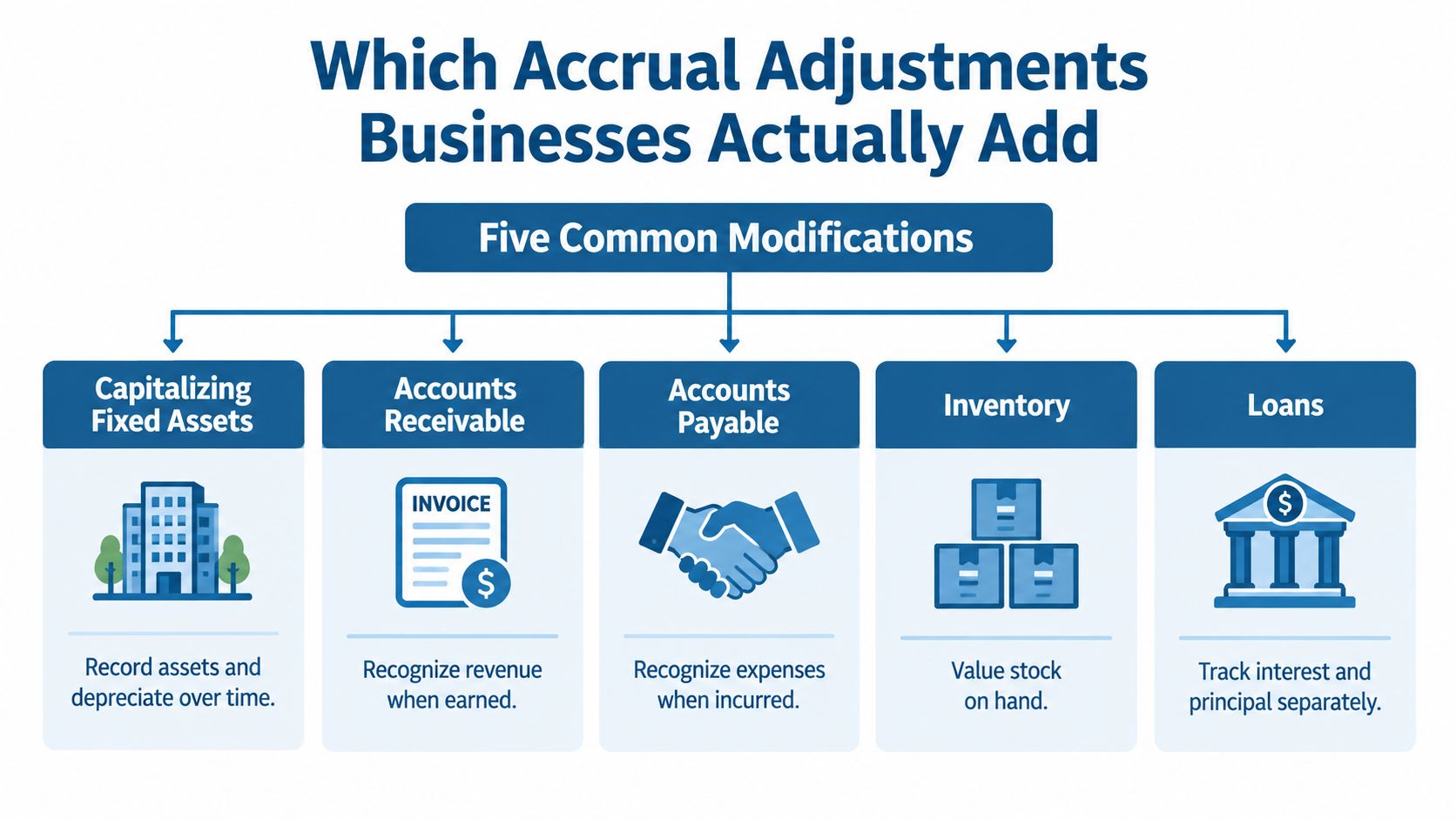
Modified cash has no required menu, and that's where owners get into trouble. Some add too few adjustments and fool themselves. Others bolt on so many they have rebuilt accrual accounting with worse documentation. Pick the few entries that fix a real blind spot in your reports, write down the rule for each one, and apply it the same way every period. A small set you can defend to a banker beats a long list nobody on your team can explain.
Put long-lived assets and debt on the books
Recording the full purchase price of a truck or machine as one period's expense makes that month look weak and every month after it look artificially cheap. Capitalize the asset and depreciate it over its useful life instead. Book the loan as a liability, and split each payment into principal and interest: principal reduces what you owe, interest is the cost of borrowing.
This is the adjustment outside readers notice first. A lender looking at a pure cash income statement sees one large expense and no debt schedule. A modified statement shows the asset, the obligation, and the payment stream behind it. If you plan to borrow or bid bonded work, start here.
Treat inventory and obligations deliberately
Inventory is where owners most often get this wrong. If inventory is a material income-producing factor in your business, accrual treatment for purchases and sales is generally required for federal tax purposes unless a small-business exception applies, so confirm your eligibility before relying on a modified cash policy (IRS guidance on recordkeeping and accounting methods). Retailers, wholesalers, and manufacturers should assume inventory needs accrual treatment until their tax adviser says otherwise.
Payroll and tax accruals earn their keep the same way. If your crew works the last week of December and gets paid in January, a pure cash report pushes that labor cost into the wrong period. Accruing payroll already earned, plus the income-tax obligation tied to the period's results, shows costs that haven't cleared the bank yet. Apply the same logic to any obligation big enough to distort a period, and skip the ones that don't move the picture.
The practical test is simple. Does the adjustment clarify what the business earned, used up, or owes, and can your bookkeeper produce it every period without guesswork? If yes, keep it. If it needs a memo to justify each time, cut it. Consistency is what makes modified statements credible to an outside reader; a method that shifts quarter to quarter reads as worse than pure cash.
Two Real Stories From the Owner Seat
A contractor can look profitable in the bank account and still have a weak picture of job performance. A restaurant can show cash moving steadily while missing the cost of food on hand or payroll already earned. Modified cash can sharpen those views, and the two cases below show where it helps and where it stops short of what outside parties need.

The contractor with delayed collections
Take a contractor with about $1.4 million in revenue, three trucks, two crews, retainage on larger jobs, and a mix of 30-day and 90-day customer payment terms. Under pure cash accounting, a completed job may not show as revenue until the customer pays. A large equipment payment lands as a major expense when paid, while the loan balance on the truck sits off the books entirely.
Recording the trucks and related debt, then depreciating them, fixes the biggest distortion cheaply. The owner gets a clearer view of equipment costs and loan obligations without changing every ordinary transaction to accrual timing. But here is my blunt read: retainage, work in progress, unpaid job costs, and receivables are exactly what a surety or lender will ask about. If those stay outside the chosen adjustments, expect to produce supplemental schedules or separate statements when bonding or credit comes up.
The restaurant with frequent purchases
A restaurant operator with two locations, weekly food deliveries, a small bar inventory, and payroll every other week faces a different blind spot. Cash records show when vendor invoices get paid, not what food remains on hand or what labor the staff has already earned by the reporting date. Selected inventory and payroll adjustments can make period results far more useful, provided the records support the entries and the applicable inventory rules are followed.
The lesson across both cases is the same. Don't ask whether modified cash is universally right. Ask which blind spots matter most to the decisions being made and to the people reading your statements. A truck-heavy contractor should prioritize fixed assets and debt. A restaurant should get a stronger handle on inventory and payroll obligations.
For a visual walkthrough of how cash and accrual timing differ, this short video works through the same completed-job, delayed-payment timing issue the contractor example raises.
Who Will and Will Not Accept Modified Cash Statements
Don't assume modified cash statements will satisfy an outside party just because they're useful to you. Banks, sureties, buyers, investors, and formal reporting requirements can call for information that a cash-centered report doesn't contain. Ask the intended reader what basis and supporting schedules they require before submitting statements.
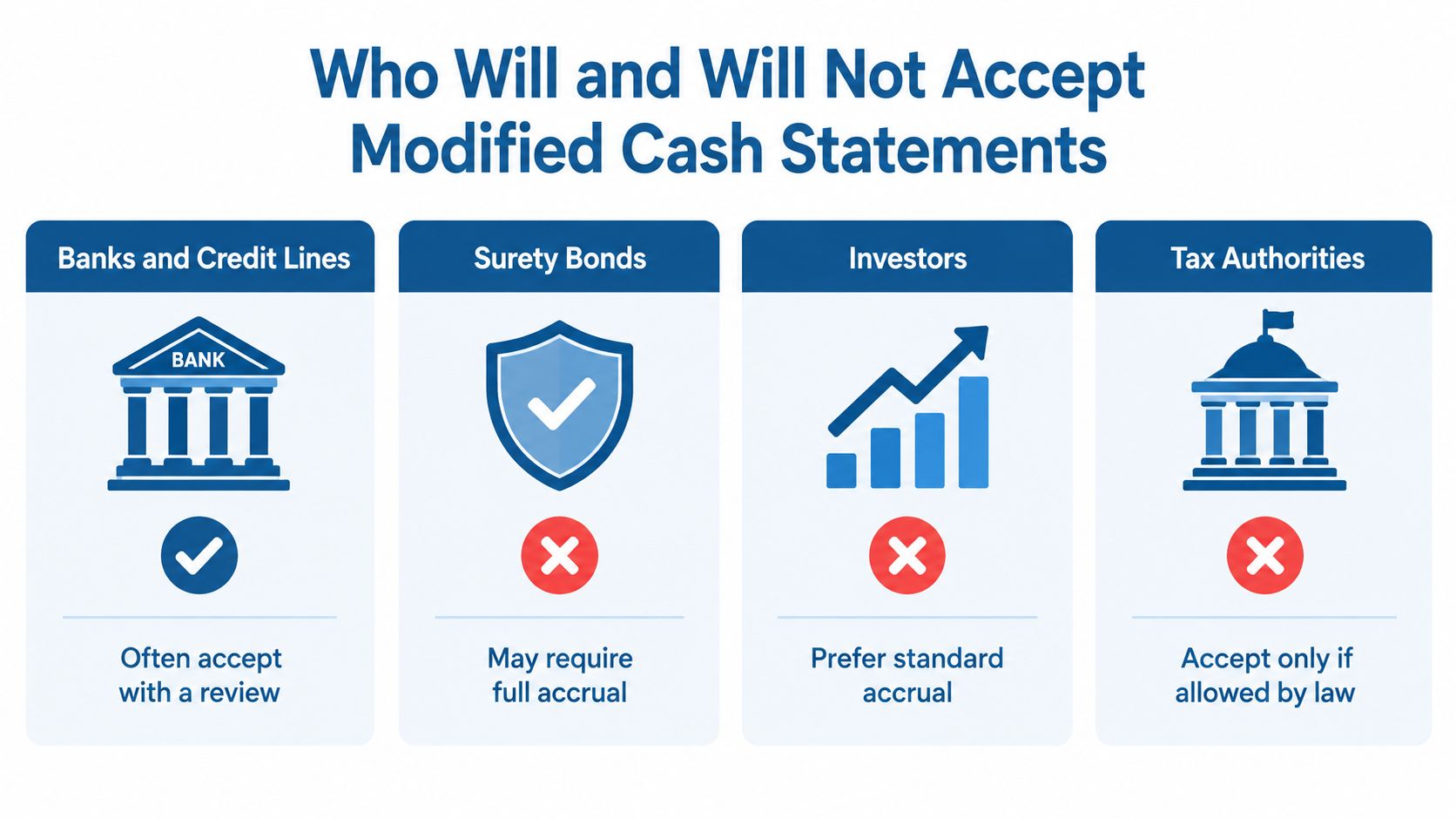
A bank reviewing a credit application may focus on the business's ability to meet debt obligations, along with the assets and receivables available to support borrowing. The bank's requirements vary, so ask whether it accepts modified cash statements and what schedules it expects. Don't assume that an internal report is enough.
Surety companies may need to assess a contractor's work in progress, retainage, receivables, unpaid costs, and backlog. A cash-centered report can leave out or obscure information that helps explain the contractor's position. If bonding capacity matters to the business, confirm the surety's reporting requirements early rather than waiting until a bond is needed.
Buyers and investors may also ask for more detail. During a sale or capital raise, they may want a consistent view of assets, liabilities, earnings, and working capital. Modified cash is a special-purpose basis outside U.S. GAAP; SEC-filed financial statements, audited statements, and formal investor reporting may require another basis or substantial conversion (SEC-filed financial statement example). A lender, partner, or investor that specifically requires audited or reviewed statements needs a reporting basis and service that meet that requirement.
Modified cash can be a sensible operating lens and still be the wrong package for an outside reader.
Keep modified cash for internal management or tax-oriented reporting when it fits your needs, but prepare accrual-style schedules or GAAP statements when the recipient requires them. For help organizing those reports, see this guide to preparing financial statements. The rule is straightforward: get the reporting requirement from the audience, not from your bookkeeping software.
Setting Up Modified Cash Without Creating New Ones
A sound modified cash policy is clear enough for another person to follow. Before changing the books, list which transactions stay cash-based, which receive accrual-style treatment, and how each adjustment will be supported and reconciled.
Use this checklist:
- Document the policy: Specify how the business handles fixed assets, depreciation, debt, inventory, receivables, payables, payroll, and tax obligations.
- Reconcile the reports: Compare modified-basis statements with bank activity and tax records so differences are understood rather than ignored.
- Check tax-method consistency: Federal tax reporting generally follows the selected method and applicable rules. Don't assume internal financial statements automatically establish the business's federal tax treatment.
- Handle method changes properly: A taxpayer changing an accounting method will generally need to file Form 3115, and a section 481(a) adjustment may be required to prevent income or expenses from being duplicated or omitted. These are federal rules; state tax conformity and financial-statement presentation can differ (IRS guidance on accounting method changes).
Match the report to its purpose. Internal management may call for modified cash statements. Tax filings must follow the applicable tax rules. A lender or surety may require additional accrual schedules, while sale due diligence or formal investor reporting may call for a different reporting basis. For practical ideas on consistent small-business bookkeeping, review accounting practices for small businesses.
This article is general information and not tax advice for your specific situation.
Blue Sage Tax and Accounting Inc. helps owner-operated businesses review bookkeeping policies, tax-method consistency, and reporting needs before statements go to lenders or other outside readers. If you want to discuss whether modified cash fits your business and what reports your stakeholders may require, Book your free consultation call today.