An LLC's deductible expenses generally include the ordinary and necessary costs of running the business, such as rent, supplies, payroll, vehicles, insurance, and professional fees. Its federal tax classification, whether a disregarded entity, partnership, or S corporation, determines who claims those expenses and how they interact with the Section 199A qualified business income deduction of up to 20%.
You may be looking at a truck invoice, restaurant equipment purchase, or bank feed full of uncategorized transactions and wondering what belongs on the return. The useful question isn't just whether something is a write-off. It's which taxpayer claims it, what documentation supports it, and whether taking it now makes sense.
Table of Contents
- Which Expenses Can an LLC Actually Deduct
- How Your LLC's Tax Classification Changes What You Deduct
- Single-Member vs Multi-Member LLCs Compared
- Where Bigger Deductions Can Quietly Lower Your QBI
- Recordkeeping That Holds Up If the IRS Asks
- Working in More Than One State Without Losing the Deduction
- Pulling It Together in a Year-End Plan
Which Expenses Can an LLC Actually Deduct
An LLC can generally deduct business expenses that meet the federal ordinary-and-necessary standard, subject to the rules for each expense. Start by confirming the LLC's tax classification, then evaluate what the purchase does for the business rather than which account paid for it.
The IRS defines ordinary expenses as common and accepted in your trade or business, and necessary expenses as helpful and appropriate. It also explains that the business generally must operate for profit and that personal spending doesn't become deductible because it passes through a business account, under its guidance on business credits and deductions.
Organize your review into recognizable bookkeeping groups:
- Premises and operations: Rent, utilities, business insurance, and supplies.
- People and outside help: Employee payroll, contractor payments, and professional fees, with owner payments reviewed separately.
- Selling and administration: Marketing, software, bank charges, and merchant-processing fees.
- Items needing closer classification: Education, inventory and cost of goods sold, vehicles, and equipment.
These are review categories, not automatic approvals. A restaurant's ingredient purchases and a consultant's software subscription serve different operational purposes. Inventory costs and long-lived assets also shouldn't be swept into miscellaneous expenses simply because cash left the account.
Practical rule: Keep the receipt, but also be able to explain what the business received and why it needed it.
For readers comparing terminology across countries, Grow My Acorn's guide to what can sole traders claim offers a UK-focused perspective. Don't apply its jurisdiction-specific rules to a U.S. federal return.
How Your LLC's Tax Classification Changes What You Deduct
The LLC label alone doesn't determine the federal return. A single-member LLC is typically disregarded for federal income tax purposes, while a multi-member LLC generally receives partnership treatment unless it elects otherwise.
Consider a hypothetical contractor with $400,000 in revenue. If the contractor owns a disregarded LLC operating a sole-proprietor business, the business income and deductions generally appear on Schedule C with the owner's individual return. The revenue figure doesn't establish the classification, and depositing customer payments into an LLC account doesn't create a corporate tax election.
A restaurant owned by partners follows a different reporting path. Under default partnership treatment, the business files Form 1065 and provides members with Schedule K-1s. If an LLC instead has an effective S corporation election, its business reporting generally moves to Form 1120-S.
Confirm the election before classifying owner payments
The IRS explains the default classifications and identifies eligible pass-through businesses in its qualified business income deduction overview. Income earned through a C corporation generally isn't eligible for that deduction.
The practical mistake is treating a change in payroll or bookkeeping as proof that the federal classification changed. Ask the preparer to confirm the effective classification and applicable election documentation before deciding how to report owner compensation.
Use the firm's LLC tax classification guidance to frame that conversation. The same supplier invoice may remain a legitimate business cost under different classifications, but owner payments, reporting, and the eventual pass-through calculation require separate attention.
Single-Member vs Multi-Member LLCs Compared
Under default federal treatment, a single-member LLC reports through its owner, while a multi-member LLC generally files a partnership return. The key distinction is the reporting process, not permission to deduct personal spending.
Single-Member LLC vs Multi-Member LLC at a Glance
| Item | Single-Member LLC | Multi-Member LLC (Partnership) |
|---|---|---|
| Business reporting | Generally Schedule C with the owner's Form 1040 for an operating sole-proprietor business | Form 1065, with Schedule K-1s issued to members |
| Ordinary business deductions | Reported in the owner's business activity | Reported by the partnership before applicable items pass through |
| Owner withdrawals | Track separately from operating expenses | Track distributions separately from expenses and member compensation |
| Owner compensation review | Distinguish draws from employee payroll | Distinguish distributions from guaranteed payments |
| Health insurance and self-employment tax | Review under the owner's applicable rules | Review member status, payment arrangements, and applicable partner rules |
| QBI review | Evaluate the owner's qualifying business income | Evaluate the member's qualifying pass-through information |
For a sole owner, the bookkeeping concern is straightforward: money transferred to a personal account isn't evidence of a business expense. For partners, the preparer also needs to understand why money was paid to a member and how the partnership recorded it.
Owner health insurance and self-employment tax shouldn't be handled by copying an employee payroll entry. Give the preparer the policy information, payment history, and owner-compensation records so those items receive the appropriate treatment.
A clean profit-and-loss statement isn't the whole partnership return. Member distributions, contributions, and compensation records need their own reconciliation.
Neither structure makes every loss immediately usable. Before relying on a projected deduction, ask whether owner-level limitations, including basis, affect what can be claimed.
Where Bigger Deductions Can Quietly Lower Your QBI
A larger ordinary deduction can reduce business income while also reducing the amount used to calculate the federal QBI deduction. That doesn't make the expense undesirable, but it means the net tax effect needs a projection.
The illustration highlights that interaction, although “tax-saving deduction” isn't a separate statutory deduction category.
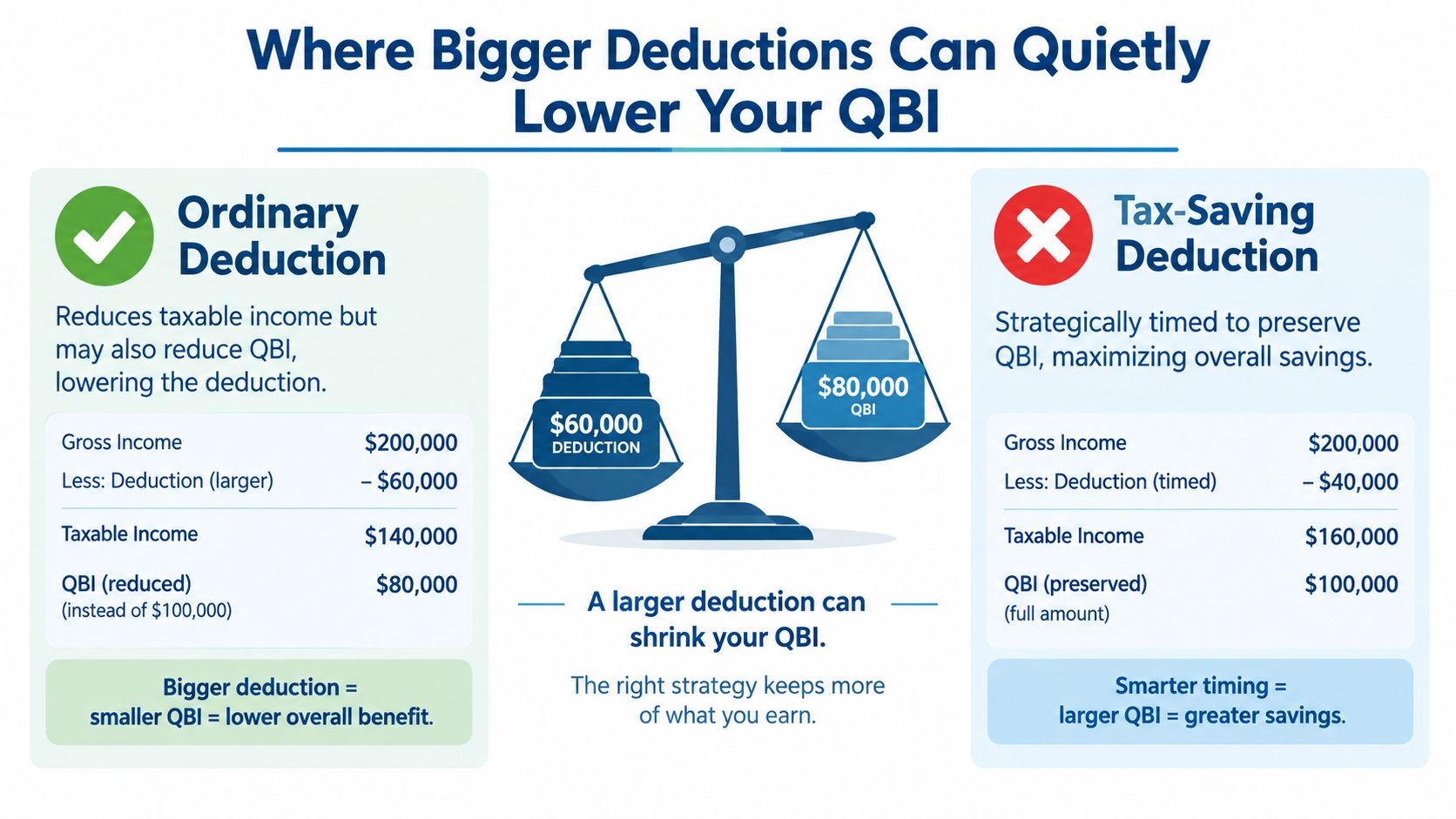
The IRS describes QBI limitations involving taxable income, business type, W-2 wages, and the unadjusted basis of qualifying property in its facts about the qualified business income deduction. Accelerated depreciation may therefore change both the ordinary business result and the potential QBI deduction.
Consider a hypothetical trades owner buying a $90,000 work truck late in the year. The purchase price alone doesn't establish the deductible amount. Vehicle classification, business use, placed-in-service timing, and annual limits all matter under the IRS rules for recovering business vehicle costs.
Ask the preparer to compare eligible current-expensing choices with regular depreciation before signing the purchase order. A deduction reduces income; it doesn't reimburse the purchase price, and preserving cash may matter more than accelerating an expense.
The accompanying video offers another opportunity to consider deduction timing.
Recordkeeping That Holds Up If the IRS Asks
Records should let someone reconstruct each deduction's amount, date, business purpose, and supporting evidence. For mixed-use assets, they also need to explain the allocation between business and personal use.
Start with a repeatable bookkeeping routine rather than a year-end receipt search.
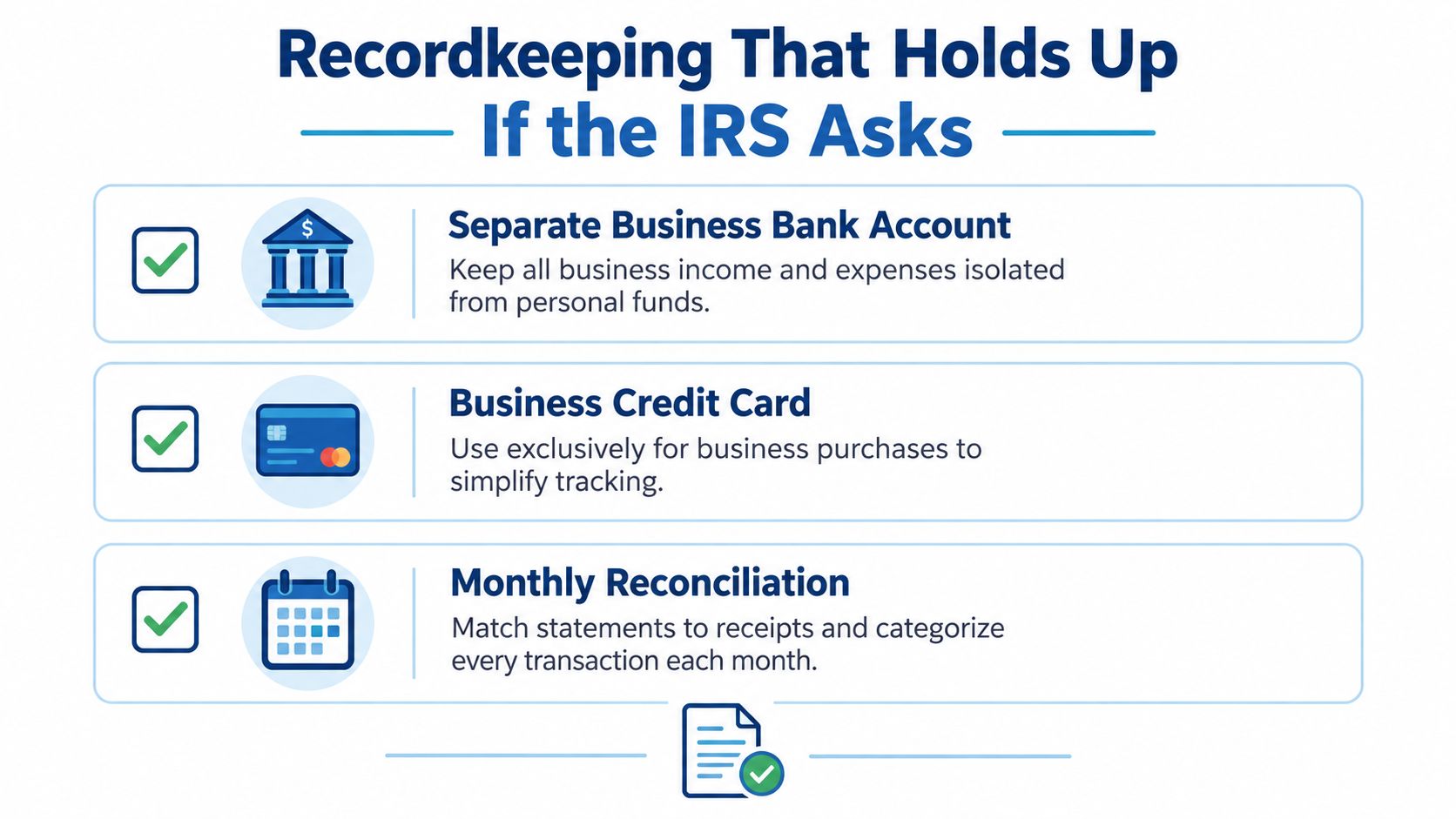
- Separate spending: Use dedicated business banking and a business credit card, then identify accidental personal charges.
- Reconcile monthly: Match statements to receipts and invoices. Capture cash purchases while the purpose is still clear.
- Maintain an asset register: Record purchase cost, ownership, business-use allocation, and placed-in-service dates.
- Track property work: Keep descriptions that distinguish repairs from improvements rather than labeling everything maintenance.
Vehicle records deserve particular attention. The IRS requires evidence of the time, place, business purpose, and amount, and a card statement alone may not establish business use, as explained in the Schedule C instructions.
Keep separate logs for an owner's mixed-use car and company work vehicles. Don't assume a personal vehicle transferred into business use carries its original purchase price as its depreciation basis; the conversion rules require a separate calculation.
The firm's guide to tracking business expenses can help turn these controls into an ongoing process. The goal isn't more paperwork. It's fewer unexplained entries.
Working in More Than One State Without Losing the Deduction
A federal deduction doesn't settle its treatment on every state return. For a multi-state LLC, the preparer needs to review filing obligations, income allocation, and state adjustments separately.
Consider a hypothetical Queens restaurant operator who also provides catering services in New Jersey. The planning questions include where employees work, where services occur, which premises the business uses, and how shared vehicle and administrative costs should be assigned.
Review state treatment without assuming conformity
Have the preparer check New York State, New York City, and New Jersey requirements where applicable. Federal QBI treatment and depreciation choices shouldn't be copied into those filings without reviewing the jurisdiction's rules.
Keep location-specific records where possible. Separate restaurant rent from catering-site costs, retain payroll location details, and document trips connected with each operation. Those records give the preparer a defensible starting point for evaluating nexus and apportionment rather than reconstructing operations from customer addresses alone.
Crossing a state line doesn't turn a personal expense into a business deduction, and a federal deduction doesn't answer every state filing question.
Home-based administration also needs care. Federal guidance generally treats travel between home and a regular workplace as personal commuting, while a qualifying home office that is the principal place of business can change the transportation analysis under IRS Publication 463.
Don't assume that answering emails at home makes every drive to the restaurant deductible. Establish the federal facts first, then check the applicable state treatment.
Pulling It Together in a Year-End Plan
Build the year-end plan around decisions that are still open, not purchases already made. Bring current books, classification records, asset details, and state activity information to the planning conversation.
Use the next 60 to 90 days as a working planning window, not as a tax deadline.
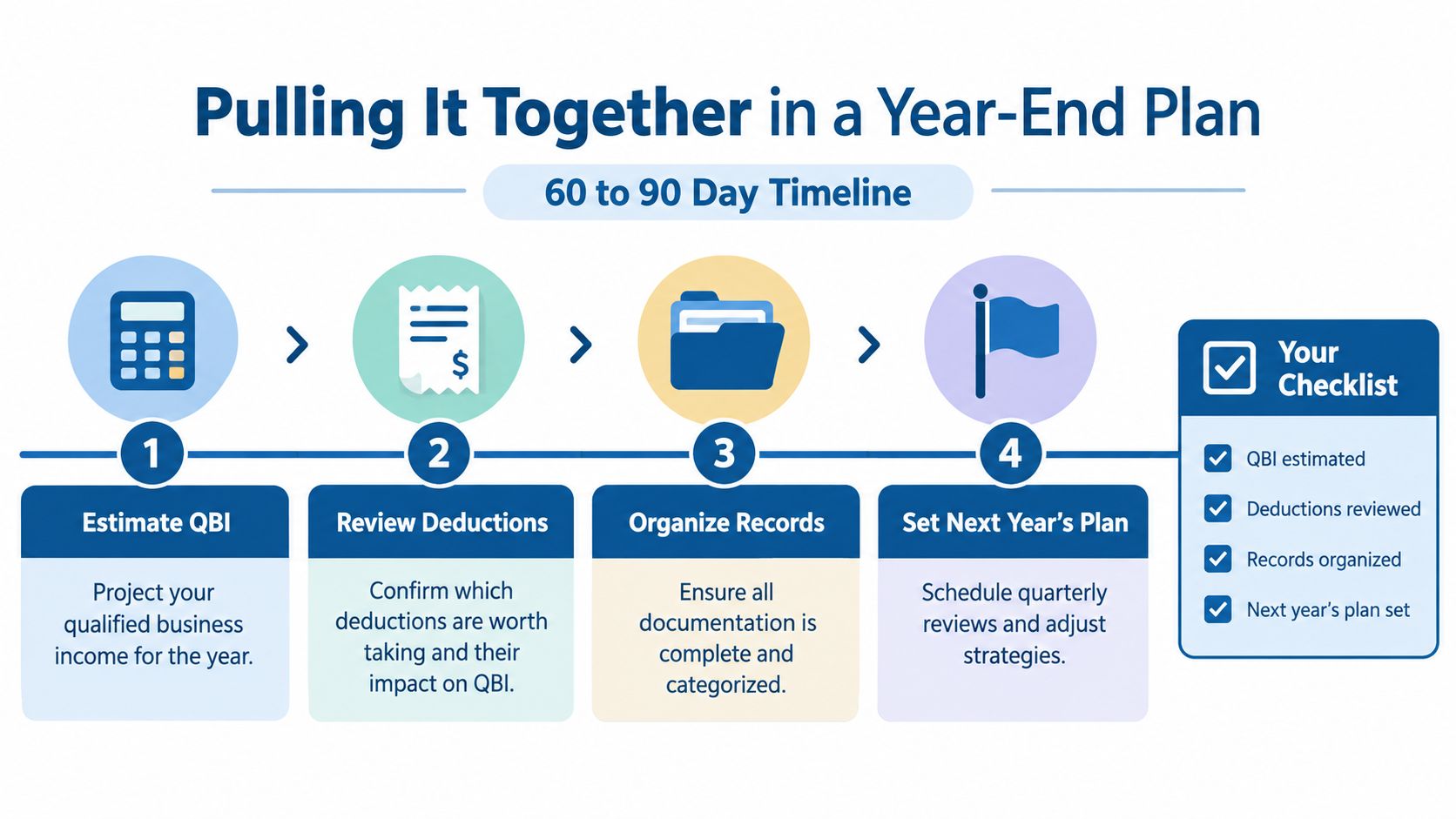
Before December 31, work through the decisions that could affect the return:
- Confirm classification and ownership: Resolve uncertainty about elections and make sure members understand how payments have been recorded.
- Run a QBI-aware projection: Compare the overall result rather than targeting the largest possible expense total.
- Evaluate equipment timing: Review Section 179, bonus depreciation, and regular depreciation eligibility alongside expected income and state treatment.
- Clean the accounts: Resolve uncategorized transactions, owner spending, and unsupported balances.
- Review multi-state activity: Identify new work locations, employees, and operating arrangements before preparing returns.
For equipment expected to last more than a year, the normal federal starting point is depreciation rather than immediate treatment as an ordinary expense. Special expensing provisions require their own eligibility analysis, as explained in the IRS Tax Guide for Small Business.
The useful planning deliverable is a comparison: what happens if you buy now, wait, or choose another eligible recovery method? Ask for the assumptions behind the projection, including business use and expected income. That gives you a decision you can evaluate against cash flow, not merely a list of LLC tax deductions.
For help connecting LLC deductions with bookkeeping, entity reporting, and year-round projections, visit Blue Sage Tax & Accounting Inc., an accounting firm serving owner-operated businesses. Bring your current financial statements and planned purchases to discuss their potential federal and state treatment. Book your free consultation call today.
This article is general information and not tax advice for your specific situation.