You've received an IRS notice, the balance is larger than expected, and paying it in full isn't realistic. The main IRS payment plan options are a short-term plan of up to 180 days, a long-term installment agreement, simple payment plans for qualifying balances, a Partial Payment Installment Agreement when full repayment isn't feasible, and an Offer in Compromise as a settlement alternative. Individuals, S-corps, LLCs, payroll-heavy businesses, estates, and trusts can face different eligibility rules, especially when payroll or trust fund taxes are involved.
Table of Contents
- What IRS Payment Plan Options Are Available in 2026
- Short-Term vs Long-Term Installment Agreements
- Real Scenarios for Individuals and Business Owners
- How to Apply for an IRS Payment Plan
- Fees, Interest, and the Total Cost of a Plan
- When to Escalate Beyond a Payment Plan
- Client-Ready Checklist and Next Steps
What IRS Payment Plan Options Are Available in 2026
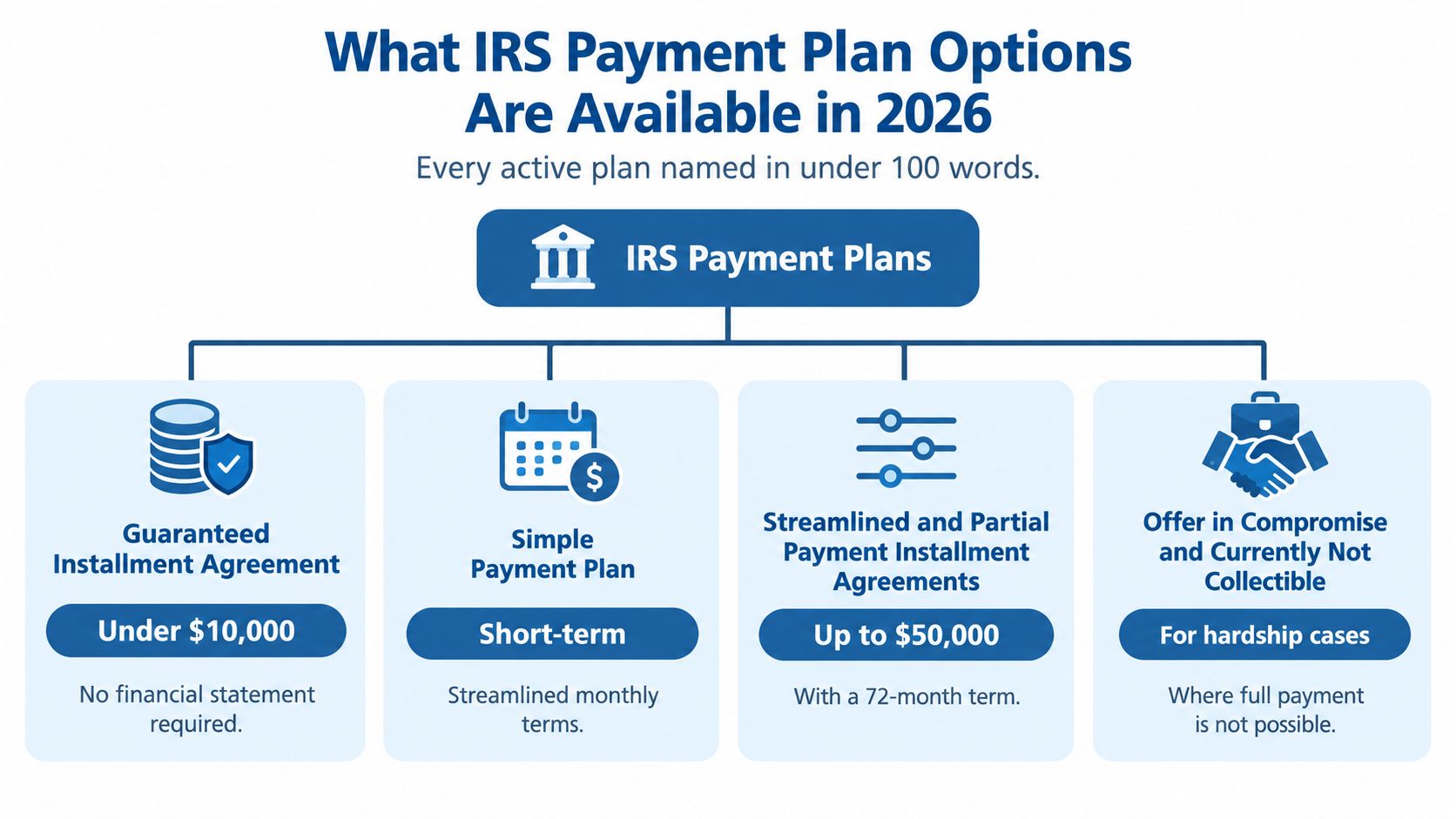
For individuals, the IRS offers a short-term plan for a combined balance under $100,000, payable within 180 days, and a long-term installment agreement for a combined balance under $50,000. The IRS describes these options in its payment plan guidance for taxpayers who need help paying.
Other paths include a Guaranteed Installment Agreement for qualifying individual balances of $10,000 or less, Simple Payment Plans, standard installment agreements for larger or more complicated balances, Partial Payment Installment Agreements, and Offers in Compromise. A Guaranteed Installment Agreement isn't a debt reduction program. It generally gives a compliant taxpayer a structured way to repay what is owed without providing a financial statement under the qualifying rules.
The plan depends on the taxpayer, not just the balance
An individual with a straightforward Form 1040 balance may qualify for an online arrangement. An S-corp owner with unpaid payroll taxes may face a different review because withheld taxes can create personal exposure through the Trust Fund Recovery Penalty. LLC classification, payroll history, current filings, responsible-party questions, and business operations can matter as much as the stated balance.
The IRS Data Book shows how central installment agreements are to federal collections. In fiscal year 2025, the IRS established 3,160,047 new installment agreements, ended the year with 4,870,810 agreements in inventory, and collected $17.882 billion from cases in installment-agreement status, according to the IRS Data Book.
The practical decision is straightforward. First determine whether the debt can be cleared within 180 days. If not, assess the long-term monthly payment, compliance requirements, fees, and collection statute. If full repayment isn't realistic, a Partial Payment Installment Agreement, Currently Not Collectible status, or Offer in Compromise may deserve review instead.
Short-Term vs Long-Term Installment Agreements
Choose a short-term plan when reliable cash flow can clear the federal balance within 180 days. Choose a long-term installment agreement when full payment in that period would disrupt payroll, operating expenses, or household obligations. The longest available term is not automatically the safest choice. Set the monthly amount from actual cash flow and leave room for future tax deposits.
For individuals, the IRS identifies online long-term plans for combined tax, penalties, and interest under $50,000. Individuals with balances under $100,000 may use the short-term option if they can pay within 180 days. Businesses can use an online long-term plan when the combined balance is under $25,000, generally for up to 24 months, as described in the IRS instructions for Form 9465.
| Feature | Short-Term Plan | Long-Term Installment Agreement |
|---|---|---|
| Payment period | Up to 180 days | Monthly payments, potentially up to 72 months for qualifying individuals |
| Individual balance rule | Combined balance under $100,000 | Combined balance under $50,000 |
| Business balance rule | Eligibility depends on the business facts and IRS path | Online business plan generally under $25,000, up to 24 months |
| Application route | Often online | Online application or installment agreement process |
| Best use | Temporary cash-flow gap | Debt that cannot be cleared within 180 days |
A short-term plan is often the better fit when a pending receivable, seasonal revenue cycle, or planned asset sale can cover the balance soon. It avoids turning a temporary shortage into a multiyear obligation. A long-term plan provides lower required payments, but the account remains subject to ongoing compliance and continued interest and penalties while the balance is unpaid. Review the current payment plan and installment agreement rules before applying, because eligibility and application requirements differ by taxpayer type.
For an S-corp or LLC owner, cash available for an IRS payment must be measured after payroll, payroll-tax deposits, rent, vendors, and personal obligations. Trust fund taxes, including withheld payroll taxes, can create Trust Fund Recovery Penalty exposure for responsible individuals. A business balance that appears to fit an online threshold may still require closer review of filings, responsible-party issues, and current operations.
Practical rule: select the shortest term that the taxpayer can sustain without missing current deposits or returns. If even that payment is unrealistic, compare other collection alternatives rather than forcing a long-term agreement that will default.
Real Scenarios for Individuals and Business Owners
A solo contractor with $400,000 in annual revenue discovers a payroll tax problem after under-withholding for two quarters. The business may have a Form 941 liability, and the IRS may examine whether the Trust Fund Recovery Penalty under IRC 6672 applies to responsible individuals. This isn't a routine online Simple Payment Plan case. The owner may need Form 9465 and financial disclosure, with payments sized around verified cash flow and the time remaining under the collection statute.
The exact monthly payment can't be responsibly stated without the assessed balance, available equity, income, expenses, filing status, and collection-period details. A payment that looks manageable on a profit-and-loss statement may fail once payroll, rent, tax deposits, and personal obligations are included.
A restaurant owner filing in two states has a federal liability plus New York and New Jersey obligations. The federal installment request doesn't automatically resolve state balances, so the owner must establish the application order and keep each jurisdiction current. If full repayment within the available long-term period isn't realistic, a Partial Payment Installment Agreement may be considered, but the IRS can require detailed financial information and may address immediate collection concerns before approving terms.
State and federal tax debts should be modeled together. A federal payment that consumes cash needed for state payroll or sales-tax obligations can create a second default.
A freelancer with a $15,000 personal balance may fit within an individual Simple Payment Plan. If the taxpayer is current with required filings and the balance qualifies, the application can generally be made online, with the IRS-listed online long-term setup fee of $29 with direct debit or $69 without it. The IRS can determine the monthly amount based on the requested term and account facts, so the taxpayer should calculate a sustainable payment before submitting the application.
These examples show the operational divide. A W-2 taxpayer with a clean individual income-tax balance may have a simple online process. An S-corp or LLC owner with payroll exposure needs to address entity records, deposits, responsible parties, and possible personal liability before treating the debt as an ordinary installment request.
How to Apply for an IRS Payment Plan
Start by confirming the balance and filing status in the taxpayer's IRS account or transcripts. The IRS generally expects required returns to be filed and current obligations to be addressed before approving a workable long-term arrangement.
Choose the application channel
Online applications are usually the most efficient for individuals who fall within the IRS thresholds. The taxpayer needs identity information, the balance details, bank information if choosing direct debit, and a monthly payment that the household can maintain.
A phone application may be appropriate when the online system doesn't fit the account or when the taxpayer needs to discuss a notice, business issue, or balance outside the normal online path. A Taxpayer Assistance Center can be relevant for taxpayers who need in-person help, but appointment availability and required identification should be confirmed before traveling.
Prepare before submitting
Have these items ready:
- Tax records: The latest filed return, IRS notices, and account transcripts.
- Bank details: Routing and account numbers if direct debit is selected.
- Payment calculation: A monthly amount based on reliable cash flow, not an optimistic month.
- Business records: Payroll filings, tax deposits, ownership information, and state filing status for S-corps and LLCs.
- Form 9465 information: Use the IRS installment agreement process when the online option isn't available or the account requires a fuller review.
Online requests may produce an immediate system response, but approval isn't the same as solving the underlying liability. A rejected request usually means the taxpayer should review the balance, compliance status, payment amount, financial disclosure, or collection issues before applying again. Repeated applications without correcting the problem can waste time while penalties and interest continue.
Fees, Interest, and the Total Cost of a Plan
An installment agreement does not freeze a federal tax balance. Interest and applicable penalties generally continue until the liability is paid, so choosing a lower monthly payment can extend the repayment period and increase the amount ultimately paid.
The practical cost is not limited to the setup fee. Interest accrues on the unpaid balance, and penalties may continue under the applicable IRS rules. A longer arrangement can preserve cash for payroll, rent, insurance, current tax deposits, and household needs, but it also leaves the taxpayer exposed to charges for more time.
| Cost Component | How It Affects the Balance | When It Applies |
|---|---|---|
| Interest | Accrues on unpaid tax | Until the balance is paid |
| Penalties | May continue under IRS rules | Until the liability is resolved or adjusted |
| Longer repayment term | Can increase the total paid | When monthly payments are kept lower |
| Direct debit | Reduces missed-payment risk | When automatic withdrawals are selected |
The IRS official installment agreement information explains current payment-plan requirements and fee treatment. The exact total depends on the balance, applicable rates, payment timing, and compliance history, so a payment that fits the budget is not automatically the least expensive option.
For an S-corp or LLC owner, the calculation must include payroll tax deposits and withheld employee taxes. A plan that consumes cash needed for the next payroll cycle can create a new liability while addressing the old one. Trust fund recovery penalty exposure also requires separate attention because paying the business balance does not necessarily resolve individual responsibility.
Before applying, review what happens if you miss a tax deadline and test the proposed payment against reliable surplus cash. DIY setup can work for a straightforward account. Professional review may justify its cost when business and personal liabilities overlap, records are incomplete, or the payment would strain current operations.
When to Escalate Beyond a Payment Plan
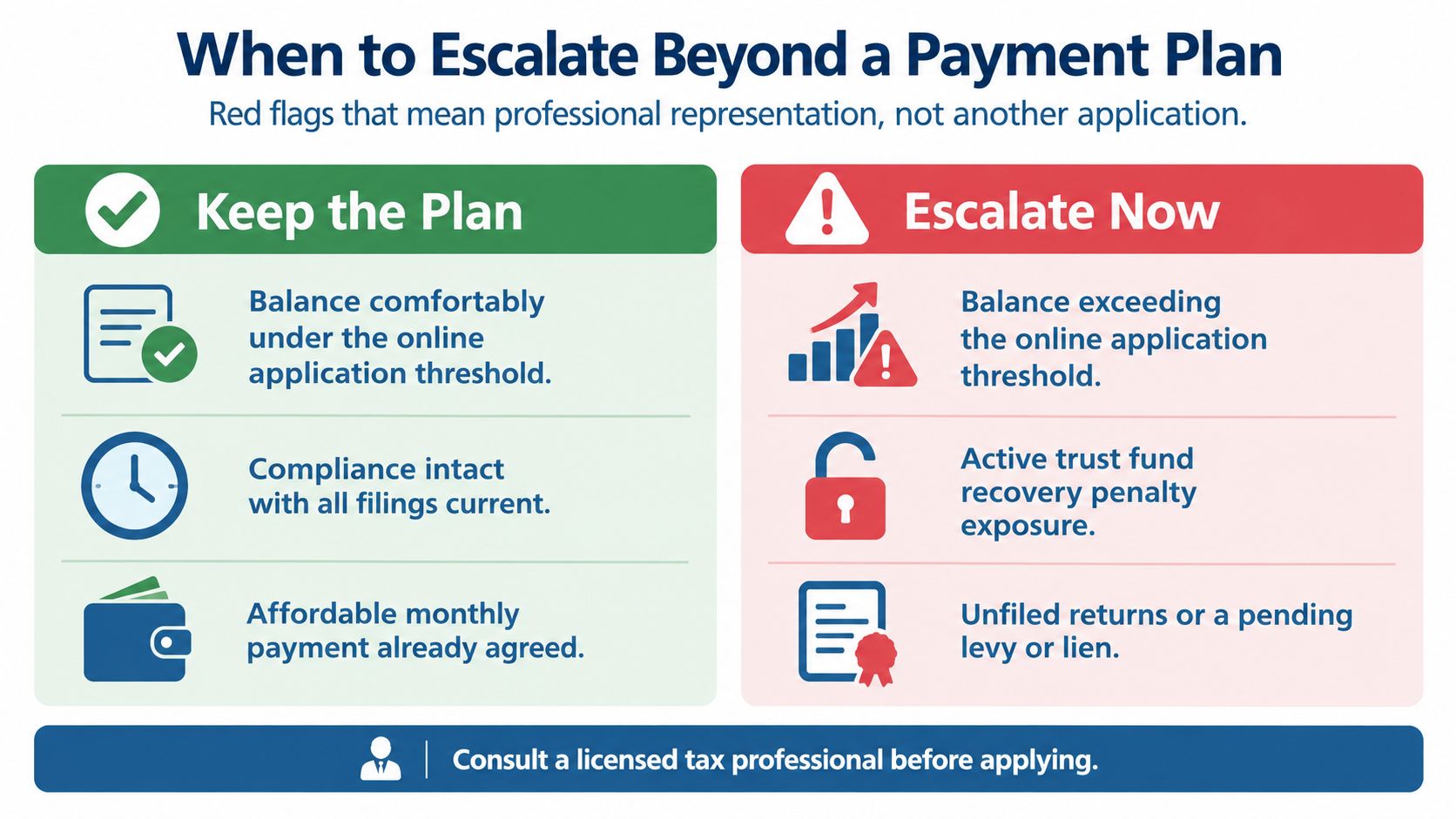
A payment plan is usually the wrong first move when the balance exceeds the online threshold, trust fund recovery penalty exposure is active, a levy or lien requires immediate attention, returns are missing, or the proposed payment would exceed reliable cash flow. Those facts can change both the application process and the negotiation strategy.
Signs that a different resolution may fit
A Partial Payment Installment Agreement may be relevant when the taxpayer can't fully repay the debt before the collection statute expires. The Taxpayer Advocate Service explains that installment agreements are the formal repayment option when repayment takes more than 180 days, and taxpayers generally may make payments until the collection period expires, which is usually 10 years from assessment.
An Offer in Compromise may fit a taxpayer who cannot reasonably pay the full balance from available assets and future income. It isn't an automatic discount and requires a financial analysis. Review the factors before assuming that an Offer in Compromise is appropriate.
Currently Not Collectible status may provide temporary collection relief where documented hardship prevents payment. It doesn't erase the debt, and the IRS can review the taxpayer's financial position later.
Payroll taxes deserve special handling. When an S-corp has unpaid trust fund amounts, officers or other responsible parties may face personal exposure. That risk makes professional representation more valuable than submitting another online request, particularly where the business must keep operating and remain current with new deposits.
Client-Ready Checklist and Next Steps
Before contacting the IRS or submitting an application, reduce the issue to a short worksheet. The objective isn't to choose the most convenient button. It's to match the taxpayer's legal structure, liability type, compliance status, and cash flow to the correct resolution path.
Use these prompts:
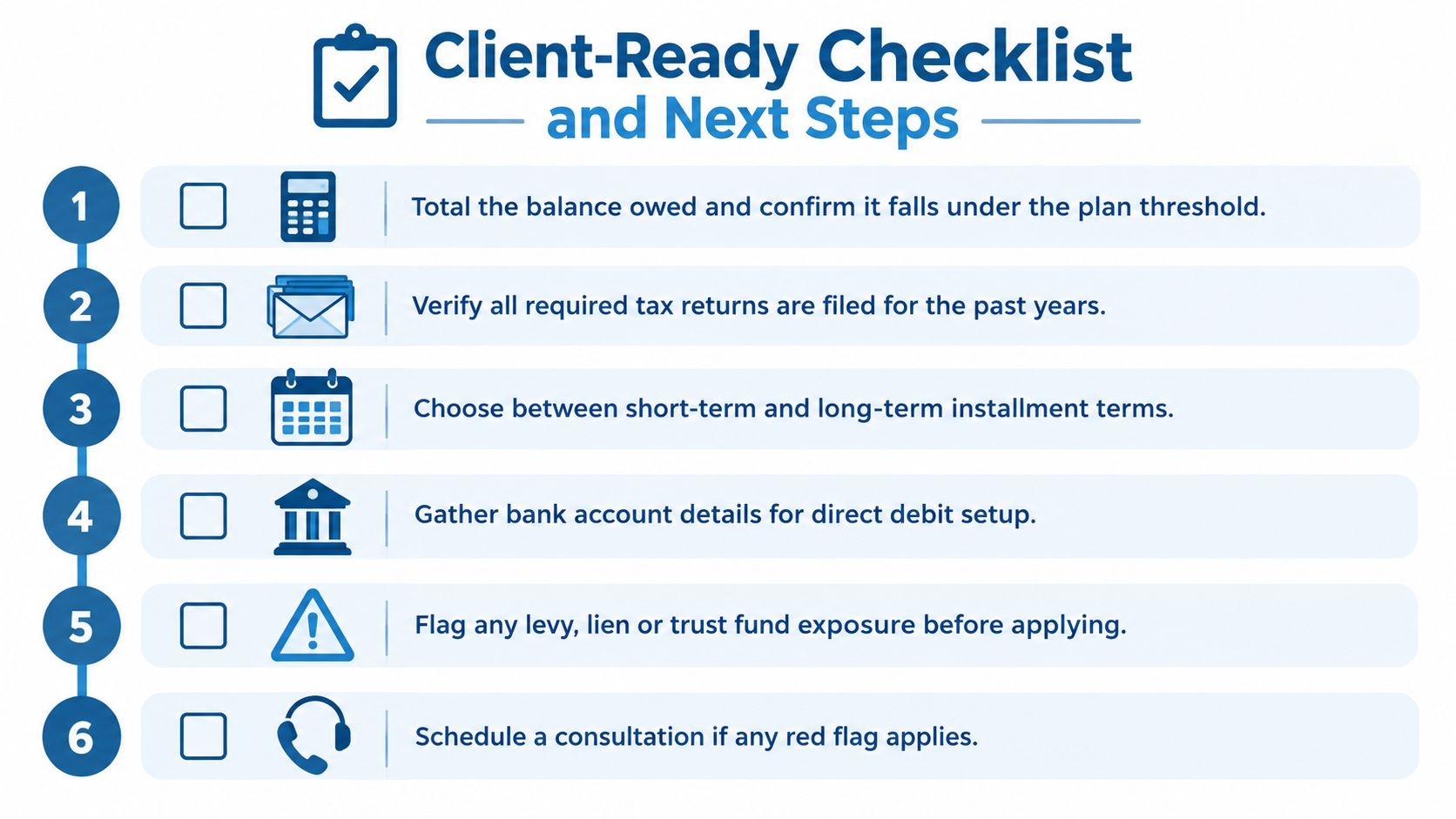
- Confirm the balance: Obtain the IRS account transcript and separate tax, penalties, and interest.
- Identify the taxpayer: Mark individual, sole proprietor, S-corp, LLC, estate, or trust.
- Match the plan: Decide whether payment within 180 days is realistic, or whether a long-term arrangement is needed.
- Check compliance: Confirm required returns are filed and current estimated payments and payroll deposits are being handled.
- Test affordability: Calculate a payment from dependable surplus cash, then account for federal, state, and local obligations.
- Flag escalation issues: Identify trust fund exposure, unfiled returns, pending levies or liens, multi-state filings, and business eligibility under the IRS Simple Payment Plan expansion announced in May 2026.
Create a 30-day action list for gathering records and stopping new compliance failures. Use the following 60 days to resolve missing filings, verify balances, and compare federal and state obligations. By 90 days, the taxpayer should either have a suitable arrangement in place or a documented escalation strategy.
If the balance exceeds $50,000, a trust fund recovery penalty is possible, or a disregarded entity has payroll history, book a consultation before submitting an online application. Blue Sage Tax & Accounting Inc. offers tax preparation, payroll and sales-tax support, multi-state filing assistance, and IRS and state notice response for individuals and small businesses.
Book your free consultation call today. Blue Sage Tax & Accounting Inc. can review your IRS balance, entity structure, payroll exposure, and payment-plan choices before you commit to an application. This article is general information and not tax advice for your specific situation.