You've collected customer payments and need money for household bills. Pay yourself as a sole proprietor through an owner's draw, generally not payroll: transfer cash from your business account to your personal account and record it as equity, not a deductible wage. Your business's net profit, rather than the amount you take home, determines the income reported on your individual federal return, generally through Schedule C. That's the core distinction in the IRS guidance for small businesses and self-employed owners.
Table of Contents
- How Do You Pay Yourself as a Sole Proprietor?
- How Do You Record an Owner Draw?
- How Do Federal Estimated Taxes Affect Your Draw?
- Do New York or New Jersey Rules Change the Payment?
- How Do You Keep Enough Cash for Taxes?
- When Should You Ask an Accountant to Set the Draw?
How Do You Pay Yourself as a Sole Proprietor?
Take documented draws after protecting money for business obligations and taxes. You can use a regular transfer schedule, but calling that transfer a paycheck doesn't make it deductible compensation.
Consider a hypothetical Queens electrical contractor with $400,000 in revenue. Revenue alone doesn't establish what the owner can afford to withdraw, because materials, employee wages, equipment costs, and other business expenses still need to be accounted for. For federal purposes in 2026, transferring $5,000 in a month doesn't create a separate wage deduction, leaving profit in the business generally doesn't defer federal income tax, and net self-employment earnings of $400 or more can trigger Schedule SE obligations under the IRS Schedule C and Schedule SE guidance.
Why the bank balance isn't your pay
A customer deposit can make your account look healthy while upcoming supplier bills make a large draw impractical. My recommendation is to set a repeatable draw schedule, then approve each transfer against updated books and a tax projection, not your available bank balance alone.
Practical rule: Decide what the business must keep before deciding what you can take home.
Customers generally don't withhold your taxes from business payments. The IRS self-employed individuals tax center explains why estimated payments are the usual way to pay federal income tax and self-employment tax during the year. Your draw schedule needs to accommodate those payments, even when household spending stays steady.
How Do You Record an Owner Draw?
Transfer the approved amount from a dedicated business account to your personal account and categorize it as owner draw or equity distribution. For a sole proprietor, including a single-member LLC taxed as a disregarded entity, don't put that withdrawal among deductible operating expenses.
In bookkeeping terms, the entry reduces business cash and records the withdrawal in owner's equity. Keep the transfer date, amount, bank confirmation, and a clear description so you can reconcile the transaction without guessing later.
Owner Draw Versus Mislabeled Pay
| Treatment | What happens to the cash | Effect on deductible expenses | Record to keep |
|---|---|---|---|
| Documented owner draw | Business cash moves to your personal account | No business expense deduction | Transfer confirmation and equity entry |
| Withdrawal mislabeled as owner salary | Cash leaves the business, but the category is wrong | Can incorrectly reduce reported profit | Corrected classification and original transfer record |
| Personal expense paid from the business account | Business cash pays a household bill directly | Doesn't become deductible merely because the business paid it | Receipt and personal-withdrawal classification |
Use a monthly approval routine rather than categorizing transfers at tax time:
- Close the books. Reconcile accounts and calculate year-to-date net profit.
- Protect committed cash. Reserve projected federal, state, and local taxes, operating needs, and upcoming bills.
- Approve the draw. Transfer only the amount the business can release without disrupting those commitments.
A withdrawal larger than current profit deserves review because it can strain cash and the owner's capital account. Draws also don't automatically create withholding, retirement contributions, or employee benefits, so handle those separately. Consistent small-business accounting practices make the distinction between personal withdrawals and business spending easier to maintain.
How Do Federal Estimated Taxes Affect Your Draw?
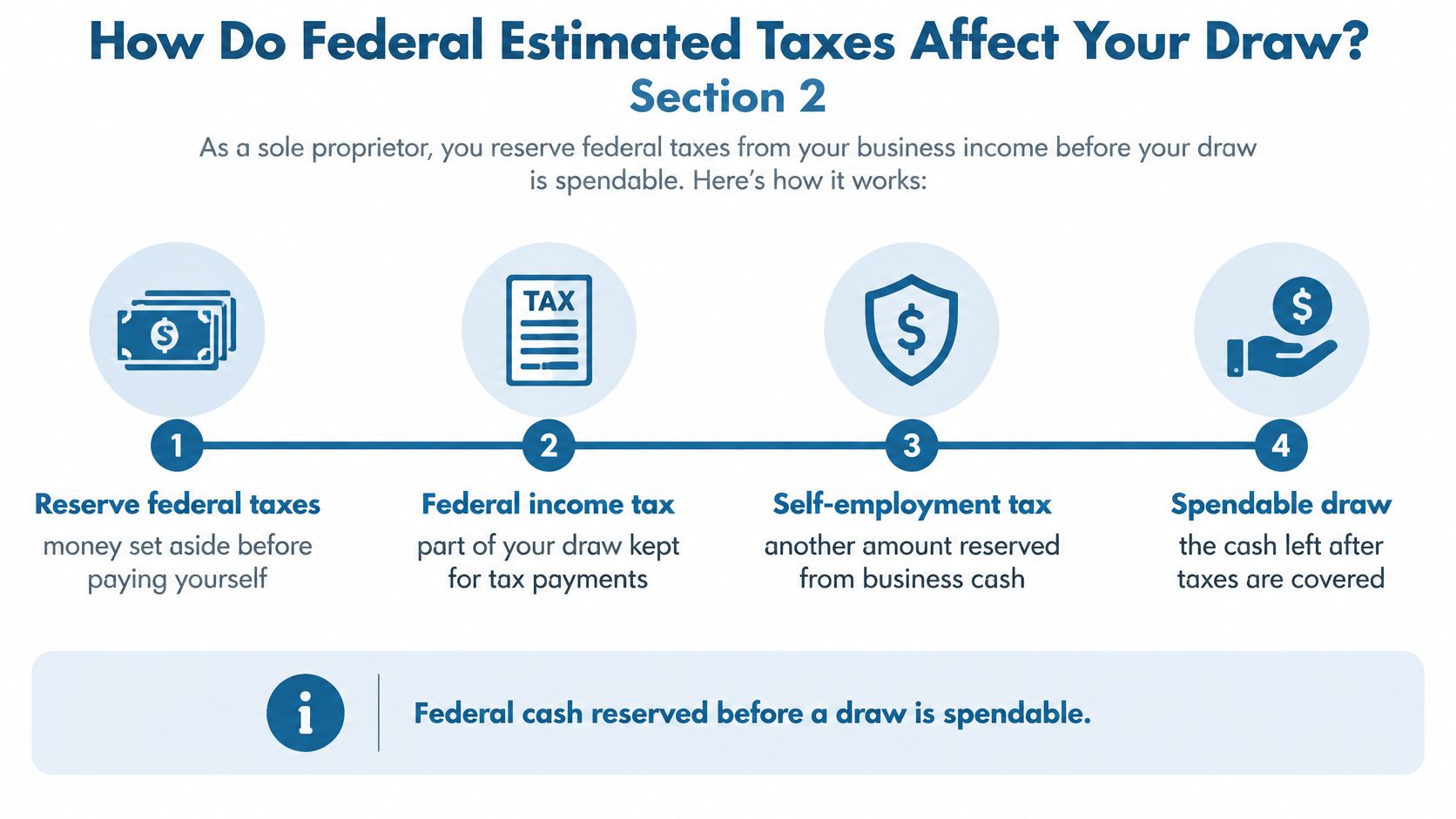
Reserve federal taxes before treating a draw as spendable cash. Your estimate should reflect expected annual profit and your household's broader federal tax position, not a flat assumption that every withdrawal carries the same tax cost.
The illustration shows the reserve-before-draw approach.
For tax year 2026, federal estimated tax generally applies when you expect to owe at least $1,000 after withholding and credits; the standard deadlines for the four estimated-tax periods are April 15, June 15, September 15, and January 15 of the following year, moving to the next business day for weekends or legal holidays. For calculations, the 2026 Form 1040-ES instructions use 92.35% of net self-employment profit to estimate self-employment earnings and allow a deduction for 50% of self-employment tax, as described in the supplied IRS federal estimated-tax guidance.
Match the reserve to the projection
Those calculation percentages aren't a universal tax-reserve rate. Use the applicable annual worksheets, and check thresholds and calculation rules each year because they can change.
The electrical contractor could take a steady draw while adjusting the reserve as profit, deductions, household withholding, or credits change. Federal underpayment penalties may apply when too little is paid by a period's deadline, even if the annual return ultimately produces a refund. A fuller explanation of how estimated tax payments work can help distinguish the payment schedule from the annual return.
The accompanying video provides another way to review paying yourself.
Do New York or New Jersey Rules Change the Payment?
State rules change what you need to reserve, not the basic draw process. Calculate the applicable New York and New Jersey obligations separately rather than applying a federal threshold to every jurisdiction.
New York specifically identifies sole proprietors, independent contractors, freelancers, and gig workers as people who may need estimated payments. For tax year 2026, payments generally aren't required when expected remaining tax, after withholding and allowable credits, is below $300 for New York State, below $300 for New York City, and below $300 for Yonkers; New York also describes protection tests of 90% of current-year tax or 100% of prior-year tax, increasing to 110% of prior-year tax for certain higher-income taxpayers, under its estimated-tax requirements.
Keep the jurisdictions separate
New Jersey says sole proprietorships and single-member LLCs report business taxes with the owner's personal taxes. For 2026, Form NJ-1040-ES instructions say someone expecting to owe more than $400 on the New Jersey income-tax return may need estimated payments, alongside the state's business filings and accounting guidance.
Consider a hypothetical restaurant owner who files in New York and New Jersey. That owner needs jurisdiction-specific projections based on the relevant income, deductions, credits, and withholding, not a single reserve labeled state taxes.
A payment threshold belongs to the jurisdiction that issued it. It isn't a national rule.
Both sets of figures above apply to 2026 and must be checked again for later years. Don't assume that sending a payment to one state resolves the other state's obligation, or that a New York State calculation automatically covers an applicable city obligation.
How Do You Keep Enough Cash for Taxes?
Use a three-account cash system: business operating cash, a dedicated tax reserve, and a personal account that receives approved draws. Maintain separate ledger categories for operating activity, tax reserves, and owner withdrawals so the bank balances and books tell the same story.
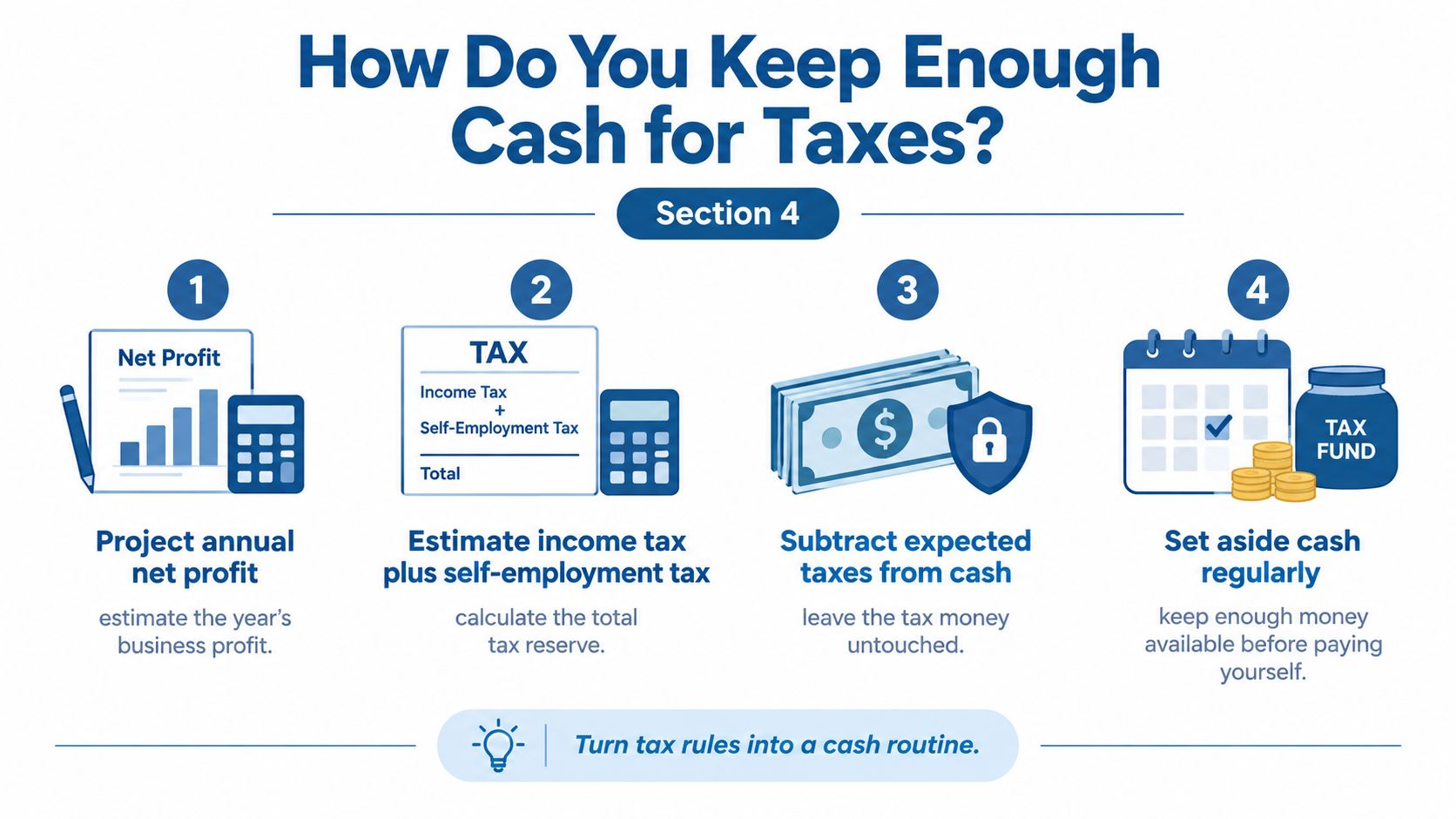
Start with projected annual net profit, estimate income tax plus self-employment tax, and subtract expected withholding and credits. Allocate the remaining liability across the scheduled payments, then reconcile the projection quarterly against actual year-to-date results.
This checklist illustrates the routine.
Reset the draw when the forecast changes
After each month-end close, update revenue, deductible costs, vehicle and equipment expenses, wages paid to actual employees, and multi-state activity. Adjust the next draw and estimated payment together rather than letting personal transfers continue unchanged when business results shift.
For 2026 federal planning, the commonly used underpayment-protection benchmark is paying at least 90% of current-year tax or 100% of prior-year tax, subject to applicable rules and higher-income exceptions; Form 1040-ES provides the calculation and payment framework in the IRS estimated-tax guidance. Meeting a protection benchmark doesn't necessarily cover the full eventual bill.
For organizing the cash side, Fintrack's discussion of a practical cash flow management system offers a supplementary resource. Keep the state projections separate, including the New Jersey test described above.
Before approving the next draw, check for these mistakes:
- Using gross receipts. Base the tax projection on net profit, not customer collections alone.
- Forgetting self-employment tax. Include it alongside federal income tax.
- Skipping state or city estimates. Review every applicable jurisdiction.
- Assuming uneven draws mean evenly spread taxes. Reconcile payment requirements against actual results and timing.
When Should You Ask an Accountant to Set the Draw?
You may be able to manage the routine yourself when you have a single business activity, steady profit, straightforward household taxes, and no multi-state filing issues. Ask an accountant for projection work when those conditions change, especially before increasing recurring withdrawals.
The useful question isn't how much you can transfer today. It's how much you can take while keeping upcoming operations and projected tax payments funded. An accountant should connect that answer to reconciled books, expected profit, and the rest of your individual return.
Recognize when a fixed draw needs review
Get help when profit swings, you file in multiple states, or you run payroll for employees while continuing to take owner draws yourself. Changes in household withholding and credits also deserve attention because they can change the estimated payments your business income requires.
Decision test: If you can explain the bank balance but can't explain the tax reserve, don't increase the draw yet.
Bring current financial statements, bank reconciliations, prior returns, estimated-payment records, and information about other household income. That gives the accountant a basis for evaluating the withdrawal schedule instead of offering a generic percentage.
The right deliverable is a usable projection and a clear draw recommendation, with assumptions you understand. Review it during the year rather than waiting until return preparation to discover that the cash you took home exceeded what you could comfortably spend.
Blue Sage Tax and Accounting Inc., an accounting firm in Bayside, Queens, offers year-round tax planning, quarterly projections, bookkeeping, and individual and business tax preparation for owner-operated businesses. Visit Blue Sage Tax & Accounting Inc. for help connecting your draw schedule to operating cash and projected federal and state obligations before year-end. Book your free consultation call today.
This article is general information and not tax advice for your specific situation.