
The popular advice, “just stay under the federal exemption,” is incomplete. To minimize estate taxes in 2026, first identify whether federal or state tax applies, then coordinate lifetime gifts, trusts, beneficiary designations, portability, and basis planning. The federal basic exclusion amount is $15,000,000 per person for 2026, while New York's estate-tax threshold is $7.35 million for 2026, so a family can be below the federal threshold and still face a state planning problem. IRS estate-tax guidance and New York threshold information show why the right plan depends on jurisdiction, asset type, marital status, and timing.
Table of Contents
- Why Estate Tax Planning Still Matters in 2026
- Which Exemption Actually Applies to You
- The Core Toolkit for Moving Assets Out of the Estate
- How Portability Can Double the Federal Shield
- Basis Step-Up and the Hidden Income Tax Trap
- Timing, Common Mistakes, and When to Call an Advisor
Why Estate Tax Planning Still Matters in 2026
Estate tax planning matters even when federal estate tax looks unlikely. New York's threshold is substantially lower, and appreciated property can create capital-gains consequences when heirs receive no basis adjustment. The right question is whether a gift or trust removes enough estate-tax exposure to justify the income-tax cost.
The federal basic exclusion amount rose from $13,990,000 in 2025 to $15,000,000 in 2026. The federal estate and gift tax system retains a 40% top rate above the applicable exclusion amount, according to the IRS. The CRS analysis explains that the exemption is inflation-indexed and examines the tradeoff between moving assets out of an estate and preserving a basis adjustment for heirs.
A trust strategy is not automatically a tax win. Compare projected estate-tax savings with the capital-gains cost before transferring an appreciated asset.
Four decisions should drive the plan:
- Jurisdiction: Identify whether federal, New York, New Jersey, or another state rule creates the exposure.
- Transfer vehicle: Match annual gifts, lifetime transfers, GRATs, QPRTs, ILITs, and business entities to the asset and objective.
- Portability: Married couples should protect the deceased spouse's unused federal exclusion through a timely estate-tax filing.
- Basis: Determine whether removing an asset is worth giving up a potential basis step-up at death.
A taxable New York estate, closely held business, multistate real estate, or recent death requires prompt review. Families far below applicable thresholds can use a lighter planning process, but they still need current beneficiary designations, accurate ownership records, and an estate plan that works together.
Portability deserves special attention because eligible couples can lose a valuable federal benefit by skipping the filing deadline. State taxes, basis step-up decisions, and that election often matter more than elaborate techniques aimed at a federal tax bill that may never arise.
Which Exemption Actually Applies to You
For 2026, the federal exemption is $15,000,000 per person, while New York's estate-tax threshold is $7.35 million. Those figures apply to different systems, and New York residents can't assume that the federal exemption protects them from New York estate tax.
| Factor | Federal Estate Tax | New York Estate Tax |
|---|---|---|
| 2026 threshold | $15,000,000 basic exclusion amount | $7.35 million estate-tax threshold |
| Annual adjustment | Federal amount is indexed and can change by year | New York threshold is indexed for inflation |
| Married-couple planning | Portability may allow the surviving spouse to use the deceased spouse's unused exclusion | Federal portability doesn't create a New York exemption |
| Main planning question | Will the gross estate plus adjusted taxable gifts exceed the federal exclusion? | Does the estate approach or exceed New York's lower threshold? |
The federal system generally becomes relevant when the gross estate, adjusted taxable gifts, and other includible property exceed the applicable exclusion amount. The IRS estate-tax statistics and filing guidance support using a complete asset inventory and Form 706 analysis rather than guessing from a net-worth figure.
New York requires closer attention because its exemption doesn't mirror the federal amount. The state's estate tax also has a cliff feature. The planning concern isn't limited to the amount immediately above the threshold, because an estate that crosses the threshold can lose the benefit of staying just under it under New York's rules. Don't treat the New York figure as a simple deduction against a federal calculation.
A New York resident with a home, investment accounts, life insurance, and a private business may be nowhere near the federal threshold yet still need New York-specific modeling. A restaurant owner filing in two states should also identify where real estate, business interests, and other property are located before selecting a trust or gifting strategy.
Connecticut may also matter in a multi-state review, but its rules and cap are separate from both federal and New York planning. Start with residency, asset situs, ownership, and beneficiary relationships. Then choose strategies. The estate tax lifetime exemption planning resource from Blue Sage can help frame that analysis before a client commits to an irrevocable transfer.
The Core Toolkit for Moving Assets Out of the Estate
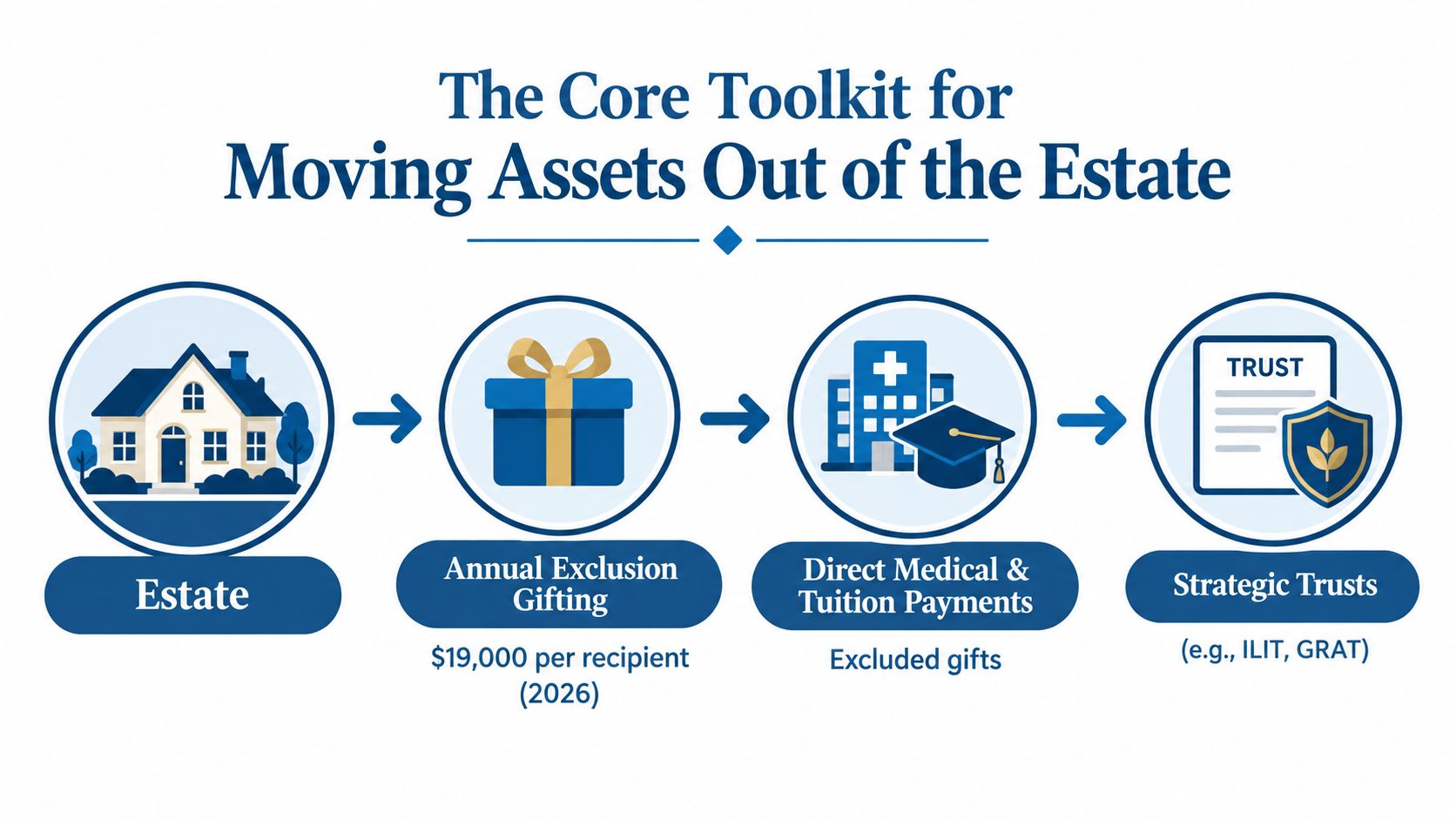
Fund $19,000 annual exclusion gifts first, then model whether a GRAT or QPRT justifies the potential basis cost before drafting an irrevocable trust. Direct payments to qualified medical providers or educational institutions can receive separate treatment when structured correctly. Keep records identifying the recipient and the expense covered.
Gifts above the annual exclusion generally use part of the donor's remaining lifetime exclusion and require gift-tax reporting. Filing a return does not automatically create gift tax, but the transfer reduces the donor's remaining federal shield. Model each substantial gift against expected appreciation, liquidity needs, control, and the recipient's basis before signing documents.
Which trust fits the asset
A GRAT, or grantor retained annuity trust, fits volatile or appreciating assets when the donor can retain an annuity while shifting future growth to beneficiaries. Valuation, the trust term, investment performance, and the donor's survival through the term determine the result. Do not use it for stable assets or clients who need unrestricted access to the property.
A QPRT can move a primary residence or vacation home while the donor keeps the right to live there during the trust term. Before using one, decide what happens when the term ends. The donor may need to pay rent and will no longer own the residence directly.
An ILIT, or irrevocable life insurance trust, can keep life insurance outside the insured's taxable estate if ownership and administration are handled correctly. The trustee, not the insured, must control the policy. Premium funding also requires timely notices and reliable documentation.
Family partnerships and LLCs can transfer partial interests in a closely held business or investment portfolio. Chapter 14 rules may restrict valuation discounts, so any discount must reflect genuine economics, governance, and marketability. A contractor with $400,000 in revenue may have no estate-tax issue from revenue alone. A valuable operating company, real estate, or life-insurance policy can change the calculation.
For families below the federal threshold, these structures are often the wrong first move. State estate taxes, future basis step-up, control of appreciated assets, and cash needs usually decide whether a transfer helps. Build the state and income-tax comparison before giving away property that may receive a better basis adjustment at death.
How Portability Can Double the Federal Shield
Portability is one of the most overlooked federal estate-tax elections. It lets a surviving spouse use the deceased spouse's unused federal exclusion, preserving planning capacity without transferring the deceased spouse's property. It does not create a New York exemption, and it does not replace every trust strategy, but it can reduce the need for complicated federal planning.
The executor generally must file a complete Form 706 within nine months after death. A six-month extension may be available. That return elects the deceased spousal unused exclusion, or DSUE. The IRS portability FAQs explain that the return must be timely and complete, including cases where no estate tax is otherwise due.
Use this workflow immediately after death:
- Inventory individually titled assets, jointly owned property, retirement accounts, insurance, and beneficiary designations.
- Estimate the gross estate and adjusted taxable gifts.
- Determine whether Form 706 is required for tax, portability, or another election.
- Calendar the nine-month deadline and request an extension early if needed.
- Keep the filed return, appraisals, and supporting valuation records for the surviving spouse's future planning.
| Scenario | Without Portability | With Portability | Tax Saved |
|---|---|---|---|
| First spouse dies and no election is filed | The survivor generally cannot use the deceased spouse's unused federal exclusion | Not applicable | Cannot be determined without the estate facts |
| First spouse dies and a timely DSUE election is filed | The survivor uses only the survivor's own available exclusion | The survivor may use the deceased spouse's unused federal exclusion for future gifts or the survivor's estate | Depends on future transfers, values, and applicable law |
| Estate is below the federal filing threshold but the executor files for portability | The unused exclusion may be lost | The election preserves potential federal planning value | Depends on the survivor's later estate and gifts |
For couples whose combined assets are below roughly $30,000,000 in 2026, portability can preserve a federal shield reflecting two exclusions when the election is properly made. The exact benefit depends on prior gifts, asset growth, and the law in effect when the survivor dies.
Do not treat the absence of tax at the first death as a reason to skip Form 706. Failing to file can permanently forfeit the survivor's access to the deceased spouse's unused federal exclusion. State-tax exposure remains a separate analysis, so portability should be reviewed alongside state planning rather than treated as a complete estate-tax solution.
Basis Step-Up and the Hidden Income Tax Trap
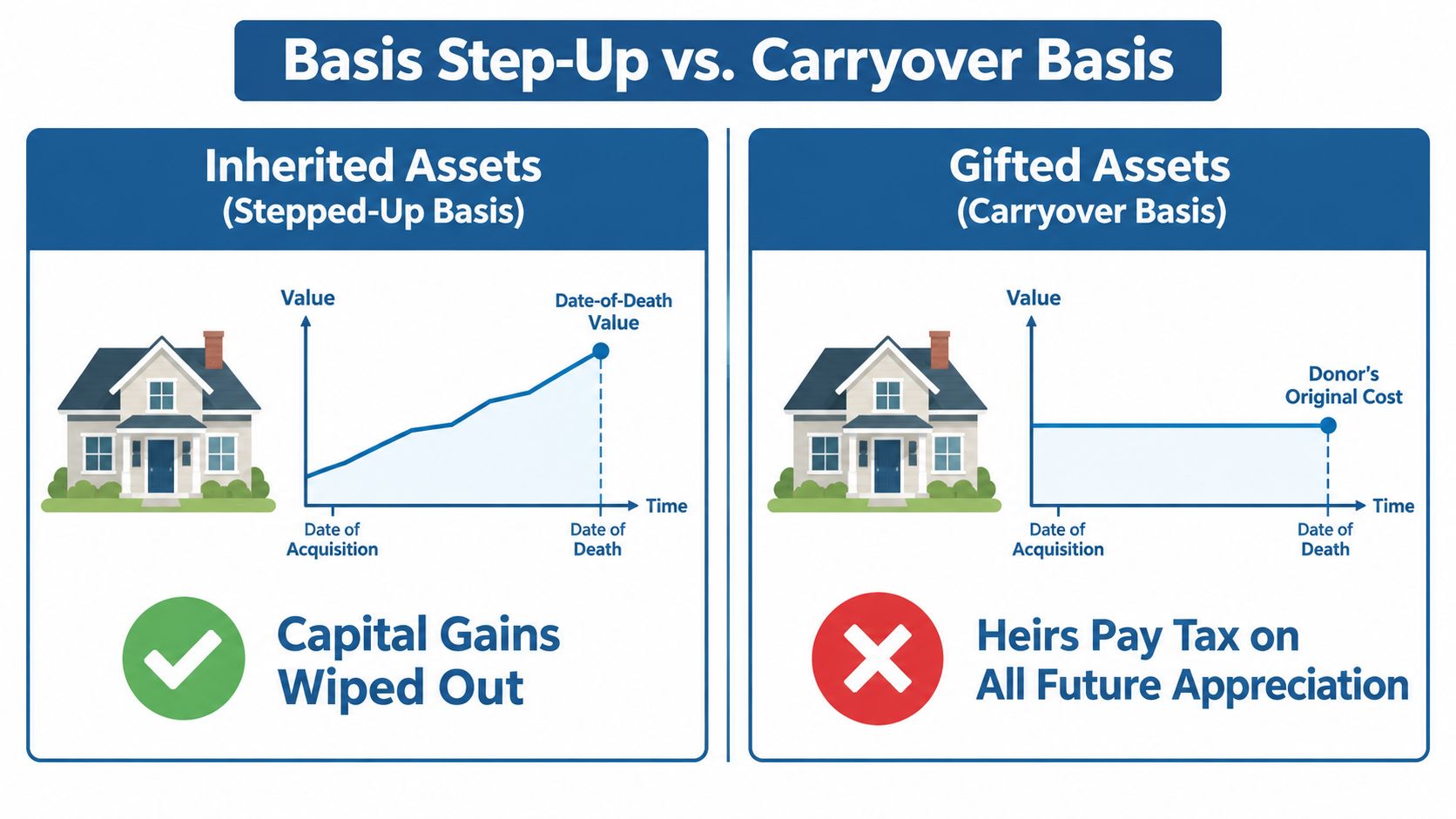
A gift can reduce the taxable estate while increasing the heir's future capital-gains exposure. Inherited property generally receives a basis adjustment to its date-of-death value, while gifted property generally carries the donor's basis forward. That difference can outweigh an estate-tax benefit when a low-basis asset is likely to be sold.
Consider a $5 million asset with a $1 million basis. A lifetime gift can remove the asset's value from the donor's estate, but the recipient may inherit the embedded $4 million gain through carryover basis. If the recipient sells, federal capital-gains tax, the 3.8% net investment income tax, and applicable New York tax may apply depending on the facts. The IRS discussion of inherited property and basis should be reviewed alongside the capital-gains implications of inherited property.
The decision depends on the asset's characteristics:
- Low-basis, highly appreciated property: Keeping it in the estate may preserve a basis adjustment, especially if heirs expect to sell.
- High-basis or recently acquired property: Gifting may create less income-tax friction when future appreciation is the primary concern.
- Operating businesses and real estate: Compare valuation, liquidity, holding period, depreciation history, and the heir's intended use.
- Assets the donor still needs: Don't give away essential liquidity merely to pursue a theoretical estate-tax reduction.
For a deeper visual explanation, this basis step-up video illustrates why estate-tax and capital-gains planning must be analyzed together. The right answer isn't “always gift” or “never gift.” It's an asset-by-asset comparison.
Timing, Common Mistakes, and When to Call an Advisor
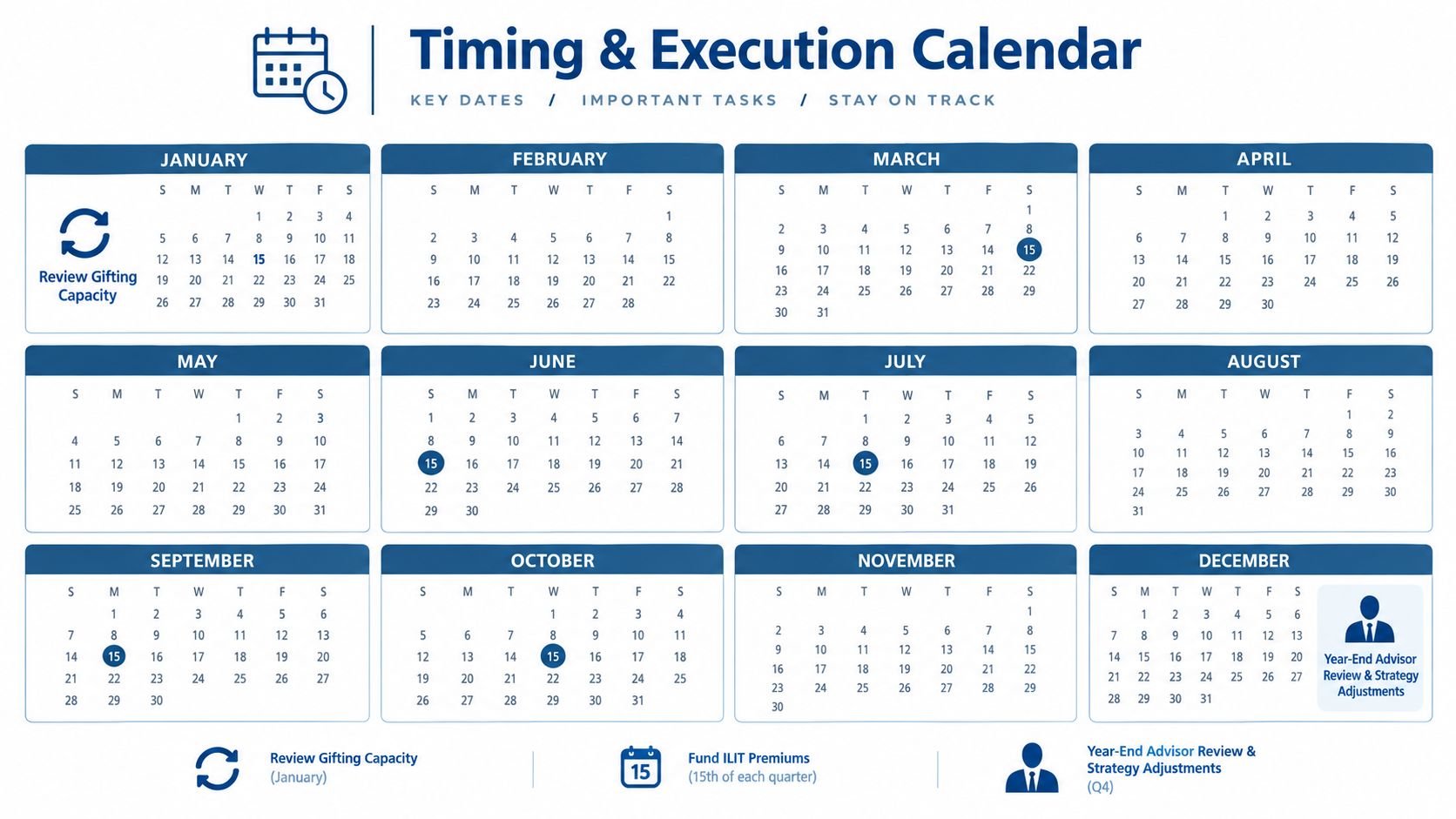
Timing decides whether an estate plan works as designed. Review gifting capacity at the start of each year, fund ILIT premiums before policy deadlines, consider GRATs or sales to intentionally defective grantor trusts during suitable income years, and begin portability work immediately after a spouse dies. Put these actions on a written calendar instead of relying on memory.
The mistakes that create avoidable exposure
The most common failures are administrative:
- Skipping portability: An executor assumes no federal tax is due, misses the Form 706 deadline, and loses the deceased spouse's unused federal exclusion.
- Ignoring gift-tax reporting: A gift may create no current tax, but failing to report it can leave valuation and lifetime-exclusion records unclear.
- Using an irrevocable trust without proper notices: ILIT premium gifts may require Crummey withdrawal notices. Missing them can undermine the intended gift treatment.
- Confusing federal and state rules: The federal threshold does not establish the New York threshold, and federal portability does not create a New York election.
- Overlooking New York's clawback rules: New York planning must account for the state's treatment of certain prior gifts when a resident dies above the state threshold. Obtain current New York legal and tax advice before making large transfers.
- Relying on outdated thresholds: Federal and state amounts adjust by tax year, so an old estate plan may no longer match the family's exposure.
A household with an estate above $5 million for federal planning purposes or above $1 million for New York planning purposes, a blended family, closely held business interests, or significant charitable goals should involve an estate-planning attorney and a tax professional familiar with multi-jurisdictional transfer tax. Those figures are screening points for professional review, not guarantees that tax is due. Blue Sage Tax and Accounting Inc. provides tax projections, trust and estate return preparation, gifting analysis, and multi-state tax coordination. Legal drafting belongs with an estate-planning attorney.
Execution rule: Put every transfer, notice, appraisal, return, and deadline on a written calendar. A complex strategy with incomplete paperwork is not a complete plan.
Review assets and beneficiary designations annually, reassess federal and state thresholds, model low-basis property before gifting, document business valuations, and treat a spouse's death as an immediate portability event. New York or New Jersey business owners, real estate investors, and multi-state filers should not let a federal-only calculation determine the plan.
Blue Sage Tax and Accounting Inc. can analyze your estate, lifetime gifts, business interests, trusts, basis issues, and multi-state exposure, then coordinate tax reporting with your estate-planning attorney. Book your free consultation call today.
This article is general information and not tax advice for your specific situation.