You're a U.S. taxpayer who paid income tax abroad, and the number on your foreign tax receipt isn't automatically your foreign tax credit. The foreign tax credit calculation generally starts with Form 1116, converts foreign amounts to U.S. dollars, separates income by category, and compares the foreign taxes paid or accrued with the U.S. tax attributable to foreign-source taxable income. The allowable credit is generally the smaller amount, subject to the IRS limitation rules and any required reductions. See the IRS overview of the foreign tax credit for the governing framework.
Table of Contents
- Understanding the Foreign Tax Credit Basics
- Calculating the Foreign Tax Credit Limitation
- Foreign Tax Credit Calculation Example
- Handling Unused Credits and Carryovers
- Documentation and Compliance Tips
- Strategic Planning for High-Net-Worth Individuals
Understanding the Foreign Tax Credit Basics
A U.S. business owner receives a foreign tax statement showing income tax paid overseas. That amount is a starting input, not the credit amount that belongs on the return. The foreign tax credit can reduce U.S. federal income tax attributable to income taxed by another government, but it does not refund every foreign payment. Eligibility, income sourcing, classification, exchange-rate treatment, and the tax type all affect the result.
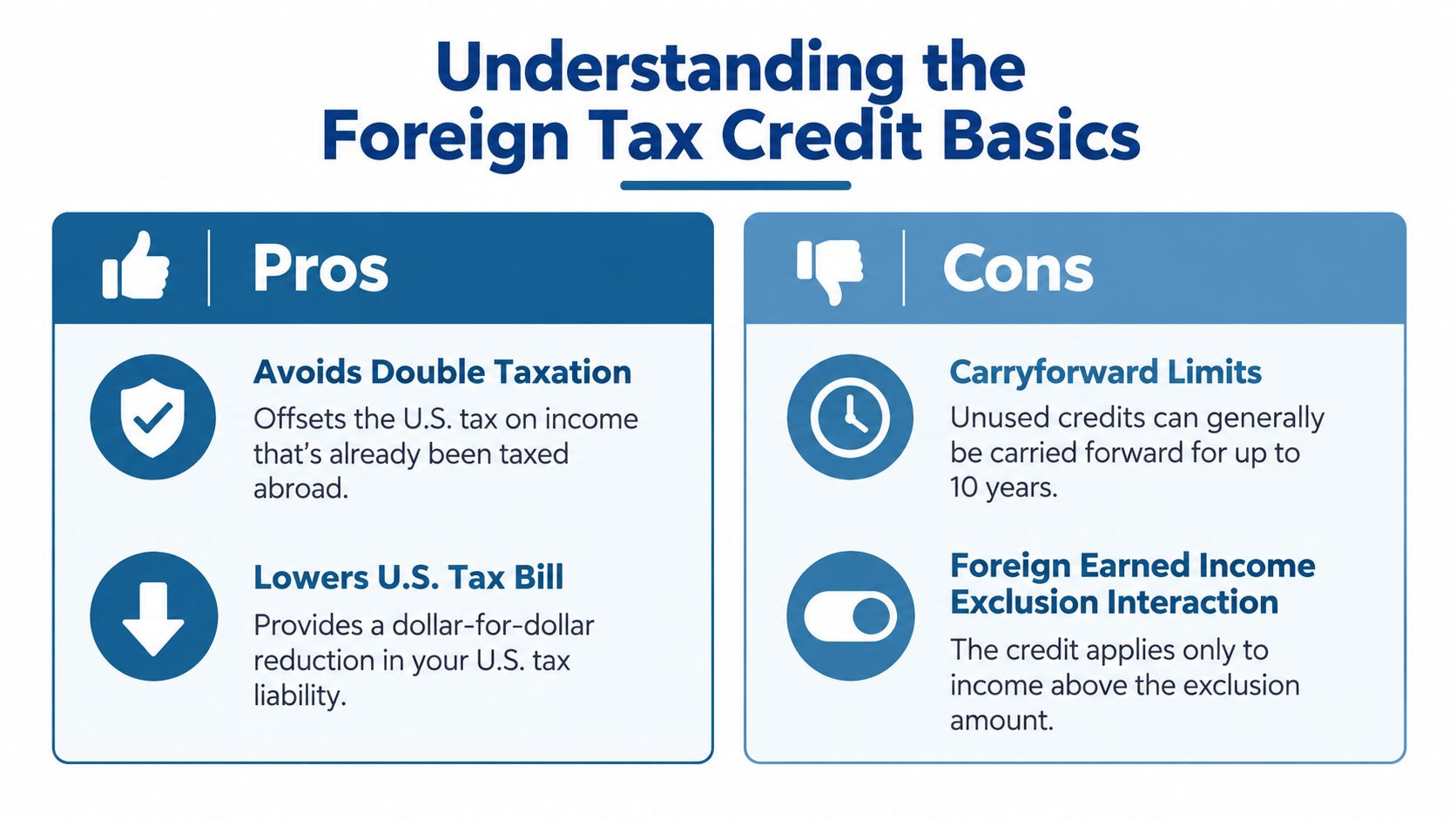
A credit reduces U.S. tax directly. A deduction reduces taxable income before tax is calculated. The credit is often the first option to test, yet it may not absorb the full foreign tax because the allowable amount depends on the U.S. tax attributable to foreign-source taxable income and the applicable limitation.
Credit or deduction
Start with the income connected to the foreign tax. A foreign income tax generally qualifies for the credit only when it is a legal, actual liability imposed on the taxpayer and connected to income. A payment shown on a foreign statement does not automatically meet those conditions, so it cannot just be entered on Form 1116.
The credit calculation requires determining the U.S. tax attributable to foreign-source taxable income. A deduction may apply when the credit is unavailable or when a full-return projection produces a better result. Compare both options using the complete return, rather than comparing the foreign receipt with the U.S. balance due.
Practical rule: Treat the foreign tax receipt as an input, not as the answer.
Contractors with foreign income may also have separate reporting and business tax concerns. For operational controls related to tax risk mitigation for contractors, accurate records remain the first line of defense. The foreign tax credit addresses federal income tax and does not replace proper business documentation.
Why Form 1116 matters
Form 1116 makes the calculation traceable. It requires the preparer to identify the foreign country, income category, foreign-source income, related deductions, foreign taxes paid or accrued, and the resulting limitation. That structure helps prevent the common error of combining wages, interest, rental income, and business income into one undifferentiated pool.
The form also separates the current-year calculation from unused credits that may carry to other years. See Handling Unused Credits and Carryovers for those mechanics. The broader rules are described in IRS Publication 514, referenced earlier, so the credit should be treated as a multi-year tax item rather than a simple subtraction from the foreign tax paid.
Calculating the Foreign Tax Credit Limitation
The allowable credit isn't automatically the total foreign tax paid. Under the federal limitation, the credit generally can't exceed U.S. tax liability multiplied by the ratio of foreign-source taxable income to total worldwide taxable income. The IRS describes the result as the smaller of the foreign taxes paid or accrued and the statutory limitation, after applicable reductions.
The basic relationship is:
U.S. tax liability × (foreign-source taxable income ÷ total worldwide taxable income) = limitation
This ratio matters because the credit is intended to offset U.S. tax on foreign-source income, not U.S. tax on domestic income. If foreign-source taxable income represents only part of worldwide taxable income, only the corresponding portion of U.S. tax enters the limitation calculation.
Build the calculation in the right order
A reliable workflow begins with income sourcing and classification, not with the foreign tax amount. First determine which income is foreign-source under the applicable federal rules. Then allocate deductions and losses that relate to that income, because the limitation uses foreign-source taxable income, not just gross foreign receipts.
Next, separate income into the required categories. Passive income and general category income, for example, are not casually combined on one calculation. Credits associated with one category generally remain tied to that category, so a high foreign tax payment on one type of income won't automatically offset U.S. tax arising from another.
All relevant income and foreign tax amounts must be converted to U.S. dollars. The exchange-rate method and timing need to be documented consistently with the reporting position. An unexplained conversion can undermine an otherwise reasonable calculation.
Use the IRS numerical framework carefully
The IRS provides a numerical framework for entering certain foreign-source income on Form 1116. When foreign-source income is taxed at 15%, the stated multiplier is 0.4054. At 20%, it is 0.5405. At 25%, it is 0.6757, and at 28%, it is 0.7568. These figures appear in the IRS's foreign tax credit compliance tips.
Those percentages are not general tax rates for every taxpayer. They reflect the relationship built into the Form 1116 limitation mechanics and must be applied in the context of the applicable form instructions, income category, and tax year. For a 2025 Form 1116, the IRS instructions should control the preparation, and amounts and filing requirements can change annually.
The most frequent analytical error is stopping after multiplying foreign income by a foreign tax rate. That may estimate foreign tax, but it doesn't determine the credit. The credit calculation must still account for U.S. tax attributable to the foreign-source portion, category separation, deductions, currency conversion, and reductions required under the federal rules.
Foreign Tax Credit Calculation Example
Consider a contractor with $400,000 in total revenue, including $100,000 of foreign-source income, who paid $20,000 in foreign income taxes. The figures are illustrative and are stated in U.S. dollars. They don't establish the contractor's actual taxable income, deductions, federal tax liability, or eligibility.
The first step is to determine the contractor's U.S. tax liability on worldwide taxable income. That figure must reflect the complete federal return, including allowable deductions and the treatment of the business income. Revenue isn't automatically taxable income, so using gross receipts in the final limitation without adjustment can produce the wrong result.
Apply the limitation
Assume the completed federal calculation produces a foreign tax credit limitation of $5,000. The contractor paid $20,000 in foreign income taxes, but the allowable current-year credit is generally the lesser amount. The usable credit in this illustration is therefore $5,000, not the entire foreign payment.
The unused amount is the difference between the qualifying foreign taxes and the credit used in the current year. Under the IRS carryover framework, unused qualified foreign income taxes can generally be carried back 1 year and forward 10 years, subject to income-category tracking and the special rule for section 951A income. The carryover isn't an immediate refund, and it may be usable only if the relevant category produces sufficient limitation in another year.
The arithmetic is simple. The classification and sourcing work determine whether the arithmetic is valid.
What this example leaves out
A real contractor's calculation may require allocation of business deductions, treatment of foreign branch income, separate Form 1116 categories, and support for whether the foreign levy is an income tax imposed on the contractor. A restaurant owner filing federal returns while operating in two states may also need to keep federal foreign-tax calculations separate from state income allocation and state credit rules. New York State, New York City, and New Jersey don't automatically follow the federal result in every respect.
That distinction matters for owner-operated businesses. A federal Form 1116 result doesn't resolve state sourcing, resident credits, nonresident allocations, or multi-state filing obligations. Those questions require a separate jurisdiction-by-jurisdiction review.
Handling Unused Credits and Carryovers
If the current-year limitation is lower than qualifying foreign taxes paid or accrued, the excess may become a carryover rather than disappearing immediately. The IRS generally allows a 1-year carryback and a 10-year carryforward for unused qualified foreign income taxes, with the carryback considered before the carryforward under the applicable rules. The IRS guidance on figuring the credit explains the qualification and carryover framework.
The choice between the two directions is practical. A carryback may connect excess foreign taxes to a prior year where unused limitation existed, while a carryforward preserves the amount for later years when foreign-source income or U.S. tax attributable to that income may be higher.
Carryback compared with carryforward
| Option | Potential use | Main condition |
|---|---|---|
| Carryback | Apply unused qualified foreign income taxes to the preceding tax year | The prior year must have sufficient limitation in the same category |
| Carryforward | Preserve unused amounts for later years | Future foreign-source income and category limitation must support use |
The records must remain separated by income category. A carryover connected to passive income generally can't be treated as a general category credit just because the general category has more U.S. tax available. The category is part of the identity of the carryover.
Section 951A income has a critical exception. Foreign taxes related to section 951A income generally can't be carried back or carried forward. Taxpayers with foreign corporations or interests that produce section 951A income need to isolate those amounts rather than placing them into an ordinary carryover schedule.
Carryover forecasting works best as part of an annual projection. A high-income year with substantial foreign taxes may generate unused amounts, but later usability depends on future foreign-source taxable income, the same income category, and the applicable U.S. limitation. A spreadsheet that tracks only the total foreign tax paid is not enough.
Documentation and Compliance Tips
The best Form 1116 file lets another preparer understand the calculation without reconstructing it from memory. Keep the foreign tax return, assessment, withholding statement, payment record, income statement, exchange-rate support, and reconciliation to the U.S. return. The documentation should show what was paid or accrued, which income it relates to, and how the amount became a U.S. dollar figure.
For 2025 Form 1116 instructions, the allowable current-year foreign tax credit is generally the smaller of the foreign income taxes paid or accrued on the foreign income, after required reductions, or the U.S. tax imposed on that foreign income as allocated under the limitation rules. The rule appears in the IRS 2025 Form 1116 instructions.
Build an examination-ready file
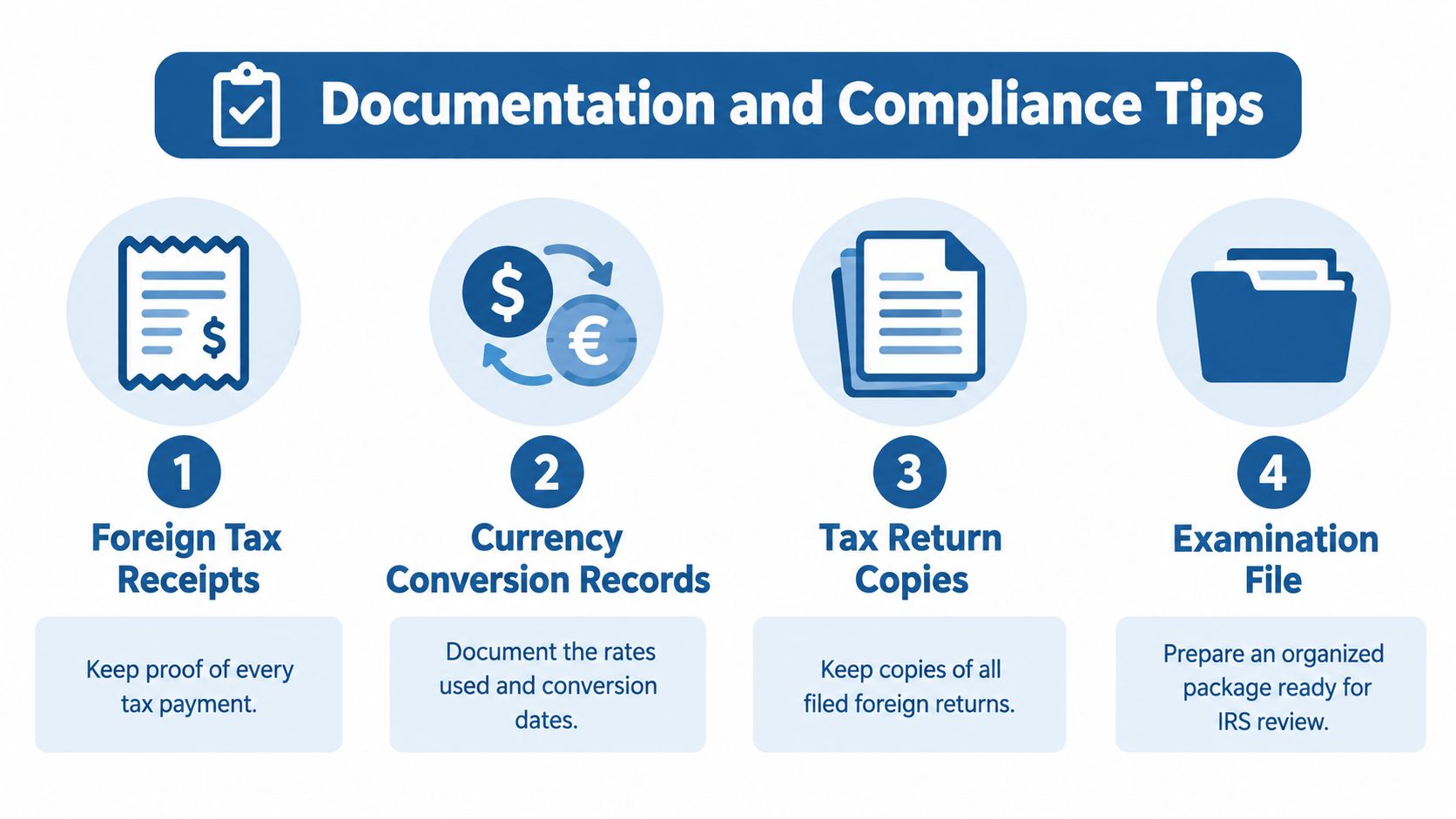
Use a checklist that follows the form rather than a folder organized only by country:
- Foreign tax receipts: Keep proof of payment, assessment, or withholding for each foreign levy.
- Currency conversion records: Document the exchange-rate source, date, and calculation used to convert income and tax to U.S. dollars.
- Tax return copies: Retain filed foreign returns and schedules that connect the tax to the reported income.
- Income-category support: Show why each item belongs in passive, general, foreign branch, section 951A, or another applicable category.
- Reduction analysis: Check whether reimbursements, refunds, subsidies, or other required reductions affect the amount eligible for the credit.
- Carryover schedule: Track each unused amount by year, country where relevant, and income category.
A common error is using the payment-date exchange rate for every item without considering the applicable reporting method. Another is reporting foreign gross income while overlooking deductions properly attributable to that income. A third is carrying forward an amount without proving where it originated.
Taxpayers with foreign accounts may also have reporting obligations separate from Form 1116. Keep those obligations distinct from the credit calculation, and review the foreign bank account reporting guidance when the facts require it.
Avoid category and tax-type mistakes
Not every foreign payment qualifies. The IRS requires the tax to be a legal and actual foreign tax liability, and a payment not tied appropriately to income may be disallowed. Withholding can also create mismatches when the amount withheld differs from the final foreign tax liability.
Don't attach Form 1116 with a single total and expect the form to sort out the analysis. For many taxpayers, Form 1116 must be attached to claim the credit, and the applicable income category determines how the tax and limitation are presented. The IRS Form 1118 instructions also confirm that unused amounts are tracked separately by income category for corporate taxpayers.
Strategic Planning for High-Net-Worth Individuals
For high-net-worth individuals and closely held businesses, the foreign tax credit calculation belongs in a multi-year projection. The key question isn't merely how much foreign tax was paid. It's whether the taxpayer has enough same-category foreign-source taxable income and U.S. tax limitation to use the credit when it matters.
Timing can affect the outcome. Income recognition, deductions, distributions, foreign tax payments, and changes in business operations may alter the limitation from one year to another. A projection can show whether a current-year credit is likely to be used, carried back, or carried forward, and whether the credit-versus-deduction choice deserves a closer comparison.

A business owner should also separate federal planning from state planning. New York State, New York City, and New Jersey may apply their own sourcing and resident-credit rules, so a federal foreign tax credit doesn't automatically settle the state return. The same is true for a taxpayer with rental property, equity compensation, a foreign business, and pass-through income across several jurisdictions.
A credit strategy that looks efficient on this year's federal return can create a tracking problem if the preparer doesn't preserve category and year information.
Blue Sage Tax and Accounting Inc. is an accounting firm that provides federal and state tax preparation, international tax support, expat and nonresident returns, and year-round projections. For taxpayers comparing foreign tax credits with other approaches, the guidance on avoiding double taxation is a useful starting point.
The practical planning file should include projected foreign-source income, expected foreign taxes, category assignments, prior carryovers, and the effect of major transactions. It should also identify facts that need specialist review, such as foreign corporations, treaty-resourced income, section 951A income, or changes in ownership.
A short explanation of the mechanical workflow can help business owners understand why the final credit differs from the foreign tax paid.
If your income, tax payments, or business operations cross borders, gather the foreign tax records before the federal return is prepared. Blue Sage Tax & Accounting Inc. can review the Form 1116 inputs, calculate the federal limitation, track eligible carryovers, and coordinate the foreign-tax analysis with applicable federal and multi-state filing work. Visit Blue Sage Tax & Accounting Inc. to discuss your facts and planning needs, then Book your free consultation call today.
This article is general information and not tax advice for your specific situation.