
In 2026, the federal estate and gift tax exemption is $15 million per person, and estate tax portability may let a married couple combine those exemptions to shield up to $30 million federally when the executor files a timely Form 706. Portability isn't automatic, and missing the filing window can permanently eliminate the deceased spouse's unused exclusion amount.
The practical issue for a New York couple is not just whether portability exists. It's whether the first estate's return is complete, filed on time, and coordinated with New York planning, trust terms, lifetime gifts, business interests, and the surviving spouse's future estate. The federal exemption amount adjusts annually, so a projection should always identify the applicable tax year. Fidelity's 2026 estate tax guidance provides the current federal figures and explains how the unused exemption can transfer to a surviving spouse.
Table of Contents
- What Estate Tax Portability Actually Means
- The Filing Deadline and Timely Election Process
- Comparing Portability to Alternative Planning Strategies
- How Portability Interacts with State-Level Rules
- Worked Example for a New York Family
- Common Pitfalls and Documentation Risks
What Estate Tax Portability Actually Means
Portability allows a surviving spouse to add the deceased spouse's unused federal estate and gift tax exclusion, called the deceased spousal unused exclusion amount, or DSUE, to the survivor's own exclusion. For 2026, that can mean a potential combined federal exclusion of $30 million for a married couple, but only if the executor properly files the required estate tax return. Fidelity explains the 2026 exemption and the potential combined amount.
The compliance failure is usually procedural, not conceptual. The executor must file a complete Form 706 even when the first spouse's estate owes no federal estate tax and falls below the ordinary filing threshold. That return gives the IRS the information needed to calculate DSUE and records the portability election for the surviving spouse's later use.

Who qualifies for portability
The federal portability rule came from the Tax Relief, Unemployment Insurance Reauthorization, and Job Creation Act of 2010, signed on December 17, 2010. It applies to estates of people who died after December 31, 2010, when the decedent was survived by a spouse. Before that rule, an unused federal exclusion generally could not transfer to another person.
The American Taxpayer Relief Act of 2012 made portability permanent for 2013 and later years. The statutory history and election framework appear in IRS Revenue Procedure 2022-32.
Portability can matter even when the first estate appears comfortably below the federal tax threshold. The surviving spouse may later inherit additional assets, continue a business, hold appreciated real estate, receive life insurance proceeds, or make substantial lifetime gifts. Those changes can increase the taxable value of the survivor's estate and make the preserved DSUE more valuable.
Practical rule: A nontaxable first estate may still need a Form 706 if the family wants to preserve the deceased spouse's unused exclusion.
Portability is separate from leaving assets to a spouse. The marital deduction may defer federal estate tax, but it does not transfer unused exclusion by itself. The executor must make the election and document the calculation. For a Queens family, that federal election also does not replace separate analysis of New York's estate-tax exemption and state filing requirements. Families seeking broader background can review these estate tax answers from Cremation.Green as general information.
The Filing Deadline and Timely Election Process
The executor generally must file Form 706 within nine months after the decedent's death to elect portability. A valid extension of up to six months may be requested, but the extension doesn't remove the need to control the filing process. The return still has to be filed within the applicable deadline to preserve the election. The IRS Form 706 instructions describe the filing deadline and extension framework.
Treat the deadline as a project, not a reminder on a calendar. Estate documents, valuations, beneficiary designations, business records, property information, prior gift records, and tax returns may all affect the DSUE computation.
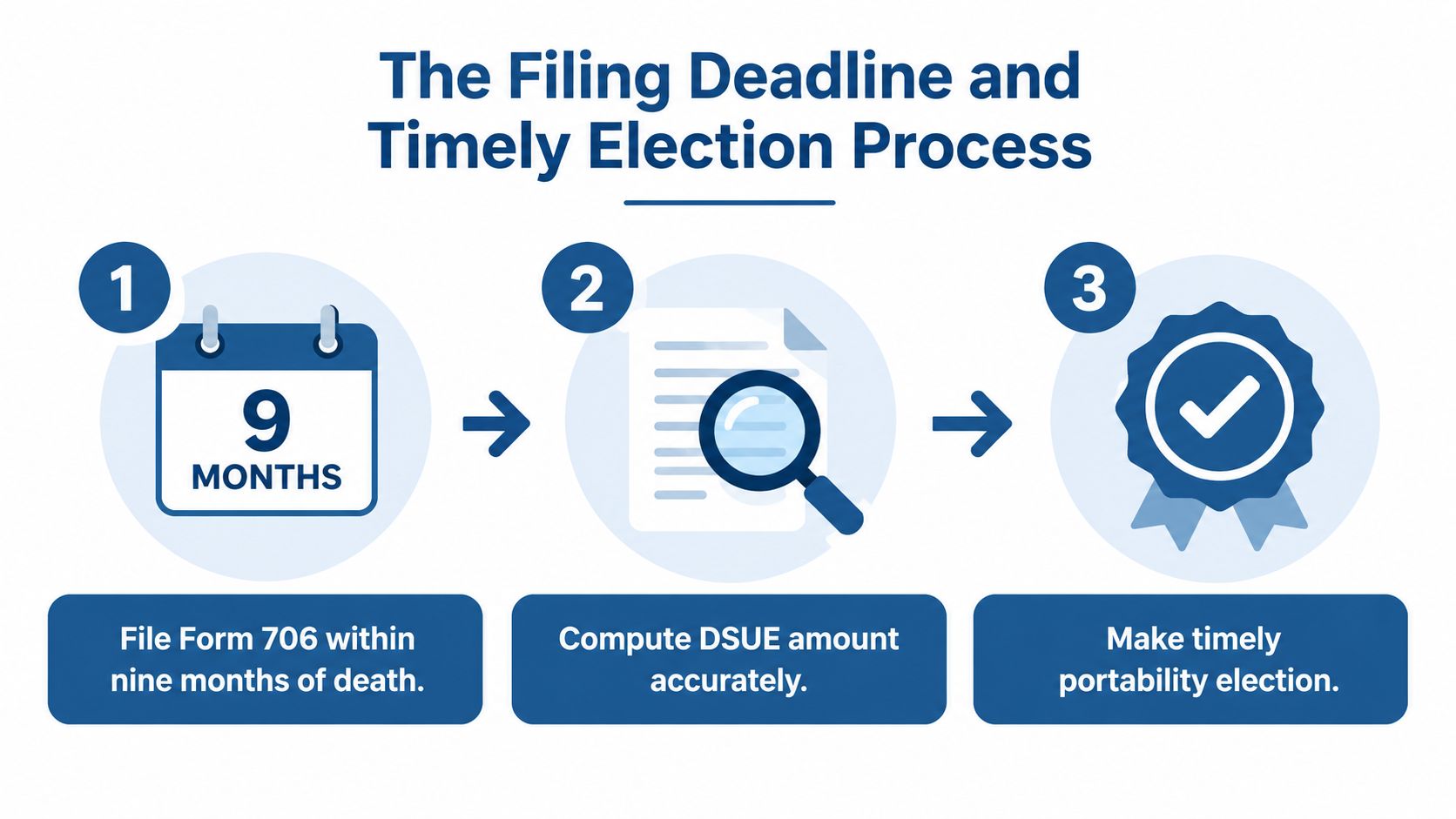
A workable filing sequence
Confirm the date of death and filing obligation. Start with the nine-month federal deadline. Don't assume that no estate tax is due means no return is required. The portability objective itself may create the filing obligation.
Assemble the estate inventory. Identify real estate, securities, business interests, retirement accounts, insurance, personal property, debts, prior gifts, and assets passing outside probate. Assets transferred to anyone other than the surviving spouse or a charity may require careful valuation and classification.
Compute the DSUE amount. The executor must calculate the unused exclusion on Form 706. The number depends on the deceased spouse's taxable estate, allowable deductions, prior taxable gifts, and other information relevant to the federal return.
Prepare a complete return. A return filed only as a formality can still fail if schedules, valuations, elections, signatures, or supporting information are missing. The IRS expects a properly prepared return, not an incomplete placeholder.
File and preserve the records. Keep the filed return, delivery evidence, appraisals, calculations, asset statements, and correspondence with the estate file. The surviving spouse may need these records years later when making gifts or preparing a second-death estate tax return.
Recent IRS guidance also recognizes a special late-election window that may extend to the fifth anniversary of death in qualifying cases. That relief isn't a reason to wait. Eligibility depends on the facts and the applicable procedure, and relying on late relief creates uncertainty that timely filing avoids. The 2026 Form 706 instructions discuss the special late-election window.
A missed deadline can prevent the surviving spouse from using the DSUE for later gifts or the survivor's estate. That is the central compliance failure. The family may have had no tax due at the first death, yet still lose an important federal planning option because nobody managed the return.
Comparing Portability to Alternative Planning Strategies
Portability is often simpler than creating and funding a trust, but simplicity isn't the same as control. It can preserve a federal exclusion for the surviving spouse, while a trust can control who receives assets, how assets are managed, and what happens after the surviving spouse dies.
A QTIP trust generally provides income and access for the surviving spouse while preserving restrictions over the ultimate beneficiaries. A credit shelter trust, also called an AB trust in some planning documents, can hold assets for the survivor without placing all those assets directly in the survivor's taxable estate. The right structure depends on family relationships, assets, state residence, business succession, and the couple's tolerance for administration.
| Planning approach | Cost and complexity | Control after first death | Protection and remarriage concerns |
|---|---|---|---|
| Portability | Usually less complex than trust funding, but requires a timely, complete Form 706 | Limited once assets pass outright to the survivor | May offer less protection from creditors, remarriage issues, or changes in the survivor's estate plan |
| QTIP trust | Requires drafting, administration, and careful qualification | Strong control over the survivor's access and final beneficiaries | Can help protect the intended remainder beneficiaries, including children from an earlier relationship |
| Credit shelter or AB trust | More involved drafting and ongoing administration | Preserves a separate trust structure for assets passing at the first death | May provide stronger control and protection than outright ownership, depending on the document and applicable law |
When portability may be enough
Portability may fit a married couple with straightforward beneficiaries, no material creditor concerns, no blended-family conflict, and a plan to keep assets under the surviving spouse's control. It can also be useful when the couple wants flexibility rather than a trust structure that requires separate administration.
That approach can create false confidence when the surviving spouse later remarries, changes beneficiaries, makes large gifts, or moves between states. The surviving spouse may also spend or transfer the inherited assets, while a trust could have preserved a separate pool for descendants or other beneficiaries.
When a trust deserves serious consideration
A trust may be more appropriate when one spouse has children from a prior relationship, owns a closely held business, expects future asset growth, wants creditor protection, or needs to control the ultimate disposition of property. It can also be relevant when the couple's state-level estate tax exposure doesn't match the federal result.
The federal portability election and trust planning aren't mutually exclusive. A couple may use portability for flexibility while also using a trust for control. For a deeper explanation of the trust structure, see Blue Sage's guide to credit shelter trusts.
Portability transfers a tax attribute. It doesn't automatically transfer asset protection, beneficiary control, or family governance.
How Portability Interacts with State-Level Rules
Federal portability doesn't automatically transfer a state estate tax exemption. New York and New Jersey must be reviewed under their own rules, even when the federal election is valid. For a Queens family, a federal Form 706 and a New York estate tax analysis are separate workstreams.
This distinction matters because the federal exemption is $15 million per person in 2026, while state exemption systems can be materially different and often lower. Recent estate portability guidance from The Tax Adviser highlights that federal portability can effectively double the federal amount for a married couple but doesn't replace state-level planning.
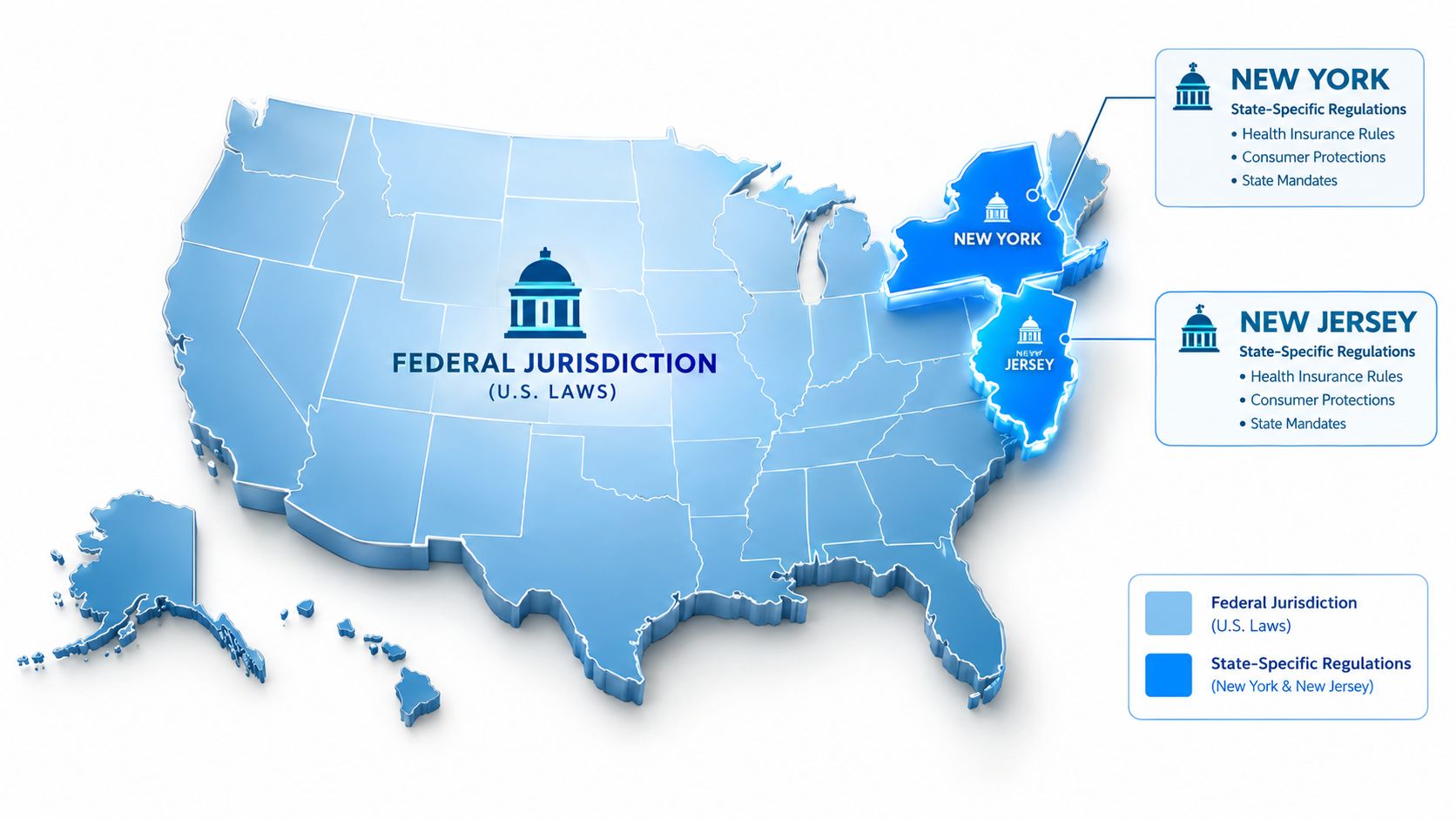
New York is not covered by the federal election
New York's estate tax system has its own exemption rules, filing requirements, and planning consequences. A federal portability election doesn't automatically carry a deceased spouse's unused federal exclusion into a New York calculation. The family needs a separate review of New York situs property, residency, deductions, trusts, and the size and character of the estate.
That review is particularly important for owners of Queens real estate, New York businesses, investment property, and interests that may change value after the first death. The relevant question isn't only whether federal portability was elected. It's whether the overall plan addresses both federal and New York exposure. Blue Sage's New York State estate tax exemption resource provides a starting point for that separate state analysis.
New Jersey and multi-state ownership
A restaurant owner filing in two states may have business interests, real estate, or operating activity connected to more than one jurisdiction. The residence of the decedent, the location of property, entity ownership, and state filing rules can affect the analysis. Federal portability doesn't consolidate those state obligations into one election.
Don't treat “SALT” as a single state-level solution for estate tax. State and local tax planning may matter to the operating business, but state death taxes require their own review. A multi-state estate plan should map each property and business interest to the jurisdiction that may claim taxing authority.
Worked Example for a New York Family
Consider a married New York contractor whose business produces $400,000 in annual revenue. Revenue measures business activity, not the contractor's taxable estate. The estate review must instead identify the value of the business interest, personal investments, real estate, insurance, retirement assets, prior taxable gifts, debts, and the couple's ownership arrangements.
Assume the first spouse dies in 2026 and leaves assets to the surviving spouse. The deceased spouse had already used $2 million of the federal exclusion through lifetime gifts. If the applicable exclusion is $15 million, the unused amount is $13 million. The executor must file Form 706 and calculate that DSUE amount. After a valid portability election, the survivor's available federal exclusion could be calculated as $15 million + $13 million = $28 million, subject to the filed return and applicable rules. The 2026 federal amount and DSUE mechanics are described by Fidelity.
Where the planning value appears
The surviving spouse may continue operating the contracting business, retain New York property, receive future business income, and hold investments that appreciate. Business value can also change as contracts, equipment, receivables, and real estate values change. A first death that creates little or no federal estate tax exposure can therefore precede a much larger survivor's estate.
Portability preserves federal exclusion for that later estate. It does not guarantee a zero federal tax bill, and it does not transfer the deceased spouse's unused federal exclusion into New York's separate estate tax system. New York's exemption and filing position require their own analysis, including the family's residency, New York property, deductions, trusts, and ownership structure.
The compliance failure is often administrative. If the executor misses the filing window, files an incomplete return, or cannot support the DSUE calculation, the survivor may retain the same business and property but lose the federal benefit. The first estate may have owed no tax. The election can still fail because the required filing was not completed properly and on time.
Why the contractor's revenue matters to the review
A contractor with $400,000 in revenue may hold fluctuating business value, equipment, receivables, real estate, retirement savings, and insurance outside a simple personal balance sheet. The estate plan should identify those assets before death and establish who can obtain records, appraisals, ownership documents, and beneficiary information.
The same issue appears with a restaurant owner operating or filing in two states. Federal portability addresses the federal exclusion only. State filings, property location, entity interests, residency, and possible state death taxes require separate coordination. Treat the federal election as one planning component, not as a state-level exemption or a substitute for multi-state review.
Common Pitfalls and Documentation Risks
The most dangerous assumption is that portability is a checkbox. The IRS requires a timely and complete return, and the executor must compute the DSUE amount rather than just announce that the exemption should transfer. The initial DSUE figure may also be redetermined later in certain circumstances, so the first calculation isn't always permanently final. The IRS Form 706 explains the DSUE computation and possible later redetermination.
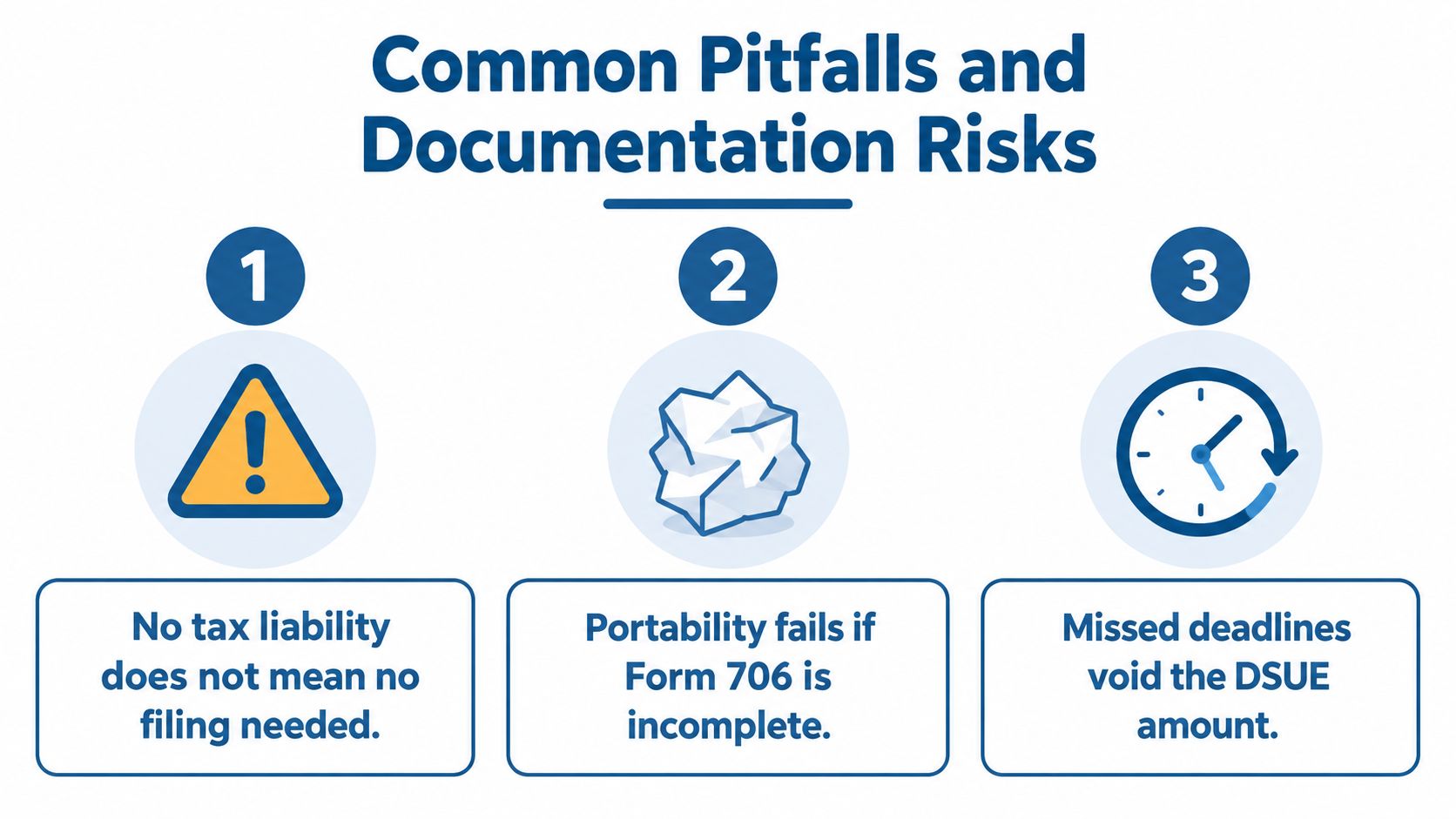
Documentation problems that can defeat the election
- No tax liability does not mean no filing needed. The executor may focus on paying no federal estate tax and overlook the separate objective of transferring DSUE.
- An incomplete Form 706 creates exposure. Missing schedules, unsupported values, unclear ownership, absent signatures, or inconsistent beneficiary information can undermine the return.
- A deadline error can eliminate the benefit. The executor may request an extension but still fail to file by the extended deadline, or may assume late relief is automatic.
- Valuation gaps affect the calculation. Closely held businesses, real estate, partnership interests, and other noncash assets need defensible values for the federal return.
- Poor records create problems later. The surviving spouse may need the original return and supporting schedules when making gifts or preparing a later estate tax return.
The return should be prepared for the survivor's future planning, not just for the first estate's closing file.
Families often coordinate estate tax work with probate administration, but those are distinct matters. Readers handling estates in another jurisdiction can review general information about probate options in Texas while recognizing that New York and federal filing requirements must be assessed separately.
Blue Sage Tax and Accounting Inc., an accounting firm, can assist with estate tax exposure analysis, projections, trust and estate returns, and multi-state tax coordination. The firm's work should be coordinated with the estate-planning attorney responsible for wills, trusts, beneficiary designations, and legal advice.
Reviewing the first spouse's filing deadline before death, assembling business and property records, and coordinating federal and New York analysis can help your family avoid treating portability as an automatic election. Visit Blue Sage Tax & Accounting Inc. to discuss the filing and projection work, then book your free consultation call today.
This article is general information and not tax advice for your specific situation.