Estate planning examples for affluent families commonly include a funded revocable trust for probate and incapacity planning, bypass and QTIP trusts for married couples, a GRAT for transferring appreciation, multi-state trust planning, and an ILIT with separate-property planning for blended families. The right choice depends on who controls the assets now, who should receive them later, what can trigger tax or court work, and whether the documents are funded and coordinated.
Which estate plan fits your family and assets? Usually, the answer turns less on net worth alone and more on family relationships, business succession, state residence, property location, and the federal or state rules that apply to that specific mix. Federal estate planning has evolved through major legislative changes, from the federal estate tax enacted in 1916, to the addition of the gift tax in 1932, to the unified estate and gift system in 1976, to the modern GST regime in 1986, and then to the Tax Cuts and Jobs Act of 2017, which doubled the base exemption and set up the sunset framework that still shapes planning conversations today, as summarized in this history of estate planning legislation.
That history matters because many people confuse probate avoidance with estate-tax planning. They aren't the same. A revocable trust may help avoid court administration for titled assets, while a different structure may be needed if the issue is appreciation transfer, marital control, or liquidity for a blended family.
Blue Sage Tax and Accounting Inc. is an accounting firm. It can help coordinate projections, trust and estate returns, and multi-state filing questions, while legal drafting belongs with an attorney. The scenarios below are estate planning examples, not promises or individualized advice.
Table of Contents
- Do I need only a will if I'm single and have no minor children?
- How do married couples balance a surviving spouse's security with children's inheritance?
- Is a GRAT a good estate planning example for a growing business owner?
- Do I need to file or probate in both states if I own property or operate in more than one state?
- How do blended families use life insurance and separate property planning without disinheriting someone by accident?
- 5-Scenario Estate Planning Comparison
- How should you put an estate plan into operation?
Do I need only a will if I'm single and have no minor children?
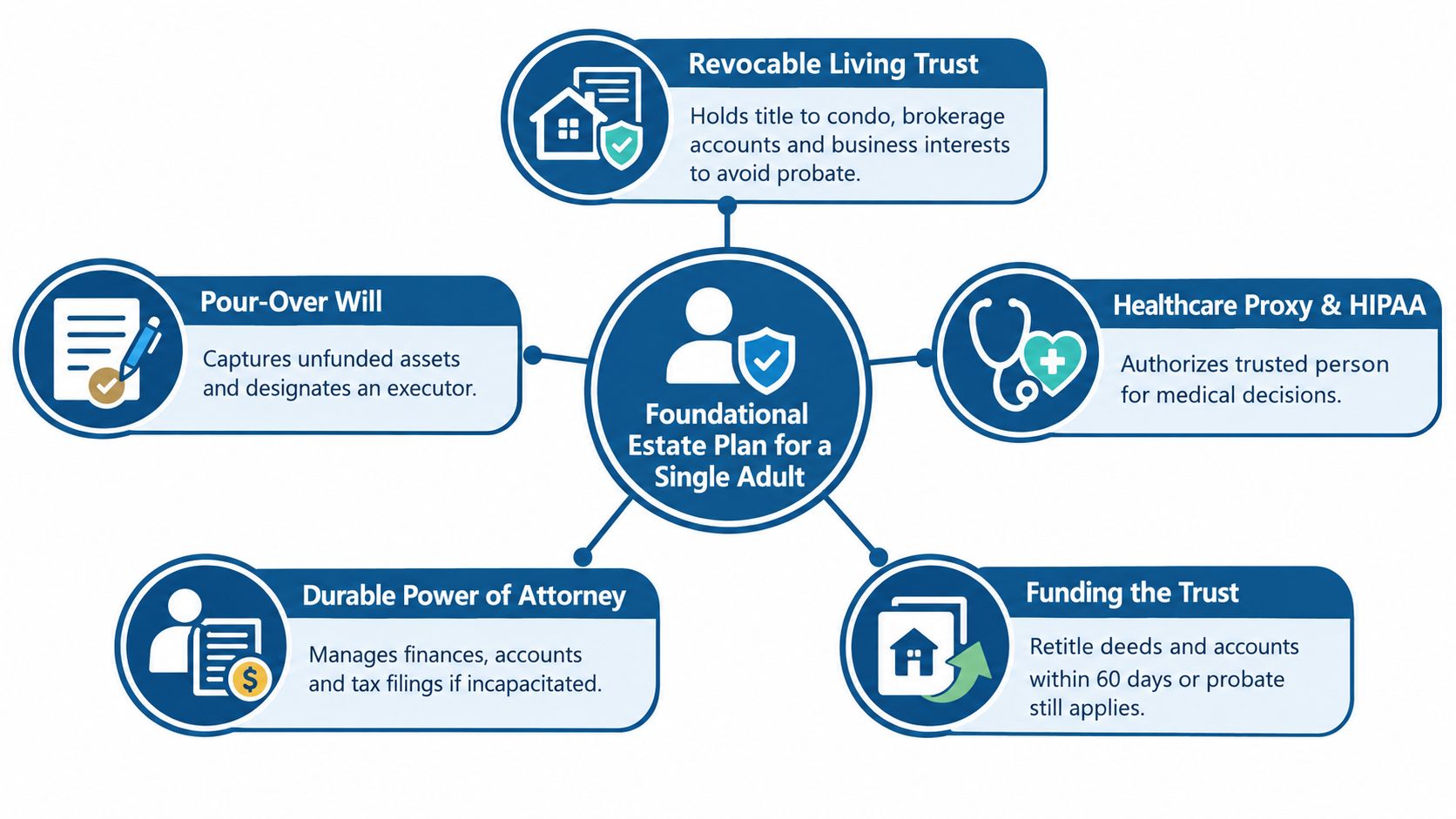
Usually, no. A will by itself may handle who receives assets at death, but it doesn't avoid probate for assets in your individual name and it doesn't replace a power of attorney or healthcare proxy during incapacity. A funded revocable living trust often works better when the concern is control during life and smoother administration later.
A single adult with no children often needs a very practical structure. Who can pay the mortgage if you're incapacitated? Who can access the brokerage account? Who can deal with the condo, business equipment, or a lease without waiting for a court process?
Who controls assets and what actually passes
A Queens freelance graphic designer earning strong 1099 income might hold a condo and brokerage account in a revocable trust, with her disabled sister named as successor trustee. A New Jersey construction contractor with substantial annual revenue might use the same structure so a chosen business successor can step in if he can't sign checks, deal with vendors, or manage equipment.
A revocable trust is useful here because the grantor keeps control while alive. But the trust has to be funded. An unfunded trust is mostly paperwork.
For a plain-English explanation, see Blue Sage Tax and Accounting Inc.'s overview of a revocable living trust.
Practical rule: If the deed, account title, or membership interest never changes, the trust usually won't control that asset when it matters.
One federal tax point surprises people. A revocable living trust usually doesn't change estate-tax treatment at death because the grantor keeps control, and trust assets are generally included in the taxable estate and receive a basis adjustment under IRC Section 1014. In the example discussed in The Tax Adviser on revocable trusts and basis adjustment, a home bought for $150,000 and later worth $700,000 inside a revocable trust resets to a $700,000 basis at death, so an heir selling shortly after for $710,000 recognizes only $10,000 of gain.
What triggers work and what gets missed
The common failure point isn't drafting. It's implementation.
- Retitle core assets: Move the condo deed, brokerage account, and relevant bank accounts into the trust promptly. Waiting months often defeats the point.
- Name the right successor trustee: Pick someone organized and willing to do actual administrative work, not just the closest relative.
- Coordinate business documents: If you own an LLC or operate under a buy-sell agreement, the trust and entity records should point in the same direction.
- Review incapacity documents: Healthcare proxies and powers of attorney should be revisited after major life changes and state moves.
People also forget digital access. If no one can find the password manager, phone records, or cloud files, the trustee may have authority on paper but still struggle in practice.
How do married couples balance a surviving spouse's security with children's inheritance?
For many high-net-worth couples, the hardest estate planning question is not who gets the assets. It is who controls them after the first death, how much access the survivor should have, what tax or probate work that choice creates, and what documents and asset titling must be in place for the plan to hold.
A bypass and QTIP structure is one of the clearest ways to answer those questions. It lets a couple separate support for the surviving spouse from the final destination of the assets. That distinction matters more than the label on the trust.
For a married couple with children, including adult children from a prior marriage, the planning lens stays the same. Who controls the assets after the first death. Who ultimately receives what remains. What triggers filings, valuations, or court process. What has to be funded correctly so the structure works in practice.
Who controls what after the first death
Take a married couple who own a restaurant group and the real estate under it. An outright transfer to the survivor gives maximum flexibility, but it also gives the survivor full power to change beneficiaries, spend principal freely, or leave the business interests in a different direction later. Some families want that result. Others do not.
A bypass trust and QTIP arrangement gives more control over those trade-offs.
The bypass trust can hold the first spouse's allocated share and preserve it under the terms set at the first death, subject to current law, valuation, and proper funding. The surviving spouse can still receive distributions if the standard allows it, but the survivor does not receive outright ownership. The QTIP trust can qualify for the marital deduction while requiring that the remaining assets pass to the chosen remainder beneficiaries, often the children, when the surviving spouse dies.
That is why these plans show up so often in second marriages, family business situations, and marriages where one spouse is more comfortable giving support than giving unlimited control.
Blue Sage Tax and Accounting Inc. also explains the basic role of a credit shelter trust.
A QTIP plan works best when the couple wants the survivor protected and the remainder locked in.
Here is a short explainer before the embedded discussion.
What triggers tax and administrative work
For federal estate planning, the IRS says the basic exclusion amount for deaths in calendar year 2026 is $15,000,000 per person, and the annual gift tax exclusion for 2026 is $19,000 per recipient, with different return mechanics for portability and gift-splitting in some cases, according to the IRS 2026 inflation adjustments announcement. Those figures change. A bypass or QTIP clause that made sense a few years ago may produce a very different result after exemption changes, a sale of the business, or a move to a state with its own estate tax system.
The tax side is only part of the work. Administration usually starts at the first death, not the second. Someone has to determine which assets fund the bypass trust, which assets pass to the QTIP trust, whether a federal estate tax return should be filed to elect portability or QTIP treatment, and whether appraisals are needed for business interests or real estate. In community property and separate property states, the characterization of the asset can change the funding analysis, so state law matters.
Implementation is where these plans succeed or fail.
- Coordinate title and beneficiary designations: Retirement accounts, insurance, and transfer-on-death accounts can bypass the trust structure entirely if the designations point somewhere else.
- Draft clear distribution standards: If the surviving spouse is also trustee, the trust should state what distributions are allowed and when an independent trustee is preferable.
- Address business governance: Restaurant, medical, or real-estate owners should align operating agreements, shareholder restrictions, and succession documents with the trust terms.
- Plan for liquidity: If wealth is concentrated in operating assets or illiquid real estate, the plan needs a source of cash for expenses, taxes, equalization, or buyouts.
- File elections on time when needed: Portability, QTIP elections, and some state-level filings are deadline driven. Missing the filing window can limit flexibility later.
Is a GRAT a good estate planning example for a growing business owner?
It can be, if the main asset has credible upside and the owner can live with the annuity structure and irrevocability. A GRAT is less about current control over every future decision and more about shifting future appreciation above the hurdle built into the structure. It's not a cure-all for a weak business or messy governance.
A contractor with about $400,000 in revenue may still be building value and may not need a GRAT yet. But an electrical contracting company owner, or a real estate investor with a concentrated appreciating asset, may look at a GRAT when the issue is moving upside to the next generation without giving the whole asset away on day one.

Who keeps control and who gets the upside
In plain English, the owner contributes an appreciating asset to an irrevocable trust and keeps the right to receive annuity payments for a set term. If the asset outperforms the required assumptions built into the GRAT, the excess value may pass to the remainder beneficiaries.
That structure often appeals to business owners who expect appreciation but aren't ready for a full transfer. It also forces discipline. If the operating agreement is vague, or if no valuation work supports the transfer, the GRAT can create more administrative burden than benefit.
What must be implemented for the structure to function
A GRAT lives or dies on documentation and operations.
- Get a professional valuation: Closely held business interests need support at the transfer date.
- Choose the right asset: This works better with assets that may appreciate meaningfully over the GRAT term.
- Coordinate succession roles: Children or other beneficiaries need a governance path, not just a future ownership interest.
- Match the GRAT with the broader plan: A GRAT shouldn't sit off to the side while the revocable trust, buy-sell terms, and beneficiary designations point elsewhere.
Another advanced valuation-driven structure is family limited partnership planning. Court-approved discounts have included a 15% minority-interest discount plus a 20% lack-of-marketability discount in one reported result, while another case applied a 45% combined discount and valued interests at $33 million instead of full asset value, as described in this family limited partnership estate planning discussion. That's not the same as a GRAT, but it shows why valuation and control rights matter in advanced planning.
Use a GRAT when the asset may grow and the owner can tolerate irrevocable structure. Don't use it as a substitute for a business succession agreement.
Do I need to file or probate in both states if I own property or operate in more than one state?
Owning assets in two states often means your family will deal with two court systems, two sets of filing rules, and sometimes two tax regimes unless the plan is built to avoid that result.
Use the same decision lens here that applies in every estate plan. Who controls the asset during life and at incapacity. Who receives it at death. What triggers court involvement, tax filings, or valuation work. What paperwork has to be in place before anyone can act.
For multi-state owners, the first problem is usually administrative. Tax comes next.
A New York resident might own a vacation home in Vermont, a warehouse in New Jersey, or an LLC that holds rental property in Florida. A business owner may operate in one state, live in another, and sign leases, loan documents, and vendor contracts across both. Those facts do not automatically mean two probates. They do mean the title, entity structure, and beneficiary designations need to be checked with care.
What usually triggers work in more than one state
Real estate is the common trigger. If out-of-state real property is still titled in your individual name at death, the home-state probate often is not enough. The personal representative may need an ancillary probate or comparable local procedure where the property sits.
Operating in more than one state is different from owning property in more than one state. A company can do business across state lines without creating a second probate file, but the entity records still need to show who has authority to act after death or incapacity. If the decedent owned the membership interest or shares outright, the transfer of that ownership may still require appraisals, notices, and tax reporting even when no second real-estate probate is required.
State tax rules can add pressure around the margins. For New York decedents, the estate tax threshold is separate from the federal system, and the amount changes over time under state law. New York's basic exclusion amount is scheduled to be $7,350,000 for dates of death from January 1, 2026 through December 31, 2026, according to the New York State estate tax page. That matters because New York also applies a cliff, so a modest increase in taxable estate value can produce a very different filing and payment result than families expect.
What tends to work better
A funded revocable trust often reduces the risk of ancillary probate, but only if the assets were transferred to the trust and the local title work was done correctly. I see plans fail here more often from incomplete implementation than from bad drafting.
The practical review is straightforward:
- Confirm how each asset is titled: Deeds, LLC interests, partnership interests, brokerage accounts, and titled equipment should match the plan.
- Identify who can act: Successor trustees, managers, and agents under power of attorney need authority that banks, counties, and co-owners will recognize.
- Separate business operations from asset ownership: The operating company, the real estate holding entity, and the trust should not conflict on paper.
- Preserve records for later filings: Appraisals, capital accounts, basis records, and trust schedules often determine how expensive administration becomes.
A transportation business is a good example. If the owner lives in New York, holds New Jersey real estate personally, and never retitles that property to a trust or LLC, the family may face a New York probate plus a New Jersey proceeding. If the same assets are owned through a properly maintained structure, with deeds recorded and entity documents aligned, the family may still have tax returns and transfer paperwork, but court involvement is often narrower.
That is the trade-off. Better front-end implementation usually means less friction later. It also means more coordination now among the attorney, accountant, title professionals, and business counsel.
Multi-state administration is one of the places where accounting support matters most. Blue Sage Tax and Accounting Inc. can help model filing exposure and coordinate trust, estate, and multi-state compliance while the attorney handles the legal architecture.
How do blended families use life insurance and separate property planning without disinheriting someone by accident?
Blended-family plans fail for a predictable reason. Control, beneficiary design, and recordkeeping do not line up with the family's actual intent.
An ILIT and separate-property planning are often used together because they answer different questions under the same decision lens. Who controls the asset during life. Who receives value at death. What events create tax or administrative work. What has to be set up correctly for the plan to work when the family is under stress.

Who controls assets and who ultimately receives them
A physician in a second marriage may want a surviving spouse to have reliable support for life, while children from a prior relationship receive the remaining trust property later. A construction company owner may want the business to pass to his children, but still wants the surviving spouse to have cash that does not depend on selling company interests at the wrong time.
Those are different assets serving different jobs.
A QTIP trust is often used when one spouse wants to control the final destination of assets while giving the surviving spouse required income rights and, in some cases, limited access to principal under a stated standard. An ILIT is often used to create a separate pool of liquidity outside that structure, with the trustee, not the surviving spouse or children, controlling distributions under the trust terms. A related advanced structure is a SLAT, which one spouse creates for the other spouse's lifetime benefit to move assets out of the grantor's taxable estate, as described in this overview of 2026 estate, gift, and GST exemption changes and planning structures.
The trade-off is straightforward. More control over ultimate beneficiaries usually means more administration, more fiduciary decision-making, and less flexibility for a surviving spouse to rewrite the plan later.
What can trigger tax or administrative work
The mistakes here are rarely theoretical. They show up when a death benefit is paid to the wrong party, when a surviving spouse has more control than the tax design assumed, or when no one can prove whether an account was separate or marital property.
If an existing life insurance policy is transferred into an ILIT, advisors have to account for potential estate inclusion issues if the insured dies during the applicable lookback period. If the ILIT is funded with annual gifts, the trustee usually needs a process for Crummey withdrawal notices and proof those notices were delivered. If separate funds were used to pay premiums or acquire property during the marriage, tracing records need to be strong enough for counsel, fiduciaries, and sometimes a probate court to follow years later.
State law also matters. Community property rules, elective share rights, and probate procedures can change whether a plan works as expected, even when the documents look clean.
What must be implemented for the structure to function
Execution decides whether this plan protects anyone.
- Trace separate property from the start: Keep account statements, inheritance records, premarital balance sheets, and source-of-funds support.
- Keep beneficiary designations aligned: Retirement accounts, life insurance, and transfer-on-death assets can override the trust language.
- Set up ILIT administration before funding begins: Name a trustee who will send notices, maintain records, open accounts, and follow distribution standards.
- Define each asset's job: Business interests may be earmarked for children, while insurance proceeds or a marital trust support the surviving spouse.
- Choose fiduciaries for neutrality, not family politics: In blended families, an independent trustee or co-trustee often reduces later conflict.
A good blended-family plan is less about using every advanced tool and more about assigning each asset to the right purpose, with documents and administration that match. That is how families reduce the risk of accidental disinheritance.
5-Scenario Estate Planning Comparison
| Plan | Implementation Complexity 🔄 | Resource Requirements & Maintenance ⚡ | Expected Outcomes 📊 | Ideal Use Cases 💡 | Key Advantages ⭐ |
|---|---|---|---|---|---|
| Single Adult with No Minor Children, Will & Revocable Living Trust | 🔄 Moderate, draft trust + pour‑over will and fund trust (deed/account retitling) | ⚡ Moderate, attorney fees, time to retitle accounts; periodic reviews | 📊 Avoids probate for funded assets; clear incapacity directives; privacy preserved | Unmarried adults without dependents; freelancers, small business owners seeking probate avoidance | ⭐ Probate avoidance, privacy, seamless incapacity management |
| Married Couple with Children, Bypass Trust & QTIP | 🔄 High, multiple trusts, irrevocable funding at death, required tax elections | ⚡ High, estate attorney, accountant, Form 706 filings, ongoing trust accounting | 📊 Preserves estate tax exemptions, provides surviving spouse income while protecting principal for beneficiaries | High‑net‑worth married couples, blended families, couples near/exceeding exemption limits | ⭐ Maximizes tax savings, protects children's inheritance, controls succession |
| Business Owner with Succession Plan, GRAT | 🔄 High, irrevocable trust, annuity schedule, careful timing and valuation | ⚡ High, professional valuation, tax filings (Form 709/1041), trustee administration | 📊 Shifts future appreciation to heirs with minimal gift tax if growth exceeds Section 7520 rate | Business owners or real estate investors with high‑growth assets who want tax‑efficient succession | ⭐ Transfers appreciation efficiently while grantor retains income/control during term |
| Multi‑State Business Owner, Ancillary Trust & Probate Avoidance | 🔄 High, multi‑jurisdictional funding, deed recordings, state‑specific rules | ⚡ High, deeds, filings in each state, coordination with multi‑state tax professionals | 📊 Reduces or avoids ancillary probate, centralizes administration, lowers multi‑state administration time/costs | Owners with real property or operations in multiple states (e.g., NY/NJ owners with out‑of‑state assets) | ⭐ Avoids multiple probates and associated costs; simplifies trustee duties |
| Blended Family with Stepchildren, ILIT & Separate Property Agreements | 🔄 High, ILIT setup, separate property agreements, Crummey compliance | ⚡ High, insurance premiums, ongoing recordkeeping, legal/accounting support | 📊 Removes life insurance from estate, provides liquidity, preserves separate property for intended heirs | Second‑marriage couples, high‑net‑worth families seeking to protect children from prior marriages | ⭐ Protects separate property, provides liquidity for taxes/equalization, secures children's inheritances |
How should you put an estate plan into operation?
Start by matching the structure to the actual objective. A single adult often needs incapacity coverage and probate avoidance. A married couple may need control over what a surviving spouse can use and what children ultimately inherit. A business owner using a GRAT is usually trying to transfer future appreciation. A multi-state owner is trying to reduce administrative friction and avoid title-related surprises. A blended family often needs liquidity, clean asset characterization, and a controlled succession path.
The sequence matters. Inventory the assets and confirm exactly how each one is owned. Identify the beneficiaries, trustees, executors, and agents who would have to act. Then map federal and relevant state exposure, especially where residence, property location, or a business entity creates different filing or estate-tax questions.
A practical plan also requires coordination. Legal documents should line up with deeds, entity records, beneficiary designations, and insurance ownership. Trust funding has to be completed. The people named in the documents need access to what they'll need, and someone should know which returns may be required for the trust, the estate, or multiple states.
Recent consumer behavior also shows why a usable plan matters more than a theoretical one. A 2025 survey found that 83% of Americans say estate planning is important, but only 31% have a will and 55% have no plan at all, according to the 2025 Trust & Will estate planning survey commentary. The gap isn't just advanced tax strategy. It's follow-through.
For UK readers comparing systems, the planning pressure looks different by market. HMRC reported that in 2022 to 2023, 31,500 taxpaying estates generated £6.70 billion in inheritance tax liabilities, and 4.62% of UK deaths resulted in an IHT charge, according to the UK inheritance tax liabilities statistics. That isn't a U.S. rule, but it shows why estate planning examples must always be tied to jurisdiction.
Blue Sage Tax and Accounting Inc. can support proactive projections and trust, estate, and multi-state tax compliance where relevant. The drafting, deed work, and trust design itself should be handled by an attorney. The best plan is the one that's properly implemented, properly funded, and periodically reviewed as family structure, business value, and state exposure change.
This article is general information and not tax advice for your specific situation.
Blue Sage Tax & Accounting Inc. helps business owners and higher-income individuals coordinate the tax side of estate planning, including projections, trust and estate returns, and multi-state filing support. If your estate planning examples involve an LLC, S corporation, rental property, or cross-state ownership, visit Blue Sage Tax & Accounting Inc. to see how the firm can fit into your attorney-led planning team. Book your free consultation call today.