The standard due date for Form 1065 is the 15th day of the 3rd month after the partnership's tax year ends. For calendar-year filers, that means March 15, with the deadline moving to the next business day when March 15 falls on a weekend or legal holiday.
That date often arrives while a contractor is still closing its books, a restaurant owner is reconciling two states, or an LLC is waiting for final partner information. The risk isn't limited to filing the federal return late. Schedule K-1s follow the same compliance clock, so a delay can affect every partner's individual tax filing.
Table of Contents
- When Is the Standard Deadline for Partnership Returns
- How to File an Extension and Manage Schedule K-1 Delays
- What Are the Penalties for Missing the Filing Deadline
- Do State and Local Deadlines Match the Federal Rules
- How Do Special Cases Alter the Filing Clock
- What Is the Best Timeline for Partnership Tax Planning
When Is the Standard Deadline for Partnership Returns
For a domestic partnership, Form 1065 is generally due on the 15th day of the 3rd month after the end of the partnership's tax year. A calendar-year partnership ending December 31 therefore follows the March 15 deadline, while a fiscal-year partnership calculates its due date from its own year-end. The IRS tax calendar guidance confirms this federal rule and the adjustment for weekends and legal holidays.
The deadline is tied to the tax year, not to a universal date that applies to every partnership. If a partnership closes its books on a date other than December 31, count forward to the 15th day of the third month after that year-end.
How the calendar-year rule works
For the 2025 tax year, a calendar-year partnership's normal March 15 deadline fell on a Sunday. The return became due on March 16, 2026, the next business day, under the IRS rule for weekends and legal holidays. That same date applied to furnishing each partner's Schedule K-1.
The synchronization matters. Form 1065 reports the partnership's income, deductions, gains, losses, and credits. Each K-1 then allocates those items to an individual partner. Partners use that information for their own tax returns, so the IRS sets the partnership return and partner statements on the same federal deadline rather than treating them as unrelated filings.
Practical rule: Put the Form 1065 deadline and the K-1 distribution deadline on the same calendar entry. A partnership that tracks only the return can still leave its partners waiting for information they need.
Why fiscal-year partnerships need a separate calculation
A fiscal-year partnership doesn't copy the March deadline. Its filing clock starts when its tax year ends, then runs to the 15th day of the third month afterward. That approach has historically governed Form 1065 deadlines, which is why a partnership ending its books outside December can have a filing date in a different month.
A December 31 year-end normally gives the partnership roughly 74 to 76 days after year-end to file. Those figures describe the ordinary compliance window and vary with the calendar. If the partnership uses the automatic extension, the filing window can reach roughly 258 to 259 days after year-end, as described in the IRS Form 1065 instructions.
Don't wait for the deadline to confirm the entity's tax year. A new partnership, converted LLC, or business with an unusual accounting period may not follow the calendar-year pattern. Confirm the year-end shown on the prior return, formation documents, and accounting records before building the compliance schedule.
How to File an Extension and Manage Schedule K-1 Delays
A restaurant partnership operating in two states can finish its federal books while still waiting on state allocations, city filings, and partner capital updates. If the managing partner waits until the original deadline to address those items, the partnership may file late or issue unreliable K-1 information. Set the extension plan before the federal due date.
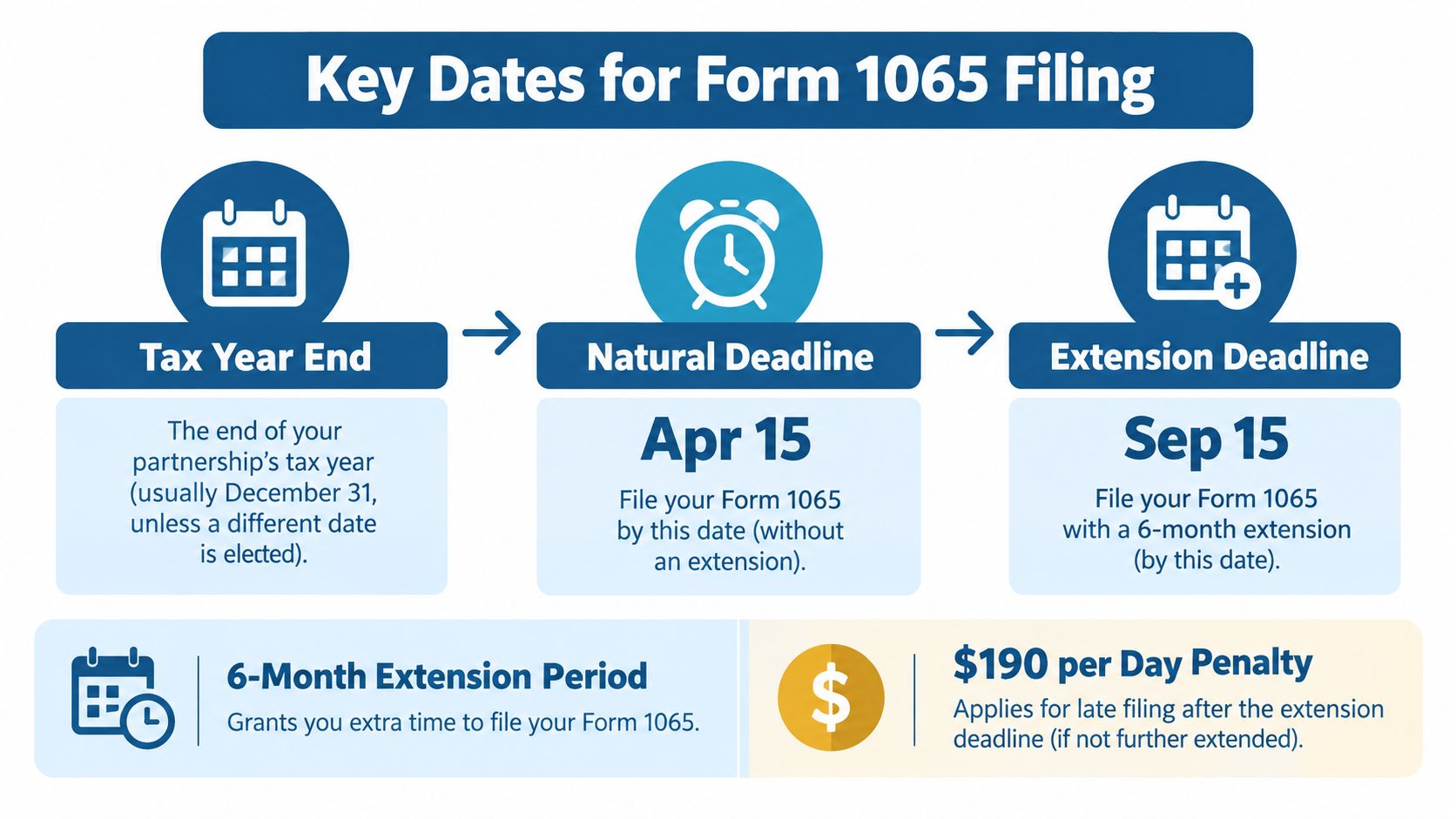
File Form 7004 by the original federal due date to obtain the automatic six-month extension for Form 1065. For a calendar-year partnership filing the 2025 tax year, that extension moves the federal filing deadline from March 16, 2026 to September 15, 2026. The Form 7004 instructions explain the filing process and timing. An extension does not eliminate the need to estimate tax obligations by the original deadline or tell partners when complete K-1 information should be available.
What Form 7004 changes
Form 7004 gives the partnership more time to complete and submit the federal return. The extension is six months, shifting a calendar-year partnership's 2025 tax year filing date to September 15, 2026. The request must be filed by the normal due date. Submitting it afterward does not fix an already late return.
Use that time to resolve revenue, inventory, depreciation, partner capital accounts, and allocation issues. Keep the bookkeeping current while the return is open, and assign someone to track missing records from each partner and operating location.
For a practical explanation of the filing process, review Blue Sage Tax and Accounting Inc.'s business tax extension deadline guidance.
Why K-1s create the operational bottleneck
Partners need Schedule K-1 to report their allocated partnership items on personal, state, and local returns. A restaurant partnership with operations in two states may also face separate state schedules and New York City filing requirements. Those layers can delay final allocations even after the federal books appear complete.
Because the extended K-1 date lands in September, partners who file estimated payments should revisit their second and third quarter estimates rather than assuming their March information is complete. They should also ask their tax professionals whether state or NYC estimates require updated amounts.
The managing partner should provide each owner with the expected K-1 date, the reason for the extension, and any known multi-state or local filing complications. Partners can then plan their personal filing options without relying on incomplete figures.
Keep a written record of the extension filing, partner notices, unresolved accounting items, state and city requirements, and final K-1 delivery. That record identifies missing information quickly and reduces disputes over who was waiting on what.
This video provides another visual explanation of the timing:
What Are the Penalties for Missing the Filing Deadline
A partnership can finish its books, wait for final partner allocations, and still incur penalties while Form 1065 remains unfiled. The same compliance clock affects the partnership return and the Schedule K-1s partners need for their federal, state, and local filings.
The federal failure-to-file penalty applies for each month or partial month the return remains late, up to 12 months. For returns due after December 31, 2025, the base amount is $255. Returns due between January 1, 2025 and December 31, 2025 use $245. The IRS failure-to-file penalty guidance confirms both amounts and the monthly calculation.
The exposure is tied to the partnership and its partners. A partial month can trigger the charge, and a partnership with several members faces more exposure than a one-partner partnership late for the same period.
Why a short delay still requires action
Business owners sometimes delay an information return while closing customer accounts, cleaning up payroll, or resolving bookkeeping questions. That approach increases risk. Form 1065 reports each partner's tax items to the IRS, and the filing duty remains even if the partnership had a loss, limited activity, or no entity-level income tax to pay.
The penalty continues until the return is filed or the applicable maximum period is reached. Waiting for perfect records can therefore increase the cost. File a complete, accurate return as soon as the required information is available. Correct later errors through the proper amended-return process instead of leaving the original return unsubmitted.
A delayed K-1 can also hold up partner filings and expose the business to problems beyond the federal return. Partners may need the final figures for state returns, New York City filings, and estimated payments. In a multi-state partnership, the partnership's filing schedule and each partner's reporting schedule must be managed together.
Penalty relief requires facts and documentation
The IRS may consider relief if the partnership establishes a qualifying reason for the delay. Relief is not automatic. “The books were difficult” is weaker than a documented account of what happened, who was responsible, and why reasonable efforts did not produce a timely filing.
Preserve correspondence, records of unavailable information, and a timeline showing when the issue arose and how it was resolved. The request should match the facts and the applicable IRS standard.
Blue Sage Tax and Accounting Inc. explains the response process in its guide to the penalty for late filing of Form 1065. The appropriate response depends on the partnership's filing history, the reason for lateness, and the available documentation.
Do State and Local Deadlines Match the Federal Rules
A partnership can file Form 7004 on time and still miss a state or city deadline. The federal extension protects the federal return only. New York State, New York City, and New Jersey may require separate returns, extensions, or payments, so owners must run one coordinated calendar for the partnership return and every partner's K-1 reporting.
A contractor operating in New York and New Jersey illustrates the risk. Extending Form 1065 does not automatically extend New York State Form IT-204, New Jersey Form NJ-1065, or a New York City Unincorporated Business Tax filing. A missed local filing can also delay the figures partners need for their own state returns and estimated payments.
How the major jurisdictions differ
The federal deadline remains the starting point, not the full compliance schedule. For a calendar-year partnership, federal Form 1065 and New York State Form IT-204 are generally due on March 15. New Jersey uses Form NJ-1065, while a partnership subject to New York City's Unincorporated Business Tax may also need Form NYC-204 on the city's separate timetable.
| Jurisdiction | Standard Deadline | Extension Rule |
|---|---|---|
| Federal | Form 1065 is due on the 15th day of the 3rd month after the partnership tax year ends | Form 7004 generally provides an automatic six-month extension when filed by the federal due date |
| New York State | Form IT-204 is due March 15 for calendar-year partnerships | Confirm New York's extension procedure and whether a separate state filing or payment is required |
| New York City | Form NYC-204 follows the city's Unincorporated Business Tax deadline, which is distinct from the federal and New York State deadlines | Review NYC extension requirements separately. A federal extension does not automatically extend the city return |
| New Jersey | Form NJ-1065 is required for partnerships subject to New Jersey filing rules | Review New Jersey's extension procedure, including any separate form or payment requirement |
The dates above apply to calendar-year filings. A fiscal-year partnership must calculate the federal and state deadlines from its own tax-year end and then verify the city schedule separately.
Build a jurisdiction-by-jurisdiction calendar
Create separate rows for federal, New York State, New York City, and New Jersey whenever the partnership has a filing connection there. Record the return name, original deadline, extension form, payment requirement, K-1 or partner statement obligation, and responsible person. Assign one owner to reconcile the dates before filing.
The federal extension protects the federal filing only unless the relevant state or city authority says otherwise.
NYC requires particular attention when the partnership carries on an unincorporated business within the city. Keep the federal information return separate from Form NYC-204, then coordinate the amounts reported to partners. For a multi-state partnership, review income, property, employees, and business activity in each jurisdiction before treating the federal extension as sufficient. The compliance clock belongs to the partnership and its partners, not to Form 1065 alone.
How Do Special Cases Alter the Filing Clock
A partnership that forms, dissolves, or changes tax classification may not have a full tax year. Calculate the deadline from the actual tax-year end, using the 15th day of the 3rd month after its tax year ends. March 15 applies only when the partnership follows a calendar year. A short year can end just months after formation or before the business completes its usual annual cycle.
A newly formed partnership may file a short initial return. A dissolved partnership may need a short final return. An LLC that changes from disregarded-entity treatment to partnership treatment also needs a documented transition, including the effective date and the beginning and ending dates of the partnership tax year.
Formation and dissolution
Consider a single-member LLC that admits a second member during the year. The federal tax classification may change on the effective date of that ownership change. The Form 1065 deadline follows the partnership tax year created by that change, not the date the original owner began operating the business.
Dissolution creates the opposite risk. Operations may stop before the normal year-end, but the partnership still must report its activity through termination. Record the termination date, identify the shortened final tax year, and determine whether the return should be marked final. Coordinate the final federal return with each affected state and city filing, because local filing obligations may follow different schedules.
Classification changes need a written timeline
Late classification elections create gaps between legal documents, tax elections, accounting records, and the filing period. Keep one timeline that shows:
- Ownership change: Record when the new member or partner joined.
- Classification date: Document when partnership treatment became effective.
- Tax-year end: Confirm the closing date for the partnership period.
- Final or initial status: Identify whether the return is initial, final, or regular.
- Partner allocations: Separate activity before conversion from activity during the partnership period.
Apply the same process when an entity moves from disregarded-entity reporting to partnership reporting. Do not place all activity on a calendar-year Form 1065 until the correct tax period is confirmed. A tax professional should reconcile the formation documents, election records, books, and partner allocations before preparation begins. That review prevents an incorrect filing period from delaying K-1s or creating mismatched federal, state, and city returns.
What Is the Best Timeline for Partnership Tax Planning
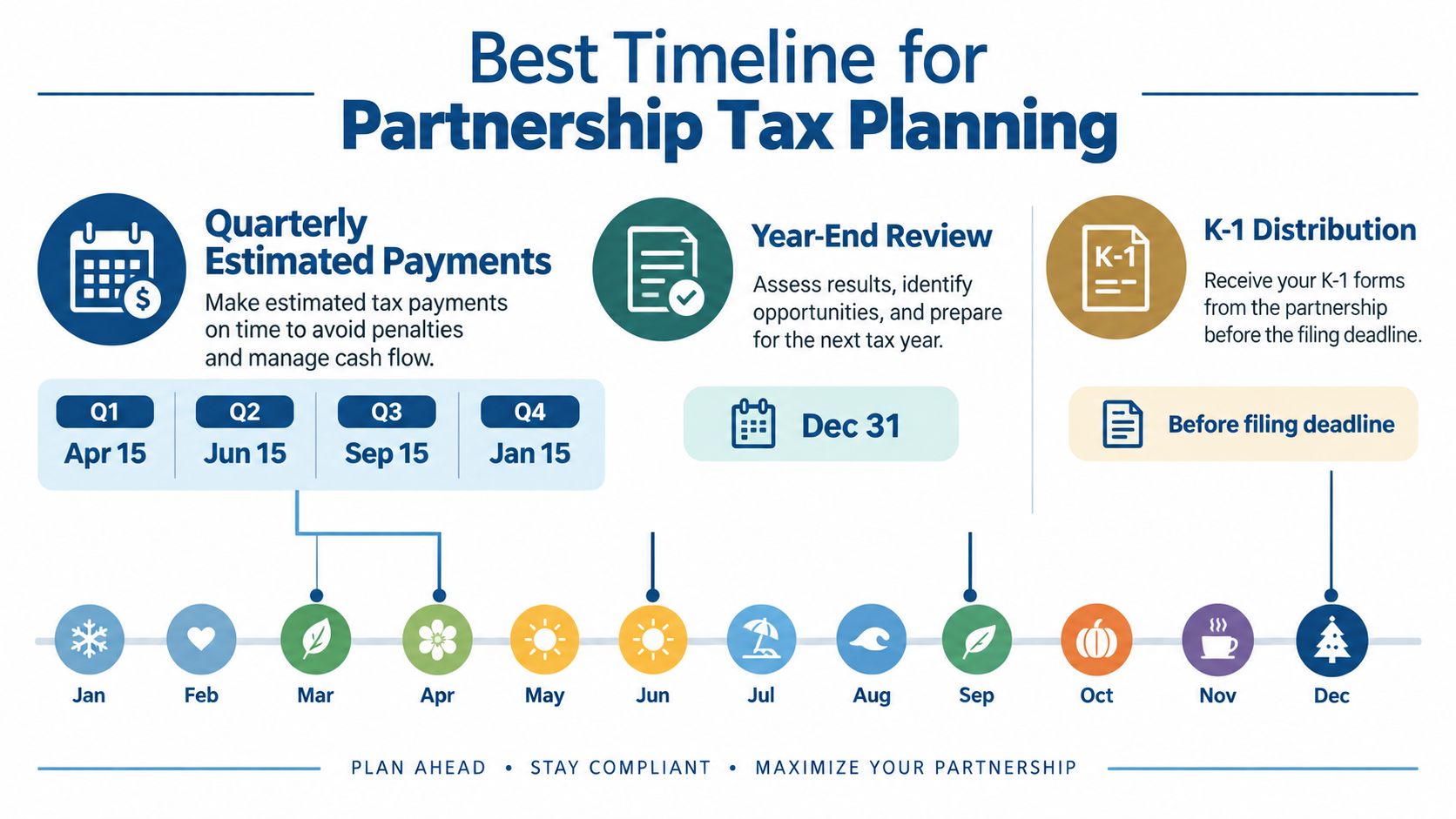
The best timeline starts before year-end and treats the Form 1065 deadline as the final checkpoint, not the beginning of tax preparation. A contractor with $400,000 in revenue should be reconciling customer receipts, subcontractor costs, equipment purchases, and partner distributions before the books are closed. A restaurant operating in two states should also identify state and local filings while the financial records are being assembled.
Use the year in stages
Earlier in the year, maintain current bookkeeping and review partner changes as they occur. Don't wait until filing season to discover that a new member's ownership percentage, capital contribution, or address was never recorded.
At year-end, close the books promptly. Reconcile bank accounts, credit cards, receivables, payables, fixed assets, payroll, loans, and partner distributions. The partnership can't produce reliable K-1s from an unfinished balance sheet.
After year-end, prepare a partner information package. Confirm names, addresses, tax identification information, ownership interests, contributions, distributions, guaranteed payments, and any special allocation terms. Ask partners for missing data with a firm internal deadline.
Decide early whether an extension is needed
Before the original due date, review the open items. If the return can be completed accurately, file Form 1065 and furnish the K-1s on time. If material information remains unresolved, file Form 7004 by the original deadline and tell partners that the K-1 timeline has moved.
An extension should come with a completion plan. Assign responsibility for each missing document, set internal review dates, and communicate a realistic K-1 delivery target. Partners can then coordinate their own individual filing decisions instead of reacting to silence.
Blue Sage Tax and Accounting Inc. provides partnership compliance, multi-state filings, bookkeeping, and year-round tax projections. The firm can help an owner organize records, evaluate the federal extension decision, and coordinate Form 1065 and Schedule K-1 preparation.
Book your free consultation call today. Blue Sage Tax & Accounting Inc. can review your partnership's federal, New York, New Jersey, and NYC filing calendar, then help organize Form 1065, Schedule K-1, extension, and tax-planning work before the deadline. You can schedule the consultation call to discuss your situation.
This article is general information and not tax advice for your specific situation.