A calendar-year S corporation's Due Date for 1120S is March 15, which is March 16 for 2026 filings because March 15 falls on a Sunday. A timely Form 7004 extension generally moves the filing date to September 15, but it doesn't move the payment date.
That's the part owners get wrong. You can buy time to file an accurate return and issue correct K-1s, but you can't use an extension as a cash-flow pause. The filing clock and the payment clock are separate, and your calendar needs to treat them that way.
Table of Contents
- When Is Form 1120-S Due for My S Corporation?
- How do I request a six-month extension for Form 1120-S?
- What Late-Filing Penalties Apply to 1120-S?
- Do New York and New Jersey Follow the Federal Deadline?
- Does an Extension Delay Paying the Tax?
- Which 2026 deadlines should I plan around?
When Is Form 1120-S Due for My S Corporation?
For a calendar-year S corporation, the federal Form 1120-S is due March 15, or March 16 in 2026. The same date governs when shareholders should receive their Schedule K-1, so a late corporate filing can delay every shareholder's personal return.
The IRS Form 1120-S instructions state that the return is generally due on the 15th day of the third month after the corporation's tax year ends, and that the 2026 calendar-year deadline is March 16 because March 15 falls on a Sunday. If the date falls on a Saturday, Sunday, or legal holiday, it moves to the next day that isn't a weekend or legal holiday. The corporation generally must also provide each shareholder with Schedule K-1, and when applicable Schedule K-3, by that same third-month date.
Form 1120-S Due Dates by Tax Year End
| Tax year ends | Original due date | Extended due date (Form 7004) |
|---|---|---|
| December 31 (calendar year) | March 15 (March 16 for 2026) | September 15 |
| June 30 | September 15 | March 15 of the following year |
| September 30 | December 15 | June 15 of the following year |
| March 31 | June 15 | December 15 |
Fiscal-year corporations use the same third-month rule from their own year-end. A June 30 year-end generally means a September 15 original deadline, not March. Most S corporations use the calendar year, although other tax years may be permitted.
Confirm the tax year end on your last filed return before you build any calendar, then share that date with every shareholder. Schedule K-3 is needed only when applicable, and for tax year 2024 the IRS introduced expanded and new filing exceptions for Schedules K-2 and K-3 attached to Form 1120-S, so check whether an exception applies before assuming a K-3 must be issued.
Practical rule: Don't work backward from April. Work backward from March, because your shareholders can't finish their personal returns without K-1 information.
How do I request a six-month extension for Form 1120-S?
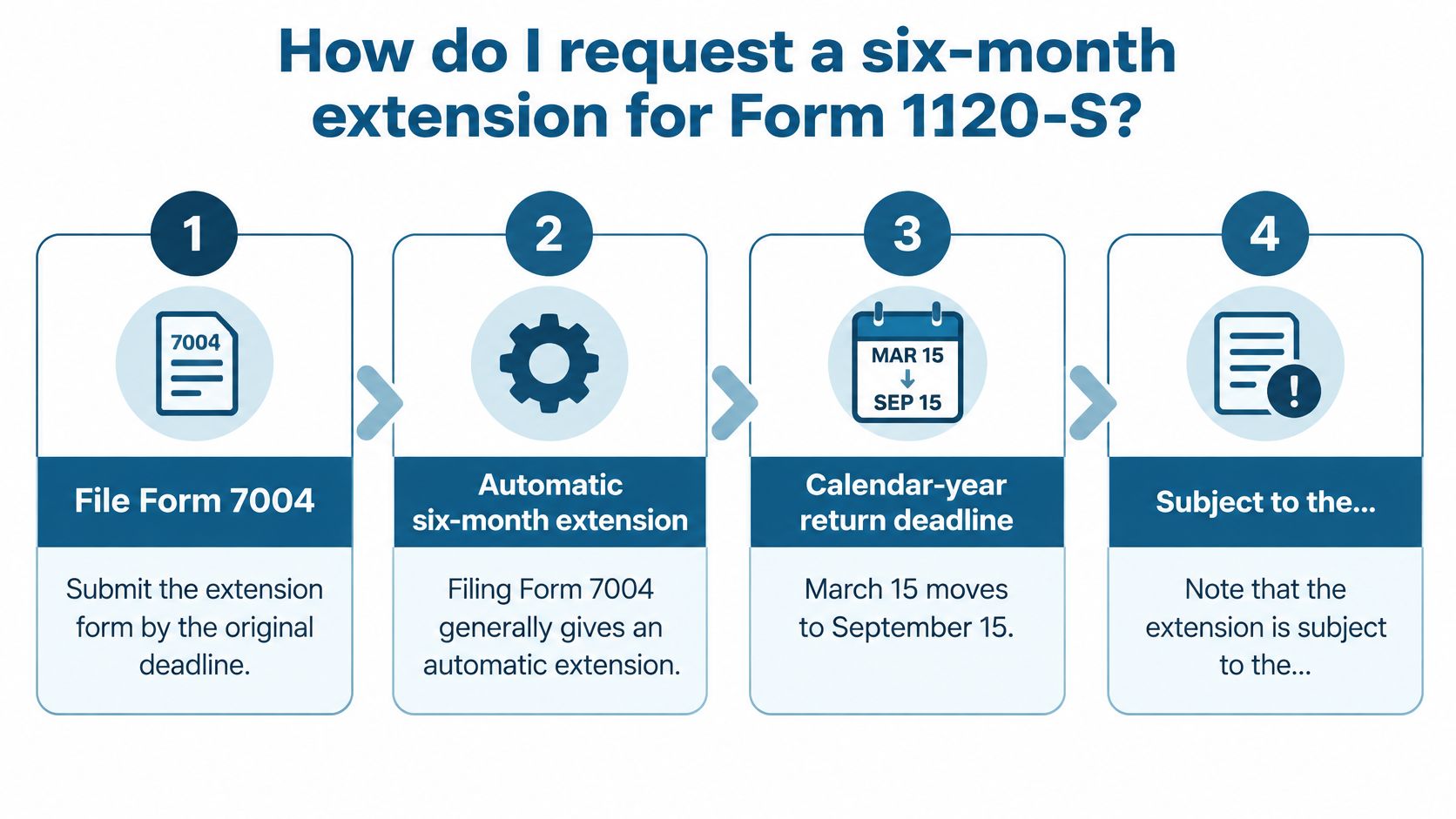
Yes, you generally can. The IRS Form 7004 instructions state that Form 7004 generally provides an automatic six-month extension when it's properly completed, filed by the original deadline, and accompanied by any required tax estimate and payment. For a calendar-year filer, that generally moves the federal filing deadline to September 15, subject to weekend and legal-holiday adjustments.
This visual summarizes the filing sequence before you work through the steps.
- Confirm your original deadline from your tax year end, because a late extension request leaves the original date in force.
- Estimate any tax due before filing, because the payment deadline doesn't move.
- File Form 7004 by the original date, electronically where possible, so you have a clear submission record.
- Include any required estimate and payment, because unpaid tax can still create interest exposure.
- Keep the confirmation and put the extended date on a shared calendar, so shareholders aren't guessing about K-1 timing.
- Treat any further relief as limited, because the IRS describes a special additional three-month extension for partnerships and S corporations that can't file by the end of the initial extension period, and that also doesn't extend payment.
Use the extra time for books, payroll reconciliation, basis schedules, and K-1 data, not for waiting until September to start. Our business tax extension deadline guide can help you place the federal date alongside other business filings.
This short video walks through the extension concept in plain terms.
I would set an internal sign-off date well before September 15. That gives you time to fix an e-file rejection or a shareholder allocation error without missing the final date.
What Late-Filing Penalties Apply to 1120-S?
A late federal Form 1120-S can trigger a monthly penalty per shareholder, even when the corporation owes no tax. A return filed more than 60 days late can also face a separate minimum penalty.
The IRS first-quarter tax calendar guidance describes the monthly penalty for an S corporation return with no tax due as based on the number of shareholders, capped at 12 months, with a base amount of $255 per shareholder per month for returns due after December 31, 2025. Separately, the 2025 Form 1120-S instructions state that for a tax return required to be filed in 2026, a return more than 60 days late has a minimum penalty equal to the smaller of the tax due or $525. Those instructions also say a penalty may be avoided when each failure resulted from reasonable cause.
Late-Filing Penalty Rules for Form 1120-S
| Penalty or rule | What it applies to | Amount or effect |
|---|---|---|
| Monthly per-shareholder penalty | Each month the return is late, up to 12 months | $255 per shareholder per month for returns due after December 31, 2025 |
| Minimum penalty | Returns more than 60 days late that are required to be filed in 2026 | Smaller of the tax due or $525 |
| Reasonable cause | Each failure that resulted from reasonable cause | Penalty may be avoided; document the reasons when the failure occurs |
The shareholder multiplier is where small companies get surprised. Say a corporation has three shareholders and files two months late. The illustration is 3 x 2 x $255 = $1,530 before any reasonable-cause relief, subject to the 12-month cap.
These figures are tied to the tax years shown and amounts adjust annually, so confirm the current-year amounts before you estimate exposure. Document reasonable cause when events happen, with dates and records, rather than trying to reconstruct a story after a notice arrives.
A one-shareholder delay and a five-shareholder delay aren't the same risk. Count your shareholders before you decide a late filing is minor.
Do New York and New Jersey Follow the Federal Deadline?
No, don't assume they do. New York State and New Jersey each set their own S corporation requirements, and a federal extension doesn't automatically extend a state filing.
Say a restaurant owner has one location in New York and another in northern New Jersey. The business files one federal S corporation return, but its state obligations depend on where it operates, where shareholders live, and what each jurisdiction requires for that tax year. If the New York location sits inside New York City, city filing rules may apply separately, so confirm them with the city rather than assuming state rules cover the city return.
Questions to Answer for Each State
- Where does the business operate during the tax year, by state and city?
- Where does each shareholder live, and could a nonresident shareholder obligation apply depending on the circumstances?
- Does the state require its own extension request, separate from federal Form 7004?
- Is any state payment due before the federal filing date or on a different schedule?
- Which return applies in each jurisdiction, labeled as federal, New York State, New York City, or New Jersey?
New York and New Jersey rules aren't interchangeable, and neither should be assumed to match the federal September 15 extended date. Use our state tax filing deadlines resource as a starting point, then confirm the current-year rule for each jurisdiction on your list.
Put each state, its return, its due date, and its extension rule on the same calendar as the federal dates. If a state date is missing, that's not a minor gap. It's an unassigned filing obligation.
Does an Extension Delay Paying the Tax?
No. An extension gives you more time to file, not more time to pay, and interest can continue on unpaid tax even when a filing extension is granted.
Owners often run one calendar while managing three separate schedules. Separating them prevents a valid corporate extension from creating personal or payroll problems.
- Corporate filing and payment clock: Form 7004 can move the filing date, while any corporation-level tax generally stays tied to the original deadline.
- Shareholder estimated tax clock: K-1 income passes through to personal returns, so shareholders may need estimates before the final K-1 is ready. If you're sorting out who needs to pay estimated taxes, that resource is a useful companion to your shareholder planning.
- Payroll clock: Payroll tax deposits and quarterly payroll returns follow their own schedules and aren't moved by Form 7004.
Say an electrician runs an S corporation with two shareholders and extends the 1120-S to September. The corporation may have more time to finalize its books, but both shareholders still need projected K-1 figures for their personal timelines. If nobody gives them an estimate early, the extension pushes uncertainty onto their personal returns.
A year-end projection fixes much of that. At Blue Sage, we run a mid-year and a fourth-quarter tax projection, set quarterly estimates against it, and tell clients which actions are still available. That process helps you decide whether an extension is worth requesting and what payment should be made by the original date.
Owner action: Put the corporate, shareholder, and payroll clocks on one page and assign a named person to each one.
Which 2026 deadlines should I plan around?
For a calendar-year S corporation, plan around March 16, 2026 as the original federal filing date and treat September 15, 2026 as the outer filing limit only if Form 7004 is properly filed. Treat the payment date as fixed at the original deadline.
Use this decision path early enough that you're making choices, not reacting to a missed date.
- Confirm the tax year end and original federal due date, because every later date depends on it.
- Confirm each state's deadline and extension rule, labeled by jurisdiction, because federal relief doesn't control state filings.
- Decide early whether an extension is likely, based on a year-end projection and the condition of your books.
- Estimate the tax and set the payment amount before the original date, because filing relief isn't payment relief.
- Confirm the K-1 timeline each shareholder needs, so the corporate schedule doesn't derail personal returns.
- Record every date in one shared calendar with a named person responsible for each item.
Blue Sage Tax and Accounting Inc., an accounting firm, can help you work through this calendar and related projections. Our S-corporation service includes Form 1120-S preparation and e-filing, federal and state, and our file-and-maintain step covers preparing and filing returns, answering notices, and providing a projection before year end.
If you want help setting those dates before the March deadline controls the conversation, Book your free consultation call today. This article is general information and not tax advice for your specific situation.
If your S corporation needs a clear federal and state filing calendar, coordinated K-1 timing, and projections that support payment decisions before the original deadline, Blue Sage Tax & Accounting Inc. can help you build that plan. Visit us to discuss your 2026 Form 1120-S dates, extension choice, and shareholder reporting needs before the next deadline arrives.