Depreciation spreads an asset's cost over its useful or recovery life, so you deduct a portion each year instead of the full price at once. The basic straight-line calculation of depreciation is (cost minus salvage value) divided by useful life, though federal tax returns generally use MACRS instead.
You've just paid for equipment, the invoice is sitting in your bookkeeping file, and your lender's profit figure doesn't match the number heading for your tax return. That gap is usually depreciation. One schedule follows your estimate of how long the asset will serve the business. The other follows federal tax rules. Both can be right, and confusing them creates avoidable filing errors.
Table of Contents
- How Do You Calculate Depreciation on a Business Asset?
- Which Recovery Period and Method Apply to Your Asset?
- How Do You Calculate MACRS Depreciation Year by Year?
- When Do Section 179 and Bonus Depreciation Change the Math?
- Do Rentals, Multi-State Filings or a Sale Change the Calculation?
- Which Depreciation Details Should I Verify Before Filing?
How Do You Calculate Depreciation on a Business Asset?
You calculate depreciation by spreading the asset's cost over the years it's used, so each year carries a portion of that cost. Start with depreciable basis, generally the purchase price plus costs to install the asset and get it ready, less amounts that aren't depreciable such as land.
The Straight-Line Formula in Practice
For book reporting, straight-line depreciation is (cost minus salvage value) divided by useful life. Say a restaurant owner buys a $30,000 commercial oven, expects a $3,000 salvage value, and estimates a 10-year useful life. The arithmetic is ($30,000 minus $3,000) divided by 10, which equals $2,700 per year.
That $2,700 reflects management's estimate for financial statements. It's useful for pricing, lender reports, and judging whether the oven earns enough to justify replacement. It isn't automatically the federal tax deduction.
For federal taxes, IRS Publication 946 explains that most business and income-producing property is depreciated under the Modified Accelerated Cost Recovery System (MACRS), generally under the General Depreciation System (GDS) unless the Alternative Depreciation System (ADS) is required or permitted. GDS can use 200% declining balance, 150% declining balance, or straight line, while ADS generally uses straight line.
Keep the book schedule and the tax schedule side by side, never merged into one number.
Depreciation starts when the asset is placed in service, meaning it's ready and available for its specific business use, not when you paid the invoice. Decide first whether you're preparing a book report or a federal return. Rental owners face the same split, and Edinhart Realty and Property Management explains how depreciation reduces rental taxable income in that rental context.
Which Recovery Period and Method Apply to Your Asset?
The asset class sets the recovery period, and GDS is the default system for most federal returns. Match the asset to its class first, then apply the method allowed for that class.
GDS recovery periods for common business assets (federal, tax years 2026)
| Asset type | Recovery period (GDS) | Typical examples |
|---|---|---|
| Computers, office machinery and light trucks | 5 years | laptop, copier, pickup truck |
| Office furniture, fixtures and most business equipment | 7 years | desks, restaurant ovens, shelving |
| Land improvements | 15 years | parking lots, fencing, landscaping |
| Residential rental buildings | 27.5 years | apartment building |
| Nonresidential real property | 39 years | office or retail building |
Confirm each classification in IRS Publication 946 before filing, since recovery periods and related amounts can be affected by annual guidance and the specific asset. Buildings deserve a second look because components inside them may qualify for shorter lives. Our explanation of cost segregation in real estate covers how owners evaluate that separation.
Choosing Between the Three GDS Methods
Declining-balance methods produce larger deductions in earlier years and smaller deductions later. Straight line spreads deductions more evenly across the recovery period. The method changes the timing of deductions rather than the total depreciable basis you recover, assuming you hold and use the asset through the schedule.
ADS generally uses straight line over its specified period. Don't choose it casually as a conservative default. Use it where federal law requires it or where an election fits your projection.
Classification errors cause more trouble than arithmetic errors:
- Depreciating land: Land isn't depreciable, so separate it from the building price.
- Mixing furniture and equipment classes: A desk and a computer don't automatically share a recovery period.
- Burying improvements in the building: Capital improvements may need their own asset record and schedule.
Record the class, method, and recovery period in your fixed-asset register when the asset enters service. I would not rely on a preparer reconstructing those choices from an invoice total years later.
How Do You Calculate MACRS Depreciation Year by Year?
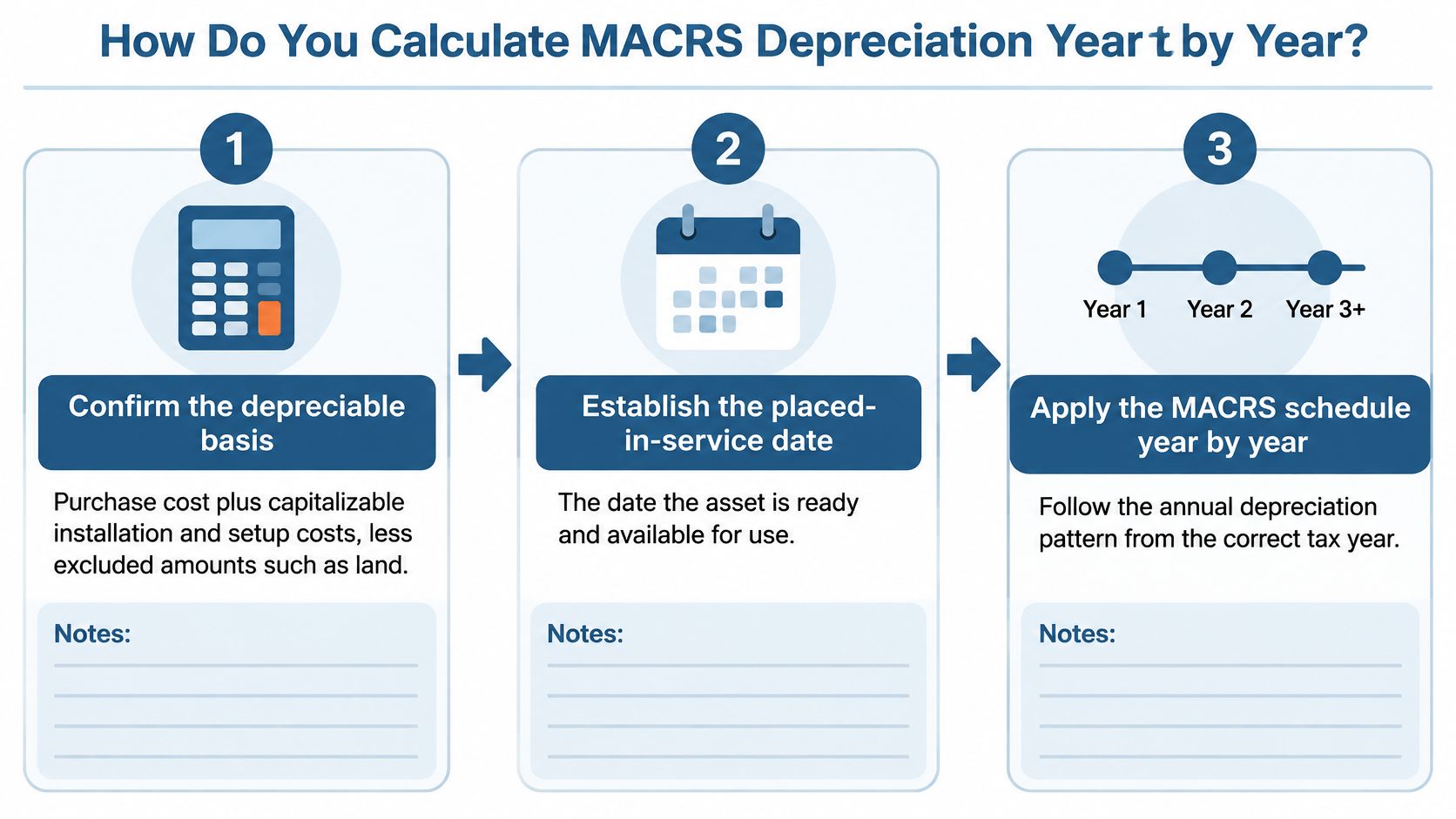
You calculate MACRS year by year by confirming basis and the placed-in-service date, classifying the asset, choosing the system and method, then applying the IRS percentage table. The sequence matters because one early error repeats in every later year.
The Six-Step Federal Calculation
- Confirm depreciable basis: Use purchase cost plus capitalizable acquisition and installation costs, reduced by excluded amounts and applicable adjustments.
- Establish the placed-in-service date: Use the date the property is ready and available for its specific business use.
- Classify the asset: Assign its prescribed recovery period.
- Determine the system: Decide whether GDS or ADS applies.
- Select the permitted method: Choose 200% declining balance, 150% declining balance, or straight line under GDS.
- Apply the percentage table: Use the IRS table for the applicable convention and recovery year.
IRS Publication 946 sets out this sequence for most U.S. business property placed in service after 1986 and provides the classifications and tables. It also flags the convention question. The half-year convention is common, but the mid-quarter convention can apply when more than 40% of the year's depreciable personal property is placed in service during the final quarter.
Worked Example With the Restaurant Oven
Assume the oven has a $30,000 depreciable basis for federal tax purposes and is 7-year property using 200% declining balance and the half-year convention. This is a hypothetical illustration, not a classification for every oven.
Year one is 14.29%, or $4,287. Year two is 24.49%, or $7,347. Notice the pattern differs from the level book expense because MACRS percentages front-load part of the recovery and apply the convention in the first year.
Practical rule: Check the final-quarter percentage before you pick a table, not after the return is drafted.
Half-year convention rates for 5-year property (federal, MACRS percentage table)
| Recovery year | 5-year property |
|---|---|
| Year 1 | 20.00% |
| Year 2 | 32.00% |
| Year 3 | 19.20% |
| Year 4 | 11.52% |
| Year 5 | 11.52% |
| Year 6 | 5.76% |
| Year 7 | n/a |
| Year 8 | n/a |
Multiply the percentage for the recovery year by depreciable basis. Keep each asset on its own line so a disposal, improvement, or change in business use doesn't corrupt the whole schedule.
When Do Section 179 and Bonus Depreciation Change the Math?
A piece of equipment can produce three different numbers in the same year: one deduction on the federal return, a different one on a nonconforming state return, and a level expense in the books. Section 179 and bonus depreciation are the levers that decide how much lands in year one. Model both against current and future income before year end, because each carries limits the regular MACRS schedule doesn't.
First-year options compared for federal returns
| Option | Timing | Key limit or condition | State note |
|---|---|---|---|
| Section 179 | Deducted in the year the property is placed in service | Capped by business income; annual dollar limit adjusted each year | Conformity varies by state |
| Bonus depreciation | Percentage deducted in the first year, remainder under MACRS | Percentage set by law for the year placed in service; confirm the current rate | Some states, such as Michigan, require adding back federal bonus depreciation |
| Regular MACRS | Spread over the recovery period | No first-year allowance beyond the schedule | Follows state rules, which may differ |
For tax years beginning in 2026, the Section 179 maximum is $2.56 million, with the phaseout starting when qualifying property placed in service tops $4.09 million and a separate $32,000 cap on qualifying sport utility vehicles. The IRS adjusts these amounts annually, and Publication 946 lists the figures for each filing year. The mechanics matter as much as the headline number: the deduction applies item by item, it can't exceed business income, and a partial personal-use percentage shrinks it.
A Contractor Scenario Worth Modeling
A landscaping contractor with $400,000 in revenue buys $60,000 of equipment in an uneven income year. If this year's income is unusually high, the largest available first-year deduction lands against income already taxed at the top of the owner's bracket. If signed contracts point to stronger income next year, spreading the deduction keeps depreciation in reserve for earnings that will face a steeper marginal rate.
A deduction moved into this year isn't available later.
The state return can widen the gap further. Where a state requires a federal bonus add-back, the federal schedule shows the full percentage in year one while the state schedule spreads the same cost across the recovery period. An owner who needs steadier reported results, expects stronger future income, or files in a nonconforming state may prefer slower depreciation, or an election out where one is available.
Tax planning fits owners whose income moves year to year, people surprised by a balance due in April, and people whose situation changed through a sale, a new state, a large bonus, or a first profitable year. If you're buying before year end, compare federal treatment, state conformity, cash flow, income limits, and future-year deductions in one projection.
Do Rentals, Multi-State Filings or a Sale Change the Calculation?
A Brooklyn restaurant owner who rents out a duplex and sells a delivery van in the same year produces three different depreciation answers on one return. A single general-ledger total won't show which asset produced which result, so each situation gets its own schedule.
Residential rental buildings depreciate over 27.5 years and nonresidential buildings over 39 years under GDS. Land comes out of the depreciable basis first, and a documented business-use percentage applies before any deduction on property also used personally. The building runs straight line over a much longer period than equipment, so it needs its own schedule from day one.
An asset-level worksheet for that rental has to carry basis, the land split, and accumulated depreciation separately for each property.

Operating in New York and New Jersey can mean a separate depreciation schedule for each state, because a state can decouple from federal bonus depreciation or Section 179 treatment. The federal schedule may allow a full first-year deduction while the state version spreads the same asset over its normal life, and that gap carries forward for years. Check each state's law for the filing year, and don't assume New York State, New York City, or New Jersey matches the federal deduction. Owners buying property in Puerto Rico operate under a separate incentive regime, described in this guide to Puerto Rico investor tax incentives, and that program sits outside the federal and state schedules above.
Sale timing deserves the same early attention, because the decision made at purchase determines what happens at disposal.
Selling an asset triggers depreciation recapture, which can convert part of the gain into ordinary income. IRS Publication 544 explains that for Section 1245 property, generally depreciable personal property, gain is ordinary income to the extent of depreciation allowed or allowable. For Section 1250 property, ordinary-income recapture generally relates to additional depreciation, and recapture under an installment sale is taxable as ordinary income in the year of sale rather than deferred. Our guide to depreciation recapture in real estate covers the property side in more detail.
Across all three situations the pattern holds: depreciation is a timing decision spread over more than one schedule, and the federal figure is only one column of it.
Which Depreciation Details Should I Verify Before Filing?
Before filing, confirm each asset's recovery class, placed-in-service date, business-use percentage, method, convention, and accumulated depreciation. Then project this year's deduction, future deductions, and possible recapture together.
Filing Checklist
- Recovery class: It matches the asset's federal classification.
- Placed-in-service date: It reflects the ready-for-use date, not the purchase date.
- Business-use percentage: Mixed-use use is documented before the calculation.
- Method and convention: They match the applicable table, including the final-quarter test.
- Carryforward: Prior-year accumulated depreciation rolls forward correctly.
- Reconciliation: The fixed-asset register ties to invoices, service records, and Form 4562.
- Separate schedules: Book, federal tax, and each state schedule are recorded separately.
Bring the prior-year return, which we describe as the most useful document, plus income documents for the year. Monthly bookkeeping is the practical minimum if you make estimated payments, borrow, or plan around profit. Blue Sage Tax and Accounting Inc., an accounting firm, can review the schedule with mid-year and fourth-quarter projections and tell you which actions remain available. Outcomes depend on your circumstances, and no result is guaranteed. Book your free consultation call today.
This article is general information and not tax advice for your specific situation.
If your fixed-asset register, book profit, and federal return are telling three different stories, Blue Sage Tax & Accounting Inc. can reconcile the depreciation schedules, model Section 179, bonus depreciation, and regular MACRS before year end, and give you a fixed written quote before work starts. Visit us to start with a free consultation focused on your assets, your states of filing, and the timing choices still open to you.