Bonus depreciation generally doesn't apply to the residential rental building itself because the IRS classifies it as 27.5-year property, but separately identifiable components such as appliances, carpeting, and land improvements may qualify. Federal 100% bonus depreciation was restored for qualifying assets acquired and placed in service after January 19, 2025.
You've bought a rental, finished work between tenants, or received a contractor's invoice, and now you need to know what belongs on this year's return. The practical question isn't whether the entire purchase qualifies for an immediate write-off. It's which assets qualify, when they became available for rental use, and whether the federal deduction carries through to your state filings.
Table of Contents
- Does Bonus Depreciation Apply to a Rental Property
- What Property Qualifies for Bonus Depreciation on a Rental
- How Cost Segregation Lets Landlords Claim Bonus Depreciation
- Bonus Depreciation vs Section 179 for Rental Real Estate
- A Multi-Year Example of Bonus Depreciation on a Rental
- The 2025 Update That Changes Rental Property Planning
- How New York and New Jersey Treat Rental Bonus Depreciation
- Planning Next Steps and Avoiding Common Mistakes
Does Bonus Depreciation Apply to a Rental Property
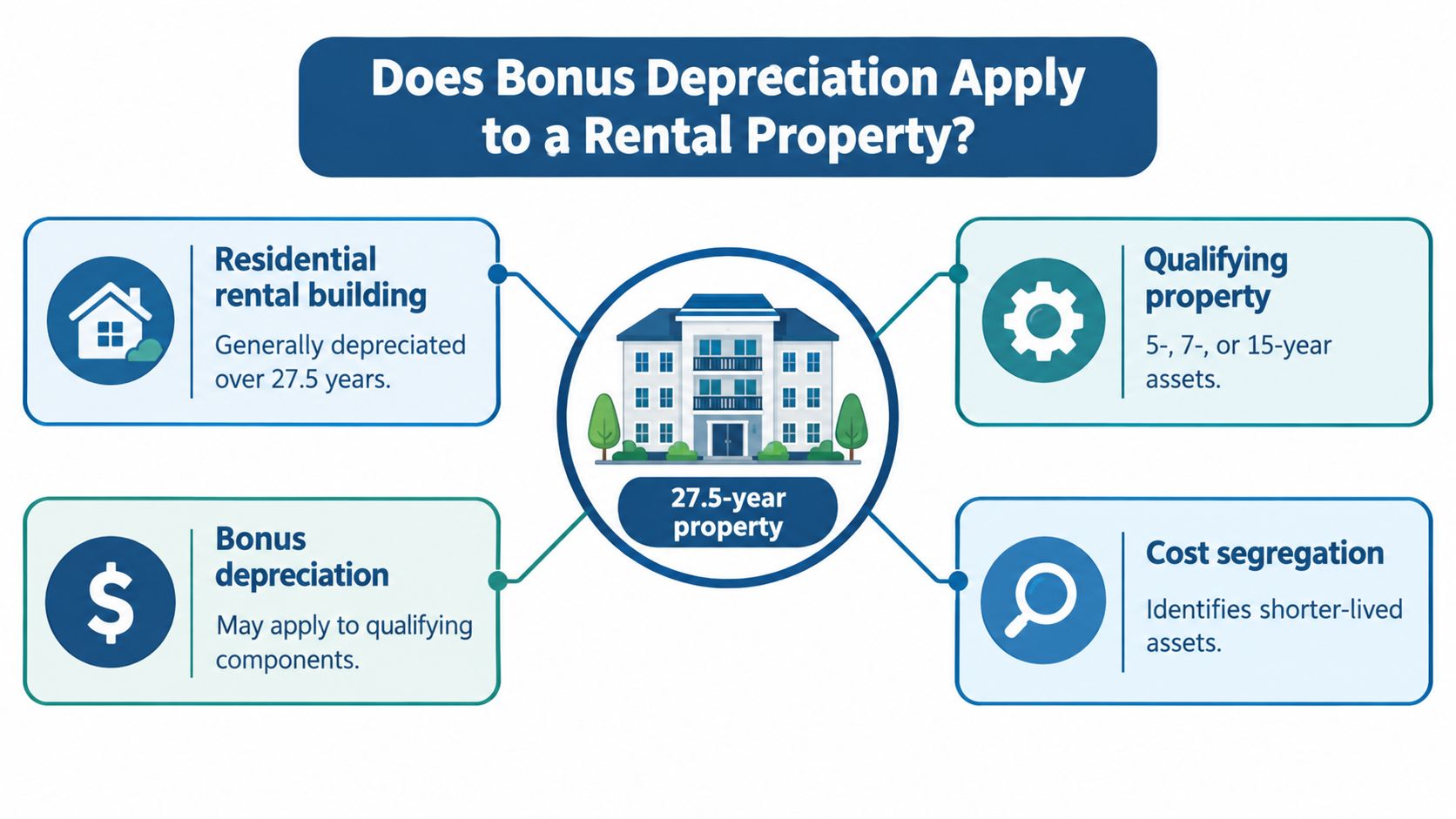
Potentially, but not to the entire residential property purchase. Separate the land, the residential structure, and any independently identifiable assets before deciding what qualifies for accelerated federal depreciation.
For federal purposes, a building generally counts as residential rental property when at least 80% of its gross rental income comes from dwelling units. The structure generally uses straight-line depreciation over 27.5 years with the mid-month convention, while land isn't depreciable, as explained in IRS Publication 946's property classification and depreciation rules.
That distinction matters when you review a closing statement. A single purchase price doesn't establish a single depreciable asset, and it doesn't tell you how much belongs to qualifying components. You need a supportable allocation rather than a percentage selected to produce the deduction you want.
Separate the purchase before calculating the deduction
Start with these categories:
- Land: Keep its allocated cost outside the depreciation calculation.
- Residential structure: Identify the building's structural basis separately.
- Potentially qualifying components: Review identifiable personal property and improvements rather than assuming everything installed inside the building belongs in the same category.
The visual below illustrates the distinction between the building and assets that may receive different treatment.
If you're evaluating an accessory dwelling unit, the CozyCube ADU tax guide provides related reading on rental-property depreciation schedules. Use that kind of resource to organize your questions, not as a substitute for classifying your actual costs.
The useful starting document is an asset schedule supported by purchase records and invoices. Without that separation, even a correct bonus-depreciation percentage can produce an incorrect deduction.
What Property Qualifies for Bonus Depreciation on a Rental
Certain shorter-lived rental assets may qualify, provided they meet the federal eligibility rules. Ownership, income-producing use, asset classification, and placed-in-service status all matter; buying something for a rental isn't enough by itself.
Federal bonus depreciation generally applies to qualifying tangible property with a recovery period of 20 years or less. Rental property must be owned, used in an income-producing activity, and have a determinable useful life, as discussed in IRS Publication 527's rental-property depreciation guidance.
Common candidates for review include:
- Appliances: Separately identify purchases and retain itemized invoices.
- Carpeting and furniture: Document what was purchased and how it's used in the rental.
- Land improvements: Distinguish improvements from the underlying land.
- Dedicated systems: Have their function and classification evaluated instead of treating all electrical work alike.
Is the expenditure a repair or an improvement?
An expenditure that betters, restores, or adapts property to a new or different use generally must be capitalized rather than treated as an immediately deductible repair. The IRS's rental-expense and improvement guidance explains that an improvement is generally depreciated as separate property.
Consider a landlord replacing a water heater while also renovating a vacant apartment. Don't classify both invoices solely by their descriptions, or assume the smaller invoice is a repair and the larger one qualifies for bonus depreciation. Review what changed, which property was affected, and whether the work restored or improved it.
Documentation rule: Ask the contractor to separate equipment, installation, and broader renovation work before the invoice becomes your only record.
Timing requires its own review. An asset acquired before the restoration cutoff doesn't automatically receive the restored treatment just because installation happened later. Keep acquisition and rental-use records together so the applicable federal transition rule can be evaluated without reconstructing events at filing time.
How Cost Segregation Lets Landlords Claim Bonus Depreciation
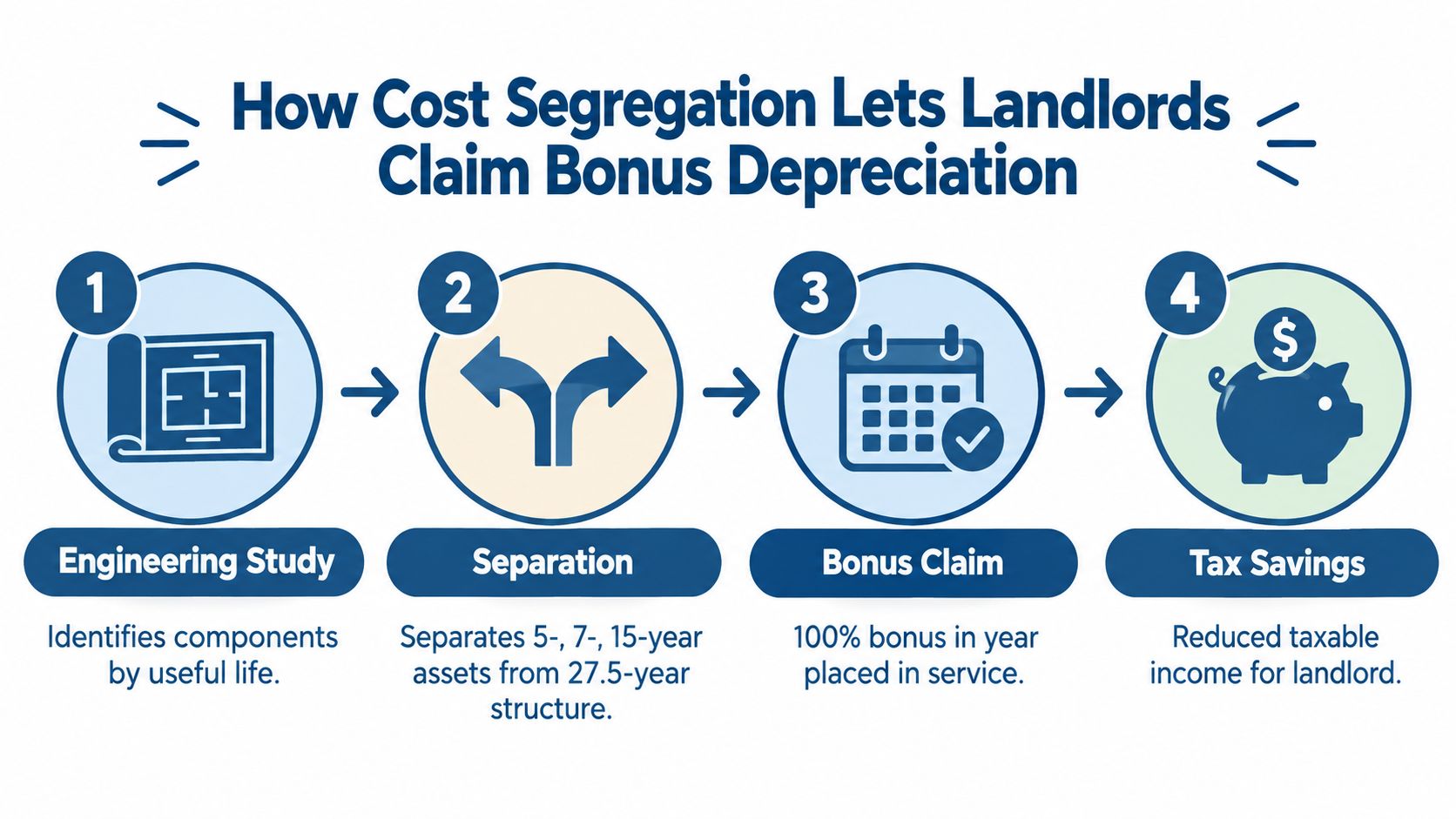
Cost segregation identifies assets within a property that may warrant shorter depreciation treatment than the structure. It supports classification; it doesn't make every building component eligible or establish that a resulting deduction is usable immediately.
A useful study connects the physical property to its tax records. Engineering classifications should reconcile with invoices, acquisition costs, placed-in-service dates, and any personal-use allocation. State treatment belongs in the implementation review, even if the study itself focuses on federal asset classifications.
For a construction contractor who also owns a rental, the contractor's familiarity with materials can help assemble records. It doesn't replace the tax analysis: knowing what an electrical system cost isn't the same as establishing its depreciation classification.
Evaluate the report, not just the projected deduction
Ask prospective providers how they support their conclusions and how the report connects to your existing depreciation schedule. A report should help your tax preparer trace a classification back to the asset and its cost, not just present a large accelerated deduction.
The process below shows how classification connects to a potential bonus claim.
For a closer look at the study itself, see this explanation of how cost segregation works in real estate. Keep the study decision separate from the deduction decision: a technically supported classification still needs the correct timing and tax-return treatment.
Accelerated depreciation moves cost recovery forward. It doesn't create another purchase cost to deduct.
That's the central trade-off. Moving deductions into an earlier year generally leaves less depreciation available later. Before commissioning a study, compare its cost and administrative work with the potential timing benefit under your circumstances, rather than treating the largest first-year deduction as the only measure of success.
Bonus Depreciation vs Section 179 for Rental Real Estate
Bonus depreciation and Section 179 aren't interchangeable labels for an immediate write-off. A landlord should evaluate the eligible asset and the separate requirements of each provision before choosing a deduction method.
The comparison needs more care than a generic equipment-purchase article suggests. Rental use, the kind of improvement, applicable income limitations, and the interaction with the rest of the return require review. A provision discussed for operating-business equipment shouldn't automatically be applied to a residential rental.
Bonus Depreciation vs Section 179 for Landlords
| Dimension | Bonus Depreciation (Section 168(k)) | Section 179 Deduction |
|---|---|---|
| Starting question | Does the asset qualify under the bonus-depreciation rules? | Does the asset and its use qualify under Section 179? |
| Timing review | Examine acquisition and placed-in-service dates | Confirm the applicable election and tax-year requirements |
| Income and loss analysis | Evaluate whether the deduction can be used on the return | Review the applicable income limitation separately |
| Residential structure | Don't treat the building as a qualifying component | Don't assume an alternative provision permits expensing the structure |
| Roof or renovation work | Classify the work rather than assuming eligibility | Verify property-type restrictions and applicable limits before claiming |
A roof invoice isn't proof of eligibility. Before applying a roof-related rule found in an article, confirm whether it concerns nonresidential property and whether it applies to your particular expenditure. Don't build a residential-rental projection around an unverified per-roof cap.
For a standalone appliance purchase, begin with the invoice and asset classification. For a broader renovation or acquisition, begin with the allocation and supporting study. Neither approach justifies selecting a deduction method before understanding the underlying assets.
The practical comparison is therefore a return-level calculation, not a slogan about which deduction is better. Ask your preparer to show the assumptions, restrictions, and consequences of the available treatment without promising that an accelerated deduction will reduce your current tax bill.
A Multi-Year Example of Bonus Depreciation on a Rental
A landlord may claim accelerated depreciation on qualifying duplex components while continuing regular depreciation on the structure. A later sale must be evaluated using the resulting depreciation history, not just the original purchase price.
Consider an illustrative restaurant owner who purchases a duplex, renovates it, and prepares it for rental use. This isn't a client result or a savings estimate; it's a way to follow the decisions across ownership.
The setting below reflects the records review that should precede a claim.

Acquisition and rental preparation
The owner separates the purchase allocation from subsequent renovation costs. A study identifies potentially qualifying components, and the preparer reviews their acquisition and placed-in-service records before calculating the deduction.
The restaurant's income doesn't, by itself, establish how the rental deduction affects the owner's return. The projection should distinguish the rental activity from the operating business rather than treating every deduction as available against every source of income.
Continued ownership and eventual sale
During ownership, the landlord retains the study and updates the depreciation schedule for new purchases, replacements, and improvements. When considering a sale, the owner gives the preparer that complete schedule rather than only the closing statement.
Federal depreciation generally reduces tax basis and can influence later gain calculations. Consequently, the sale review should address depreciation-related consequences, including any applicable recapture, before the landlord treats sale proceeds as freely available cash.
This accompanying video provides another format for considering the topic.
The planning lesson is to compare the acquisition-year benefit with continued ownership and a potential sale. An attractive initial deduction isn't a complete investment analysis, particularly if you expect to dispose of the property relatively soon.
The 2025 Update That Changes Rental Property Planning
Older phase-out charts no longer describe the federal treatment of all newly qualifying assets. The restoration changed the decision framework, but acquisition timing and placed-in-service timing must both satisfy the applicable rules.
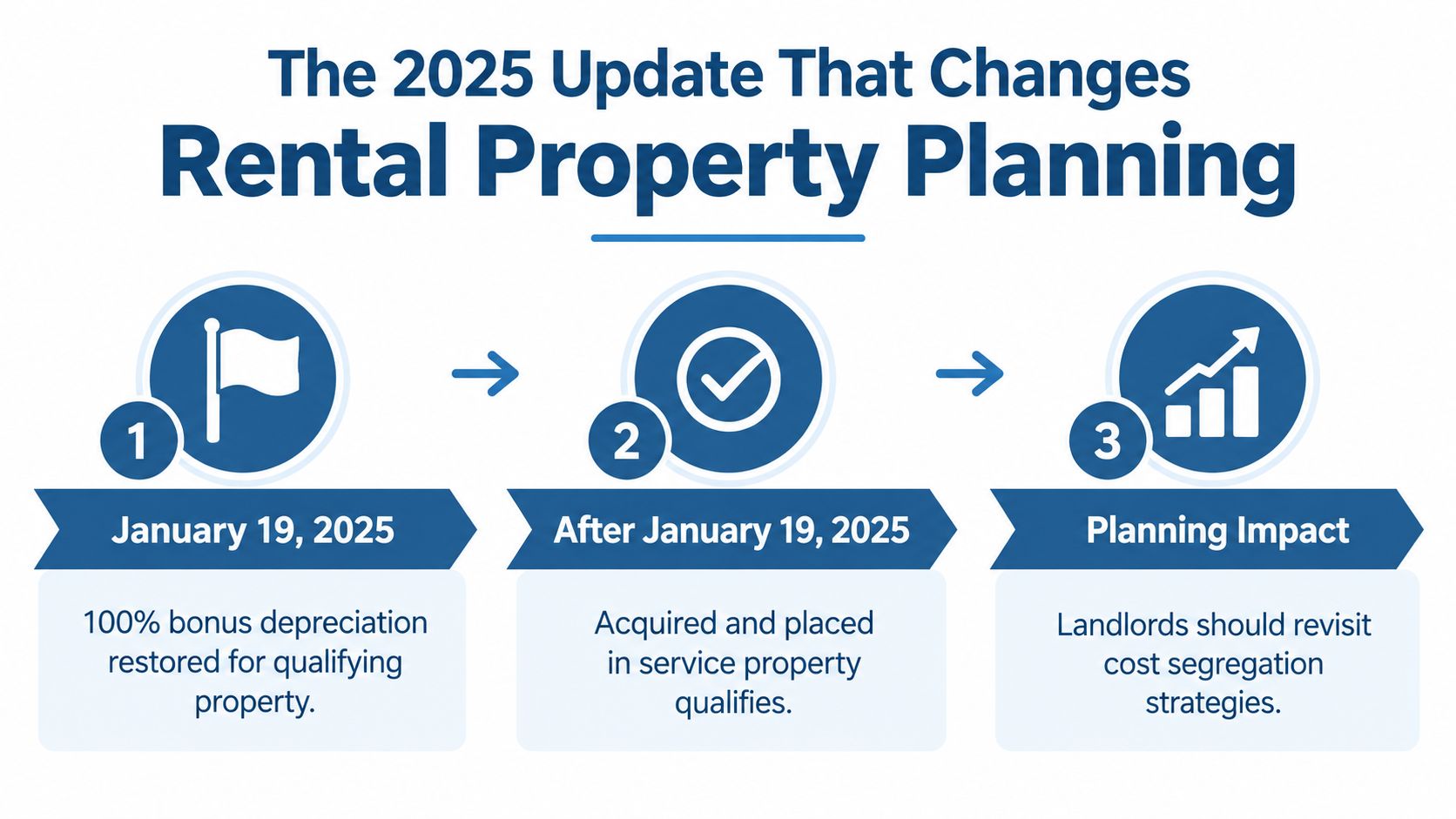
For federal tax year 2025, qualified property acquired and placed in service after January 19, 2025 became eligible for the restored 100% special depreciation allowance. Property placed in service January 1 through January 19, 2025, and property acquired before January 20, 2025 but placed in service later, generally remains under the prior phase-down rules, according to the IRS's current rental-property publication.
The transition is illustrated below; the qualifying window begins after the cutoff, not on it.
Why the old chart can produce the wrong answer
The original schedule called for 80% in 2023, 60% in 2024, 40% in 2025, and 20% in 2026. That historical schedule, described in Tax Foundation's bonus-depreciation policy history, shouldn't be applied indiscriminately to assets covered by the restoration.
These are statutory percentages tied to tax years and transition rules, not figures that adjust annually. Check the applicable law each filing year rather than rolling a prior percentage forward.
- Check acquisition: Establish when the asset was acquired.
- Check availability for rental use: Document when it was placed in service.
- Check the asset itself: The law change doesn't cure an ineligible classification.
A property bought while substantial work remains unfinished deserves particular attention. Purchase, construction completion, and readiness for rental use may occur at different times. The year you file the return doesn't replace those underlying dates.
How New York and New Jersey Treat Rental Bonus Depreciation
A federal bonus-depreciation deduction doesn't automatically determine New York State or New Jersey treatment. Landlords with either jurisdiction's filings should project state consequences separately rather than carrying the federal result into every return.
Tax Foundation's discussion of the restored federal bonus-expensing policy provides context for the federal change. The practical multi-state issue is that a federal deduction may require separate state adjustments and projections; the federal calculation alone isn't a completed state analysis.
For a Queens landlord who also owns a New Jersey rental, that distinction belongs in year-round planning. The owner needs to know which filings are affected and what each jurisdiction requires, not merely whether the federal return shows a larger depreciation deduction.
Keep separate calculations where required
A useful projection distinguishes:
- Federal treatment: Record the deduction under the applicable federal rules.
- New York State treatment: Verify conformity and any required adjustment for the filing year.
- New Jersey treatment: Review its treatment independently rather than assuming it matches New York State.
- New York City considerations: Check any applicable city filing separately; a state conclusion isn't automatically a city conclusion.
This isn't a reason to reject bonus depreciation. It's a reason not to estimate payments from a federal projection alone.
A federal deduction may change your federal projection without producing the same result on a state return.
Ask for schedules that explain the differences and retain them with the underlying asset records. If separate adjustments are required, clear records help prevent later depreciation calculations from losing track of costs already treated differently.
Quarterly projections are useful when renovations, acquisitions, or rental readiness change during the year. Update the assumptions when those events occur rather than waiting until preparation season to discover that the federal and state numbers don't match.
Planning Next Steps and Avoiding Common Mistakes
Start with records and a projection before committing to an accelerated-depreciation strategy. The goal is a supportable deduction with understood consequences, not the largest number a preliminary report can display.
Create an asset file containing closing records, itemized invoices, the study if applicable, and documentation of rental availability. Keep repair decisions alongside the supporting work descriptions so the preparer can distinguish current expenses from capitalized costs without guessing.
Resolve the questions that affect the return
- Classification: Does the proposed treatment match the asset's actual function and use?
- Timing: Do the acquisition and placed-in-service records support the applicable rule?
- Deduction usability: How do the rental activity and other return limitations affect the projection?
- State treatment: Are separate schedules or adjustments needed?
- Exit planning: What does the depreciation history mean for a potential sale?
For the deduction-usability question, review the explanation of passive activity loss rules for rental owners. That analysis deserves separate attention rather than an assumption that rental depreciation will offset unrelated business income.
Financing is another separate decision. If you're budgeting for an acquisition, down payment advice from Quicklending LLC offers related reading, but keep the financing budget distinct from your tax projection. An anticipated deduction shouldn't substitute for cash needed to close, complete work, or operate the rental.
The most avoidable mistakes are procedural: missing invoices, unsupported allocations, stale timing assumptions, and projections that stop at the federal return. Address those before year-end decisions become difficult to change.
Blue Sage Tax & Accounting Inc., an accounting firm based in Bayside, Queens, offers year-round tax planning, quarterly projections, and multi-state filing support for rental-property owners. Bring your depreciation schedule, acquisition documents, and renovation invoices for a discussion of federal eligibility, timing, and New York or New Jersey adjustments. Book your free consultation call today.
This article is general information and not tax advice for your specific situation.