The audit is almost finished. Your controller has reconciled the accounts, the auditor has reviewed the supporting schedules, and the engagement partner sends a short document for signature. It may look routine, but the auditor representation letter is a formal piece of audit evidence. If it's incomplete, signed by the wrong person, or dated incorrectly, the audit may not be ready for the opinion to be issued.
That can create particular pressure for a high-net-worth individual, family office, closely held business, or real estate entity. A missing disclosure about an owner loan, trust interest, litigation matter, valuation judgment, or subsequent event can require additional work at the point when everyone expects the file to close.
What an Auditor Representation Letter Actually Is
On the final day of fieldwork, an audit partner may hand management a letter covering several pages of familiar and highly specific statements. The auditor isn't asking you to certify that every transaction was personally reviewed. The request is for written confirmation that management has fulfilled its responsibilities and has told the auditor about matters relevant to the financial statements and audit.
An auditor representation letter is a written statement from management, and sometimes those charged with governance, confirming matters such as:
- Responsibility for the financial statements: Management confirms that it prepared and presented the financial statements under the applicable reporting framework.
- Completeness of information: Management states that it provided the auditor with access to records, accounting data, contracts, minutes, and other relevant information.
- Disclosure completeness: Management confirms that significant matters, including related parties, commitments, contingencies, and subsequent events, have been properly identified and disclosed.
- Management judgments: Management explains that estimates, valuations, and other judgments reflected in the accounts are reasonable based on the information available.
The letter is audit evidence, but it isn't a substitute for the auditor's testing. ISA 580 explains that written representations are more reliable than oral statements, while also making clear that they don't replace audit procedures designed to obtain sufficient appropriate evidence. The auditor still examines records, tests transactions, evaluates estimates, and considers whether the financial statements are materially misstated. The ISA 580 management representations standard%20-%20Mgmt%20Representations.pdf) provides the technical framework for that relationship.
Who signs the letter
The appropriate signatory is someone with sufficient authority and direct knowledge of the entity's financial reporting. A chief executive officer or chief financial officer commonly signs for a company. In a closely held business, the owner, managing member, or equivalent senior officer may sign. A trustee, director, or person charged with governance may also need to participate, depending on the entity's structure and the applicable audit requirements.
For a family office, the correct signatory may not be the person who performs the bookkeeping. A controller might prepare the schedules, but the owner, trustee, director, or senior executive responsible for the financial statements may need to provide the representations.
Why the date matters
The letter is ordinarily dated as near as practicable to, but not after, the auditor's report date. It links management's confirmations to the financial statements and events known at the point the auditor issues the opinion.
Practical rule: Read the letter as a final confirmation of what management knows and is responsible for, not as a formality that can be signed without review.
Why the Letter Became a Mandatory Audit Requirement
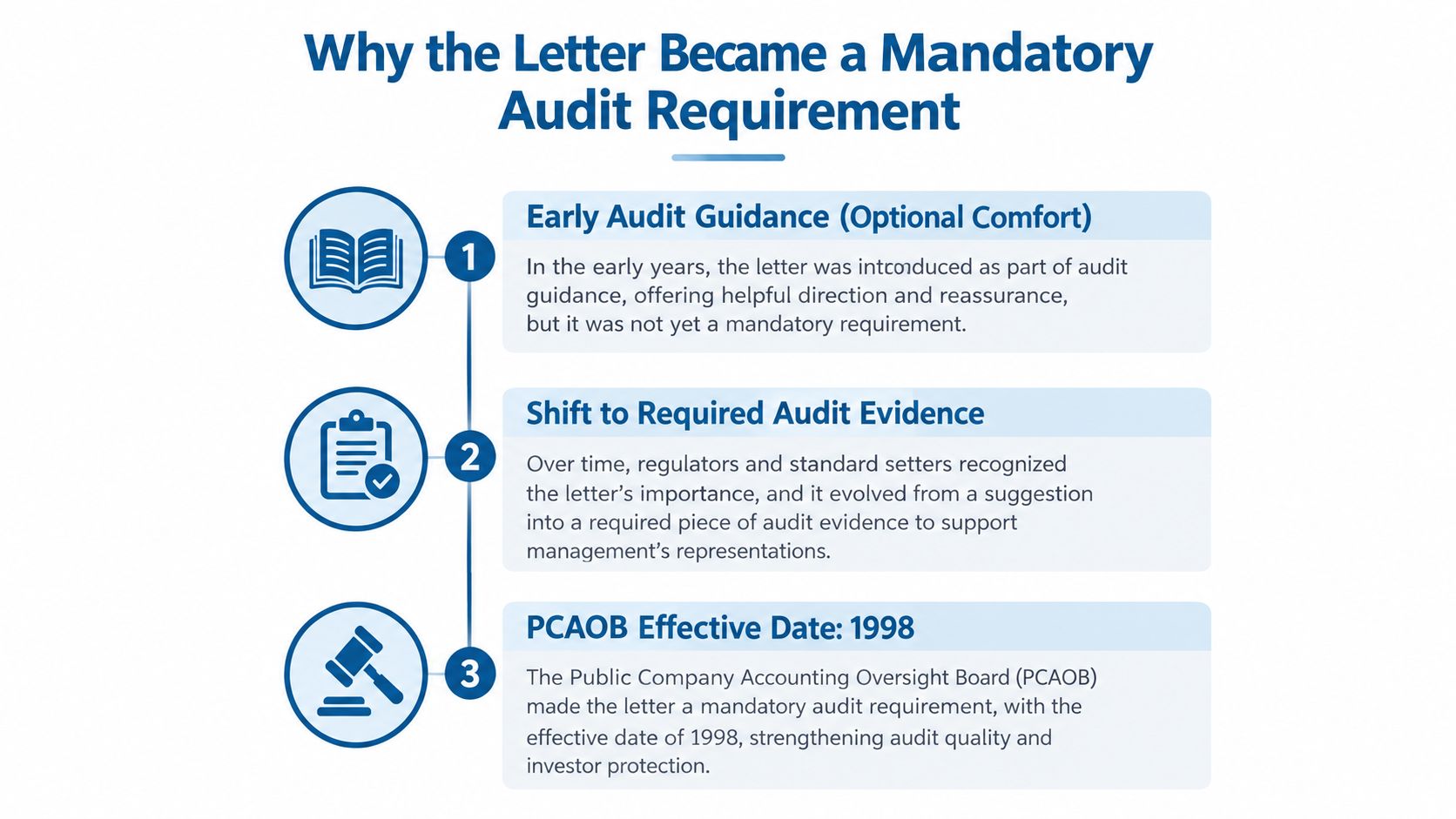
The representation letter became a formal part of modern audit completion because auditors need evidence from the people responsible for the accounting records, but they can't obtain every fact through independent observation. Management knows about plans, intentions, undisclosed agreements, side arrangements, legal matters, and transactions involving owners or related parties that may not be obvious from the general ledger.
In the United States, the PCAOB's archived AU Section 333 states that the requirement for written management representations applied to audits of financial statements for periods ending on or after June 30, 1998. The PCAOB's current AS 2805 standard on management representations preserves the central principle that the auditor must obtain written representations from management.
Internationally, ISA 580 became effective for audits of periods beginning on or after December 15, 2004, according to the PCAOB's archived explanation of written representations. Contemporary ISA (UK) 580 practice continues to require written confirmations for each audit. The requirement is therefore not merely a local preference or a partner's customary closing request.
The professional skepticism rationale
Written representations close an evidence gap, but they don't eliminate professional skepticism. A signed statement that the entity has disclosed all related-party transactions is useful. It becomes stronger when it agrees with the ownership records, board minutes, bank confirmations, legal correspondence, and transaction testing.
The standard also matters because refusing to provide the letter can create a scope limitation. If management won't provide a required representation, the auditor must evaluate how that refusal affects the audit evidence and the audit opinion. A qualified opinion, disclaimer, or other modification may become relevant depending on the circumstances and the significance of the missing evidence.
The letter became mandatory because it establishes an accountable, documented point of management confirmation. It doesn't transfer all responsibility for the audit to the client, and it doesn't allow the auditor to skip testing. It makes management's responsibility explicit and gives the auditor a required source of corroborative evidence.
Required and Recommended Contents of the Letter
A well-prepared letter should feel specific to the entity, not copied from an unrelated audit file. The exact wording varies by reporting framework, jurisdiction, and engagement risk, but the underlying requests usually address management responsibility, completeness, disclosures, estimates, and events through the report date.
Core representations
Management will generally be asked to confirm that it:
- Prepared the financial statements: The accounts comply with the applicable reporting framework and include the required disclosures.
- Maintained responsibility for records and controls: Management remains responsible for the accounting records and internal control environment relevant to financial reporting.
- Provided complete information: The auditor received access to records, documentation, personnel, contracts, minutes, and other requested information.
- Recorded transactions completely: Assets, liabilities, revenues, expenses, commitments, and other transactions have been recorded and presented appropriately.
- Identified related parties: The entity has disclosed known related-party relationships and transactions, including owner dealings, family relationships, intercompany balances, and entities under common control.
- Addressed estimates and valuations: Significant assumptions and judgments, including investment property or private investment valuations, have been disclosed and applied consistently.
- Considered subsequent events: Management has informed the auditor about events occurring after the reporting date and through the auditor's report date that may require adjustment or disclosure.
- Disclosed fraud and non-compliance: Management has communicated known or suspected fraud, illegal acts, and relevant violations of laws or regulations.
A letter may also include engagement-specific confirmations about tax positions, debt covenants, insurance coverage, going concern considerations, shareholder agreements, construction obligations, or restrictions on assets. These are not decorative additions. They help the auditor connect the general standard requirements to the client's actual risk areas.
| Topic Area | Required Assertions | Recommended Additions |
|---|---|---|
| Financial statements | Management accepts responsibility for preparation and presentation | Confirmation of unusual accounting policies or significant judgments |
| Records and controls | Information provided is complete and records are available | Description of unresolved control matters and remediation plans |
| Related parties | Known relationships and transactions have been disclosed | Owner, family, trust, and intercompany transaction schedules |
| Estimates and valuation | Significant estimates and assumptions are reasonable | Investment property, private equity, art, or complex asset valuation support |
| Legal matters | Known litigation, claims, and contingencies are disclosed | Matter-by-matter legal status, insurance recovery, and settlement updates |
| Subsequent events | Relevant events through the report date have been communicated | Updated financing, acquisitions, distributions, or property events |
| Compliance and commitments | Relevant non-compliance and obligations are identified | Tax positions, debt covenants, guarantees, and insurance confirmations |
For an executive or owner reviewing the draft, the useful question isn't “Can I sign this quickly?” It's “Which statement could be wrong because another adviser, entity, or family member knows something the finance team hasn't included?” A visual reminder about responsibility and planning can also be useful alongside the executive compensation planning resource, particularly where compensation, ownership, and related-party arrangements overlap.
Management Letter vs Legal Counsel Letter
These documents answer different questions and come from different people.
The management representation letter is signed by officers, directors, trustees, owners, or other responsible representatives of the entity. It covers the financial statements, accounting records, internal controls, management's plans and intentions, related parties, estimates, fraud matters, compliance, and subsequent events.
The legal counsel letter comes from the entity's attorney, usually in response to an auditor's inquiry. It addresses litigation, claims, threatened proceedings, regulatory matters, and legal contingencies. Auditors use legal counsel's response to assess whether management's accounting for legal exposures is reasonable and whether relevant matters may have been omitted. The audit inquiry letter to legal counsel illustrates the separate role legal counsel can play.
A management statement might say, “We have disclosed all known litigation and claims.” A lawyer's response may identify a pending matter, describe its procedural status, or explain why counsel can't express an opinion about an unasserted claim. Management cannot sign on behalf of the lawyer, and the lawyer shouldn't sign management's broader financial statement representations.
| Feature | Management Representation Letter | Legal Counsel Letter |
|---|---|---|
| Signatory | Management, directors, trustees, owners, or those charged with governance | External or internal legal counsel |
| Main subject | Financial statements, records, controls, estimates, plans, and disclosures | Litigation, claims, threatened proceedings, and legal contingencies |
| Typical wording | Management confirms completeness and responsibility | Counsel responds within the limits of legal knowledge and professional obligations |
| Audit purpose | Confirms management's assertions and responsibilities | Corroborates legal exposure and related accounting |
| Common entity relevance | All audited entities | Especially relevant where litigation, development, leasing, disputes, or regulatory issues exist |
Both letters may be needed in a real estate or closely held business audit. Management knows about leases, guarantees, and negotiations. Counsel knows what has been asserted, threatened, filed, or discussed through legal channels. Each document reduces a different category of audit risk.
Preparing, Signing, and Dating the Letter Correctly
The best time to review the representation letter is before the audit reaches its final signing meeting. A client who waits until the last hour may discover that a representation refers to an old valuation, omits a new loan, or names a former officer as the signatory.
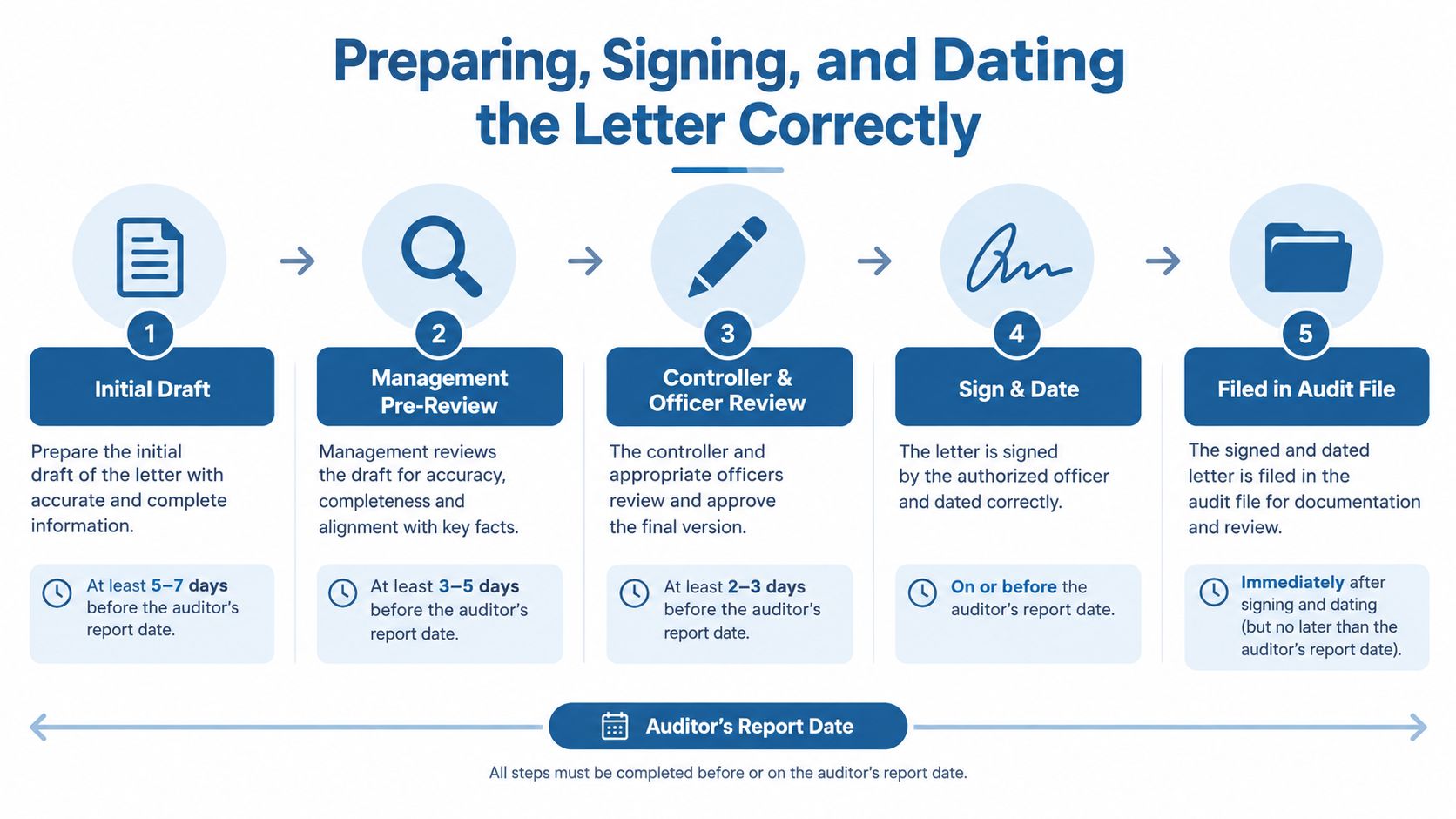
A practical sequence
Start with the draft. The engagement team usually prepares the letter from the audit facts and the applicable standard. Management should read every paragraph, mark statements that need clarification, and identify information that changed after the initial fieldwork.
Involve the people who know the facts. The controller or CFO should coordinate the review, but the process shouldn't stop with accounting. The tax adviser, general counsel, property manager, investment officer, trustee, or family office executive may hold information relevant to a representation.
Confirm authority. A corporation may use its CEO and CFO. An LLC may require the managing member. A trust may require the trustee. A homeowners' association may involve its board or authorized officers. The audit team should confirm the governing documents and engagement requirements rather than relying on a title alone.
Reconcile the letter to the final accounts. Compare the representations with the final trial balance, financial statement drafts, disclosure checklist, board minutes, legal inquiry, debt schedules, investment reports, and subsequent-event review.
Sign and date at the correct point. ISA (UK) 580 requires written confirmations for each audit and says they should be obtained as near as practicable to, but not after, the auditor's report date. The Institute of Chartered Accountants in England and Wales guidance on letters of representation describes this timing requirement and the letter's role as audit evidence.
A closing checklist
Use this sequence during the final phase:
- Before sign-off: Obtain the draft, assign each representation to a knowledgeable reviewer, and list open questions.
- During management review: Check related parties, commitments, contingencies, estimates, fraud matters, compliance, and subsequent events.
- Before signing: Verify the financial statements and disclosures agree with the representations.
- At signing: Use the correct authorized signatories and a date no later than the auditor's report date.
- After receipt: The auditor documents the signed letter in the audit file and resolves any qualification, omission, or inconsistency.
Electronic signatures and scanned copies may be accepted under applicable firm policy and jurisdictional requirements, but the engagement team still needs evidence that the document was signed by the right person and received at the right time.
Watch the workflow visually, then discuss any entity-specific questions with the engagement team:
Common Pitfalls That Trigger Audit File Findings
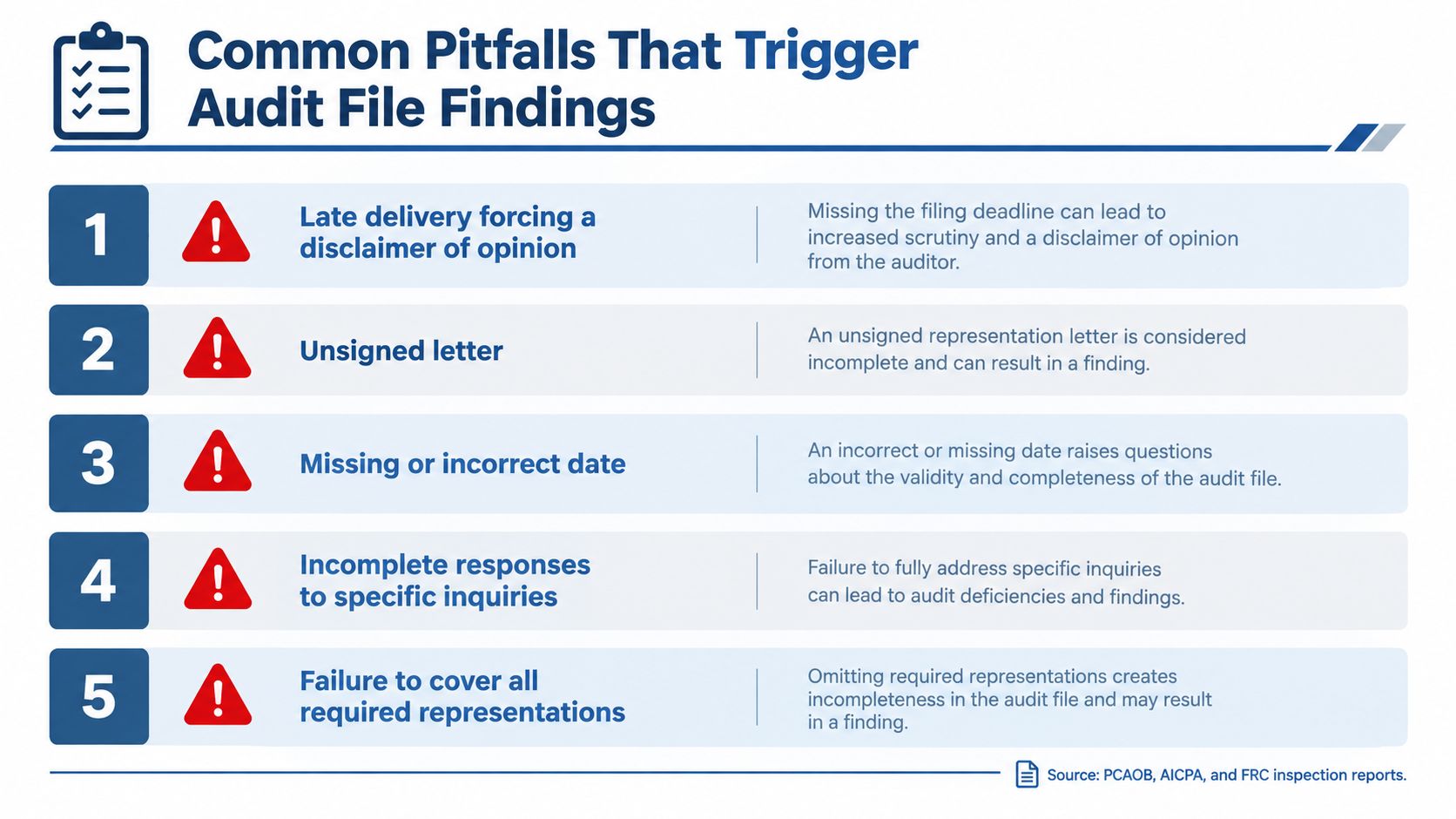
A common assumption is that a representation letter is harmless paperwork. That assumption fails when the document is late, incomplete, or signed by someone without appropriate authority. Regulator commentary described in the ATO review of SMSF audit files identifies missing, unsigned, undated, incomplete, and late-signed letters as operational file problems.
The defects auditors must resolve
Late delivery creates a timing problem. The auditor can't date the report before receiving the required representations. A letter signed after the report may require the auditor to revisit the report date, perform follow-up procedures, or evaluate a limitation on the scope of the audit.
The wrong person signs. A bookkeeper or controller may know the ledger but lack the authority to represent the entity. For a trust, family office, partnership, or HOA, the auditor needs to understand who has responsibility under the governing structure.
The final document differs from the draft without explanation. Management may correct wording during review, but unexplained changes can create uncertainty about what was represented and why the audit team accepted the final version.
The letter uses boilerplate that misses the entity's risks. A generic statement may not address guarantees between family entities, owner loans, property development commitments, investment valuations, or unusual distributions. Entity-specific matters need entity-specific confirmation.
A response is incomplete. Leaving out a response about fraud, legal claims, non-compliance, going concern, or subsequent events can create an unresolved evidence gap. An unsigned legal response creates a separate problem when the audit relies on counsel's confirmation.
Before the final meeting, ask five direct questions:
- Timing: Has the letter been signed before the auditor's report is dated?
- Authority: Does each signatory have the required responsibility and knowledge?
- Completeness: Does the letter cover the financial statements, periods, and relevant disclosures?
- Customization: Does it address the entity's actual related parties, estimates, guarantees, and legal matters?
- Consistency: Does it agree with board minutes, schedules, counsel responses, and the final financial statements?
If an answer is no, raise it before the partner expects the file to close. A quick escalation gives the auditor time to investigate. Silence at the end of fieldwork gives the issue less room to resolve.
Entity-Specific Considerations for HNWs, Family Offices, and Real Estate
The same standard can produce very different questions depending on how wealth is held and how transactions move through the entity.
A high-net-worth individual
A personal balance sheet may include private equity interests, artwork, trusts, personal guarantees, and investments held through several entities. Management may need to confirm ownership, valuation methods, restrictions, related-party relationships, transfers between personal and business accounts, and events affecting those assets.
The useful preparation isn't a longer generic letter. It's an organized ownership chart, investment statements, valuation support, trust documents, loan schedules, and a list of transactions involving family members or controlled entities.
A family office
A family office may coordinate payments, investments, intercompany loans, beneficiary distributions, and pooled vehicles. The representation letter may need confirmations about authorization, completeness of related-party transactions, custody arrangements, allocations between family members, and balances between commonly controlled entities.
Finance staff should assemble intercompany reconciliations, distribution approvals, investment reports, governing documents, and minutes before the auditor drafts the final wording. The New York accounting and advisory guide can serve as a planning reference for organizing broader accounting and advisory needs.

A closely held business
Owner-managed companies often mix business and personal activity through shareholder loans, related-party leases, deferred compensation, guarantees, or informal arrangements. Management may understand these matters intuitively, but the auditor needs them identified, recorded, and disclosed consistently.
A transaction listing, shareholder loan reconciliation, compensation agreements, lease documents, and board or member approvals can make the representation process more precise.
A real estate entity
A real estate company may need to address construction in progress, property valuations, debt covenants, tenant incentives, rent escalations, guarantees, environmental matters, and disputes with contractors or tenants. Supporting schedules should be ready before the letter is reviewed, including loan agreements, covenant calculations, development budgets, leases, tenant ledgers, appraisal materials, and legal correspondence.
| Entity Type | Key Representations to Anticipate | Supporting Documentation |
|---|---|---|
| High-net-worth individual | Ownership, valuations, trusts, guarantees, related entities, and personal transactions | Investment statements, valuation support, trust records, ownership chart, loan schedules |
| Family office | Intercompany activity, distributions, pooled investments, custody, and authorization | Intercompany reconciliations, distribution approvals, investment reports, governing documents |
| Closely held business | Owner transactions, shareholder loans, compensation, leases, and guarantees | Loan schedules, agreements, payroll records, leases, minutes, transaction listings |
| Real estate entity | Property valuation, construction costs, leases, debt covenants, and contingencies | Appraisals, development budgets, loan agreements, lease files, legal correspondence |
The right preparation question is, “What does this entity know that a standard trial balance won't show?” That answer usually points directly to the representations and supporting files that deserve attention.
Key Takeaways and Shared Responsibilities
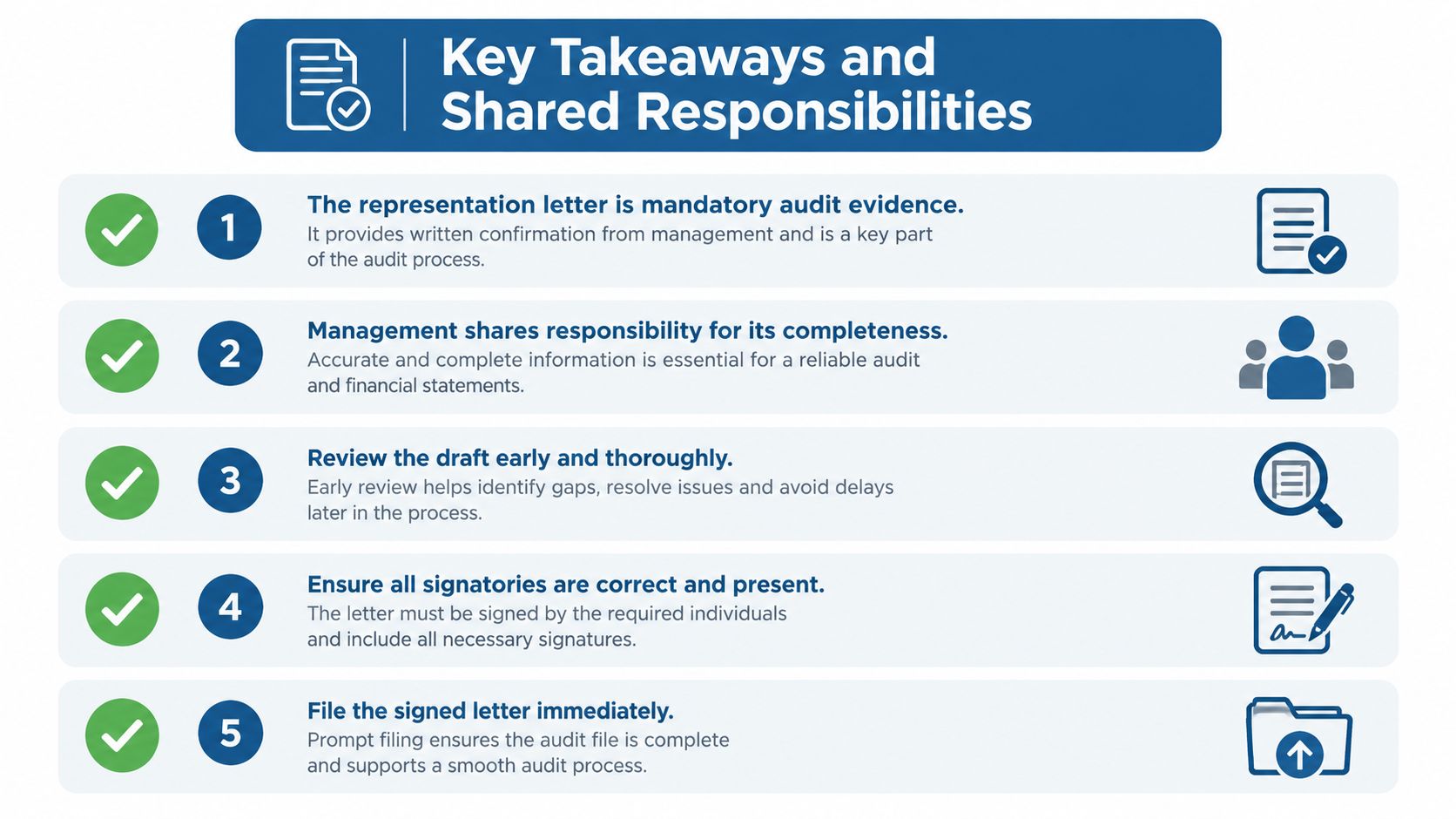
The representation letter is a required part of audit evidence under ISA (UK) 580 and PCAOB AS 2805. Management provides written confirmations because it is responsible for the financial statements and has knowledge of plans, transactions, relationships, and matters that may not appear clearly in the accounting records.
The auditor remains responsible for obtaining sufficient appropriate audit evidence and evaluating whether the representations are consistent with the rest of the file. The letter supports audit procedures, but it can't replace confirmation, inspection, observation, recalculation, analytical work, or testing.
Client responsibilities
- Review early: Read the draft before the final signing meeting.
- Answer specifically: Identify related parties, legal matters, estimates, commitments, fraud concerns, compliance issues, and subsequent events.
- Use the right signatories: Confirm authority under the company, partnership, trust, LLC, or HOA structure.
- Check consistency: Compare the letter with the final financial statements, disclosures, minutes, schedules, and counsel correspondence.
- Sign on time: Make sure the signed letter reaches the auditor no later than the auditor's report date.
Auditor responsibilities
- Draft appropriately: Tailor the letter to the engagement and applicable standard.
- Evaluate evidence: Treat management representations as corroborative, not standalone proof.
- Follow up: Investigate omissions, inconsistencies, refusals, changes, and late delivery.
- Document receipt: Retain the signed and dated letter in the audit file.
- Assess the opinion impact: Consider whether missing representations create a scope limitation or require a modified opinion.
Schedule a pre-signing review with your engagement partner before the letter arrives at the closing meeting. Blue Sage Tax & Accounting Inc. helps high-net-worth individuals, family offices, closely held businesses, and real estate entities organize financial information, address audit questions, and prepare for tax and audit representation needs, so visit Blue Sage Tax & Accounting Inc. to discuss your situation.