A 1099 contractor generally may deduct ordinary and necessary business expenses on Schedule C, including qualifying home-office costs, vehicle expenses, supplies, and business insurance; eligible health insurance and retirement contributions generally receive separate treatment on the federal return. New York and New Jersey rules can differ from federal treatment.
You're sorting supply-house invoices, van expenses, insurance statements, and customer payments, trying to figure out what truly counts. The answer depends on why you incurred each cost, how much was business-related, and whether your records support it, not merely whether you paid with a business card.
For a sole proprietor, deductible operating expenses reduce Schedule C net profit, which feeds the self-employment tax calculation and quarterly estimated-tax projections. Other deductions work elsewhere on the return, so they don't all have the same effect.
These 1099 contractor tax write-offs are worth reviewing before filing, but spending money just to claim a deduction rarely makes financial sense. Dollar limits and mileage rates can adjust annually, so use the rules for the tax year you're filing.
Table of Contents
- 1. Can I Deduct a Home Office If I Work at Customer Job Sites?
- 2. Can I Write Off My Work Van Using Mileage or Actual Expenses?
- 3. Can I Deduct Tools, Equipment, Software, and Supplies Immediately?
- 4. Can I Deduct Health Insurance for Myself and My Family?
- 5. Can SEP IRA, SIMPLE IRA, or Solo 401(k) Contributions Reduce My Taxable Income?
- 6. Can I Deduct Part of My Self-Employment Tax?
- 7. Can I Claim the Qualified Business Income Deduction?
- 8. Can I Deduct Business Travel and Meals at a Job Site?
- Common 1099 Contractor Deductions at a Glance
- Keep the Records That Make These Deductions Hold Up
1. Can I Deduct a Home Office If I Work at Customer Job Sites?
Working at customer sites does not automatically rule out a home-office deduction. The space generally must be used regularly and exclusively for business and meet the principal-place-of-business test or another qualifying test.
An electrician who uses a spare bedroom only for estimates, scheduling, invoicing, and bookkeeping may qualify if it is the principal location for that administrative work and there is no other fixed location where substantial administrative work occurs. A dining table shared with the family generally does not meet the exclusive-use requirement.
What records support the deduction?
Keep measurements, a floor plan, photographs, and records showing how the space is used. Compare the simplified and actual-expense methods before choosing; a larger-looking calculation is not necessarily available or preferable.
- Actual expenses: Keep rent or eligible ownership costs, utility bills, insurance records, repair invoices, and the calculation used to allocate costs to the business space.
- Business activity: Use a calendar or task log to document regular administrative work in the space.
- State substantiation: New York State may ask for documentation of business use of a home. Check current state requirements rather than assuming federal records settle the state filing.
New York State, New York City, and New Jersey treatment should be checked separately. Federal eligibility does not establish the result for state or city taxes, so keep records that support both your business use and the calculation you claim.
2. Can I Write Off My Work Van Using Mileage or Actual Expenses?
You can generally deduct the business-use portion of qualifying vehicle expenses using standard mileage or actual expenses, subject to eligibility rules. Ordinary commuting and personal driving aren't deductible business mileage.
For federal tax year 2025, the IRS standard-mileage notice sets the business rate at 70 cents per business mile. That rate applies to that tax year, not automatically to a later return.
A drywall contractor driving between customer sites and a supply house should record each trip's date, destination, business purpose, and mileage. Driving from home to a regular work location is generally commuting; starting from a qualifying principal-place-of-business home office can change the analysis.
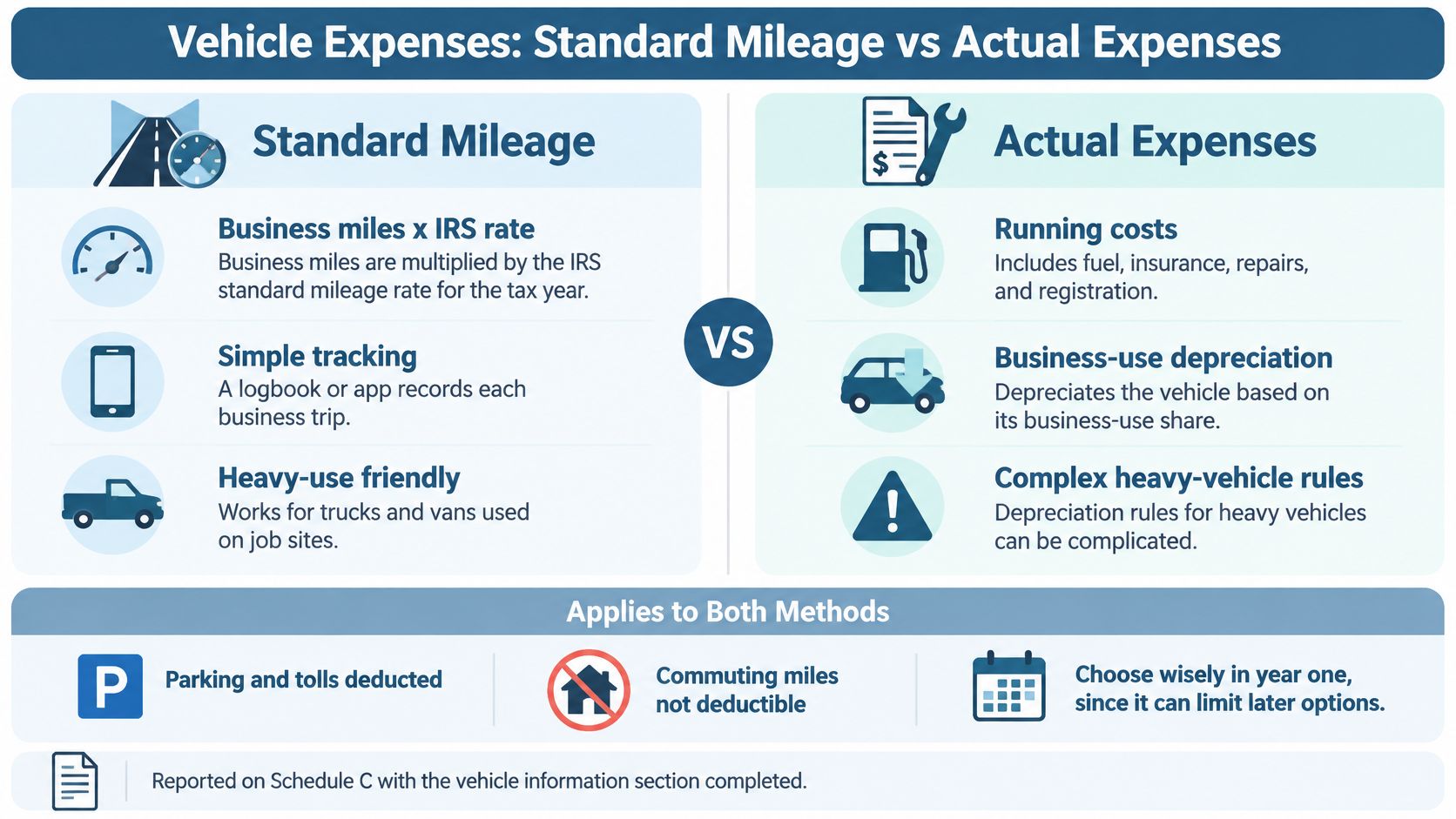
Which method fits the vehicle?
Standard mileage simplifies the calculation, but it doesn't eliminate the mileage log. Actual expenses require invoices for fuel, repairs, insurance, registration, and other eligible costs, plus total mileage to establish business use.
Choose the method with future years in mind. For an owned vehicle, the initial method choice can restrict later options.
Use a timestamped mileage app such as MileIQ, review trip classifications regularly, and retain beginning- and end-of-year odometer readings. Preserve the federal calculation and review any required state adjustments, particularly those involving vehicle depreciation.
3. Can I Deduct Tools, Equipment, Software, and Supplies Immediately?
Ordinary business supplies and software subscriptions are generally deductible operating costs, but durable equipment may need different treatment. The IRS business-expense guidance distinguishes current expenses from property expected to last more than one year, which generally may require depreciation unless an applicable expensing rule allows otherwise.
For an electrician, connectors used on installations and a recurring estimating-software subscription differ from a cable puller expected to serve many projects. Don't put every supply-house purchase into the same expense category.

What belongs in the equipment file?
- Purchase evidence: Save the itemized invoice, payment record, and equipment description.
- Service date: Record when the equipment became ready and available for business use, not just when you ordered it.
- Business allocation: Document personal use of laptops, phones, and internet service rather than claiming the entire bill automatically.
Federal immediate-expensing elections and bonus depreciation require a tax-year-specific review. New York and New Jersey can require different depreciation treatment, so retain separate federal and state asset schedules.
For a new operation, Mazurly's startup cost breakdown can help organize launch spending, but pre-opening costs shouldn't automatically be classified as current operating expenses.
4. Can I Deduct Health Insurance for Myself and My Family?
Eligible self-employed health insurance premiums may qualify for a federal adjustment to income rather than a Schedule C operating expense. The deduction generally depends on business earnings, how the coverage is established, and eligibility for subsidized employer coverage.
Say a sole proprietor buys family coverage through an individual marketplace policy. Premiums may qualify, but the calculation must account for the business-income limit and any premium tax credit coordination.
Eligibility for a subsidized employer plan through your own employment or a spouse's employment can disqualify premiums for affected months. Choosing not to enroll doesn't necessarily preserve the deduction.
Keep coverage records by month
Retain premium statements, payment confirmations, marketplace documents, and employer-plan eligibility records. Qualifying long-term care premiums have additional restrictions, so don't combine them with ordinary medical premiums without reviewing the applicable rules.
Filing distinction: Owner health insurance isn't the same expense as general liability insurance. Putting both into a Schedule C insurance account can distort the return.
The calculation generally uses Form 7206 where applicable. S corporation owners have separate reporting requirements, and New York State and New Jersey treatment should be reviewed independently.
This overview of how to claim health insurance deductions when self-employed provides additional context, but your coverage eligibility and entity structure determine the result.
5. Can SEP IRA, SIMPLE IRA, or Solo 401(k) Contributions Reduce My Taxable Income?
Contributions to an eligible self-employed retirement plan may be deductible within the rules for that plan and tax year. Your available contribution depends on eligible earnings, plan design, other retirement-plan participation, and employee coverage requirements.
A contractor working alone may compare a SEP IRA with a solo 401(k), while an owner hiring employees needs to consider eligibility and employer contribution obligations. A plan that fits an owner-only operation may become more expensive or administratively demanding after hiring.
Compare the cash commitment, not just the deduction
Retirement contributions move cash out of the operating account and into an account with withdrawal restrictions. Before funding the plan, allow for payroll, material purchases, insurance, and estimated taxes.
- Plan documents: Retain adoption agreements and amendments.
- Contribution records: Keep deposit confirmations showing the contribution type and designated tax year.
- Employee information: Maintain compensation and service records needed to determine coverage.
Setup deadlines and funding deadlines differ, so review them before year-end rather than assuming filing-season action will be sufficient. Contribution limits can adjust annually, and New Jersey treatment shouldn't be assumed to match the federal deduction.
Compare self-employed retirement plan options using projected net earnings and staffing plans, not gross customer payments.
6. Can I Deduct Part of My Self-Employment Tax?
Federal rules generally allow a deduction for one-half of self-employment tax, as described in the IRS guidance on self-employment tax calculations. This is an adjustment to income, not a Schedule C expense, and it doesn't reduce the self-employment tax itself.
A contractor receiving payments from a single customer still calculates business profit and self-employment tax under the applicable rules. The deduction isn't an additional payment or a separate bill to enter in the bookkeeping system.
Why does this matter for quarterly estimates?
A contractor who assumes this deduction reduces self-employment tax directly may reserve too little cash. Tax software generally calculates the adjustment from Schedule SE and carries it to the individual return, but the underlying business profit still needs to be accurate.
Keep the completed calculation with your tax records, including information about wages from other employment. Wage income can affect the Social Security portion of the calculation.
A deductible adjustment and a business expense can both affect income tax, but they don't necessarily affect self-employment tax the same way.
Review how to reduce self-employment tax before making entity or compensation changes. Federal treatment doesn't automatically settle New York or New Jersey treatment, and restructuring introduces obligations beyond claiming deductions.
7. Can I Claim the Qualified Business Income Deduction?
Eligible business owners may qualify for the federal qualified business income deduction, but it isn't a deduction for money spent. Eligibility and the calculation depend on qualified business income, taxable income, business type, and potentially wages and qualifying property.
An electrician operating as a sole proprietor may qualify even without buying additional equipment. A consulting contractor may face different limitations because specified service businesses have additional restrictions at higher taxable-income levels.
What records does the calculation need?
Start with accurate business accounts, then identify adjustments affecting qualified business income. Gross receipts alone don't establish the deduction, and owner health insurance, retirement contributions, and the deductible portion of self-employment tax can affect the calculation.
- Business classification: Document the services performed, especially when consulting and product sales overlap.
- Payroll and property: Preserve employee wage records and qualifying asset information when relevant.
- Return calculations: Retain the applicable Form 8995 or Form 8995-A computation and supporting schedules.
Construction businesses aren't automatically subject to the specified-service limitation, but other limitations can still apply. Review the law for the tax year being filed rather than relying on an older calculator.
New York State and New Jersey generally don't provide the same federal QBI deduction. Don't treat it as a reduction to Schedule C operating profit or assume it reduces state taxable income.
8. Can I Deduct Business Travel and Meals at a Job Site?
Qualifying business travel away from your tax home may be deductible, including eligible transportation and lodging costs. Business meals are subject to separate limits, while personal meals, ordinary commuting, and most entertainment don't qualify.
An HVAC contractor based in Queens who accepts a temporary New Jersey assignment may qualify for travel expenses if the tax-home and away-from-home requirements are met. Crossing a state line alone doesn't make a hotel stay or restaurant bill deductible.
What should the receipt explain?
For travel, retain the assignment agreement, work schedule, itinerary, lodging invoices, and transportation receipts. For meals, record who attended, their business relationship, and what business was discussed.
A restaurant consultant meeting a prospective client should save the itemized meal receipt and note the proposed engagement. A card statement showing only the restaurant name doesn't establish the participants or business purpose.
- Separate personal costs: Identify vacation days, family expenses, and other nonbusiness charges.
- Separate entertainment: Don't classify event tickets as meals just because a customer attended.
- Check state consequences: A deductible trip and a New Jersey filing obligation are separate questions.
Apply the meal limitation for the tax year being filed rather than deducting the entire restaurant total automatically. Keep meals, lodging, and transportation in separate bookkeeping categories so the correct rules can be applied.
Common 1099 Contractor Deductions at a Glance
Use this table to connect each deduction to its federal reporting treatment, the records or rules it depends on, and state differences that can affect the return. A deduction generally reduces Schedule C net profit; that profit also feeds self-employment tax and quarterly estimated payments. Accurate records throughout the year help you estimate those amounts before filing.
| Item | Federal Reporting | Key Requirement | State Treatment |
|---|---|---|---|
| Home Office Deduction | Actual expenses use Form 8829 and flow to Schedule C; the simplified method is also available | Regular and exclusive business use of a defined home area | New York State, New York City, and New Jersey may differ from federal rules |
| Vehicle Expenses (Standard Mileage or Actual Expenses) | Schedule C, including vehicle information | Deduct business-use costs; keep a contemporaneous mileage log and exclude commuting | New York and New Jersey may require adjustments, particularly for vehicle depreciation |
| Tools, Equipment, Software, and Supplies | Generally Schedule C; larger purchases typically use Form 4562 | Ordinary and necessary business costs; durable items may require an expensing election or depreciation | Equipment depreciation can differ in New York and New Jersey; keep separate state asset schedules |
| Self-Employed Health Insurance Deduction | Form 7206; claimed as an adjustment to income | Limited by business net profit; unavailable for months you were eligible for a spouse's employer-subsidized plan | New York and New Jersey may treat it differently |
| Retirement Plan Contributions (SEP IRA, SIMPLE IRA, Solo 401(k)) | Deducted on the federal return, subject to plan rules | Limits, eligibility, and deadlines depend on plan type and annual federal rules | Do not assume New Jersey follows the federal treatment of retirement deductions |
| Deduction for One-Half of Self-Employment Tax | Calculated on Schedule SE and carried to Schedule 1 of Form 1040 | Reduces income tax, not self-employment tax | State treatment varies; check New York and New Jersey returns |
| Qualified Business Income (QBI) Deduction | Form 8995 or Form 8995-A | Eligibility and limits depend on income, business type, wages, and property | New York and New Jersey generally do not follow the federal deduction |
| Business Travel and Business Meals | Reported as business expenses; specific form not stated | Travel must be business-related and away from the tax home; meals are generally 50% deductible | Out-of-state travel can raise separate New Jersey filing questions |
Keep the Records That Make These Deductions Hold Up
A customer payment, a receipt, and a note about the job should tell a consistent story. Keep business and personal accounts separate, reconcile them regularly, and attach itemized receipts to transactions. Record the business purpose when you make a purchase, especially for meals, travel, and mixed-use expenses.
The IRS small-business tax guide explains that independent contractors generally report business income and deductible expenses on Schedule C. Personal spending does not become deductible just because you are self-employed, so classify each transaction while the details are clear.
Make the records useful before filing season
- Reconcile income: Match customer payments to invoices, and investigate deposits that are not sales.
- Review allocations: Update mileage records and support the business-use share of expenses for services used personally and for work.
- Maintain an asset list: Record equipment purchases, service dates, and disposals, and track differences between federal and state treatment.
- Project profit: Keep a running Schedule C estimate and record estimated-tax payments already made.
Cloud bookkeeping tools such as QuickBooks Online or Xero can bring records together, but review automatic categories before relying on them. Cloudvara's guide to cloud accounting discusses organizing a shared accounting workflow.
Schedule C net profit affects self-employment tax and quarterly federal estimated-tax projections. A useful projection considers household income, withholding, deductions, and credits, rather than applying a fixed percentage to gross receipts. That gives you a clearer picture of cash needed for taxes as the year progresses.
The IRS independent-contractor guidance explains that contractor payments generally lack federal withholding and that late required estimated payments can lead to underpayment penalties. Check New York State, New York City, and New Jersey obligations separately when they apply.
A deduction can reduce taxable income, but the expense still uses cash. Keep costs tied to real business needs and records you can explain.
Blue Sage Tax and Accounting Inc. provides year-round tax planning and quarterly projections for contractors considering cash flow and federal and state filing obligations. Learn about the firm's services, or book a consultation call with Blue Sage Tax & Accounting Inc..
This article is general information, not tax advice for your specific situation.