
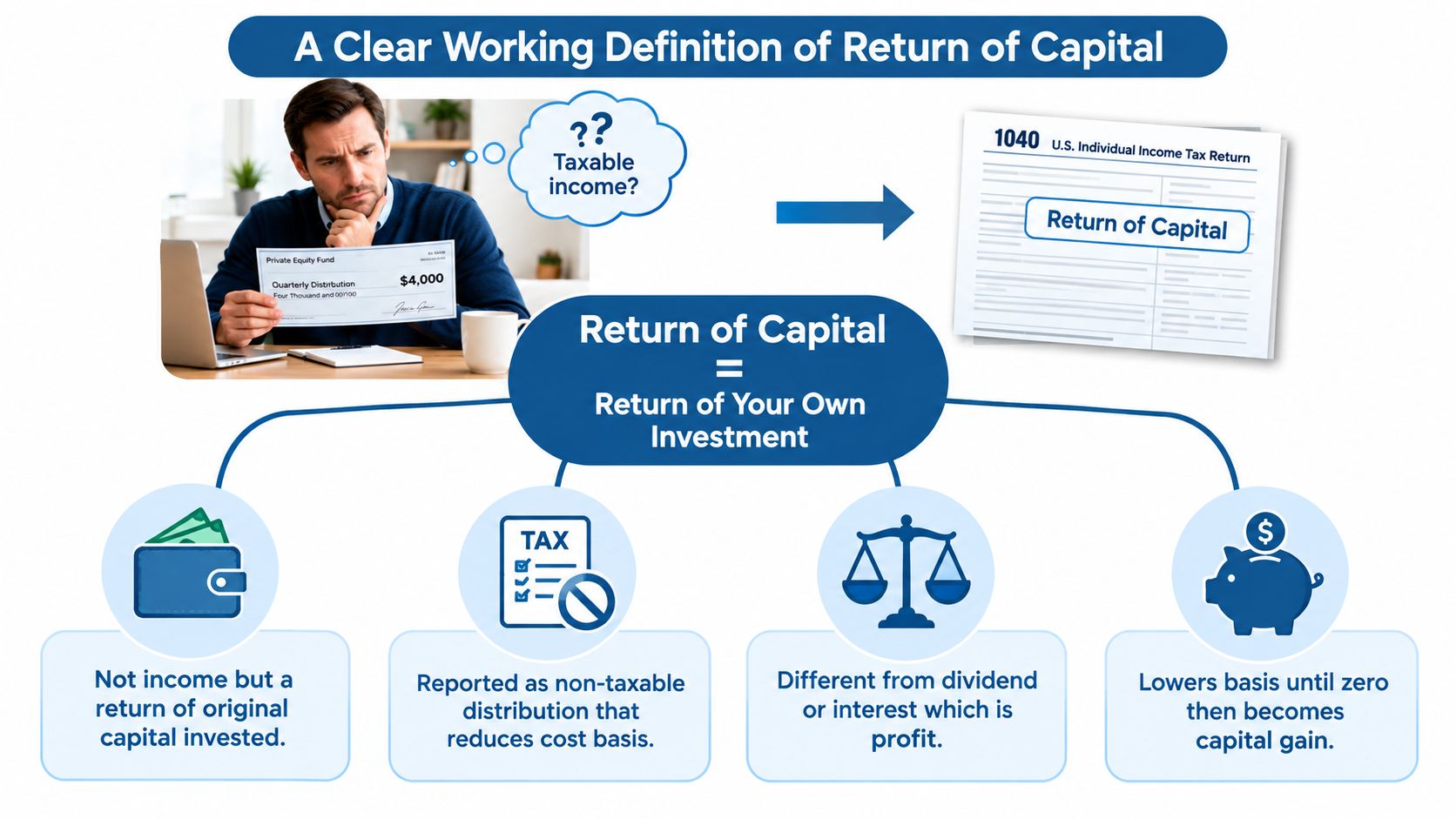
Return of capital is a nondividend distribution that isn't taxed as income when you receive it. Instead, it reduces your adjusted cost basis dollar for dollar until your basis reaches zero, after which any additional distribution becomes taxable capital gain.
You may encounter the issue after receiving a distribution that looks like ordinary portfolio income. A private equity fund might send a $4,000 quarterly distribution, for example, while the tax form labels it a nondividend distribution. The cash is real, but the tax treatment depends on whether the payment came from earnings or from capital you previously invested.
That distinction matters most when you later sell the investment. A return of capital, or ROC, can postpone tax today while increasing the gain you may report tomorrow. The cleanest way to understand it is to follow the investment's adjusted basis, then connect that basis to Form 8949 and Schedule D.
A Clear Working Definition of Return of Capital
Suppose you invest in a private equity fund and receive a $4,000 quarterly distribution. You may reasonably assume the payment is fully taxable income, especially if it arrives in the same account as dividends and interest. Then the tax statement identifies some or all of it as a nondividend distribution, creating an understandable question: if the cash isn't taxable income now, what is it?
A return of capital is money an entity gives back from the investor's contributed capital rather than from profits earned by the entity. The exact classification depends on the investment and its tax reporting, but the core federal rule is straightforward. The IRS explains that a distribution can qualify as a return of capital when the paying corporation has no current or accumulated earnings and profits. The payment generally reduces the investor's adjusted basis, and any amount received after basis reaches zero becomes taxable capital gain under IRS guidance on distributions and basis.
Think of your investment basis as a security deposit. When part of that deposit comes back, you receive cash, but your financial stake in the asset becomes smaller. ROC isn't the same as a dividend, interest payment, rental profit, or appreciation. Those categories generally reflect income or growth produced by an asset. ROC represents the return of part of what you put in.
The three-part mental model
- You receive cash. The distribution may appear in a brokerage account or arrive from a fund.
- Your basis declines. The amount classified as ROC reduces your adjusted cost basis dollar for dollar.
- Tax moves forward. You generally recognize the deferred tax when you sell, or sooner if the distribution exceeds your remaining basis.
Your basis usually begins with the purchase price and purchase costs. The IRS describes gain as sale proceeds minus adjusted basis, with basis generally tied to cost and later adjustments. That means ROC doesn't make income permanently tax-free. It changes the timing of recognition, which is why experienced investors describe ROC as tax deferral rather than tax elimination.
Return of Capital Versus Ordinary Dividends
The easiest way to avoid confusion is to compare the source of each payment with its reporting and tax treatment. A dividend generally represents a distribution from corporate earnings and profits. Interest represents compensation for allowing another party to use your money. ROC represents a return of invested principal.
| Income Type | Source | Reporting Form | Federal Tax Treatment |
|---|---|---|---|
| Ordinary dividend | Corporate earnings and profits | Form 1099-DIV | Generally taxed in the year received as dividend income |
| Qualified dividend | Corporate earnings and profits, subject to applicable qualification rules | Form 1099-DIV | Generally eligible for the applicable long-term capital-gains rate when the requirements are met |
| Interest | Payment for the use of invested money | Form 1099-INT, and potentially Schedule B reporting | Generally taxed as ordinary income |
| Return of capital | Return of contributed investment capital | Form 1099-DIV or other investment tax reporting | Generally not taxed when received, but reduces adjusted basis |
The key difference is timing. Ordinary dividends and interest generally enter the tax calculation for the year you receive them. ROC usually doesn't enter taxable income at that point because the investor is receiving back part of the investment's basis. The later sale uses that lower basis, which can create a larger capital gain reported on Form 8949 and Schedule D, as described in IRS guidance on basis and capital gains.
Why the label matters
A payment's description in an account statement doesn't determine its tax result. A cash distribution can look like a dividend economically while appearing as ROC for tax purposes. Read the year-end tax form and the issuer's final classification rather than assuming every payment belongs on Schedule B.
There are also situations where ROC becomes currently taxable. For example, when a C corporation has no earnings and profits and a distribution exceeds the shareholder's basis, the excess is treated as gain under the applicable corporate distribution rules. The practical question is always the same: how much basis remained immediately before the payment?
Practical rule: Treat ROC as deferred tax attached to your investment, not as permanently tax-free spending money.
How Corporations, Partnerships, REITs, and Funds Pay ROC
ROC doesn't look identical across investment structures. The entity type affects the form you receive, the box or code you review, and the basis ledger you need to maintain.
Corporations
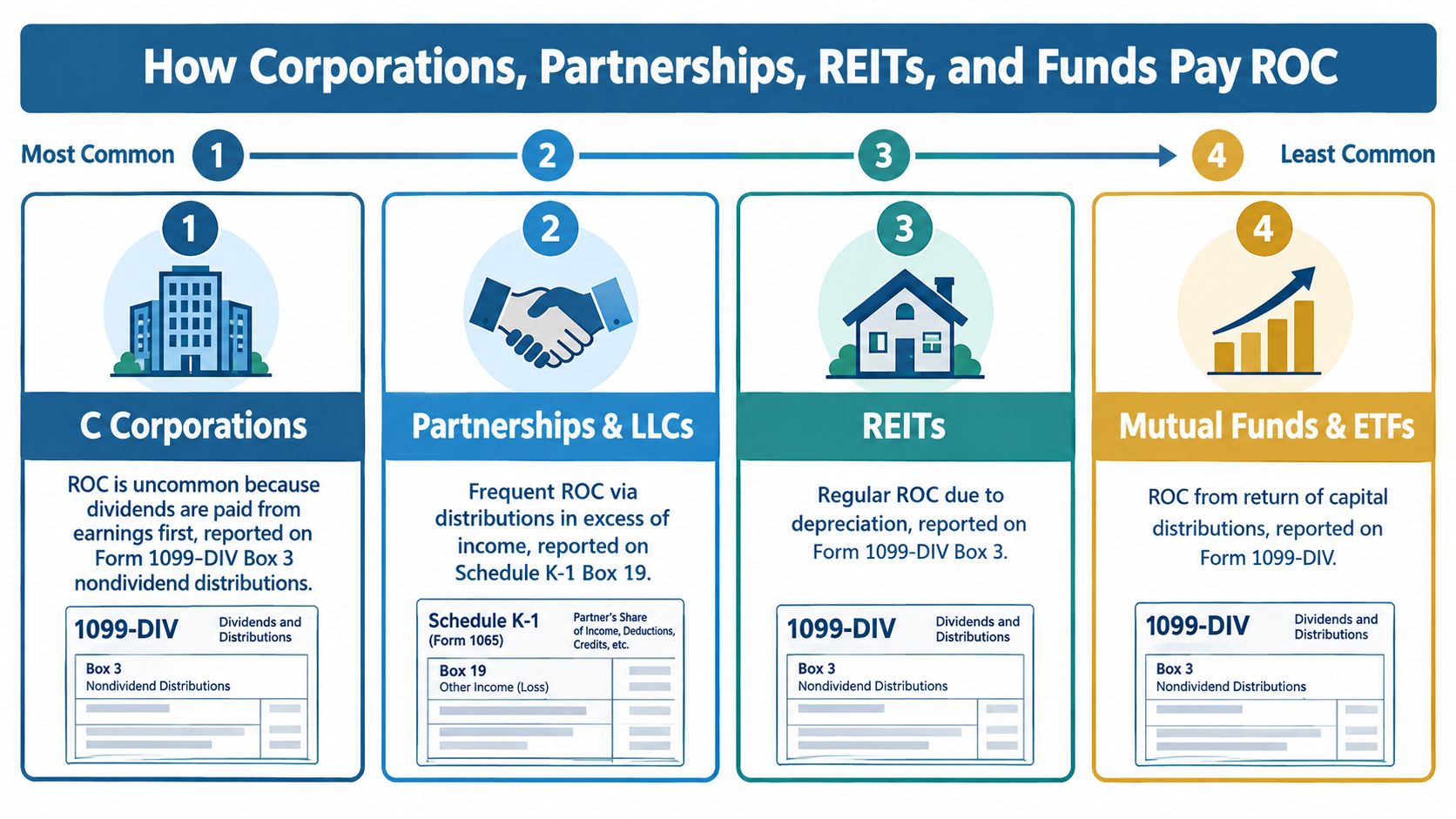
C corporations commonly distribute earnings as dividends, so ROC is less common in the ordinary course. When a distribution exceeds available earnings and profits, the shareholder generally looks to basis for the next layer of treatment. Form 1099-DIV can identify a nondividend distribution in Box 3, separate from ordinary dividends and qualified dividends.
The form is only the starting point. You still need to compare the reported amount with your adjusted basis in the specific shares that generated the distribution.
Partnerships and LLCs taxed as partnerships
Partnership distributions often require more detailed basis work because the partner's outside basis changes through contributions, allocations, liabilities, and distributions. The partnership reports information on Schedule K-1, and the investor must reconcile those items with the partnership interest's own basis records.
Don't assume that a cash distribution equals taxable income. A partner may receive cash while taxable income is reported separately, or receive a distribution that reduces outside basis. The K-1 instructions, state schedules, partnership agreement, and tax capital information should be reviewed together.
REITs
REIT investors frequently see a mixture of ordinary dividends, capital gain distributions, and nondividend distributions. On Form 1099-DIV, ordinary dividends generally appear in Box 1, capital gain distributions in Box 2a, and nondividend distributions in Box 3.
Depreciation and the structure of real estate investments can contribute to distributions that don't match the investor's intuitive idea of current taxable income. The form's classification controls the starting point, but the investor's adjusted basis controls what happens later.
For a visual reference related to accounting and advisory work, you can review this accounting and advisory guide for New York investors.

Mutual funds and closed-end funds
Mutual funds and closed-end funds can also report nondividend distributions on Form 1099-DIV. A closed-end fund may use ROC as part of its distribution policy, while a mutual fund may have different mechanisms for distributing investment results. Investors shouldn't infer the classification from the fund's advertised distribution yield.
Maintain a separate basis record for each security and lot. A broker's displayed basis may not reflect every ROC adjustment, particularly when the investment was transferred, reorganized, held at another institution, or owned before the broker began tracking the relevant information.
A Step by Step Basis Adjustment Example
Consider an investment purchased at $10.00 per share for 1,000 shares. The initial cost basis is therefore $10,000. The investor receives ROC distributions during two years, and each payment reduces the basis rather than creating current taxable income.
The first distribution totals $2,000. The investor's adjusted basis falls from $10,000 to $8,000. The next distribution totals $2,500, reducing the remaining basis to $5,500.
| Event | Cash Flow | Adjusted Basis | Cumulative ROC Received |
|---|---|---|---|
| Purchase of 1,000 shares at $10.00 | ($10,000) | $10,000 | $0 |
| First ROC distribution | $2,000 | $8,000 | $2,000 |
| Second ROC distribution | $2,500 | $5,500 | $4,500 |
| Sale of investment | $6,000 | $5,500 before sale | $4,500 |
The investor then sells the position for $6,000. The capital gain is $500, calculated as the $6,000 proceeds minus the reduced $5,500 basis. Without the ROC adjustments, the investor might incorrectly compare the sale proceeds with the original $10,000 cost and report the wrong tax result.
Mapping the example to tax forms
For a REIT investment, the ROC generally starts with Form 1099-DIV, Box 3. The sale is then reported using Form 8949, with the resulting totals flowing to Schedule D. The investor should enter the correct adjusted basis, not blindly accept a broker's default figure.
That manual review becomes especially important when distributions span multiple years. Keep the original purchase confirmation, each annual Form 1099-DIV, transaction statements, and the final Form 1099-B together. The goal is a continuous audit trail from original cost to final sale.
What Happens When Basis Reaches Zero
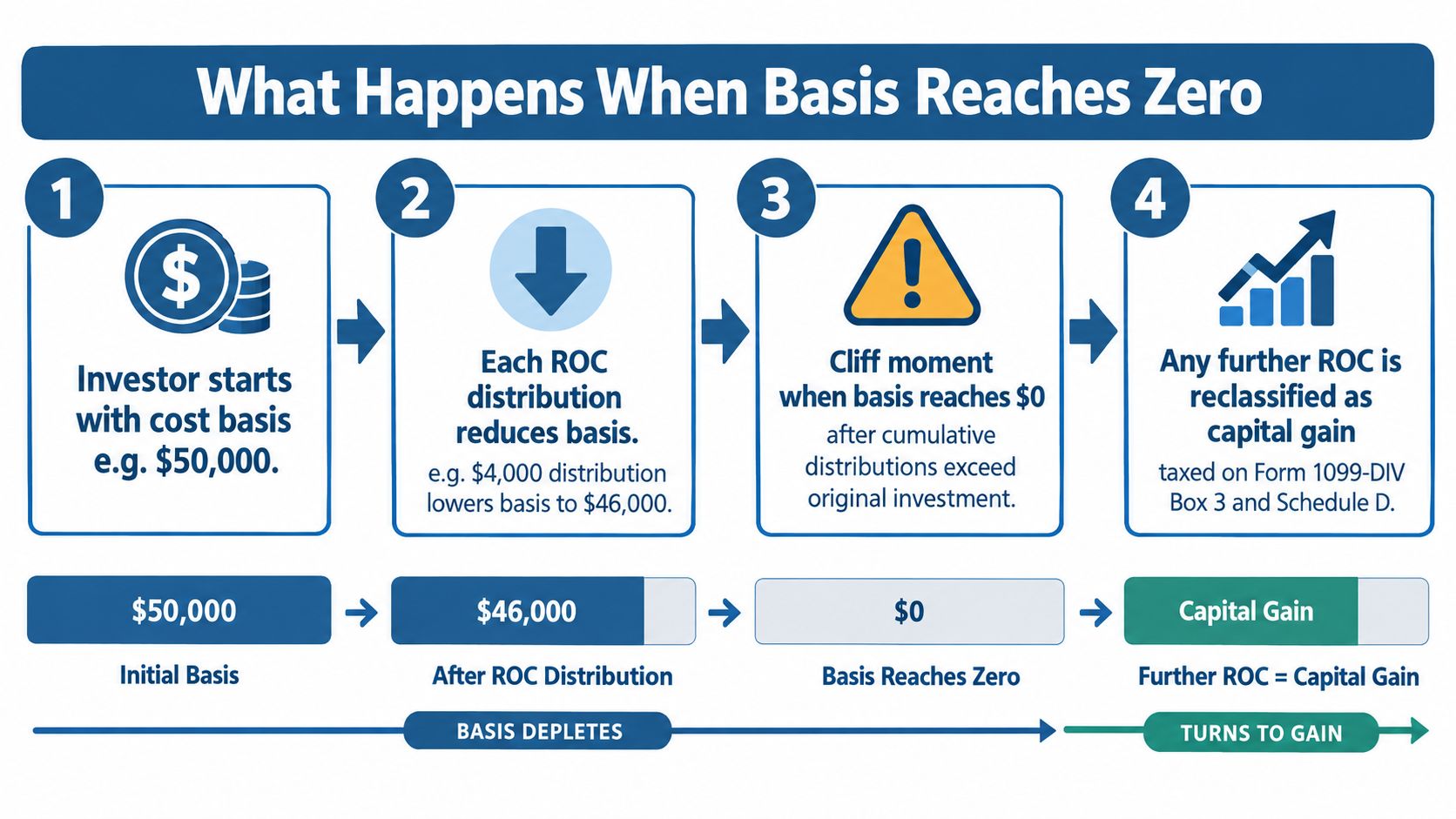
Basis reaching zero is the point where the deferred-tax concept changes character. Before that moment, a qualifying ROC payment generally consumes existing basis. Once no basis remains, a further distribution can't reduce basis below zero. The excess becomes taxable capital gain.
For example, assume an investor has $2,000 of remaining basis and receives $3,000 of cumulative ROC. The first $2,000 uses the remaining basis. The additional $1,000 is gain because the investor has already recovered the entire recorded investment basis.
The holding period can affect whether the gain is treated as long-term or short-term. The final tax form and the investment records should be reviewed together, because the issuer's reporting may need to be reconciled with the investor's basis history and holding period.
A later sale can produce a surprising result. In a rising market, the lower basis can turn what feels like a modest economic gain into a larger reported capital gain. In a declining market, the investor may still recognize a loss if the sale proceeds fall below the adjusted basis, even after years of distributions.
New York investors should also separate federal treatment from state and local filing questions. Residency, source rules, the investor's entity structure, and the nature of the investment can affect the state analysis. A New York resident with nonresident investment activity may need to reconcile federal basis adjustments with state reporting, including Form IT-203 when a nonresident or part-year filing applies.
The important operational point is simple. Don't wait for the sale to reconstruct the history. Record each ROC payment when the issuer reports it, so the zero-basis event can be identified in the correct tax year.
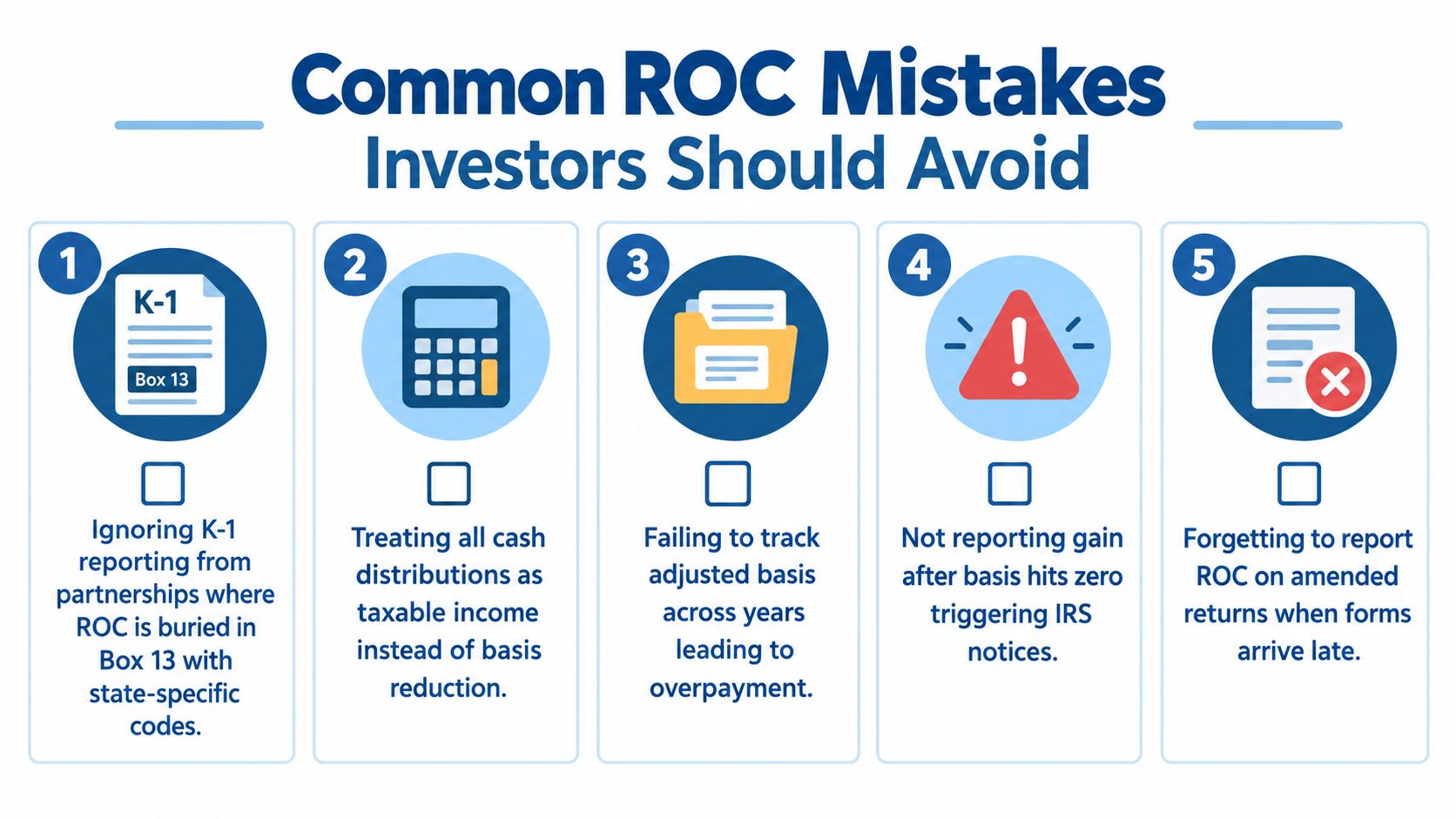
Common ROC Mistakes Investors Should Avoid
ROC errors usually begin with a reasonable assumption: cash received must be income. That assumption fails because tax reporting follows the payment's classification and the investment's basis, not the appearance of money in a bank account.
The paperwork gets separated
Partnership and LLC investors may overlook a K-1 because it arrives later than brokerage statements or includes state-specific schedules. The corrective action is to keep every K-1 with the partnership's basis schedule and review the distribution information before preparing the individual return.
A second problem appears after a broker change, account transfer, or fund reorganization. The new institution may show an incomplete basis history. Preserve the original purchase records, transfer statements, distribution notices, and prior returns instead of assuming the new 1099-B contains the full record.
The cash gets classified twice
Some investors treat a Box 3 nondividend distribution as dividend income on Schedule B and also reduce basis later. That approach can create inconsistent reporting and may cause the same cash to influence the return twice. Use the tax form classification as the starting point, then record the basis adjustment in the investment ledger.
A nondividend label doesn't mean “ignore this payment.” It means the payment belongs in your basis records.
Similar labels create bad comparisons
A Form 1099-DIV Box 3 amount is a nondividend distribution. It isn't automatically the same thing as a return of premium on an annuity, a partnership distribution, or a refund from an investment platform. Confirm the underlying asset and the form before applying a familiar rule.
Multi-state investors face another trap. A federal basis adjustment may interact with state filing requirements, entity-level reporting, and source rules differently from a simple single-state portfolio. Flag investments involving partnerships, real estate, REITs, or multiple jurisdictions for a separate state review.
Finally, correct late-arriving forms rather than forcing the original return to remain unchanged. An amended return may be necessary when revised tax information changes the reported distribution or the resulting gain.
Record Keeping and Tax Planning Action Steps
A reliable ROC record starts with one basis ledger for each investment that may make these distributions. A spreadsheet can suit a simple portfolio. Family offices and real-estate investors may need portfolio-accounting software that preserves lot-level history and connects each entry to its source documents.
For every position, record:
- Original cost: Include the purchase price, acquisition costs, date, number of units, and account or entity owner.
- Annual ROC: Enter each Form 1099-DIV Box 3 amount and relevant K-1 distribution code with its tax year.
- Remaining basis: Subtract cumulative ROC and add other documented basis adjustments.
- Sale information: Compare the ledger with the broker's Form 1099-B before preparing Form 8949 and Schedule D.
- State details: Keep state schedules and entity allocation records with the federal forms.
Reconcile the ledger before filing. A broker's basis may omit an older ROC adjustment, a transfer from another institution, or a fund reorganization. Compare both records and make the appropriate adjustment on Form 8949 instead of accepting an incomplete default. That step connects the earlier cash distribution to the later capital-gain calculation.
Tax planning can limit surprises. If distributions made after basis reached zero create capital gains, review whether realized losses elsewhere in the portfolio may offset those gains under the applicable rules. Partnership investors should review suspended passive losses and state filings because both may affect when the result is recognized and how it is reported.
For high-net-worth and real-estate investors, conduct an annual ROC review using four questions:
- Which holdings reported nondividend distributions?
- What is the cumulative ROC for each lot?
- Which positions are approaching zero basis?
- Do federal, New York, city, and other state records agree?
For a broader planning framework, review this executive compensation planning playbook. Investors who want professional support can also consult Blue Sage Tax & Accounting Inc., a boutique tax and advisory firm handling individual, partnership, real-estate, multi-state, and investment reporting matters.
Key Takeaways on Return of Capital
The most useful answer to what is return of capital is a timing rule: ROC generally gives you cash without current income tax, but it reduces the basis attached to your investment. That deferred tax remains connected to the position until a sale, or until distributions exceed the remaining basis.
Keep three numbers visible for every affected investment:
- Original cost, including properly documented acquisition costs.
- Cumulative ROC received through the current tax year.
- Remaining adjusted basis after all applicable adjustments.
Those numbers tell you whether a new distribution is still reducing basis or has crossed into taxable gain. They also make the eventual sale easier to report because Form 8949 and Schedule D depend on an accurate adjusted basis, not merely the amount shown in a brokerage dashboard.
ROC is not automatically a sign of a poor investment, and it isn't automatically a favorable one. It may support cash flow and defer recognition, but the lower basis can produce a larger gain later. For real estate investors, family offices, and other high-net-worth taxpayers, that timing should be part of portfolio planning rather than an unexpected result at tax filing.
Review the tax form, update the ledger, reconcile the broker's basis, and identify any position that may reach zero basis. That routine keeps federal reporting aligned with K-1 information, Form 1099-DIV classifications, Form 8949, and Schedule D while turning a future liability into something you can plan for.
Blue Sage Tax & Accounting Inc. helps investors, real estate owners, partnerships, and families manage basis tracking, ROC reporting, Form 8949, Schedule D, K-1 information, and multi-state tax considerations. Visit Blue Sage Tax & Accounting Inc. to request guidance on reviewing your investment records and planning for deferred gains.