When you earn a regular paycheck, your employer handles the taxes for you, withholding a portion from each check and sending it to the IRS. But what happens when you’re self-employed, run a business, or have significant investment income? That's where estimated tax payments come in.
Think of it as a do-it-yourself version of tax withholding. The IRS operates on a ‘pay-as-you-go’ system, meaning they expect to receive tax payments throughout the year, not just in one lump sum on Tax Day. For those without an employer managing withholding, the responsibility falls on you to calculate what you owe and send it in periodically.
Demystifying The Pay-As-You-Go System

The concept is simple: if you have income sources where taxes aren't automatically taken out, you need to step into the role your employer would normally play. It’s all about staying current with your tax obligations to avoid a nasty surprise—and potential penalties—when you file your annual return.
This system ensures that the government receives revenue consistently and helps you manage your cash flow without facing a massive, unexpected tax bill.
Who Typically Makes These Payments?
So, who exactly needs to worry about this? The requirement for estimated tax payments generally falls on a few specific groups. If you see yourself in this list, it’s a good sign you need to pay close attention.
- Self-Employed Individuals: This is the big one. Freelancers, consultants, independent contractors, and gig economy workers who get paid via Form 1099-NEC or 1099-K are prime candidates.
- Small Business Owners: If you're a sole proprietor, a partner in a partnership, or an S-corporation shareholder, you’re paying tax on your share of the business's profits as you earn them.
- Investors: Significant income from dividends, capital gains from selling stocks, interest, or rental property income can easily trigger the need for estimated payments.
- Retirees: Sometimes, those with pensions or large IRA distributions find that not enough tax is being withheld, requiring them to make up the difference with quarterly payments.
The rule of thumb is straightforward: if you expect to owe at least $1,000 in tax for the year after accounting for any withholding and tax credits, the IRS expects you to make estimated tax payments.
This threshold is designed to prevent a large tax debt from building up over the course of the year.
The Logic Behind Quarterly Deadlines
To keep things organized, the IRS splits the tax year into four payment periods, each with its own deadline. This structure mimics the consistent withholding from a W-2 employee's paycheck, ensuring you’re paying your share as you earn the income.
These quarterly payments are not just a suggestion; they are a fundamental part of our tax system. In fact, for the 2025 tax year, the IRS anticipates around 11.7 million individual estimated tax returns will be filed.
Here are the standard deadlines you'll need to mark on your calendar.
| Standard Estimated Tax Payment Deadlines |
| :— | :— |
| For Income Earned During | Standard Payment Due Date |
| January 1 – March 31 | April 15 |
| April 1 – May 31 | June 15 |
| June 1 – August 31 | September 15 |
| September 1 – December 31 | January 15 of the next year |
Note: If a due date falls on a weekend or holiday, the payment is due on the next business day.
Sticking to this schedule is crucial. It helps millions of taxpayers manage their finances effectively and, most importantly, keeps you in good standing with the IRS by avoiding underpayment penalties. You can find more helpful insights on how these payments work from resources like TurboTax.
So, Do I Actually Need to Pay Estimated Taxes?
Knowing what estimated taxes are is one thing. Figuring out if you need to pay them is where the rubber meets the road. It has less to do with your job title and everything to do with how your money comes in—and how much tax, if any, is being set aside along the way.
Let’s get out of the weeds of tax code for a second and look at real people. We see these situations every day at Blue Sage Tax & Accounting, and chances are, you might see yourself in one of them.
Who Typically Makes These Payments?
Picture a few of our New York City clients. Their careers are completely different, but they all share one critical task: paying taxes on their own, four times a year.
-
The Freelance Consultant: A sharp marketing strategist in Manhattan is crushing it, working with several hot tech startups. She gets a stack of 1099s at year-end, but not a single one had taxes withheld. Her income is great but lumpy, so making quarterly payments is the only way to stay ahead of a massive tax bill.
-
The E-commerce Entrepreneur: Over in Brooklyn, an entrepreneur’s online apparel store is taking off. Sales are a rollercoaster—slow in the summer, booming during the holidays. As the owner, there’s no HR department withholding taxes from her profits. That responsibility falls squarely on her shoulders.
-
The Investor: A retiree living comfortably in Queens isn't working, but her portfolio is. A good chunk of her income comes from dividends and the capital gains from selling some appreciated stock. None of that income has taxes taken out automatically, so she has to calculate and send in quarterly payments herself.
See the common thread? All these people earn income outside of a standard W-2 paycheck. If your financial life looks anything like this, it’s time to dig into the specific IRS rules.
The Two Simple Rules from the IRS
The IRS boils it down to a straightforward, two-part test. You generally have to pay estimated tax if both of these things are true for you:
- You expect to owe at least $1,000 in tax for the current year, after you subtract any withholding (from a W-2 job, for example) and any refundable credits you’re eligible for.
- You expect the total of your withholding and refundable credits to be less than the smaller of these two numbers:
- 90% of the tax you’ll owe for the current tax year, OR
- 100% of the tax you paid for the prior tax year. (This second number jumps to 110% if your adjusted gross income was over $150,000).
I know, that can still feel a bit dense. Let’s walk through it with a real-world scenario.
Let's Put it to the Test:
Imagine you're a freelance graphic designer. Last year, your total tax liability was $10,000. This year has been fantastic—you landed some huge projects and now expect your total tax to be around $15,000. You don't have a side gig with a W-2, so your withholding is $0.
Now, let's apply the two rules:
- First, will you owe at least $1,000? Absolutely. You're expecting to owe $15,000.
- Second, is your withholding ($0) less than 90% of this year's tax ($13,500) or 100% of last year's tax ($10,000)? Yes, $0 is definitely less than both.
Since you answered "yes" to both, you're on the hook for making estimated tax payments. This system is just the government's way of making sure you pay as you go, just like everyone with a traditional 9-to-5 job. Pushing it off doesn’t make the tax bill vanish—it just means you’ll get hit with it all at once, plus some painful penalties.
How to Calculate Your Estimated Tax Payments
Figuring out your estimated tax payments can feel a bit like forecasting the weather, but the IRS isn't asking you to be perfect. The goal is simply to make a solid, good-faith projection of what you'll owe for the year. Fortunately, they provide the tools to get it right.
The go-to resource for most people is the worksheet included in Form 1040-ES, Estimated Tax for Individuals. This form is your roadmap. It guides you step-by-step through calculating your expected income, deductions, and credits to arrive at a reliable estimate.
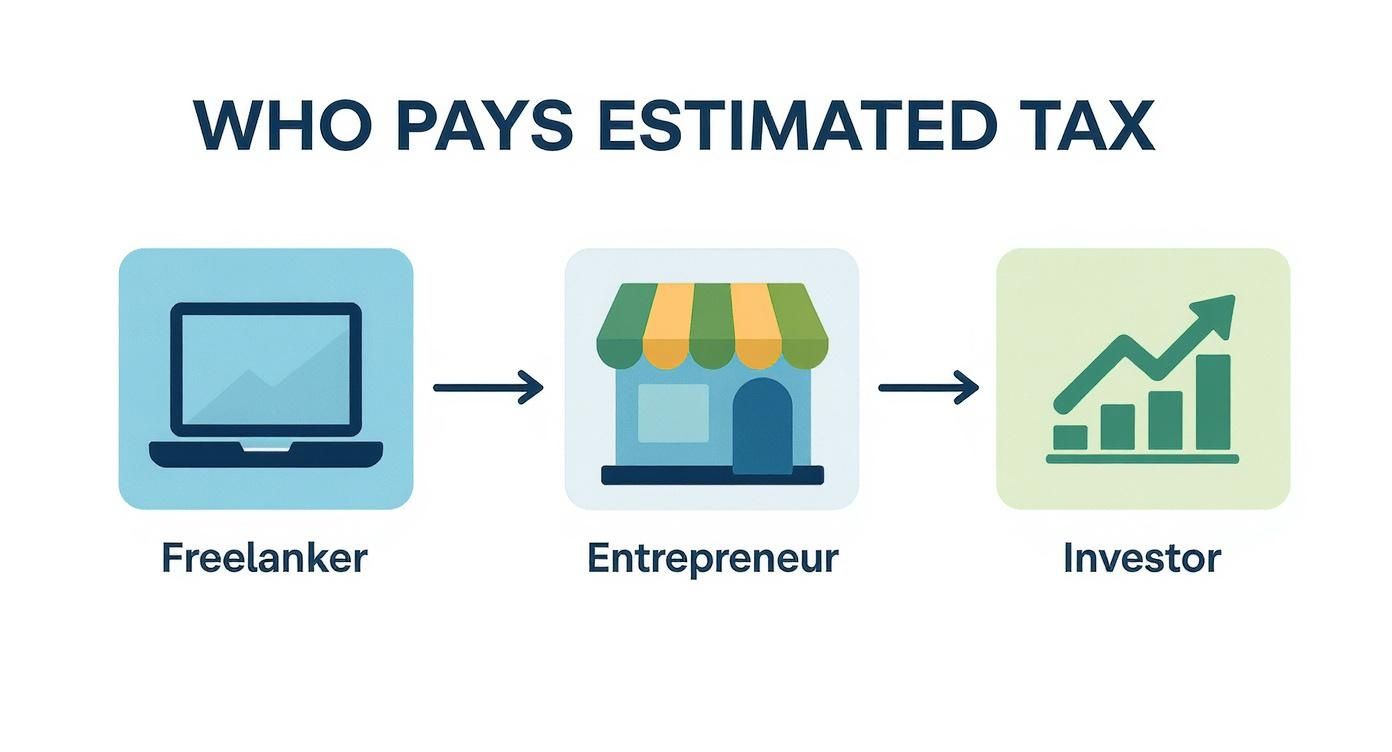
As you can see, this isn't a niche issue. Freelancers, small business owners, and savvy investors all share this responsibility. They can't rely on an employer to handle their taxes, so they have to be proactive.
The Standard Method: A Straightforward Approach with Form 1040-ES
The standard calculation using the Form 1040-ES worksheet is pretty logical. You start with your big-picture income and then methodically subtract your deductions and credits to find your estimated tax liability.
Here’s a breakdown of the typical steps:
- Project Your Adjusted Gross Income (AGI): First, add up all the income you expect to earn for the year—business profits, freelance gigs, investment gains, you name it. Then, you get to subtract certain "above-the-line" deductions, like contributions to a traditional IRA or student loan interest.
- Factor in Deductions and Credits: Next, you'll reduce your taxable income by subtracting either the standard deduction for your filing status or your itemized deductions if they're higher (think mortgage interest, state taxes, and charitable gifts). After that, you'll apply any tax credits you qualify for, which are great because they reduce your tax bill dollar-for-dollar.
- Don't Forget Self-Employment Tax: For any self-employed individual, this is a big one. You have to calculate and pay both the employer and employee portions of Social Security and Medicare taxes. This usually comes out to about 15.3% on your net earnings up to the annual limit. The good news? You get to deduct one-half of what you pay in self-employment tax from your income.
Once you’ve worked through these steps, the form will show your total estimated tax for the year. From there, it's simple: just divide that total by four to get your quarterly payment amount.
Let's Look at an Example:
Imagine a freelance graphic designer in Queens projects she'll net $80,000 for the year. After running the numbers and accounting for her deductions and self-employment taxes, her total estimated tax liability is $16,000. Using the standard method, she’d send the IRS a $4,000 payment each quarter.
This method works beautifully for people with steady, predictable income. But what if your income is anything but?
The Annualized Income Method: For When Your Income Ebbs and Flows
Life as an entrepreneur or freelancer is rarely a straight line. You might land a huge contract in the spring and then have a much quieter summer. For those with lumpy or seasonal income, the standard method can cause a serious cash-flow headache, forcing you to pay tax on money you haven't even earned yet.
That's where the Annualized Income Installment Method comes in. It’s a game-changer.
Instead of making four equal payments, this method lets you pay tax based on what you actually earned during each specific payment period. It's more work—you'll need to use Form 2210, Underpayment of Estimated Tax by Individuals, Estates, and Trusts—but it perfectly aligns your tax obligations with your cash flow. You essentially re-calculate your projected annual income at the end of each quarter.
Comparing the Two Methods Side-By-Side
Let's go back to our graphic designer. Suppose her $80,000 income is front-loaded: she lands a $50,000 project in the first quarter and then earns a steady $10,000 in each of the next three quarters.
Here’s how her payments would look under each method:
| Payment Period | Standard Method Payment | Annualized Method Payment |
|---|---|---|
| Q1 (Jan-Mar) | $4,000 | ~$7,500 (Higher, matching her high income) |
| Q2 (Apr-May) | $4,000 | ~$1,500 (Lower, reflecting her normal income) |
| Q3 (Jun-Aug) | $4,000 | ~$1,500 (Lower, reflecting her normal income) |
| Q4 (Sep-Dec) | $4,000 | ~$5,500 (A true-up to meet her annual obligation) |
Note: These are simplified estimates for illustrative purposes.
See the difference? The annualized method lets her pay more when the cash is flowing and less when things are slow, which is a much healthier way to manage her finances. It requires diligent bookkeeping, but for anyone with an unpredictable income stream, the peace of mind is often worth the extra effort.
Using IRS Safe Harbor Rules to Avoid Penalties
When it comes to estimated taxes, the IRS isn’t looking for a perfect crystal ball reading of your income. The real goal is much simpler: pay enough tax throughout the year to avoid the dreaded underpayment penalty. This is where the IRS “safe harbor” rules come in—they’re your best friend in this process.
Think of these rules as a financial safety net. As long as your total payments for the year hit one of these specific benchmarks, you're generally shielded from penalties. You might still owe a bit more when you file in April, but you won’t get dinged for underpaying along the way. It’s a way to remove the guesswork and anxiety from the equation.
The IRS gives us two main safe harbor provisions to work with. Getting a handle on these is the key to building a smart, penalty-proof tax strategy.
The Two Main Safe Harbor Rules
Figuring out your estimated tax payments is a lot less stressful when you have a clear target. The IRS offers two straightforward paths to keep you in the clear. The best part? You only need to meet one of them.
-
The 90% Rule: This one is based on the current year. You need to pay at least 90% of the tax you will ultimately owe for this year. This approach works well if you have a pretty good handle on your annual income and deductions, making it a good fit for those with stable, predictable earnings.
-
The 100% (or 110%) Rule: This rule looks backward, not forward. You must pay 100% of the total tax shown on your prior-year tax return. If you're a higher-income taxpayer—meaning your Adjusted Gross Income (AGI) was over $150,000 last year—the bar is raised to 110% of last year's tax.
The prior-year rule is incredibly powerful because it’s based on a hard number you already know: last year's tax bill. There’s no need to forecast future sales or guess your year-end income. You just take that number and make sure your payments hit the mark.
This provides a welcome dose of certainty, which is why it's a favorite strategy for entrepreneurs, real estate investors, and consultants whose income can swing wildly from one quarter to the next.
A Tale of Two Freelancers
Let's look at how this plays out in the real world with two freelance consultants in New York City, Maria and David.
Case Study 1: Maria Uses the Prior-Year Rule
Last year, Maria's total tax liability was $20,000. This year, her business exploded, and she projects her tax bill will be closer to $35,000. Instead of trying to nail down that moving target, she leans on the 100% prior-year safe harbor. She simply makes four quarterly payments of $5,000 each, hitting a total of $20,000.
Come tax time, she’ll owe the remaining $15,000, but she won’t face a single penny in underpayment penalties. She met the safe harbor. This strategy kept her cash flow simple and her mind at ease all year.
Case Study 2: David Forgets the Rules
David also had a fantastic year. His prior-year tax was also $20,000, and this year's bill is also shaping up to be $35,000. The problem? He got busy and made zero estimated payments. In April, he's hit with a double whammy: he owes the full $35,000 at once, plus the IRS tacks on an underpayment penalty.
The penalty works like interest on a loan, calculated for every day each quarterly payment was late. Since David missed all four deadlines, his penalty could easily add several hundred dollars to his tax bill—money that was completely avoidable.
When Can Penalties Be Waived?
While the safe harbor rules are your best defense, the IRS understands that life happens. They can waive the underpayment penalty, but only in very specific and limited situations.
These rare exceptions typically include:
- Unforeseen Events: You were unable to make payments because of a casualty, disaster, or another unusual event where enforcing the penalty would be unfair.
- Retirement or Disability: You retired (after turning 62) or became disabled during the tax year, and your underpayment was for a good reason, not just willful neglect.
But banking on a waiver is a risky bet. The most reliable path forward is proactive planning. By understanding and using the IRS safe harbor rules, you can confidently manage your estimated tax payments and keep your hard-earned money where it belongs—in your pocket.
Don't Forget About State and Local Estimated Taxes
Getting your federal estimated tax payments right is a big win, but don't celebrate just yet. It’s often only half the battle. A surprisingly common and costly mistake is forgetting the second layer of compliance: state and local estimated taxes.
Most states—and even some cities like New York City—have their own "pay-as-you-go" systems that run completely parallel to the IRS. They have their own thresholds for who needs to pay, their own calculation worksheets, their own due dates, and, of course, their own penalties. Just copying your federal payments and sending a smaller check to the state won't cut it.
State Rules Are a Different Ballgame
It’s easy to assume state tax rules are just a watered-down version of the federal ones. That's a dangerous trap. The requirements can be wildly different, creating compliance nightmares for anyone who isn't paying close attention. A freelancer in one state might face a completely different set of obligations than an investor just across the border.
Let's look at California, a state famous for its unique tax code, to see how different things can be.
- Payment Deadlines: While the IRS splits quarterly payments into a 40-20-20-20 structure, California's rhythm is completely different. They require 30% by April 15, 40% by June 15, 0% by September 15, and the final 30% by January 15 of the next year.
- Safe Harbor Rules: The state’s safe harbor rules are also unique. While the basic idea is similar to federal guidelines, the specific income thresholds and required payment percentages are tailored to California's own tax laws.
- Forms and Filing: You can't just use a federal form for your state payments. California requires you to use its specific forms, like Form 540-ES, not the federal Form 1040-ES.
This one example makes it crystal clear: you could manage your federal payments perfectly and still end up with a nasty surprise from the state if you don't play by their specific rules.
The main takeaway here is that tax compliance isn't a single task—it's a multi-layered process. You have to actively check the requirements for every single state and city where you might owe tax. This is absolutely critical for remote workers, owners of multi-state businesses, or anyone who has moved during the year.
How to Stay on Top of Local Rules
So, how do you keep all these different rules straight? Your first stop should always be the official department of revenue or taxation website for your state and city. That’s where you’ll find the official forms, detailed instructions, and payment portals.
Given the sheer variety of regulations out there, this is where professional guidance becomes invaluable, especially if your financial life has a few moving parts.
This idea of prepaying taxes on non-wage income isn't just a U.S. thing, either. Many countries around the world have similar systems. In the United Kingdom, for instance, taxpayers make "payments on account" twice a year, which brought in £12 billion in 2023. Canada's Revenue Agency collected about CAD 15 billion in quarterly payments back in 2022, proving just how essential these systems are to governments worldwide. You can explore more about global tax policies and trends to get a broader perspective.
For anyone earning income in multiple states or trying to navigate the complex tax web of a major city, working with a tax professional isn't a luxury—it's just smart risk management. A firm like Blue Sage Tax & Accounting can make sure you’re buttoned up on every federal, state, and local requirement, saving you from penalties and giving you total peace of mind.
Creating Your Estimated Tax Payment Plan
Knowing the rules and running the numbers is one thing. Actually building a practical, stress-free system to handle your payments is how you stay ahead of the game. A solid plan turns that knowledge into action, transforming a dreaded chore into a simple financial habit. This isn't about becoming a CPA overnight; it's about creating a blueprint for consistency and peace of mind.

The best systems are built on simple, repeatable actions. When you automate as much as possible, you eliminate the risk of forgetting a payment or scrambling for cash when a deadline is staring you down. It’s all about making smart choices today to prevent major headaches tomorrow.
Building Your Proactive Payment System
A few key habits can make managing your estimated taxes feel almost effortless. Think of these as the building blocks for a penalty-proof financial routine that puts you in the driver's seat.
Here are a few proven tactics you can put into practice right away:
-
Open a Dedicated "Tax" Savings Account: This is non-negotiable. Treat the IRS like a business partner who must be paid. Open a separate, high-yield savings account and set up automatic transfers. Every time you get paid, immediately move 25-30% of that income into this account. That money is off-limits—it’s reserved for taxes, period.
-
Use Accounting Software: Modern tools like QuickBooks or Xero are absolute game-changers. They can track your income, categorize your expenses, and generate reports that make projecting your quarterly income a breeze. This data is the foundation for accurate calculations.
-
Schedule Quarterly Financial Reviews: Block out time on your calendar a few weeks before each tax deadline. This is your dedicated moment to check in, review your year-to-date income, and see if your next payment needs to be adjusted up or down.
These simple steps shift your mindset from reactive to proactive. Instead of taxes being a nasty year-end surprise, you start managing them as a predictable, ongoing part of doing business. That’s absolutely essential for long-term financial health.
Partner with Blue Sage for Total Confidence
While these strategies provide a strong framework, navigating the specifics can still be a challenge, especially if your income fluctuates or you have complex investments. That's where having a dedicated partner makes all the difference. At Blue Sage Tax & Accounting, we don’t just file forms. We build a year-round strategy that aligns with your financial goals.
We help our clients by:
- Creating Accurate Income Projections: We use advanced modeling to develop a reliable forecast of your annual income, which helps make sure your estimated payments are on target.
- Implementing Strategic Tax Planning: We’re always looking for opportunities to maximize deductions and credits throughout the year, helping you minimize your overall tax bill.
- Managing All Filings: We handle all federal, state, and local estimated tax filings for you, ensuring every deadline is met and every payment is accurate.
Don’t let the complexity of what is estimated tax payment create unnecessary stress in your life. With Blue Sage Tax & Accounting, you can turn uncertainty into confidence and finally get some financial peace of mind.
Common Questions About Estimated Tax Payments
Let's face it, the world of estimated taxes can feel a bit murky. When you’re dealing with your own money and unique financial situation, a lot of practical questions pop up. Getting straight answers is the key to handling things with confidence and sidestepping those pesky penalties.
Here are some of the most common questions we hear from clients, along with our straightforward advice.
What Should I Do If I Miss a Payment Deadline?
First, don't panic. If a deadline slips by, the single most important thing to do is pay as soon as you possibly can.
Think of the underpayment penalty like interest on a loan—it’s calculated based on how much you owe and for how long that amount is overdue. The sooner you pay, the less the penalty will be. Acting fast is always your best move. Don't wait for the next quarterly due date to play catch-up; a late payment is far better than no payment at all.
Can I Just Increase My W-4 Withholding Instead of Paying Quarterly?
Absolutely, and for many people, this is a much simpler strategy. If you have a W-2 job alongside your freelance work, business income, or investments, you can adjust your Form W-4 to have your employer withhold more tax from each paycheck.
This approach essentially puts your estimated payments on autopilot. The trick is to calculate the extra withholding accurately so you hit one of the IRS safe harbor thresholds. Get that right, and you can avoid the hassle of quarterly deadlines and the risk of underpayment surprises.
This W-4 method is a great choice if you prefer a "set it and forget it" approach. It rolls all your tax obligations into one simple, automated process managed through your payroll.
My Income Is Unpredictable. How Am I Supposed to Estimate It?
This is a classic dilemma for freelancers, seasonal business owners, or anyone with lumpy cash flow. The answer is the Annualized Income Installment Method.
Instead of trying to guess your annual income and dividing it by four, this method allows you to pay based on what you actually earned in each specific period. It requires a bit more record-keeping as you go, but the payoff is huge. Your tax payments directly mirror your cash flow, so you won't be forced to overpay during a slow quarter just to catch up from a busy one.
I'm Retired. Do I Still Have to Worry About This?
Retirement doesn’t mean you get a free pass on estimated taxes. It all comes down to where your money is coming from. If you’re receiving income from pensions, 401(k) distributions, or IRA withdrawals without any taxes being withheld, you'll likely need to make estimated payments.
The same goes for retirees who generate significant income from investments, like stock dividends or capital gains. The rule of thumb is the same for everyone: if you expect to owe $1,000 or more in tax for the year after accounting for any withholding, you need to be paying quarterly.
At Blue Sage Tax & Accounting Inc., we help you navigate these questions and build a proactive tax plan that actually fits your life. Contact us today for a consultation and gain clarity on your financial future.