The Alternative Minimum Tax (AMT) is essentially a second, parallel tax system. It was created to make sure high-income individuals, who might otherwise use a lot of deductions to zero out their tax bill, still pay a certain minimum amount of tax.
Think of it this way: you calculate your taxes once using the familiar, regular tax rules. Then, you calculate it again using the much stricter AMT rules. You have to pay whichever amount is higher.
A Tale of Two Tax Roads

To really grasp what the alternative minimum tax is, imagine the U.S. tax code as two distinct highways leading to the same place: your final tax bill. The first highway is the regular tax system we all know. It’s like a local road with plenty of off-ramps for deductions, credits, and exemptions that help lower your taxable income.
The second highway is the AMT. This one is the express lane. It runs right alongside the local road but is much more direct, with almost no exits. This route eliminates many of the most common deductions that high earners rely on to reduce their regular tax liability.
Why You Might Get Pushed into the Express Lane
Every year, certain taxpayers have to figure out their tax bill using both routes. If the express lane calculation (the AMT) results in a higher tax than the local road (the regular system), you're required to pay that higher AMT amount.
The point of the AMT isn't to be punitive. It was designed to catch situations where high-income households could legally use so many deductions and tax breaks that they ended up paying very little—or even no—federal income tax.
Certain financial moves and deductions act like on-ramps, shifting you from the local road onto the AMT express lane. We often call these AMT triggers, and they’re surprisingly common for successful investors, executives, and business owners.
A few of the biggest triggers include:
- Exercising Incentive Stock Options (ISOs): The paper gain you have when you exercise ISOs—the spread between the market value and your purchase price—is a massive preference item for AMT, even if you don't sell the shares.
- High State and Local Taxes (SALT): The regular tax system gives you a limited deduction for state and local taxes, but under AMT rules, that deduction is disallowed completely.
- Large Capital Gains: A significant long-term capital gain can push your income high enough to trigger the AMT, especially if you also have other preference items.
- Certain Itemized Deductions: Things like investment advisory fees or home equity loan interest (if not used for the home) are added back into your income under the AMT calculation.
Understanding this dual-highway concept is the critical first step. It shows that the AMT isn't an additional tax—it's a completely separate and more stringent way of calculating the tax you already owe, just to make sure a baseline is met.
Regular Tax vs Alternative Minimum Tax At a Glance
This table provides a quick comparison of the two parallel tax systems, highlighting the fundamental differences in their approach to calculating your tax liability.
| Feature | Regular Tax System | Alternative Minimum Tax (AMT) System |
|---|---|---|
| Tax Rates | Seven tax brackets ranging from 10% to 37%. | Two tax brackets: 26% and 28%. |
| Deductions | Allows a wide range of deductions (e.g., SALT, mortgage interest, charitable gifts). | Disallows or limits many common deductions, including state and local taxes. |
| Exemptions | Offers a standard deduction or itemized deductions. | Provides a specific AMT exemption amount, which phases out at higher incomes. |
| Tax Credits | Allows a broad array of tax credits to reduce liability. | Restricts the use of certain tax credits. |
| Income Items | Standard income sources like wages, interest, and dividends. | Adds back "preference items" like the bargain element from ISO exercises. |
Ultimately, both systems aim to determine your tax liability, but the AMT's simpler, broader-base approach ensures that substantial income doesn't escape taxation through otherwise legal deductions and strategies.
A Brief History of the AMT: Why It Was Created
To get a real handle on the Alternative Minimum Tax, you have to understand where it came from. It wasn't dreamed up by bureaucrats who love complexity. The AMT was born from a public relations nightmare for the U.S. Treasury back in the late 1960s.
The story goes like this: a report surfaced showing that in 1966, a whopping 155 high-income taxpayers—each earning over $200,000, which was a fortune back then—paid absolutely nothing in federal income tax. Legally. They had simply used the existing tax code, packed with deductions and preferences for things like large capital gains, to their full advantage. As you can imagine, the public was outraged.
The Original Goal
Congress had to act. Their solution, part of the Tax Reform Act of 1969, was a simple "add-on" tax. The goal was straightforward: make sure every high-income household paid at least some minimum amount of tax, regardless of how many loopholes or deductions they could find. You can dig into the early mechanics in this in-depth report on the individual AMT from the Urban-Brookings Tax Policy Center.
What started as a simple backstop, however, eventually morphed into the complicated, parallel tax system we have today. Instead of just adding a little tax on top, it became about re-calculating your entire tax bill under a completely different set of rules.
The Problem of "AMT Creep"
For decades, the AMT had a major design flaw: its exemption amounts and tax brackets weren't adjusted for inflation. As wages and the cost of living naturally went up, the tax started catching people it was never meant for. This slow but steady expansion became known as "AMT creep."
A tax designed to target a few hundred millionaires began to ensnare millions of upper-middle-class families, especially those in high-tax states or those with several children, who lost their valuable personal exemptions under the AMT calculation.
For years, this created a mess. Congress would have to pass temporary "patches" just to keep the AMT from hitting more and more middle-class taxpayers, making long-term financial planning a guessing game.
Recent Changes and a Return to Focus
Everything changed with the Tax Cuts and Jobs Act (TCJA) of 2017. While the TCJA didn't get rid of the individual AMT, it made two huge adjustments that pulled the plug on its uncontrolled spread:
- Higher Exemption Amounts: The law significantly increased the amount of income you could earn before the AMT even became a consideration.
- Inflation Indexing: Most importantly, it finally tied these higher exemptions to inflation, putting a stop to AMT creep once and for all.
These moves effectively reset the AMT, pushing it back toward its original mission. Today, it almost exclusively affects the high-net-worth individuals and business owners it was first designed for. Knowing this history is key, because it shows why smart, proactive AMT planning has become such an essential strategy for anyone serious about protecting their wealth.
Common Triggers That Put You In The AMT Lane
Think of the tax system as having two parallel highways. Most of us drive on the regular tax highway, but certain financial moves can divert you onto the Alternative Minimum Tax (AMT) expressway. It's a faster, stricter route with fewer off-ramps (deductions). Knowing what these on-ramps are is the first step in avoiding a surprise toll.
These triggers aren't exotic loopholes. More often than not, they're the natural side effects of financial success—especially for high-earners, investors, and entrepreneurs. They usually boil down to one of two things: receiving income that isn't heavily taxed under the regular rules, or taking large deductions that the AMT system simply won't allow.
Let’s get into the specifics of what can land you in the AMT lane.
Exercising Incentive Stock Options (ISOs)
For many tech executives and startup employees, this is the big one. It's often the most shocking and financially significant AMT trigger. When you exercise Incentive Stock Options (ISOs), you don't actually owe any regular income tax at that moment. The beauty of the regular system is that you only pay tax when you sell the stock, hopefully at lower long-term capital gains rates.
But the AMT plays by a completely different set of rules.
The gap between the stock’s fair market value on the day you exercise and the price you paid (your "strike price") is known as the bargain element. For your regular tax return, this is just a "paper" gain. But for the AMT, that entire bargain element is treated as real, taxable income in the year you exercise.
Example: A Tech Executive's Surprise Tax Bill
Let's say you exercise 10,000 ISOs from your company. Your strike price is just $5 per share, but the stock is now flying high at $55 per share. In an instant, you've created a $500,000 paper profit (($55 – $5) x 10,000). While your regular tax bill for this event is zero, that entire $500,000 gets added to your income for the AMT calculation. This one move can single-handedly throw you into the AMT.
High State and Local Tax (SALT) Payments
Another major on-ramp to the AMT involves the taxes you pay to your state and local governments. Under the regular tax code, you can deduct what you pay in state and local taxes (SALT)—which includes property and income taxes—but it's capped at $10,000 per household. For anyone in a high-tax state like New York or California, that cap is hit almost immediately.
The AMT, however, is much less generous. It completely wipes out the deduction for state and local taxes.
- Regular Tax: You can deduct up to $10,000 for SALT.
- Alternative Minimum Tax: You can deduct $0 for SALT.
This means if you claim the full $10,000 deduction on your regular return, you have to add that entire amount right back when figuring out your AMT income. While the SALT cap has somewhat lessened the impact of this trigger since it was enacted, it’s still a major factor, especially for those with significant state tax burdens.
Accelerated Depreciation on Real Estate or Equipment
For business owners and real estate investors, depreciation is one of the best tools for lowering taxable income. The regular tax system often allows for accelerated depreciation, letting you write off larger chunks of an asset's cost in the early years. It’s a great way to improve cash flow and incentivize investment.
The AMT, however, isn't a fan of this approach. It mandates a much slower, more conservative depreciation schedule—typically the straight-line method over a longer asset life. This creates a direct conflict between your regular tax calculation and your Alternative Minimum Taxable Income (AMTI).
Here’s how it plays out:
- Year 1 Regular Tax: You take a big, accelerated depreciation deduction of $80,000 on a new piece of equipment.
- Year 1 AMT Calculation: The AMT rules only allow a straight-line depreciation of $50,000 on that same asset.
- The AMT Adjustment: You’re forced to add the $30,000 difference back to your income for the AMT calculation.
Over the years, and especially for investors with multiple properties or a lot of equipment, these adjustments really start to add up. What looks like a smart tax-saving move under the regular rules can become a liability under the AMT, which is why you have to look at every investment through both tax lenses.
How The AMT Calculation Actually Works
Figuring out the Alternative Minimum Tax can feel like learning the rules to a second, more complicated game after you've already mastered the first. It's not an extra tax piled on top of your regular one; it's an entirely separate calculation. You essentially do your taxes twice—once with the familiar rules and again with the AMT's stricter rulebook—and you pay whichever bill is higher.
To pull back the curtain, let’s walk through a simplified but very real-world scenario. We’ll follow a hypothetical tech professional, "Alex," whose successful year might unexpectedly put them on the hook for the AMT. This step-by-step breakdown will show you exactly how the pieces fit together.
Step 1: Start With Regular Taxable Income
The journey into the AMT begins on familiar ground: your regular taxable income from your Form 1040. This is the number you arrive at after you’ve already taken all your standard or itemized deductions.
Let's imagine Alex is a single filer with a salary of $400,000. After maxing out a 401(k) and making a few other adjustments, Alex's adjusted gross income (AGI) is $350,000. From there, Alex itemizes deductions to lower this figure even further.
Step 2: Add Back Disallowed Deductions and Preference Items
This is where the two tax systems diverge dramatically. The AMT calculation systematically disallows many of the very deductions high earners rely on to lower their regular tax bill. You're forced to add these "preference items" and other adjustments back, effectively inflating your income for AMT purposes.
For Alex, a couple of major items come right back into play:
- State and Local Taxes (SALT): Living in a high-tax state, Alex paid $35,000 in state income and property taxes. While the regular tax system already caps this deduction at $10,000, the AMT is even harsher—it disallows the deduction entirely. Alex has to add that $10,000 back.
- Incentive Stock Options (ISOs): Alex exercised ISOs this year, and the "bargain element"—the difference between the stock's market price and the much lower exercise price—was a whopping $300,000. Under regular tax rules, this isn't taxed until the shares are sold. For the AMT, however, it's considered income the moment you exercise.
This is where many successful professionals get tripped up. The very things that signal a great financial year can also be the biggest triggers for the AMT.
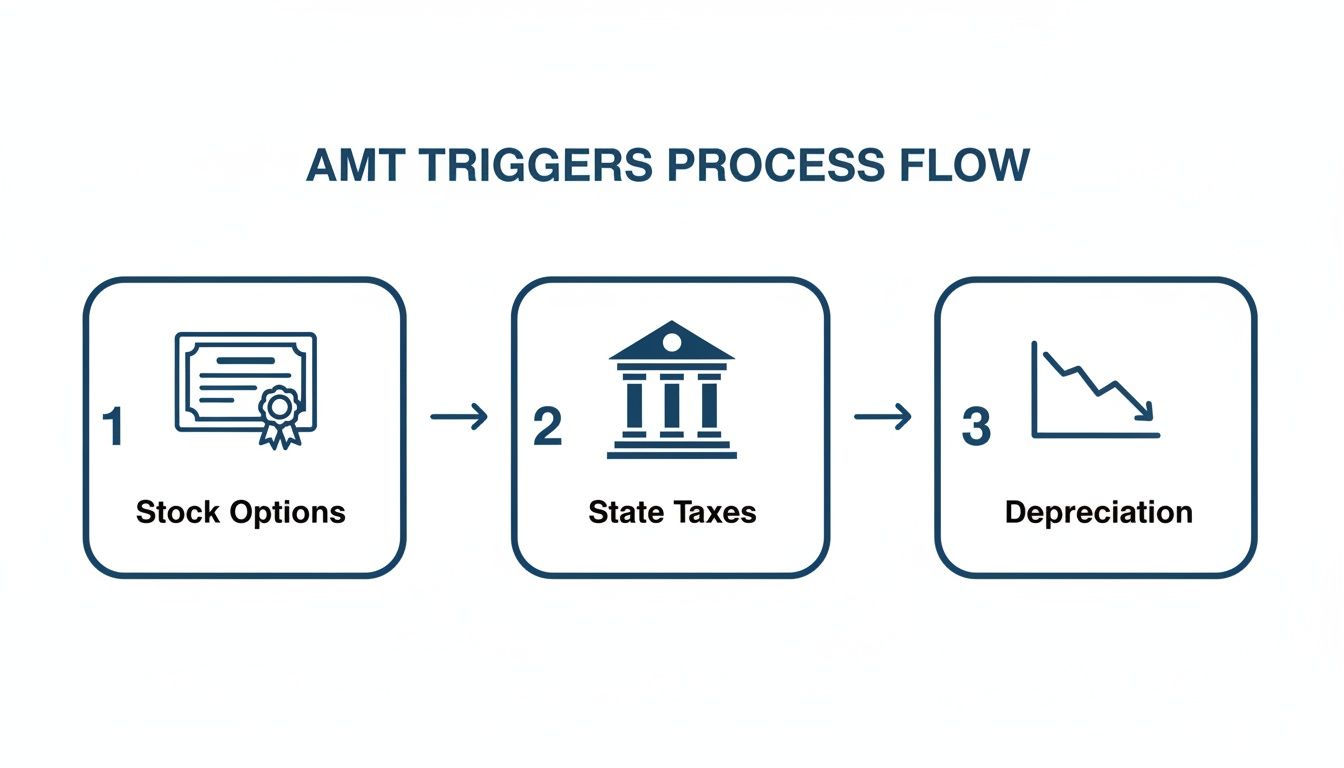
As the visual shows, exercising stock options, paying hefty state taxes, or even using certain depreciation methods are common on-ramps to the AMT superhighway.
Step 3: Subtract the AMT Exemption
Once you've added back all the preference items to get your Alternative Minimum Taxable Income (AMTI), the system gives you a bit of a break: the AMT exemption. Think of it as a built-in deduction designed to shield middle-income taxpayers from getting caught in this net.
But there’s a catch. This exemption isn't for everyone. It begins to phase out once your AMTI hits a certain level, and it disappears completely for high earners. For 2024, a single filer gets an $85,700 exemption, but it starts getting reduced once AMTI exceeds $609,350. Because Alex’s AMTI is now well past that threshold, the exemption is wiped out entirely.
The AMT exemption is a crucial buffer, but its phase-out mechanism is what keeps the tax targeted at high-income individuals. Once your income grows, this protection vanishes.
Step 4: Apply the AMT Tax Rates
Now that we have the final AMTI, we apply the AMT tax rates. The good news? It's much simpler than the seven-bracket progressive system used for regular income tax.
For 2024, there are just two rates:
- 26% on the first $232,600 of AMTI.
- 28% on any AMTI above that amount.
Running Alex's AMTI through this two-tiered structure gives us a figure called the "Tentative Minimum Tax."
Step 5: Compare and Pay the Difference
This is the moment of truth. You place your regular tax liability side-by-side with your Tentative Minimum Tax. If the AMT calculation results in a higher tax, you owe the difference.
Let's say Alex's regular federal tax bill came out to $75,000. But after running the numbers through the stricter AMT rules, the Tentative Minimum Tax is $110,000. Alex doesn't pay both. Instead, Alex pays the base $75,000 in regular tax plus an additional $35,000 in AMT.
This brings the total federal tax payment up to the higher $110,000 figure, ensuring the "minimum" tax required by law is met. This entire reconciliation happens on IRS Form 6251.
Strategic Planning To Navigate The AMT

Knowing how the Alternative Minimum Tax works is one thing. Actively keeping it from eating into your wealth is another game entirely. Smart AMT strategy isn't about scrambling for fixes in April; it’s about having a forward-looking, multi-year game plan that sees major financial events on the horizon and models their impact under both tax systems.
For high-net-worth individuals, this proactive mindset turns the AMT from an unavoidable tax punch into a manageable variable. By carefully timing your income, deductions, and investments, you can often sidestep or significantly reduce an AMT bill, protecting your capital for the long haul. The secret is to view every major financial decision through two different tax lenses at once.
Timing Incentive Stock Option Exercises
The exercise of Incentive Stock Options (ISOs) is without a doubt the most powerful—and dangerous—AMT trigger. One large exercise can create a monstrous AMT preference item, leaving you with a shocking tax bill on money you haven't even received in cash. The most powerful defense is simply good timing.
Instead of cashing in all your vested options in a single year, think about spreading the exercises out. This approach helps keep the annual "bargain element" small enough to stay under the AMT's radar.
- Model It Out: Work with a tax pro to run the numbers. See exactly what the AMT hit would be if you exercise different amounts in different years.
- Match Your Goals: This isn't just a tax decision. You have to weigh the tax savings against your belief in the company's stock and your overall investment strategy.
- Look at the Big Picture: The best time to exercise might be in a year when your other income is lower, giving you more breathing room before you cross into AMT territory.
This kind of deliberate pacing gives you back control, preventing one financial event from hijacking your entire tax situation.
Managing State And Local Tax Payments
Since the AMT system completely ignores your state and local tax (SALT) deductions, this is a huge area for planning—especially if you live in a high-tax state like New York or California. While the $10,000 SALT cap in the regular tax system has evened the odds a bit, smart timing of these payments can still save you money.
For example, if you know you're going to be in the AMT for 2024, you could consider pushing your Q4 state estimated tax payment from December into January 2025. You get zero benefit from that deduction in an AMT year anyway. By delaying it, you move the deduction to a future year when you might be back under the regular tax system and can actually use it.
Of course, a move like this requires sharp income projections to make sure you don't trigger an underpayment penalty. It's a perfect example of the strategic thinking that cuts your tax burden over time.
The AMT has a long history of "bracket creep." Without adjustments for inflation, projections once warned the tax could ensnare 33.4 million taxpayers by 2010. A permanent legislative fix in 2012 finally indexed the exemption amounts for inflation, which dramatically scaled back its reach and refocused the tax on the high-income households it was originally designed for. You can dive into the details on the Congressional Research Service website.
The AMT Credit: Your Path To Recoupment
Paying the AMT doesn't always mean that money is gone for good. Think of it more like a prepayment of future taxes. When your AMT bill is triggered by "deferral items"—like the exercise of ISOs—you generate a minimum tax credit.
This credit becomes a powerful asset. In later years when your regular tax is higher than your AMT calculation, you can use this credit to slash your regular tax bill dollar-for-dollar.
Here's a real-world example:
- Year 1 (AMT Year): You exercise ISOs and get hit with a $40,000 AMT payment. This generates a $40,000 AMT credit that you can carry forward.
- Year 2 (Regular Tax Year): You sell some of that stock. Your regular tax on the capital gain is $50,000, while your tentative minimum tax is only $30,000.
- Applying the Credit: You're not in the AMT this year. You can now apply that $40,000 credit, which cuts your tax bill from $50,000 all the way down to $10,000.
This credit is a vital piece of the puzzle for long-term ISO planning, ensuring you aren't unfairly taxed twice on the same income. But tracking and using these credits requires flawless record-keeping. An expert at a firm like Blue Sage Tax & Accounting can ensure you get back every dollar you’re owed.
Partnering With An Advisor For AMT Strategy
Knowing that our tax system has two parallel highways is one thing, but actually navigating the Alternative Minimum Tax requires an experienced co-pilot. This isn't a do-it-yourself project. The AMT is a complex, parallel system where a seemingly small misstep can trigger a huge, unexpected tax bill.
The only effective defense against the AMT is proactive, multi-year management. Trying to handle complex triggers like Incentive Stock Options or specific real estate depreciation schedules on your own is a serious risk. The financial world is full of cautionary tales about people who got hit with staggering tax bills simply because they didn't get advice before a major transaction.
The Value Of Professional Tax Modeling
The real power in AMT planning comes from sophisticated tax modeling. A specialist can project your income and deductions under both the regular and AMT systems several years into the future, giving you the foresight to make strategic decisions that minimize your overall tax burden over time.
For instance, an advisor can model the precise impact of exercising a specific number of ISOs this year versus spreading them out. They can pinpoint the best time to realize capital gains or pay state taxes to either stay out of the AMT lane entirely or, in some cases, strategically use the lower 28% AMT rate to your advantage.
Sophisticated AMT planning isn't about finding loopholes. It's about using advanced modeling to make informed, strategic decisions that align with your long-term financial goals, ensuring you never pay a dollar more in tax than legally required.
From Education To Action
This guide has peeled back the layers on what the alternative minimum tax is, but knowledge is only the first step. The next is to take decisive action to protect your wealth. Your financial situation is unique—from stock options and real estate to business investments—and it demands a personalized strategy that no off-the-shelf software can deliver.
Working with a dedicated firm like Blue Sage Tax & Accounting helps you move from theory to practical application. A consultation can give you a clear assessment of your AMT risk, uncover hidden opportunities for tax savings, and help build a customized plan that evolves with your finances.
Don't wait for a surprise on your tax return. Take control of your financial future today.
Common Questions We Hear About the AMT
When you first encounter the Alternative Minimum Tax, it’s natural to have questions. It's a confusing part of the tax code. Let's walk through some of the most frequent ones we get from our clients.
Did the 2017 Tax Law Get Rid of the AMT?
Not exactly. While the Tax Cuts and Jobs Act (TCJA) of 2017 didn't eliminate the individual AMT, it made some huge changes. The law significantly increased the AMT exemption amounts and the income levels where those exemptions start to disappear.
The practical result? Far fewer people are getting hit by the AMT today. The TCJA essentially re-aimed the tax back at its original target: high-income taxpayers with specific types of deductions and income.
What’s the Difference Between an “Adjustment” and a “Preference Item”?
It’s easy to mix these up, but the distinction is important. Think of a preference item as a one-way street—it only adds to your income for AMT purposes. A great example is the tax-exempt interest you might earn from certain private activity bonds.
An adjustment, however, is more of a two-way street. It can either increase or decrease your AMT income. For instance, the way you calculate depreciation for a business asset is different under regular tax rules versus AMT rules. This difference creates an adjustment that could go either way depending on the year and the asset.
Can I Ever Get Back the AMT I’ve Paid?
Yes, you often can! This is one of the most important things to understand. When you pay AMT because of "deferral items"—like exercising Incentive Stock Options (ISOs)—you generate something called a minimum tax credit.
This credit doesn't just vanish. You can carry it forward and use it to lower your regular tax bill in future years, but only in years when you aren't on the hook for the AMT. It's the system's way of making sure you're not permanently double-taxed on timing differences.
Does Living in a High-Tax State Automatically Trigger the AMT?
It doesn't happen automatically, but it’s a major red flag. State and Local Tax (SALT) deductions, a huge benefit for many, are completely wiped out when calculating AMT income.
While the $10,000 SALT cap for regular taxes has lessened the impact for some, taxpayers in states with high income taxes can still find this one disallowed item is enough to push them into AMT territory.
Figuring out how these pieces fit together is where having a professional in your corner makes all the difference. At Blue Sage Tax & Accounting Inc., we specialize in building the multi-year models needed to see what’s coming and manage your AMT exposure. Discover our proactive tax strategies and schedule a consultation today.