When you're earning a high income, the standard tax advice you hear everywhere—"just max out your 401(k)!"—is really just table stakes. For people in your position, true tax planning strategies for high income earners aren't about simple deductions. They're about sophisticated wealth management, using specialized accounts, investment structuring, and legacy planning to legally and ethically minimize what you send to the government.
Why Standard Tax Advice Is Not Enough
Let's be real. Once your income climbs past a certain point, following the usual tax tips feels like bringing a garden hose to a five-alarm fire. The strategies that work wonders for the average taxpayer just don't have the same punch when your financial life gets more complicated.
As your income grows, you run into a whole new set of obstacles that can quietly siphon away your wealth. You're suddenly contending with the highest marginal tax brackets, the Alternative Minimum Tax (AMT), and frustrating phase-outs that can gut the value of common deductions and credits. And then there’s the 3.8% Net Investment Income Tax, which can take a nasty bite out of your investment returns.
The real problem is that high earners can't afford to just play defense in April. You need a year-round offense. The entire goal is to shift from being a passive taxpayer who just settles the bill to becoming an active manager of your own tax destiny.
This guide is built around that very idea. We're going to dive into the advanced strategies you need to master this high-stakes game. Think of your financial life as a high-performance engine; this is the owner's manual for tuning it to run at peak efficiency.
Shifting Your Financial Mindset
To genuinely lower your tax bill, you have to fundamentally change how you think about taxes. Stop seeing them as an unavoidable cost of success and start treating them as a manageable variable within your overall financial plan.
This new mindset involves a few key shifts:
- Proactive Planning: It's about making smart moves in January, June, and September that shape your year-end tax outcome, instead of just scrambling to find deductions in December.
- Integrated Strategy: This means every decision—from how you invest, to how you structure your business, to how you plan your estate—is made with a tax-aware perspective.
- Professional Collaboration: You need a team. A great CPA, a sharp financial planner, and an experienced attorney all working in concert can optimize your entire financial picture in a way no single professional can.
By making this shift, you can keep more of what you earn and focus on what really matters: building lasting wealth for yourself, your family, and the generations to come.
Supercharge Your Retirement and Savings
For most folks, retirement saving is pretty straightforward: contribute to a 401(k) and let it ride. But when you’re a high-income earner, that's just the starting block. To really move the needle on your wealth and slash your tax bill, you need to look past the basics and tap into strategies built for your specific financial situation.

Think of your standard 401(k) contribution like putting a solid, reliable engine in your car—it gets the job done. The strategies we're about to unpack are more like adding a supercharger, a performance exhaust, and a custom tune-up. They take your tax-deferred growth to a whole new level.
Beyond the Standard 401(k) Contribution
First things first: maxing out your standard employee contribution is table stakes. For 2025, that’s $23,500 (or $31,000 if you're age 50 or over). Every single dollar you put in here shrinks your taxable income for the year, giving you an immediate and satisfying tax break.
But what if your plan lets you do more? This is where it gets really powerful. Some 401(k) plans allow for after-tax contributions, which cracks open the door to a truly incredible technique.
This is the key to the Mega Backdoor Roth strategy. It’s an absolute game-changer for high earners who are already hitting their regular contribution limits but want to shovel even more money into a tax-advantaged account.
How It Works: The Mega Backdoor Roth lets you put after-tax money into your 401(k)—all the way up to the total limit of $70,000 for 2025 (that's your contribution plus your employer's). You then immediately convert those funds into a Roth IRA or Roth 401(k). This move shifts a huge chunk of cash into an account where it can grow completely tax-free forever.
Powerful Tools for Business Owners and the Self-Employed
If you’re a business owner, a consultant, or have a sizable side hustle, you’ve got access to some even more potent retirement vehicles. These plans are designed to let you shelter a massive portion of your earnings from today's steep tax rates.
- SEP IRA (Simplified Employee Pension): This plan lets you contribute up to 25% of your compensation, with a ceiling of $70,000 in 2025. It’s incredibly flexible and simple to set up, making it a go-to choice for freelancers and small business owners who want to make large, tax-deductible contributions without the administrative headache.
- Defined Benefit Plan: Think of this as a traditional pension plan, but one you create for yourself. It can allow for eye-watering tax-deductible contributions, often climbing above $100,000 or even $200,000 a year, depending on your age and income. While more complex to manage, these plans offer the single biggest tax deduction of any retirement plan out there.
Strategic Timing with Deferred Compensation
For executives and other highly compensated employees, a Nonqualified Deferred Compensation (NQDC) plan can be a brilliant strategic tool. These plans let you defer a portion of your current income—like a big bonus or part of your salary—and have it paid out in future years.
The game plan is simple: you defer the income from your peak earning years when you're stuck in the highest tax bracket. Then, you receive that money in retirement when your income—and your tax rate—is likely much lower. It’s a classic move of shifting income from high-tax years to low-tax ones.
Pushing pre-tax contributions to the limit is a fundamental wealth-building strategy. In the U.S., where the top federal tax bracket is a hefty 37%, every dollar deferred is a dollar protected from that peak rate. This approach works especially well when combined with other tax-planning tactics, creating a powerful, multi-pronged approach to keeping more of what you earn. For a deeper dive, check out Fidelity's 2025 analysis on how tax policies impact high earners.
By layering these advanced retirement strategies, you can make a serious dent in your current tax liability. We’re not just talking about a few thousand in annual tax savings; we’re talking about what could amount to millions more in your nest egg come retirement. It’s one of the most effective tax planning strategies for high income earners you can deploy.
Protecting Your Legacy with Smart Gifting
Great tax planning goes way beyond just lowering your income tax bill this year. It's really about playing the long game—making sure the wealth you’ve built is preserved for your family and the causes you care about. Once your net worth starts to climb, the federal estate tax becomes a very real concern. We're talking about a potential 40% tax on the assets you leave behind, which is why smart gifting strategies need to be part of your financial playbook.

Picture your taxable estate as a big bucket that you fill up over your lifetime. When you pass away, the government can dip in and take a huge chunk of what’s left. Smart gifting is how you legally and strategically move assets out of that bucket while you're still alive, making sure more of your hard-earned money gets to your loved ones instead of Uncle Sam.
The Power of the Lifetime Exemption
The absolute cornerstone of modern estate planning is the lifetime gift and estate tax exemption. Think of it as a massive, tax-free hall pass from the IRS. It allows you to transfer a huge amount of assets to others—either during your life or after you're gone—without paying a dime in federal gift or estate tax.
Right now, this exemption is at a historic high, creating a window of opportunity you don't want to miss. For 2025, the U.S. lifetime exemption is $13.99 million per person, which means a married couple can shield nearly $27.98 million. For someone with a $20 million net worth, gifting appreciating assets now could sidestep a 40% estate tax on all their future growth, a move that could literally save millions. You can dive deeper into these kinds of year-end opportunities by checking out the 2025 tax landscape insights from Plante Moran.
This isn't just about giving away money. It's about a powerful concept known as "estate freezing." By gifting an asset today, you're not just transferring its current value; you're also transferring all of its future growth out of your estate.
Let that sink in. Say you gift $1 million in stock that balloons to $3 million over the next ten years. By gifting it now, you've moved that entire $2 million of future appreciation out of your estate, effectively protecting it from that 40% tax hit. It’s a proactive strategy that secures your family’s financial future.
Strategic Tools for Effective Gifting
Of course, it’s not always as simple as writing a check. There are sophisticated tools that give you more control, precision, and tax efficiency. These are the instruments that turn a smart idea into a brilliant, well-executed plan.
-
Annual Gift Exclusion: This is your yearly freebie. In 2025, you can give up to $19,000 to as many people as you want, and it doesn't even touch your big lifetime exemption. A married couple could give $38,000 to each of their kids, grandkids, or anyone else, systematically shrinking their taxable estate every single year.
-
Trusts: Trusts are the legal workhorses of estate planning. For example, a Grantor Retained Annuity Trust (GRAT) is a fantastic tool that lets you transfer assets with high growth potential, get an income stream back for a few years, and then pass all that growth to your heirs, tax-free. An Irrevocable Life Insurance Trust (ILIT) can own a life insurance policy for you, which keeps the massive death benefit from being counted as part of your taxable estate.
To make sense of these options, it helps to see them side-by-side.
Comparing Key Estate Planning Tools
| Strategy | Primary Tax Benefit | Best For |
|---|---|---|
| Annual Exclusion Gifting | Removes assets from the estate annually without using the lifetime exemption. | Systematically reducing a large estate over time through smaller, consistent gifts. |
| Lifetime Exemption Gifting | Moves significant assets and all their future appreciation out of the estate. | Transferring high-growth assets (like startup equity or real estate) early. |
| Grantor Retained Annuity Trust (GRAT) | Transfers future appreciation to heirs tax-free while the grantor receives an annuity. | Volatile assets with high appreciation potential, especially in a low-interest-rate environment. |
| Irrevocable Life Insurance Trust (ILIT) | Excludes life insurance proceeds from the taxable estate. | Providing tax-free liquidity to heirs to cover estate taxes or other expenses. |
Each of these tools has a specific job, and the right combination depends entirely on your family's situation and your long-term goals.
A Simple Family Example
Let's put this into practice. Meet Sarah and Tom, a couple with a $25 million estate and two children. Their goal is simple: pass on as much of their wealth as possible.
- Annual Gifting: Every year, they use the annual exclusion to gift $38,000 ($19,000 from each of them) to both of their children. That’s $76,000 moved out of their estate, tax-free, year after year.
- Lifetime Exemption: They decide to gift a $2 million portfolio of growth stocks into a trust for their children. This uses up a small piece of their lifetime exemption but, crucially, ensures all future growth on that $2 million happens completely outside of their taxable estate.
By layering these two simple but powerful strategies, Sarah and Tom are actively shrinking their future estate tax bill. This isn't a one-and-done deal; it's an ongoing commitment. Protecting your legacy is one of the most important tax planning strategies for high-income earners, ensuring the wealth you’ve built continues to support your family's dreams for generations to come.
Using Investments and Real Estate to Cut Taxes
Your investment portfolio is so much more than just a growth engine; it's one of the most powerful tools you have for actively managing your tax bill. For high-income earners, baking tax efficiency directly into your investment and real estate strategies can generate savings that are just as impressive as your actual market returns. This isn't about finding sketchy loopholes. It's about making smart, informed decisions that work with the tax code, not against it.

Let’s start thinking differently about your portfolio. Instead of just asking, "What's my return?" the real question is, "What's my after-tax return?" That shift in perspective is huge, especially when you’re staring down the 3.8% Net Investment Income Tax on top of federal capital gains rates that can hit 20%.
Mastering Your Taxable Investment Portfolio
Your everyday brokerage account gives you incredible control because you decide precisely when to lock in gains and losses. Two core techniques are non-negotiable for any high earner: tax-loss harvesting and asset location.
Tax-loss harvesting is just a fancy term for strategically selling investments that are down. Think of it as turning a portfolio lemon into some very valuable financial lemonade. That realized loss doesn't just vanish—it becomes a tool you can use to cancel out capital gains from your winning investments.
For instance, say you sell a hot stock for a $40,000 gain. You could then sell an underperformer for a $25,000 loss. The result? You’re only paying taxes on a net gain of $15,000. And if your losses are bigger than your gains, you can even use up to $3,000 of that excess loss to reduce your regular income each year, carrying the rest forward.
Asset location is the other side of the coin. This is the art of putting the right type of investment in the right type of account to keep taxes low. It's like a coach putting players in their best positions on the field.
- Tax-Advantaged Accounts (401k, IRA): These are the perfect home for your tax-inefficient assets. Think bonds that kick off regular interest payments, which are taxed at high ordinary income rates. Inside these accounts, that income can grow tax-deferred or even tax-free.
- Taxable Brokerage Accounts: This is where you want your most tax-efficient assets, like growth stocks you plan to hold for years. Their gains aren't taxed until you sell, and when you finally do, you get the benefit of lower long-term capital gains rates.
Unlocking Real Estate's Tax Advantages
Real estate brings some of the most potent tax-saving opportunities to the table, and they go way beyond simple appreciation. For serious property investors, these strategies can create significant "paper losses" that can shelter rental income and push tax payments years—or even decades—down the road.
A Cost Segregation study is one of the sharpest tools in an investor's kit. Normally, you depreciate a whole building over a long period—27.5 years for residential or 39 for commercial. A cost seg study gets an engineer to break the property down into all its little pieces.
By identifying components with much shorter lifespans—like carpeting (5 years), landscaping (15 years), or appliances (5 years)—a Cost Segregation study lets you accelerate your depreciation deductions. You get to take those write-offs much, much sooner, which front-loads your tax savings and frees up a ton of cash flow right away.
Another pillar of real estate tax planning is the 1031 Exchange. This provision lets you sell an investment property and defer paying a single dime of capital gains tax, as long as you roll the proceeds into a similar "like-kind" property within a set time frame. It's a powerful way to continuously trade up, growing your real estate portfolio without the constant drag of taxes on your equity.
By weaving these investment and real estate tactics together, you turn your assets from passive holdings into active players in your financial game plan. These are the kinds of tax planning strategies for high income earners that build and protect real, lasting wealth. At Blue Sage Tax & Accounting Inc., we specialize in helping clients in New York City and beyond put these very strategies to work to improve their bottom line.
Advanced Strategies for Business Owners and Expats
When you're an entrepreneur, an executive, or have any financial ties outside the U.S., the tax planning playbook gets a whole lot more interesting. Your status as a business owner or an American living abroad opens up some seriously powerful opportunities to structure your finances in ways that can dramatically cut your tax bill.
It's about getting strategic not just with your money, but with your physical location and the very entity you do business through. These aren't just minor tweaks to save a few bucks; they're foundational decisions that can create massive savings over time.
Structuring Your Business for Tax Efficiency
The legal structure you pick for your business is easily one of the most impactful financial decisions you’ll ever make. It's not just a box you tick on a form—it literally dictates how profits flow to you and, more importantly, how the IRS gets to tax them.
Think of it like choosing the right vehicle for a cross-country trip. An S-Corp, an LLC, and a C-Corp will all get you where you’re going, but they have very different engines, fuel efficiency, and costs along the way. Your business profits are the fuel.
-
S-Corporation: This is a classic for a reason. Profits "pass through" directly to your personal tax return, which lets you sidestep the double taxation that hits C-Corps. It can also be a smart way to lower your self-employment tax burden.
-
LLC (Limited Liability Company): The chameleon of business structures. An LLC is incredibly flexible and can be taxed like a sole proprietorship, a partnership, or even an S-Corp, giving you the power to choose the most advantageous tax treatment for your specific situation.
-
C-Corporation: With its flat 21% corporate tax rate, a C-Corp can be a great fit if you plan to pour a significant amount of your earnings right back into growing the company.
For anyone with a pass-through entity (like an S-Corp or most LLCs), one of the biggest wins is the Qualified Business Income (QBI) deduction. This allows eligible owners to deduct up to 20% of their business income right off the top. Making the right entity choice is the first and most critical step to unlocking this powerful tax break.
Navigating the Global Tax Maze
Once your career crosses international borders, a whole new world of tax considerations—and opportunities—opens up. The name of the game is avoiding double taxation, which is exactly what it sounds like: both the U.S. and a foreign country trying to tax the same income. No, thank you.
Your primary shield against this is the Foreign Tax Credit. This credit lets you reduce your U.S. income tax bill by the amount of taxes you've already paid to another government. It's a dollar-for-dollar reduction, which makes it an incredibly powerful tool.
For high-earning expats, understanding these credits isn't just a good idea—it's a financial necessity. Without them, your effective global tax rate could become absolutely crippling, wiping out the financial benefits of an international career.
Tapping into Expat Tax Incentives
Here’s where it gets really interesting. Many countries are in a global competition for top-tier talent, and they use lucrative tax incentives to sweeten the deal. These special "expat regimes" are specifically designed to give skilled foreign workers a major financial leg up.
For instance, countries like Luxembourg and the Netherlands have rolled out the red carpet for expats. Luxembourg's program can exempt up to 50% of a skilled worker's gross salary from income tax.
The Netherlands has its famous 30% ruling, which allows qualifying professionals to receive 30% of their salary completely tax-free. For a high earner making €300,000, that’s a cool €90,000 that the tax man can't touch. This simple rule can drop their effective tax rate from nearly 50% down to around 35%. It's no surprise that, according to this analysis of global tax trends from Equus, over 70% of multinational firms are prioritizing these regimes for their executive placements.
Successfully navigating these international rules and complex entity structures isn't a DIY project. As a firm deeply experienced in multi-state and international tax issues, we at Blue Sage Tax & Accounting Inc. help our clients in New York City and around the world implement these advanced strategies to protect their global income.
Putting Your Tax Plan into Action
Knowing about all these tax strategies is great, but that's only half the battle. A brilliant plan on paper doesn't save you a dime until you actually put it into motion. Let's walk through how to turn these ideas from theory into real, tangible savings.
This isn't about a last-minute scramble in April. Think of it as a year-round discipline, a rhythm you get into that keeps your financial picture clear and proactive. A good timeline is your best defense against missed deadlines and lost opportunities.
Your Annual Tax Planning Calendar
Breaking the year down into quarters makes the whole process feel less overwhelming. Each period has a distinct focus, with the work you do in one quarter setting the stage for the next.
-
Q1 (Jan-Mar): Review and Reflect. As you’re pulling together all your documents for last year's taxes, it's the perfect time to sit down with your CPA and do a post-mortem. What worked? Where did you get hit with an unexpected tax bill? This analysis is the foundation for everything you'll do this year.
-
Q2 (Apr-Jun): Strategize and Project. With last year’s return in the rearview mirror, it’s time to look ahead. Work with your financial advisor to map out your expected income, potential capital gains, and planned deductions for the current year. Now is the ideal time to adjust your 401(k) contributions or max out an HSA.
-
Q3 (Jul-Sep): Mid-Year Check-Up. This is your halftime. Take a close look at your investment portfolio to spot any potential tax-loss harvesting opportunities you can use later. It’s also a great, low-stress time to handle any planned charitable giving or family gifts before the holiday chaos kicks in.
-
Q4 (Oct-Dec): Game Time. Now we execute. This is when you pull the trigger on year-end moves: selling specific investments to lock in losses, making those final charitable contributions, or completing a Roth conversion. This quarter is all about cementing the savings you've been planning for all year.
The single most important thing to remember? You don't have to figure this out on your own. High-level tax planning is a team sport, not a solo mission. Building the right team is the best investment you can make.
Assembling Your Financial Dream Team
To pull these strategies off correctly and without running into trouble, you need a tight-knit team of pros who are actually talking to each other. Each one brings a critical piece of the puzzle to the table.
Your core team should include:
- A Proactive CPA: You need more than just a tax preparer. You need a strategic partner who lives and breathes this stuff.
- A Financial Planner: This is the person who makes sure your tax strategy fits seamlessly into your bigger investment and wealth-building goals.
- An Estate Attorney: Absolutely essential for navigating the complexities of trusts, gifting, and protecting your legacy.
Consider this guide your call to action. It’s time to take control of your financial destiny by making smart, year-round tax planning a cornerstone of how you manage your wealth. At Blue Sage Tax & Accounting Inc., we specialize in quarterbacking this collaborative effort for our clients in New York City and across the country.
Answering Your Top Questions
When you start digging into advanced tax planning, a few key questions always seem to pop up. Let's tackle them head-on so you can move forward with clarity.
How Often Should I Be Looking at My Tax Plan?
Think of your tax plan as a living document, not something you set and forget. A full-blown review with your CPA and financial advisor should happen at least once a year.
But that's just the baseline. You'll need to revisit it immediately after any major life event. Did you get married? Sell a business? Have a child? Come into an inheritance? These are all triggers to get your team on the phone. Staying on top of these changes is what separates a decent plan from a great one.
What's the Single Biggest Tax Mistake High Earners Make?
Easy. It’s waiting until the last minute. So many people treat taxes as a once-a-year event in March or April, but by then, it’s too late. The most powerful opportunities to save are long gone.
The real money is saved by making smart moves all year long. It’s about managing capital gains over the summer, timing your big charitable donations in the fall, and maxing out retirement accounts well before you even get your W-2. Procrastination is the most expensive mistake you can make—it can literally cost you hundreds of thousands of dollars.
Tax planning isn't a sprint; it's a marathon.
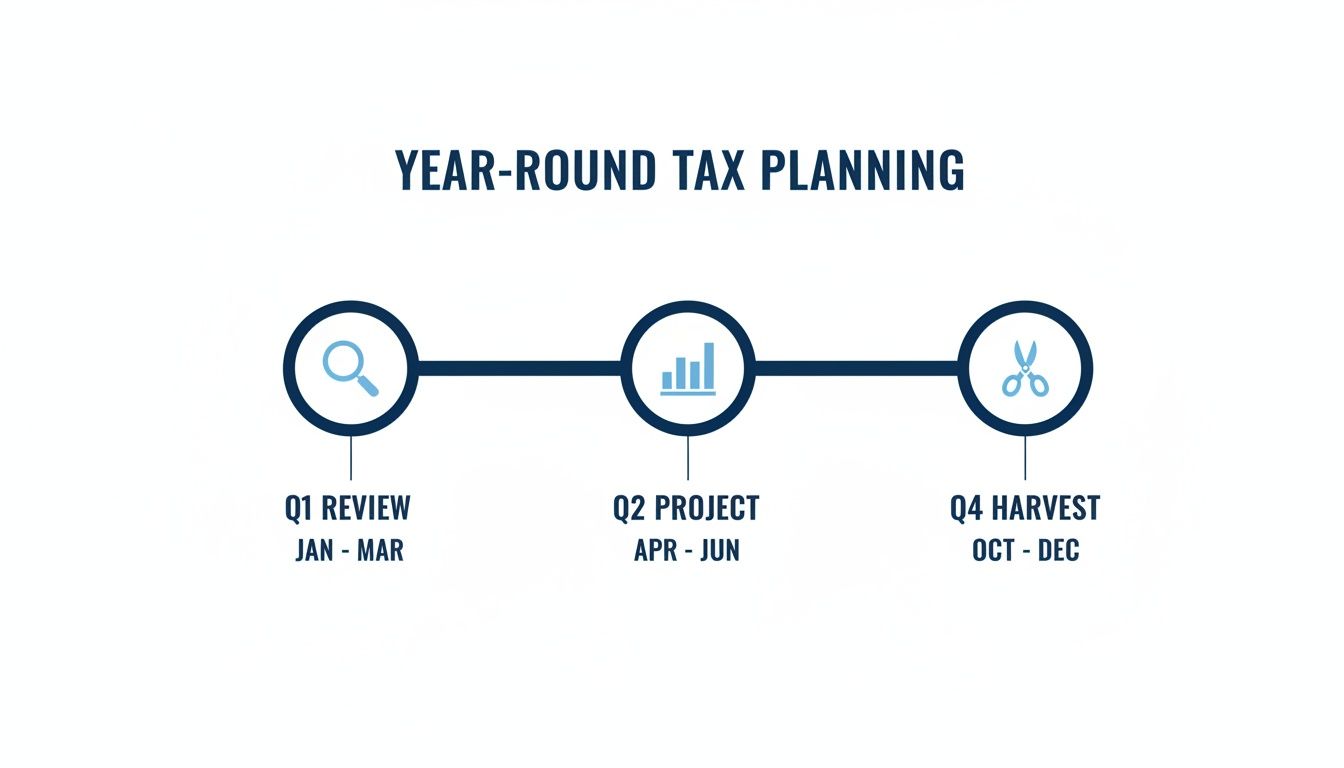
As you can see, the work is spread throughout the year—reviewing what happened, projecting what's next, and making strategic moves when the time is right.
Are These Kinds of Tax Strategies Actually Legal?
One hundred percent. Everything we've talked about is perfectly legal and laid out within the U.S. tax code. We're not talking about sketchy loopholes; we're talking about established tools like:
- Funding every retirement account to the legal limit
- Using tax-loss harvesting to offset gains
- Setting up trusts for estate and gift planning
- Taking advantage of real estate depreciation
The secret isn't finding some gray area; it's about proper execution. These strategies have rules, and you have to follow them to the letter. That's why having a team—a CPA, an attorney, and a financial advisor—is non-negotiable. They make sure every 'i' is dotted and every 't' is crossed, keeping your plan effective and fully compliant with the IRS.
At Blue Sage Tax & Accounting Inc., our entire focus is on building these kinds of proactive, year-round tax plans for high-net-worth families and businesses in New York City and across the country. If you're ready to get ahead of your taxes, schedule a consultation with our team and let's explore what's possible.